A phone that rings nowhere
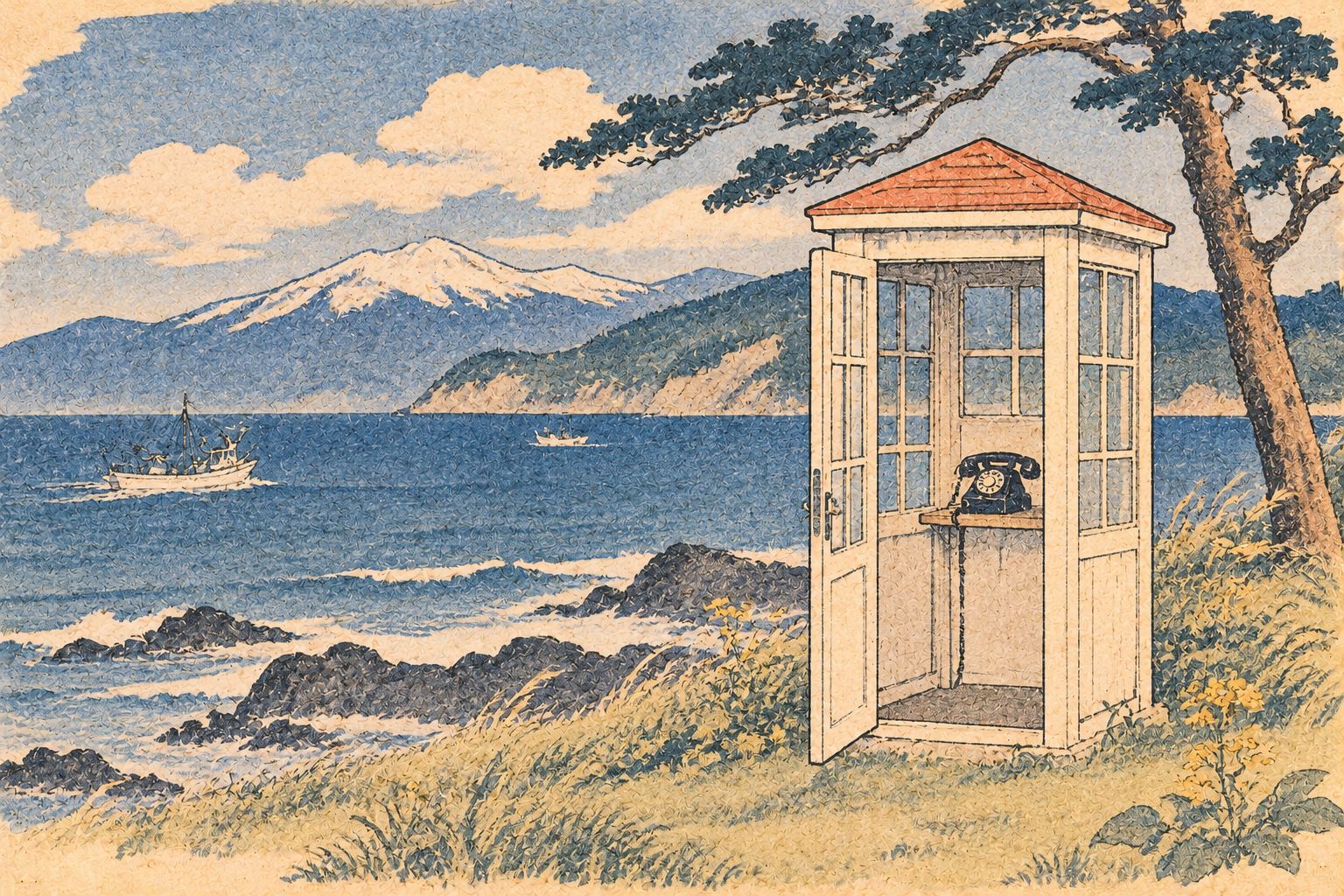
On a beach near Minehama fishing port in Rausu, a town on the eastern side of Japan’s Shiretoko Peninsula, there is now a small white telephone booth. Inside sits an old black telephone with no connected line. It cannot dial a number, summon a voice or restore a missing person to the shore. Its purpose is to make room for a conversation that ordinary technology cannot carry.
The Ocean Phone, or Umi no Denwa, was completed on November 1, 2026, by people connected to the sinking of the sightseeing vessel KAZU I. Among them were the fisherman and volunteer searcher Kenji Sakurai, a father whose family members remain missing, and roughly 20 local supporters. Their work took approximately half a year. What they built is modest; the loss behind it is not.
A father at the receiver
On opening day, a man from Obihiro picked up the telephone and spoke to his son and former wife, both still missing after the 2022 disaster. His son was seven years old when the boat sank. Hokkaido television stations filmed the moment and reported the father’s wish to speak in a quiet place. The words conveyed yearning, not an expectation that an actual call would be answered.
In interviews broadcast by HBC and other outlets, he explained that the pain had not vanished, but the new location allowed him to think quietly about the people he missed. It is important not to turn that account into a tidy story of healing. The father has not declared his grief finished, and a journalist cannot give that ending to him.
A little railway ending at the sea
The roughly two-meter-tall wooden booth has pale walls and a blue roof, according to local reports. A telephone, a small table and a place for written messages are inside. The structure has also been called Omoi no Eki, a “station of feelings” or remembrance. Outside, a short section of wooden track points toward the sea.
That track matters because the missing boy loved trains, particularly Japan’s shinkansen. In a place where the phone has no line and the railway has no destination, everyday objects carry very personal memories. Visitors may see a universal symbol of loss. For this family, however, the details are not abstract: they recall a particular child.
The disaster behind the memorial
On April 23, 2022, KAZU I departed from Utoro on the western coast of Shiretoko with 24 passengers and two crew members. During a trip toward the peninsula’s tip, the vessel took on water near Kashuni Falls and sank. The disaster left 20 people dead and six missing, a toll still reported in November 2026. The passenger list included children.
The geography is worth stating clearly. The boat went down off the peninsula’s western coast, while the memorial has been constructed near Rausu on its eastern side. It stands beside the same wider maritime landscape, but it is not the precise sinking site. These distinctions matter when a place of remembrance becomes international news.
The loss was not an unavoidable act of nature
Japan’s Transport Safety Board published its final accident investigation in September 2023. Its findings, as summarized in public safety material and contemporary reporting, pointed to problems with the bow hatch, the flooding sequence, decisions to operate amid deteriorating conditions, and failures of the operator’s safety-management system. Oversight and inspection effectiveness also came under criticism.
The existence of a memorial must not erase those findings. A moving object on a beach and a technical report about preventable hazards answer different public needs. One offers a place to speak; the other explains what went wrong and how a similar tragedy might be avoided. A serious account of the Ocean Phone has to make room for both.
The fisherman who kept looking
Sakurai was among those who helped search for people missing after the sinking. Local reporting describes him discussing the idea of a memorial with a bereaved father and recruiting fishermen and other residents to construct it, beginning around April 2026. The project emerged from practical effort—clearing ground, building a small shelter, placing a telephone—rather than from a grand architectural scheme.
At the opening, Sakurai told reporters that more than four years had passed without a permanent monument in place and that families needed somewhere to remember. That reflects his account at the time, not a comprehensive audit of every proposed memorial or the views of all relatives. The Ocean Phone cannot be assumed to represent every bereaved family.
A quiet idea that began elsewhere in Japan
The Ocean Phone draws inspiration from a better-known memorial in Otsuchi, Iwate Prefecture: the Wind Phone. Gardener Itaru Sasaki created the original after a personal bereavement, beginning the project before the March 2011 earthquake and tsunami. The unconnected receiver later became available to other people grieving losses from the disaster that devastated the surrounding region.
The Wind Phone’s appeal has been discussed internationally, but its origins deserve care. It was not initially designed as an official monument or a technological device that could reach the dead. It was an intimate place to speak without expecting an answer. Rausu’s Ocean Phone inherits that idea while belonging to a different community, accident and set of families.
Why a telephone?
A memorial might be a stone, a plaque, a garden or an annual service. A telephone offers a different kind of invitation. It has a receiver that can be held, a ritual nearly everyone recognizes, and a pause in which a person may choose to speak or remain silent. The technology is deliberately incomplete; that incompleteness is the point.
No clinical claim should be attached to the design without evidence. An unconnected telephone is not an established treatment for prolonged grief, and not every person who loses someone would find such a place comforting. Its value begins with the people who wanted it and the freedom to use—or not use—it.
Shiretoko: the landscape and the community
Shiretoko is internationally known for its coast, forests and wildlife, but the new memorial is part of the lived environment of a fishing community. Rausu lies on the side of the peninsula facing the Nemuro Strait, across the mountains from the Utoro departure port. This is a working coast, not an empty scenic backdrop.
The contrast is easy for outsiders to romanticize: a quiet telephone, dramatic water, a distant horizon. The people who constructed it, however, worked with local terrain and a continuing human need. Their labor and the families’ choices should remain more important than picturesque descriptions of Hokkaido.
Remembering without making grief a spectacle
Television reports show a father speaking on the opening day. Japan.co.jp has not interviewed him, filmed the event or obtained permission for any private family photographs. His account here is attributed to published Japanese reporting. The absence of new interviews means there are also things this story should not try to know: what he said in private, whether other relatives approve of the project, or how he feels on any particular day.
For the same reason, visiting arrangements cannot be guessed. Public opening hours, parking access, restrictions on filming, and maintenance arrangements were not confirmed from the sources reviewed. Readers should not treat an intimate memorial as an unrestricted tourist attraction.
The unanswered questions still belong in the story
In November 2026, six people remained listed as missing from the 2022 sinking. The families’ experiences have unfolded alongside official investigation and debates about maritime safety. The Ocean Phone does not close any of those processes. Nor does its completion settle future questions about permanent commemoration or responsibility.
There are practical questions for the people maintaining it: how a small wooden structure withstands Hokkaido weather, who cares for notes left behind, and how a site built through volunteer effort will be sustained. These are questions for follow-up reporting, not facts that can responsibly be invented.
What a line that goes nowhere can hold
There is no mystery about the receiver. It is not connected. Its limitation is plain and physical. Yet a father could hold it, say the names of people he misses, and be heard by those standing nearby—or perhaps by no one at all. The device does not promise a reply. It makes room for words.
Four and a half years after KAZU I sank, the responsibilities of maritime safety and public accountability remain distinct from the need to remember. On the Rausu coast, a handful of people have given that need a modest form: a white booth, a black telephone, a child’s wooden railway, and space to speak without being asked when grief will end.
Sources and reporting method
Desk reporting based on November 1–2 coverage by Hokkaido news organizations, public accident-safety material and historical reporting on the Wind Phone. Japan.co.jp did not visit the location or conduct fresh interviews with the family or organizers.
- Kushiro Shimbun: Ocean Phone opens on the Rausu beach (November 2, 2026)
- HBC Hokkaido Broadcasting: Memorial and family account (November 2, 2026)
- UHB / Fuji News Network: Completion ceremony and volunteer account
- HTB Hokkaido News: How the memorial was built (November 1, 2026)
- Jiji Press: The Ocean Phone and the bereaved father
- Japan Ministry of Land, Infrastructure, Transport and Tourism: KAZU I safety lessons
- Kyodo news report on the Japan Transport Safety Board 2023 findings
- IBC Iwate: Origins and purpose of the Wind Phone in Otsuchi
- Tokyo Institute of Technology essay: The Wind Phone and remembrance