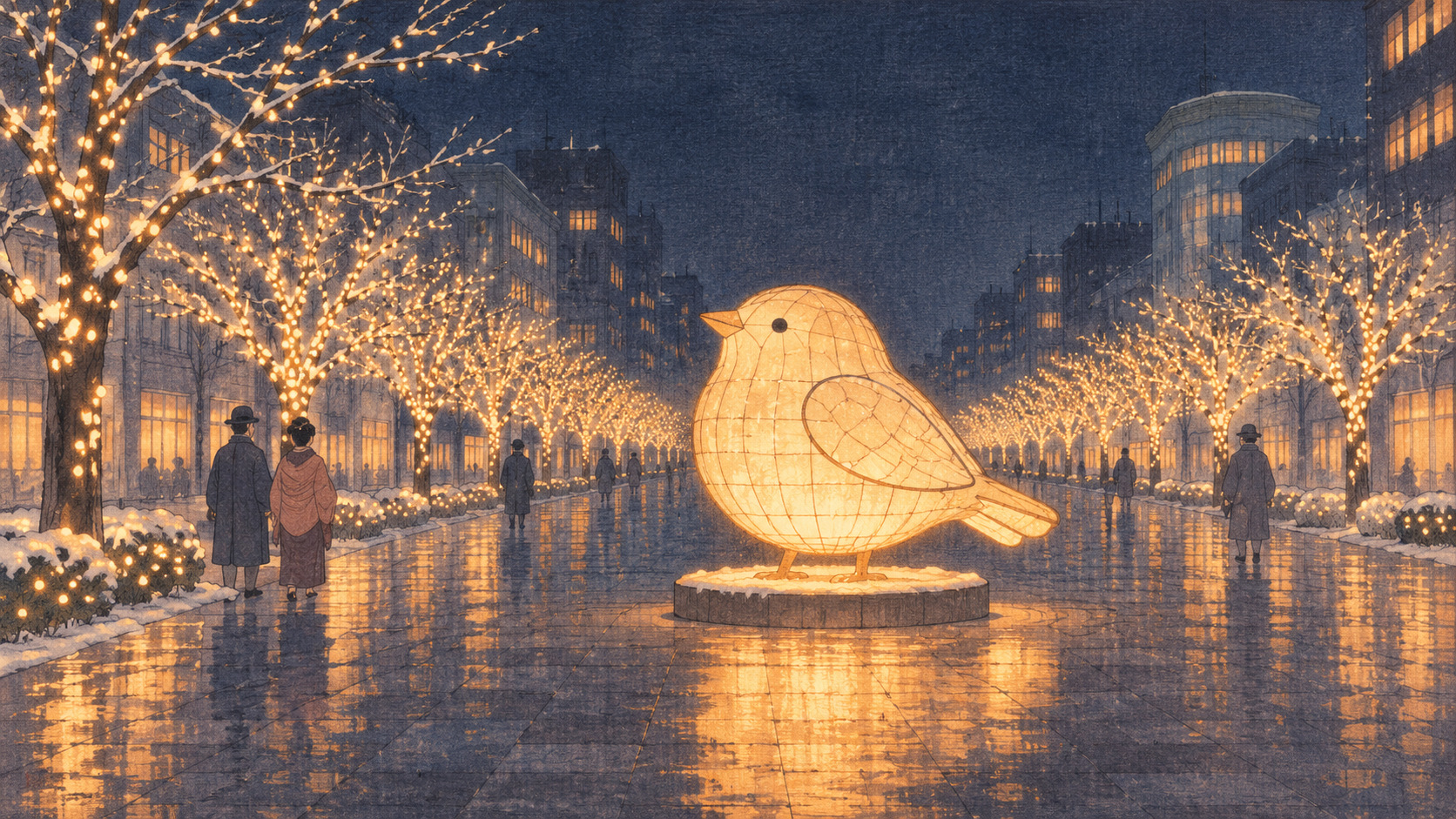
- A farewell is being built into Tokyo’s winter lights
- Six venues, a quarter-million lights and one pedestrian experience
- Why a penguin receives a ceremonial send-off
- The twenty-five years since a transit card changed daily life
- Suica Renaissance and the decision to change
- A pedestrian corridor created by modern Shinjuku
- How six designs tell different stories
- A winter soundtrack at the plaza
- Practical guide: dates, hours and the stamp rally
- What remains when the lights go out
A farewell is being built into Tokyo’s winter lights
Tokyo’s winter illuminations are familiar enough that another opening might seem routine. But the six-venue Shinjuku Minamillumi festival scheduled to begin November 11, 2026, has an unusual emotional center. Amid roughly 275,000 LED lights, the organizers are preparing a ceremonial pathway for the Suica Penguin, a character that has accompanied millions of everyday journeys since the contactless rail card debuted a quarter-century ago.
At Suica Penguin Plaza outside Shinjuku Station’s New South Gate, a “Hanamichi Gate” will suggest a festive procession toward a new beginning. The reason is not a new train service or store opening. JR East says the character will retire from its official image-character role on March 31, 2027. By turning the station plaza into a stage for farewell photographs, the winter event makes the relationship between a commercial symbol and public memory unusually visible.
The opening is scheduled, not observed. This report draws on organizing companies’ announcements, JR East’s public records and historical urban-development documents. It does not claim to have witnessed the lighting ceremony or measured November crowds.
Six venues, a quarter-million lights and one pedestrian experience
The festival spans Suica Penguin Plaza, JR Minami-Shinjuku Building, JR Shinjuku Miraina Tower, Shinjuku Maynds Tower, Takashimaya Times Square, and Shinjuku Southern Terrace with Odakyu Southern Tower. In Japanese the complete list is published by the organizers; English translations of individual building names vary. It is therefore the six official venue identities, not a convenient map label, that should guide visitors.
Odakyu’s October 16 announcement attributes approximately 275,000 LEDs to the festival as a whole. That is an organizer-supplied design figure, not an independent count of illuminated bulbs on the night. The stated theme, “Colorful & Heartful,” is pursued through distinct visual treatments at each venue, connected by light, shared music and the walking routes between buildings.
The underlying proposition is urban rather than purely decorative. A festival distributed over several properties encourages visitors to read the station neighborhood as a continuous place. Whether it increases sales or shifts foot traffic is a different empirical question, one the promotional materials do not answer.
Sources: 新宿ミナミルミ2026–2027|主催者公式案内 · 小田急電鉄|2026年10月16日開催発表
Why a penguin receives a ceremonial send-off
The installation at Suica Penguin Plaza is called “Suica’s Penguin in Bloom.” A Hanamichi Gate—a name evoking the flower-lined path of a celebratory exit—is scheduled to frame a photo spot where visitors can imagine accompanying the penguin on its departure. Organizers also describe an opportunity to pose near a penguin display and a SHINJUKU letter installation.
Its importance has less to do with the complexity of the construction than with the familiarity of the figure being honored. Most mascots are designed to explain a product. This one became part of the visual texture of ordinary commuting: cards, posters, shops and souvenirs repeatedly placed the same friendly character in front of people who might never consciously think of themselves as fans.
The retirement is not happening on November 11. JR East gives March 31, 2027, as the final date, with the successor starting April 1. The illumination is one scene in a longer farewell, not the conclusion of the transition.
Sources: 小田急電鉄|2026年10月16日開催発表 · JR東日本|2026年9月8日 新キャラクター選考と交代日
The twenty-five years since a transit card changed daily life
Suica began service on November 18, 2001, across 424 stations in the Tokyo metropolitan area. JR East’s original announcement described a shift to contactless IC-based entry through ticket gates. The physical act of using rail transport changed: instead of pushing a magnetic ticket through a machine, travelers tapped a card and kept walking. Its payment functions subsequently expanded; electronic money service began in 2004.
The penguin was present from the 2001 introduction. Its creator, illustrator and picture-book artist Chiharu Sakazaki, gave JR East a distinctive image capable of traveling between technical information and lighthearted affection. The publishing house Kawade Shobo Shinsha identifies Sakazaki as the designer of both the Suica Penguin and the Chiba Prefecture mascot Chiibakun.
It is worth remembering how unfamiliar electronic fare media once seemed. A character could simplify the cultural introduction of a technology even though it performed no technical function. For many users, the penguin became a stable presence while cards, phones, fare systems and payments evolved around it.
Sources: JR東日本|2001年Suicaサービス開始の発表 · 河出書房新社|坂崎千春の著者紹介
Suica Renaissance and the decision to change
JR East’s decision was announced as part of its “Suica Renaissance” strategy in November 2025. In September 2026 the company set out exact handover dates: March 31 for the penguin’s departure and April 1 for its replacement. The new character is intended to express the next stage of Suica as something more broadly integrated into people’s everyday services, rather than principally a transport and small-payment tool.
The process carries its own attempt at public participation. JR East commissioned proposals from younger creators, narrowed them to three designs and announced a customer vote. It planned to reveal the chosen successor on November 18, the card’s twenty-fifth anniversary. That forthcoming announcement should not be presented as a result already known to the November 11 newsroom.
Corporate reinvention and personal attachment do not always move at the same speed. JR East has business reasons to signal a new identity; customers have decades of routine association with the old one. Both are part of the story, but neither proves that future services will be better or worse.
Sources: JR東日本|2026年9月8日 新キャラクター選考と交代日 · JR東日本|2025年11月11日 Suica Renaissance 第2弾
A pedestrian corridor created by modern Shinjuku
The setting itself tells a history of urban adaptation. Odakyu’s corporate chronology records the opening of Shinjuku Southern Terrace and Odakyu Southern Tower on March 20, 1998. The Ministry of Land, Infrastructure, Transport and Tourism describes how a roughly 350-meter pedestrian promenade was constructed over railway space and connected to adjacent development, making it easier to circulate between formerly disconnected parts of the southern station district.
That achievement is easy to overlook because the route now feels ordinary. A city of tracks, roads, entrances, offices and retail spaces only becomes walkable when planners establish connections at the right level and scale. Southern Terrace was an important intervention in that everyday geography.
The illuminations exploit the resulting sequence of passages and viewpoints. They are not simply a collection of isolated objects arranged for photographs, but an attempt to turn infrastructure into a winter public experience. The claim of architectural continuity is grounded in the history of the site; claims about the current quality of movement would require observation.
Sources: 小田急電鉄|社史・1998年新宿サザンテラス開業 · 国土交通省|新宿南口の都市再開発と人工地盤
How six designs tell different stories
Each participating property has its own program. JR Minami-Shinjuku Building is slated to use a red-and-gold holiday tree; Miraina Tower emphasizes a classical festive atmosphere. Shinjuku Maynds Tower is preparing lantern imagery around wishes, gratitude and hope. Takashimaya Times Square proposes a brighter gift-season setting, while the Southern Terrace and Odakyu Southern Tower theme is “Relay.”
The variety matters. A rail plaza, an office tower, a shopping entrance and a pedestrian terrace are not interchangeable spaces, even if marketers refer to them as one destination. They serve different populations and are busiest at different hours. The common soundtrack and planned lighting sequence connect these spaces without pretending they are identical.
Visitor experience will ultimately depend on things the promotional design cannot establish: whether walkways remain accessible, whether signage makes the route easy to understand, and whether commuters can pass through comfortably when photo spots are crowded. Those questions deserve reporting after the opening.
A winter soundtrack at the plaza
Another cultural element is the music. Universal Music Japan announced on October 31 that the Spitz song “Mishiranu Ito” would be played daily at Suica Penguin Plaza during the illumination period. The collaboration places a contemporary Japanese pop song within the choreography of a commuter space.
There is a difference between hearing music in a concert hall and encountering it on a route home. On a station plaza, the soundtrack becomes part of an everyday environment, mixed with footsteps, conversation and the rhythms of transport. The appeal of that combination will differ among visitors, and listening preferences vary.
The music-company announcement establishes the planned collaboration, but no observation of the playback on or after November 11 is claimed in this article.
Sources: ユニバーサル ミュージック|スピッツとペンギン広場のコラボ
Practical guide: dates, hours and the stamp rally
The overall festival is scheduled for November 11, 2026, through February 14, 2027. For the main outdoor illuminations, the announced opening-night time is 6 p.m. to midnight. From November 12 through November 30, the standard outdoor schedule is 5 p.m. to midnight; from December 1, 4:30 p.m. to midnight. Individual buildings have different hours and closing dates, particularly indoor trees that end at Christmas.
A digital stamp rally is planned for November 11 to December 25. Visitors can collect stamps by using their smartphones at venue checkpoints; collecting four of six is associated with a memo-pad gift for the first 500 qualifying participants, subject to supply and the organizer’s terms. Digital stamp availability is listed as 6 a.m. to midnight, but that does not mean every building is accessible during those hours.
Tokyo’s official tourism site lists the festival as free to attend. Visitors should check the current venue-by-venue notice because weather, access restrictions and business operating hours can change the practical experience.
Sources: 新宿ミナミルミ2026–2027|主催者公式案内 · 東京都観光公式 GO TOKYO|新宿ミナミルミ
What remains when the lights go out
The farewell creates a rare overlap of calendar, infrastructure and design history. On November 18, Suica turns twenty-five. Five months later, the familiar penguin is scheduled to step away from its official role. In between, a winter walkway gives people a reason to look again at an image they have encountered in routine travel for years.
Other cities have mascots, branded public spaces and holiday lights. What makes this situation particular to Shinjuku is the combination of a transit symbol, a complex rail-centered pedestrian landscape and an organized ceremonial goodbye. The story of a character is also, unexpectedly, a story of how places acquire a sense of continuity.
No company can decide exactly what its symbol will mean in memory. The organizers can construct a gate and provide lights; commuters, families and travelers will attach their own associations—or none at all. That space between marketing intent and public experience is where the richest part of this winter story lies.
Sources and verification method
Organizer, railway-company and Tokyo tourism primary records take priority. Plans are distinguished from observed outcomes; the LED count comes from organizers, with no independently verified visitor or economic-impact figures.
- 新宿ミナミルミ2026–2027|主催者公式案内
- 小田急電鉄|2026年10月16日開催発表
- 東京都観光公式 GO TOKYO|新宿ミナミルミ
- JR東日本|2026年9月8日 新キャラクター選考と交代日
- JR東日本|2025年11月11日 Suica Renaissance 第2弾
- JR東日本|2001年Suicaサービス開始の発表
- 小田急電鉄|社史・1998年新宿サザンテラス開業
- 国土交通省|新宿南口の都市再開発と人工地盤
- 河出書房新社|坂崎千春の著者紹介
- ユニバーサル ミュージック|スピッツとペンギン広場のコラボ
- JR東日本|Suica公式ページ
- JR東日本|25周年記念企画
- 大和証券オフィス投資法人|Shinjuku Maynds Tower