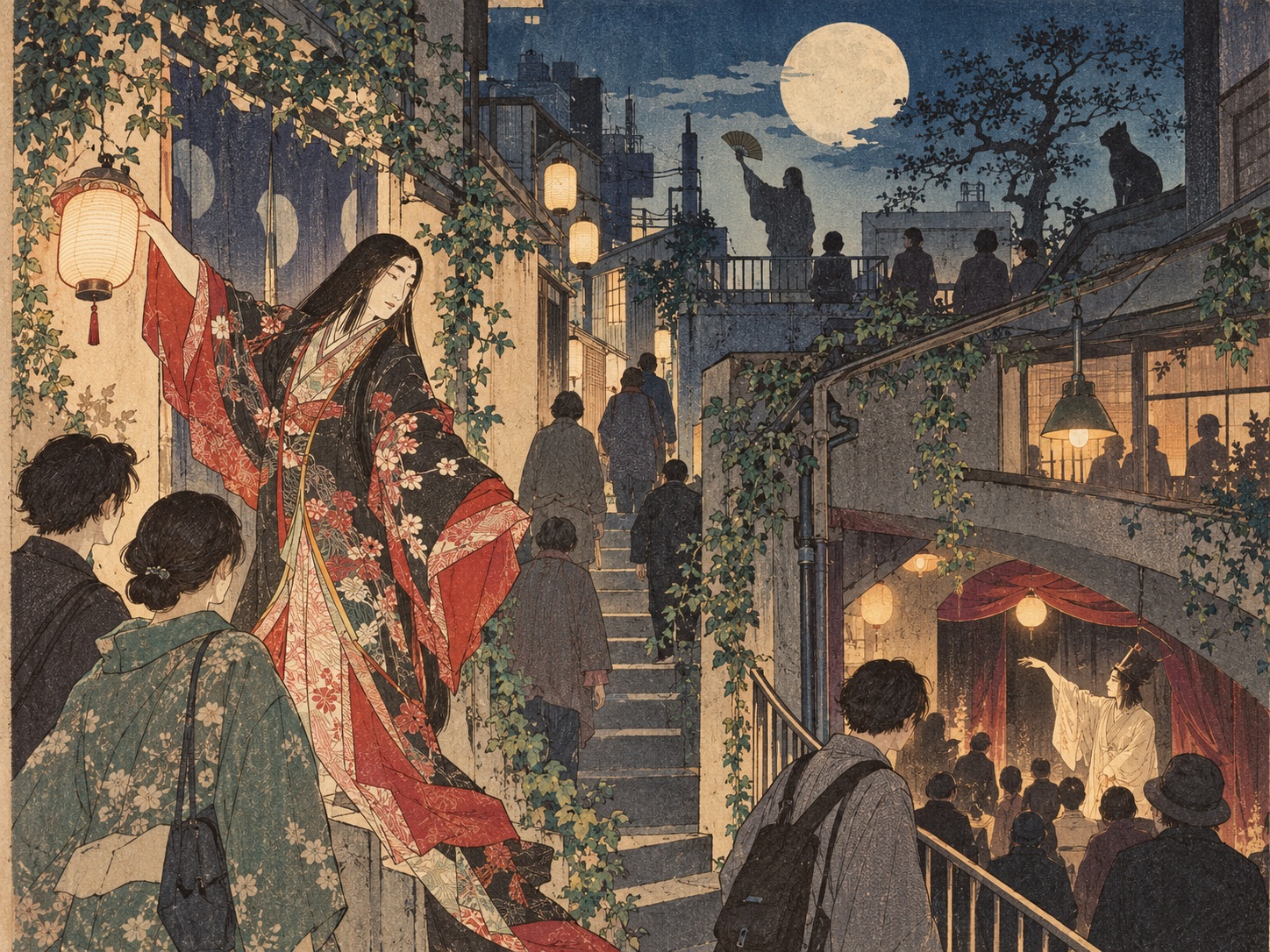
The theater begins outside the theater.
Audience members gather outside Shimokitazawa Station’s East Exit with their own smartphones and earphones. A poet’s voice begins in their ears. They start walking through crowds, shopping streets, alleys, parks and the transformed railway corridor.
Daisydoze’s “Nekomachi — Cat Town” does not separate stage from audience. Shimokitazawa itself becomes the set.
Instead of watching theater, the audience walks through it
In conventional theater, the audience sits down, the lights fall and performers enter.
“Cat Town” reverses that relationship. If the audience does not move, the story does not move.
The poet’s voice guides people away from the station and into the actual neighborhood. Shop lights, bicycles, station announcements, traffic and night air become part of the production.
Along the way, pale-blue catlike performers appear in public space, redirecting the audience’s attention toward the next location.
Sakutaro Hagiwara’s “Cat Town” is not a random literary reference
The literary center of the work is poet Sakutaro Hagiwara’s story “Cat Town.”
Daisydoze explicitly describes the production as a fictional homage to Hagiwara’s work. The setting also has a genuine connection to the writer.
Setagaya City notes that many writers and poets once lived around Shimokitazawa and that Hagiwara, Riichi Yokomitsu and Mari Mori were among those who left works connected with the area.
Hagiwara built his own house in Daita in 1933. His writing repeatedly transforms ordinary urban scenery into something unstable, dreamlike and slightly threatening.
That sensibility fits a production in which the audience is asked to see familiar streets as if they have suddenly become another world.
“The invisible becomes visible”
Daisydoze summarizes the work with a simple idea: things that cannot normally be seen begin to appear.
That does not depend only on theatrical effects.
A staircase, service alley, station square or dark corner becomes meaningful because the audience has been instructed to look differently.
Ordinary pedestrians and ticketed audience members may occupy the same street while inhabiting entirely different narrative realities.
That split perception is one of the defining pleasures of immersive theater.
Shimokitazawa was already a theater town
The production works in part because Shimokitazawa has spent decades building an unusually dense theater culture.
Setagaya City’s cultural plan notes that the Honda Theatre Group operates eight theaters in Shimokitazawa and has long supported Japan’s small-theater scene.
The Shimokitazawa Theatre Festival began in 1990. Its 36th edition ran in February 2026. Setagaya’s own public information simply calls Shimokitazawa a “theater town.”
Honda Theatre, The Suzunari, small performance spaces, live houses, vintage shops and cafes sit unusually close together.
Performance has therefore been part of the neighborhood’s everyday identity long before “Cat Town” put actors into the streets.

Putting the railway underground created a new stage above it
Modern Shimokitazawa was physically transformed by the undergrounding of the Odakyu Line.
When the tracks between Higashi-Kitazawa, Shimokitazawa and Setagaya-Daita were moved underground, roughly 1.7 kilometers of former railway land became available above ground.
Odakyu redeveloped that corridor as Shimokita Senrogai, mixing public space, shops, lodging, event areas and pedestrian connections.
Setagaya City also used workshops with local residents when planning plazas, green areas, paths and other public facilities along the former rail alignment.
“Cat Town” uses that changed urban geography directly: the audience walks from Shimokitazawa toward Setagaya-Daita through a district whose physical structure has been rewritten in the last decade.
The memory of the railway survives underground
The Japan Times review describes the experience eventually leading underground near Setagaya-Daita, where the audience encounters an eerie world of blue cats around old railway space.
The key urban fact is that the railway did not disappear. It moved below ground.
The audience first walks through the new city created above the former tracks, then descends toward the infrastructure that replaced them.
Literary unreality and transport history begin to occupy the same physical space.
Earphones create a private theater inside a public street
The use of personal earphones is more than a technical convenience.
The city remains public. Cars pass. Stores play music. Other people talk.
But inside the audience member’s ears, the poet speaks privately.
Two people can stand on the same corner while only one is inside the fiction.
ON THE TRIP, which created the audio-AR component, specializes in location-based sound experiences. In “Cat Town,” that audio layer is synchronized with live movement and real geography.
Leaving the black box also creates limits
A city is less controllable than a theater.
The official production information warns that the route includes stairs and slopes and asks preschool-age children, people with visual or hearing concerns, people with difficulty walking and wheelchair users not to participate for safety reasons.
Performances continue in ordinary rain but can be canceled in severe weather.
Those restrictions expose a tension in site-specific immersive work: the city offers authenticity and unpredictability, but it also carries accessibility barriers that a conventional theater can sometimes address more easily.
A major work inside Moon Art Night Shimokita
“Cat Town” was presented as one of the main works of Moon Art Night Shimokita 2026.
The festival ran from September 18 through October 4 across the Shimokitazawa area, using streets, rooftops, the former rail corridor and public spaces for large-scale and site-specific art.
Its organizers include the Shimokitazawa shopping-district federation, Odakyu Electric Railway and Startbahn.
Where other festival works occupy sites, Daisydoze’s piece makes the audience move between them.
Daisydoze writes with places as much as with dialogue
Daisydoze describes itself as a creative team making immersive theater with cities as stages.
Yui Takeshima is credited as writer and director, with Kaori Kondo as creative producer and costume designer.
The group says it incorporates the history and mythology of real places while mixing dance, song, theater and installation into work that crosses conventional genres.
“Cat Town” is its 10th production. Daisydoze also says it was selected for Japan’s Agency for Cultural Affairs “SOIL” fellowship in 2026 and would pitch its work to the international market at the Edinburgh Festival Fringe.
What “site-specific” really means
Could “Cat Town” simply be moved to another city?
Not without becoming a different work.
Shimokitazawa Station, Setagaya-Daita, Hagiwara, the old railway alignment, street geometry and pedestrian flow are all embedded in the experience.
The same actors, recordings and costumes placed elsewhere would not produce the same theater.
This is not a play performed against a city backdrop. The city is one of the materials from which the play is made.
Can Shimokitazawa release theater from the building?
Shimokitazawa’s small-theater tradition has long made room for experimental work inside compact venues.
“Cat Town” carries that experimental instinct outside.
The audience moves through shops and commuters, hears trains and traffic, and watches the distinction between performer and ordinary passerby blur.
Once theater spills into the street, the neighborhood’s accumulated cultural identity becomes part of the stage machinery.
Forty-five minutes later, the same street may look different
The measure of an immersive work is not necessarily the size of its set.
It may be whether the audience sees the same alley differently on the way home.
“Cat Town” borrows Hagiwara’s surrealism to layer invisible history over a Shimokitazawa that is itself continually changing.
The streets remain ordinary. The shops remain open. Trains still run.
For 45 minutes, however, cats occupy the margins, a poet speaks inside the listener’s head and the memory of railway tracks rises back through the city.
When the performance ends, the fiction disappears. The altered way of looking may last longer.
Sources and references
- daisydoze — 『猫町 NEKOMACHI』2026公式サイト。
- daisydoze — “Nekomachi — Cat Town” production page.
- MOON ART NIGHT SHIMOKITA 2026 — official festival site.
- イープラス — イマーシブシアター『猫町』公演情報・スタッフ。
- The Japan Times — “Poetry, history and performance entwine in Daisydoze’s immersive spectacle,” October 1, 2026.
- 世田谷区 — 「下北沢周辺の文士旧居跡」萩原朔太郎ほか。
- 世田谷区 — 第4期文化芸術振興計画(下北沢の劇場・演劇祭・音楽祭)。
- 世田谷区 — 北沢地域の主なお祭り「下北沢演劇祭」。
- 小田急電鉄 — 「下北沢エリアの線路跡地開発」下北線路街。
- 世田谷区 — 「小田急線上部利用の街づくりの取り組み」。
Reporting cutoff: October 6, 2026, 8:05 a.m. JST. Dates, duration, route, smartphone/earphone format, homage to Sakutaro Hagiwara and Daisydoze’s description of “Cat Town” as its 10th work are verified through official production materials. Shimokitazawa theater history, literary history and redevelopment of the former rail corridor are verified through Setagaya City and Odakyu materials. Interpretive passages are Japan.co.jp analysis.
Why it matters
“Cat Town” removes the fixed auditorium and makes the walk from Shimokitazawa to Setagaya-Daita the structure of the performance.
Why here
Hagiwara’s local literary connection, decades of small-theater culture and the redeveloped former rail corridor give the work material it could not simply reproduce elsewhere.
What to watch
Whether city-scale immersive theater can grow while addressing the accessibility limits that come with stairs, slopes and uncontrolled public space.