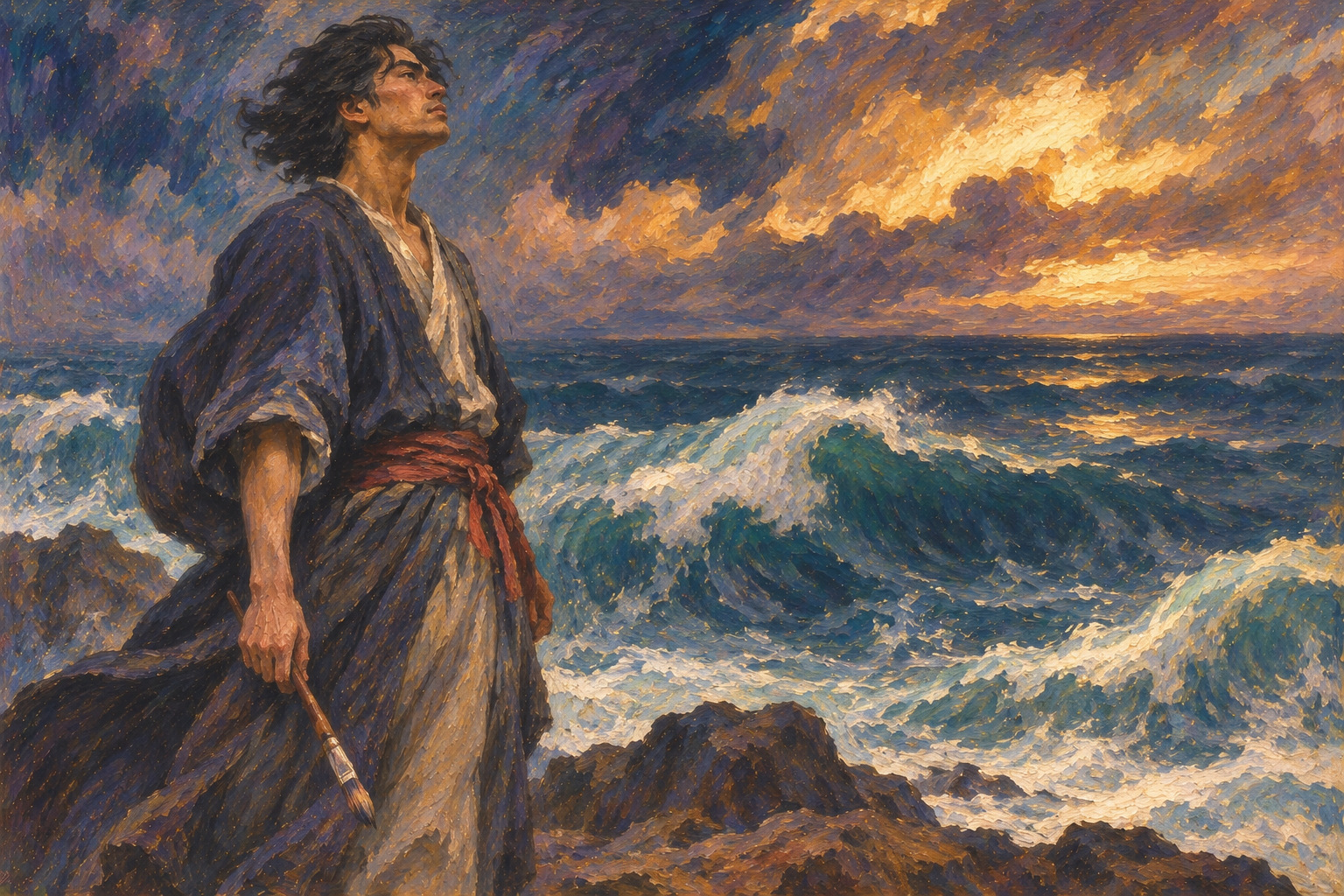
Why Shigeru Aoki matters now
For JAPAN.co.jp’s November 16, 2026 Art Choice, Shigeru Aoki is more than a historical painter to admire from a distance. He represents a recurring drama in modern culture: an artist can be visibly gifted, briefly celebrated and still find himself edged out by institutions that were supposed to confirm his place in history.
Aoki’s story is often compressed into a tragic slogan—young genius, poverty, tuberculosis, early death. That is not wrong, but it is incomplete. He emerged from a provincial background in Kurume, absorbed Western-style painting in Tokyo, immersed himself in Japanese myth and literature, and produced images that fused oil painting with a deeply Japanese symbolic imagination. He was recognized early. He was not simply ignored. Yet after a decisive confrontation with the establishment in 1907, he never truly recovered his position in Tokyo’s art world.
That combination of brilliance, ambition, conflict and afterlife makes Aoki an unusually strong fit for JAPAN.co.jp: unmistakably Japanese, visually powerful, and historically resonant well beyond the confines of art history.
From Kurume to Tokyo
Aoki was born on July 13, 1882, in what is now Kurume, Fukuoka Prefecture. According to Art Platform Japan, he began studying yōga—Western-style painting—with the local artist Mori Miyoshi when he was around 13. A classmate from his early years, Sakamoto Hanjirō, would also become an important painter. Already as a student, Aoki was drawn not only to image-making but also to literature, circulating a handmade literary magazine with friends.
In 1899 he left school and moved to Tokyo. He studied first at Koyama Shōtarō’s Fudōsha painting school, then entered the Western-painting department of Tokyo Fine Arts School in 1900. There he learned under the shadow of Kuroda Seiki, the dominant figure in modern Japanese oil painting. But Aoki was never content to be a faithful stylistic follower. He read mythology, religion and literature voraciously and saw painting as a way of answering the question of who he was supposed to become.
That inner urgency matters. It explains why his best work feels unlike mere academic exercise. Even when working in the medium and conventions of Western oil painting, he was trying to build an imaginative world of his own.
The breakthrough: Hakubakai and A Gift of the Sea
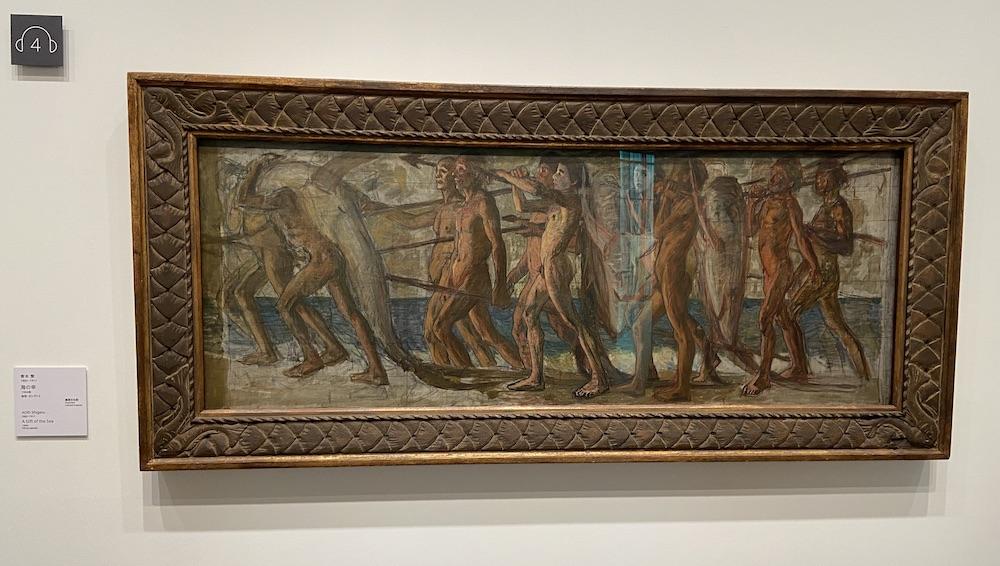
In 1903 Aoki won the first Hakuba Prize at the Eighth Hakubakai Exhibition for a group of mythological studies. It was a striking debut. The following year, after graduating from Tokyo Fine Arts School, he traveled with Sakamoto Hanjirō, Morita Tsunetomo and Fukuda Tane to Mera on the Boso coast in Chiba Prefecture. Out of that trip came A Gift of the Sea, now one of the defining paintings of modern Japanese art.
Artizon Museum notes that the work was not a straightforward transcription of a fishing scene. Inspired in part by Sakamoto’s description of a large catch being landed, Aoki transformed the episode into something closer to a ceremonial procession. Ten nude men carry large sharks across a long frieze-like canvas. The result feels ancient, physical and mythic all at once.
The Agency for Cultural Affairs lists the 1904 painting as an Important Cultural Property, designated in 1967. That status is historically telling. Long before he became a legend of thwarted talent, Aoki had already created a work strong enough to enter the core canon of Japanese modern art.
Paradise under the Sea and the 1907 rupture
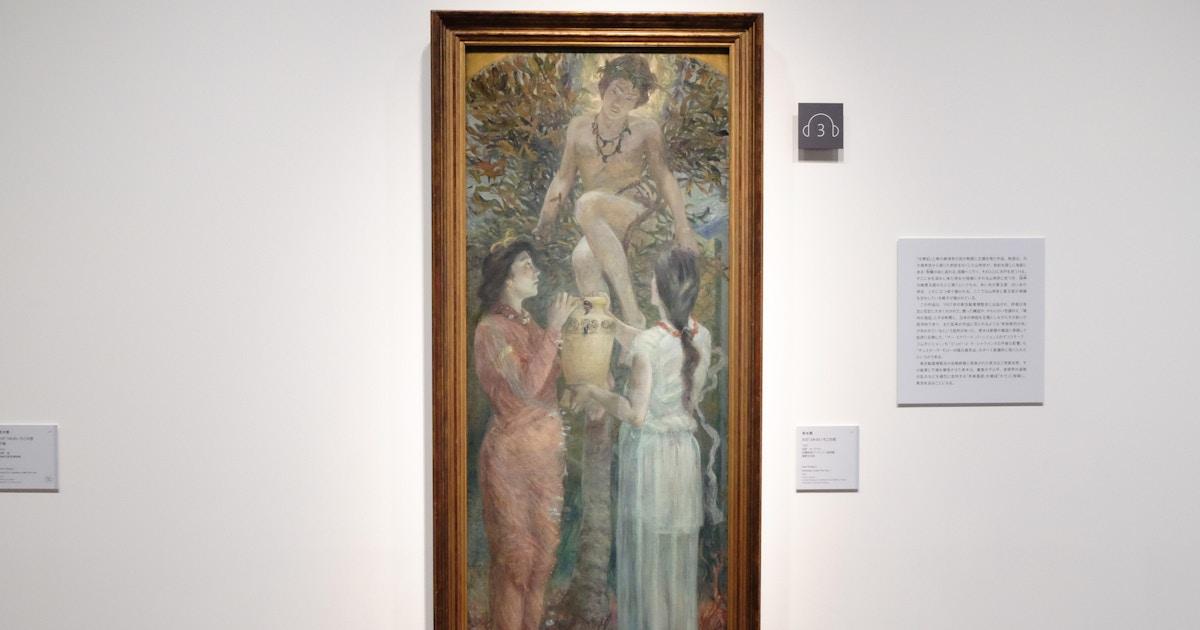
The real turning point came in 1907. Aoki prepared Paradise under the Sea for the Tokyo Industrial Exposition. Artizon Museum describes the canvas as a mythological scene based on the Kojiki: the palace of Watatsumi, the sea deity, depicted in a sensuous underwater world. Art Platform Japan adds that Aoki studied the appearance of fish, seaweed and the human body underwater as part of his preparation.
He entered the competition with high expectations. Instead, the painting was placed at the bottom of the third-prize category. APJ records that Aoki publicly expressed his displeasure in the magazine Hōsun on October 23, 1907. The same source notes factional conflict at the exposition between supporters of the Hakubakai and the Pacific Painting Association over the fairness of the judging.
That nuance matters. Aoki was not a nobody angrily protesting obscurity. He was a known young painter whose peers had expected much more. The injury was therefore not merely personal pride. It was a rupture between an artist convinced of his own direction and an establishment that refused to ratify it on the terms he expected.
Rejected—but not in a simple way
To say that Aoki was “rejected by the art establishment” is broadly true, but only if the phrase is handled carefully. He had already been rewarded with the Hakuba Prize. A Gift of the Sea drew strong attention. Writers and fellow artists admired him. He was not universally dismissed.
Yet after 1907 he lost momentum at precisely the moment when institutional consolidation mattered most. His father died that summer. He became responsible for family members in Kurume while also having a son with Fukuda Tane. Economic insecurity, family obligation and the loss of central recognition combined in ways that would be devastating for any young artist, let alone one whose imagination demanded large-scale work.
The most accurate description is not that Aoki had no supporters. It is that he collided with institutional judgment at a decisive moment and never regained a stable place at the center of the Tokyo art world.
Poverty, wandering and an early death
After returning to Kyushu in 1907, Aoki moved among Kumamoto, Saga, Fukuoka and other places, relying on former teachers, friends and acquaintances. He continued to paint. APJ points to works such as Fishermen Returning Home and notes that he sought commissions for portraits and other assignments to survive. He also hoped to re-enter the central arena through the Ministry of Education Fine Arts Exhibition, but apparently failed to meet the submission deadline for Sound of Autumn in 1908.
These details matter because they correct the false idea that Aoki simply gave up. He continued to work, to seek commissions and to imagine a return. But the infrastructure required for sustained artistic life—money, health, stable patronage, institutional access—was collapsing around him.
On March 25, 1911, he died in Fukuoka City of pulmonary tuberculosis. He was 28. Few careers in Japanese art history feel so compressed: intense formation, early acclaim, decisive conflict, material hardship and death before middle age.
How his legacy was rescued
Aoki’s posthumous reputation did not arise automatically. Friends and admirers worked to preserve it. APJ records a posthumous exhibition organized in Tokyo in 1912, followed by the publication of Aoki Shigeru Gashū in 1913. Additional posthumous exhibitions in 1939 and 1940 helped widen awareness of the surviving works.
Equally important, A Gift of the Sea and Paradise under the Sea were later acquired by Ishibashi Shōjirō, founder of what became Bridgestone Corporation. APJ notes that Sakamoto Hanjirō encouraged him to collect the works because he feared Aoki’s art might otherwise be dispersed or lost. That is not a minor footnote. It is a reminder that canonical status depends not only on artistic merit but also on preservation, collecting and institutional stewardship.
By the postwar period Aoki had been absorbed into the canon of modern Japanese painting. In other words, the same broader art world that failed to secure his living career eventually enshrined him as a classic.
Curating the three featured images
This story features three images. The first is A Gift of the Sea, the best place to begin if one wants to understand Aoki’s physical force, compositional daring and ability to transform observed life into a scene of almost ritual intensity. It explains why later viewers saw him not as a minor eccentric but as a major modern painter.
The second is Paradise under the Sea, indispensable because it carries both the glory and the wound of Aoki’s career. It shows his fascination with Japanese myth and his willingness to push beyond naturalism into invented atmospheric space. It is also the painting that became inseparable from his quarrel with institutional judgment in 1907.
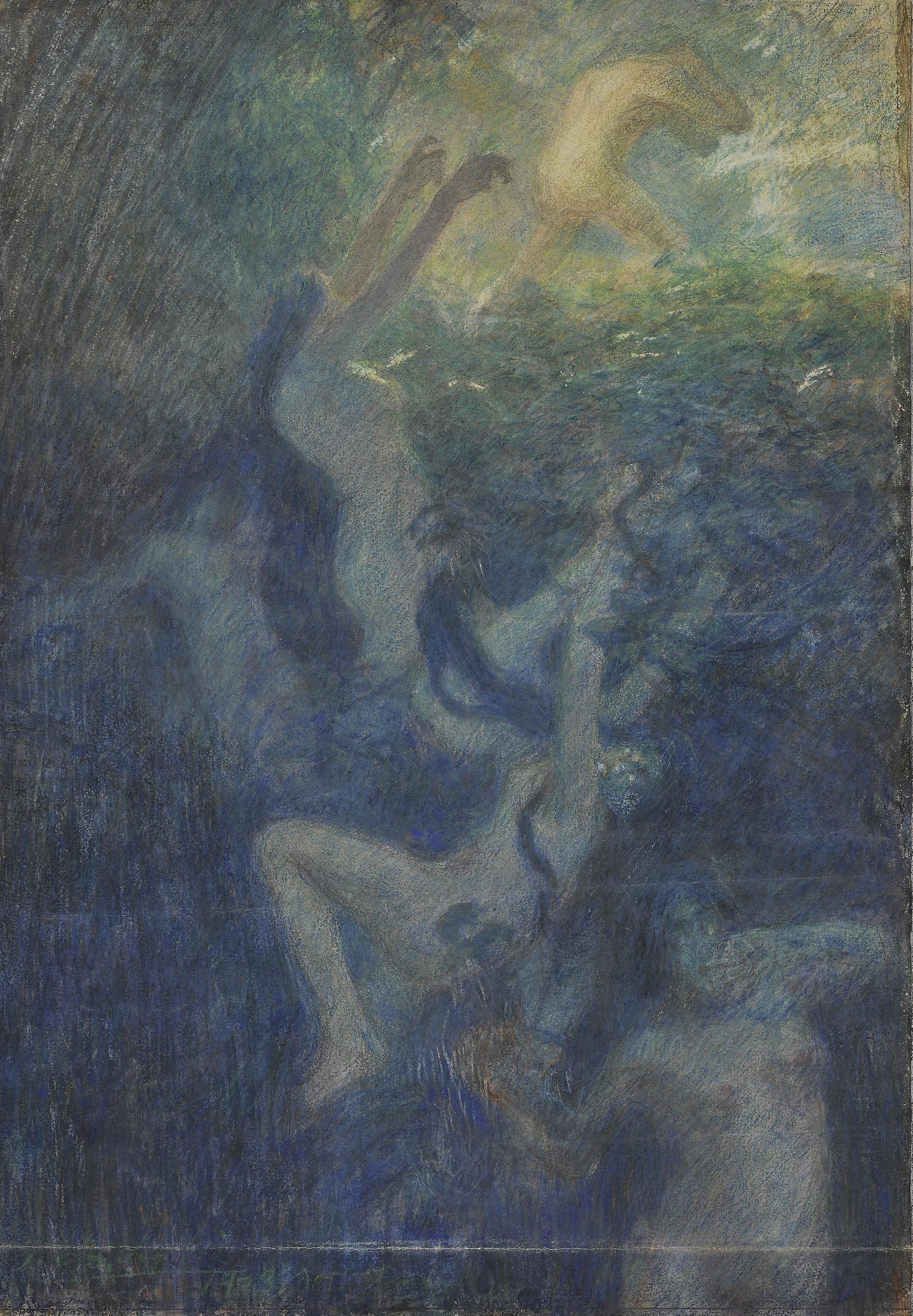
The third featured image is a supplementary blue-toned mythological composition from the JAPAN.co.jp image archive. Editorially, it is valuable because it helps readers see Aoki’s recurring attraction to fluid bodies, dreamlike blue tonalities and a mythic, almost submerged pictorial world.
Why Aoki fits JAPAN.co.jp’s November 16 image package
Aoki was chosen as the visual inspiration for the 15 editorial illustrations in this edition because his pictorial language translates surprisingly well across subject areas. The muscular human bodies of A Gift of the Sea can energize sports and business stories. The submerged, mythic atmosphere of Paradise under the Sea speaks naturally to stories about hybrid cells, uranium extraction from seawater and Antarctic climate science. His sensitivity to landscape and weather works equally well for rural tourism and ecology stories.
Just as important, Aoki offers something different from the ukiyo-e framework that often shapes overseas expectations of Japanese visual culture. His paintings are unmistakably Japanese in subject and sensibility, yet grounded in oil paint, atmospheric depth and bodily mass. That makes them ideal for contemporary editorial illustration: historical without being nostalgic, symbolic without dissolving into cliché.
In other words, he gives JAPAN.co.jp a way to render current news with emotional depth, national specificity and visual gravity.
The lasting meaning of his career
Aoki’s life should not be reduced to a morality tale in which the establishment was wrong and the genius was right. History is rarely that tidy. But his career does force a difficult question: what happens when an artist’s imaginative ambition outpaces the institutions meant to support or rank him?
His work survived. His reputation grew. Two of his best-known paintings are Important Cultural Properties. And yet the human life that produced them remained precarious almost to the end. That tension is central to why Aoki still matters. He stands at the intersection of modern Japanese art, regional identity, literary romanticism, institutional conflict and the unstable economics of artistic labor.
For JAPAN.co.jp, that is precisely the point. Shigeru Aoki is not only a strong public-domain artist. He is a historically meaningful one—someone whose work outlived the judgments that once seemed to limit it.
Primary sources and museum references
- Art Platform Japan | AOKI Shigeru
- Artizon Museum | A Gift of the Sea
- Artizon Museum | Paradise under the Sea
- Agency for Cultural Affairs | A Gift of the Sea
- Japan Search / Cultural Heritage Online | Yomotsuhirasaka
- University Art Museum, Tokyo University of the Arts | Yomotsuhirasaka
- Aoki Shigeru Memorial House chronology