- A life measured in paintings, not merely anniversaries
- From Aichi to a professional painter’s education
- The work continued after Kotaro Migishi’s death
- A woman building institutions as well as canvases
- France changed the landscape of her painting
- Color is an architecture, not an adjective
- Homecoming, honors, and the flowers of old age
- Why three museums have revisited Migishi
- How to visit—and what to look for
A life measured in paintings, not merely anniversaries
The flowers do not sit politely in Setsuko Migishi’s paintings. Color seems to push against the edge of the canvas; buildings emerge from dense painted surfaces; an interior becomes an arena of pattern and weight. The celebrated Japanese painter developed an unusually forceful visual language across a career shaped by war, widowhood, travel, and persistent work.
A retrospective at the Yokosuka Museum of Art opened on November 14, 2026, bringing together approximately 70 works, including pieces being shown in this exhibition for the first time. Running through December 20, it draws chiefly from the Ichinomiya City Memorial Art Museum of Setsuko Migishi and follows the artist chronologically. Art historian Satoshi Yamada supervises the show.
There is a small chronological point worth keeping straight. The exhibition carries a 120th-anniversary title, but Migishi was born in 1905: the anniversary fell in 2025. The 2026 presentation is part of the continuing commemoration, not a claim that she was born in 1906. More important than the anniversary is the way the exhibition invites a fresh look at what she made.
From Aichi to a professional painter’s education
Migishi was born in the village of Konobu-nakajima, now part of Ichinomiya in Aichi Prefecture. She moved to Tokyo in 1921 and studied Western-style painting with Saburosuke Okada, later entering the Women’s School of Fine Arts. In 1924 she completed her studies and married fellow painter Kotaro Migishi.
For a Japanese woman in the early twentieth century, choosing painting as a profession involved far more than mastering oil pigments and perspective. Public exhibitions, professional associations, studio access, and artistic networks were essential to a career—and women did not encounter these institutions on equal terms with men.
The exhibition’s 1925 Self-Portrait captures an artist near the beginning of that negotiation. It is tempting to read confidence or future greatness into any youthful self-portrait, but its historical value also lies in a simpler fact: a young woman had placed herself, explicitly, at the center of her own work.
The work continued after Kotaro Migishi’s death
Kotaro died suddenly in 1934. Setsuko continued painting while raising children and taking part in public exhibitions. Her husband’s career remains part of the context, but reducing her achievements to the story of a widow guarding his legacy would conceal the independent aesthetic decisions evident in her work.
The Japanese Agency for Cultural Affairs describes the saturated reds, yellows and deep greens of her 1932 Flowers and Fruit, noting a forceful approach with affinities to Fauvism. Its catalogue also records the difficulty women encountered in gaining full membership in important painting societies, even when their submissions received recognition.
She eventually moved into the New Creation Association, or Shinseisakuha Kyokai, and her 1939 Interior shows domestic objects reorganized as a powerful decorative structure. Patterns, carpets and furnishings were not a fallback from a supposedly more serious world of subjects. They offered material through which a distinctive pictorial space could be built.
A woman building institutions as well as canvases
Migishi’s career was inseparable from the networks that let women exhibit. In 1947 she became a founding participant in the Women Artists Association, known in Japanese as the Joryu Gaka Kyokai. That role broadened her significance beyond individual acclaim.
Art histories often appear to move from one master to the next. But reputations depend on opportunities to show work, critics willing to engage with it, and other artists who create institutions when established ones exclude them. The association’s formation belongs to that wider history of postwar cultural reconstruction.
Migishi achieved considerable recognition in the 1950s, yet success did not erase the conditions that had shaped her generation. Her contribution is best understood as both aesthetic and professional: the development of a demanding painterly language and participation in expanding the conditions in which women could sustain artistic careers.
France changed the landscape of her painting
In 1954 Migishi made her first journey to France. She later worked in Cagnes in the south and in the village of Vérron in Burgundy, returning repeatedly to the challenge of painting streets, walls, villages and land. Places once observed as exterior scenery became dense structures of color on her canvases.
The Yokosuka exhibition identifies Venice (1972) and The Thunder Is Coming (1979) among notable works. Their different subjects allow a viewer to ask how an artist turns the physical character of a place into an image governed by rhythm, mass and painted color.
To describe her work only as “influenced by Europe” would be inadequate. Japanese artists traveling in the mid-century encountered older European traditions, but they did not simply acquire a new style and bring it home. For Migishi, travel became part of a long process of reconsidering what painting could do.
Color is an architecture, not an adjective
“Passionate” is a convenient label for Migishi, but it does not explain the paintings. A crimson passage can draw the viewer forward because of the turquoise next to it; a dark contour can set a building against the sky; a heavy brushstroke can turn a patch of paint into a sensed surface.
The 1939 Interior demonstrates how repeated red and blue motifs can organize a crowded image. The famous late flower subjects ask another question: when the image already appears exuberant, what holds the whole composition together? These are interpretive questions for readers to test against the works themselves, not quotations or claims about the artist’s inner intentions.
Viewing art at screen size makes this especially difficult. A digital reproduction can communicate composition but seldom conveys the full impact of paint thickness, surface, and dimensions. This report is based on the museum’s documentation and published catalogues, not a firsthand inspection of the gallery installation.
Homecoming, honors, and the flowers of old age
Migishi returned to Japan in 1989 and worked in Oiso, Kanagawa Prefecture, where she had established a studio in 1964. She was named a Person of Cultural Merit in 1994, described by her memorial museum as the first woman Western-style painter to receive that distinction. Her memorial museum opened in Ichinomiya in 1998. Migishi died in 1999 at the age of 94.
The retrospective includes a work with the strikingly repetitive Japanese title Saita Saita Sakura ga Saita—roughly, “They Bloomed, They Bloomed, the Cherry Blossoms Bloomed”—dated 1994–98. Its presence near the end of a long artistic trajectory makes an important point: flowers were neither merely a youthful theme nor a late-career retreat from experimentation.
A career narrative can finish neatly at the moment of official recognition. Paintings cannot. What deserves attention is the fact that she continued to revise her world in color after honors and retrospective acclaim had already arrived.
Why three museums have revisited Migishi
The anniversary project has moved among institutions connected to the artist’s legacy. A 2026 catalogue published by Seigensha is edited by the Ichinomiya City Memorial Art Museum of Setsuko Migishi, Kobe City Koiso Memorial Museum of Art, and Yokosuka Museum of Art. Its chapter structure moves from Migishi’s early years through interiors and still lifes to landscapes and her final flowers.
This collaborative presentation matters in the geography of Japan’s art history. Ichinomiya preserves her birthplace connections; the broader museum network puts her work before audiences whose cultural lives do not depend on traveling to Tokyo. Comparing loans across collections also helps resist the reduction of an artist to two or three endlessly reproduced signature images.
The anniversary title may be historical, but the interpretive challenge is contemporary: how do institutions tell the life of a woman artist without converting its hardships into a sentimental tale, or allowing recognition by established art circles to obscure the work itself?
How to visit—and what to look for
Setsuko Migishi: A Retrospective runs at the Yokosuka Museum of Art, 4-1 Kamoi, Yokosuka, from November 14 to December 20, 2026. Galleries are open from 10 a.m. to 6 p.m.; the museum lists December 7 as a closure date. Regular adult admission is ¥1,500; high-school and university students and visitors aged 65 or older pay ¥1,300, while children through junior high school are admitted free. Additional exemptions apply.
The show is supervised by art historian Satoshi Yamada, with cooperation from Nagoya City Art Museum and the Hori Art Museum. The museum identifies approximately 70 works, including the 1925 Self-Portrait, interiors of the 1930s and 1940s, landscapes of the French period, and work from Migishi’s last years. The official museum page should be checked before travel for changes in access or ticketing.
Begin with the objects rather than the legend. Look at an interior and ask how its carpet rearranges space. Stand before a landscape and follow the edges of its buildings. Look at flowers and consider which colors hold the picture together. That is the reward of a chronological retrospective: seeing not simply the story of an exceptional life, but how a painter learned to see differently over time.
Sources and reporting notes
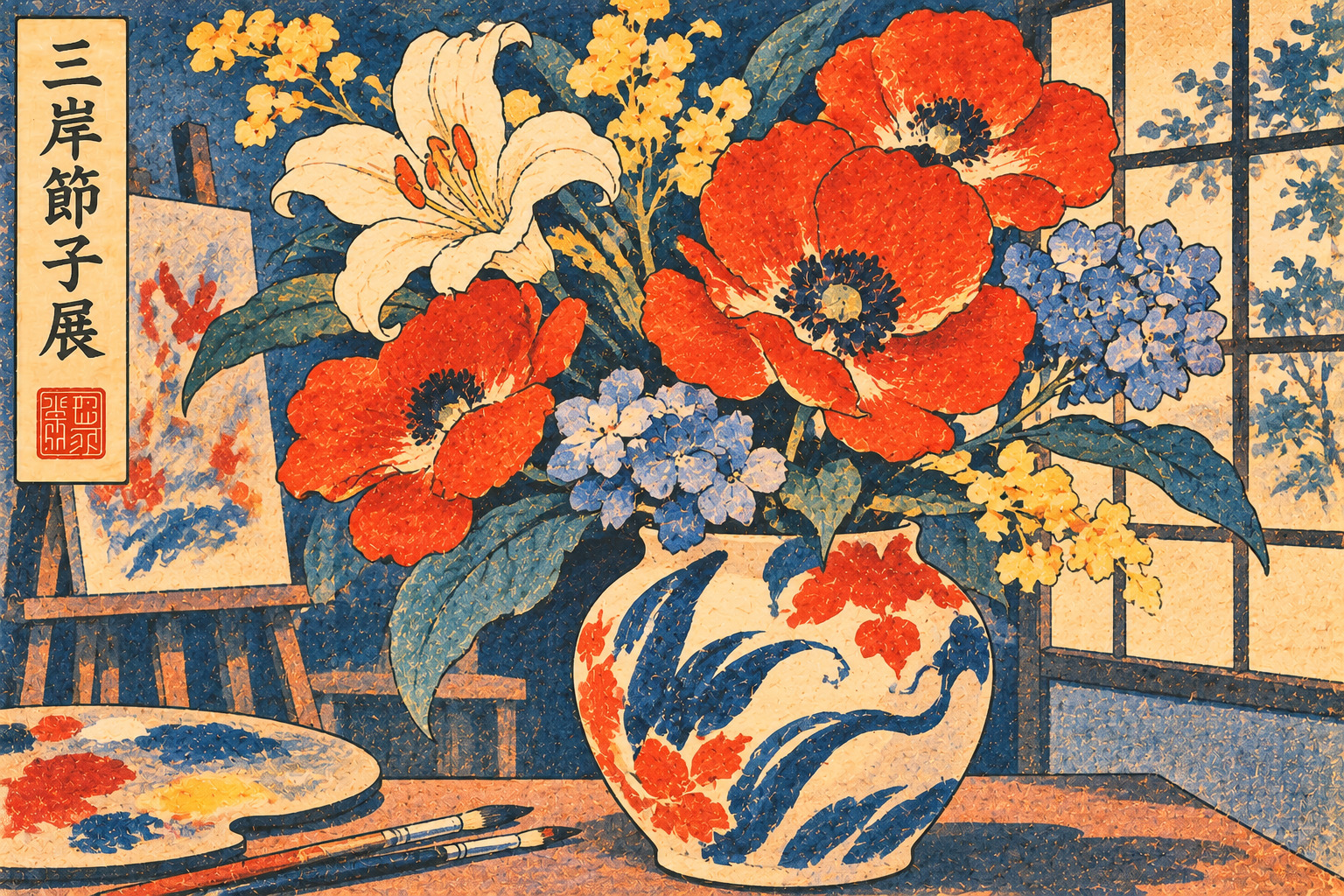
Reporting scope: Based on the host museum, the artist’s memorial museum, public collection records and museum-authored catalog information. We did not inspect the exhibition in person or interview the curator. Interpretations are editorial analysis. The illustration is not a reproduction of Migishi’s copyrighted paintings.