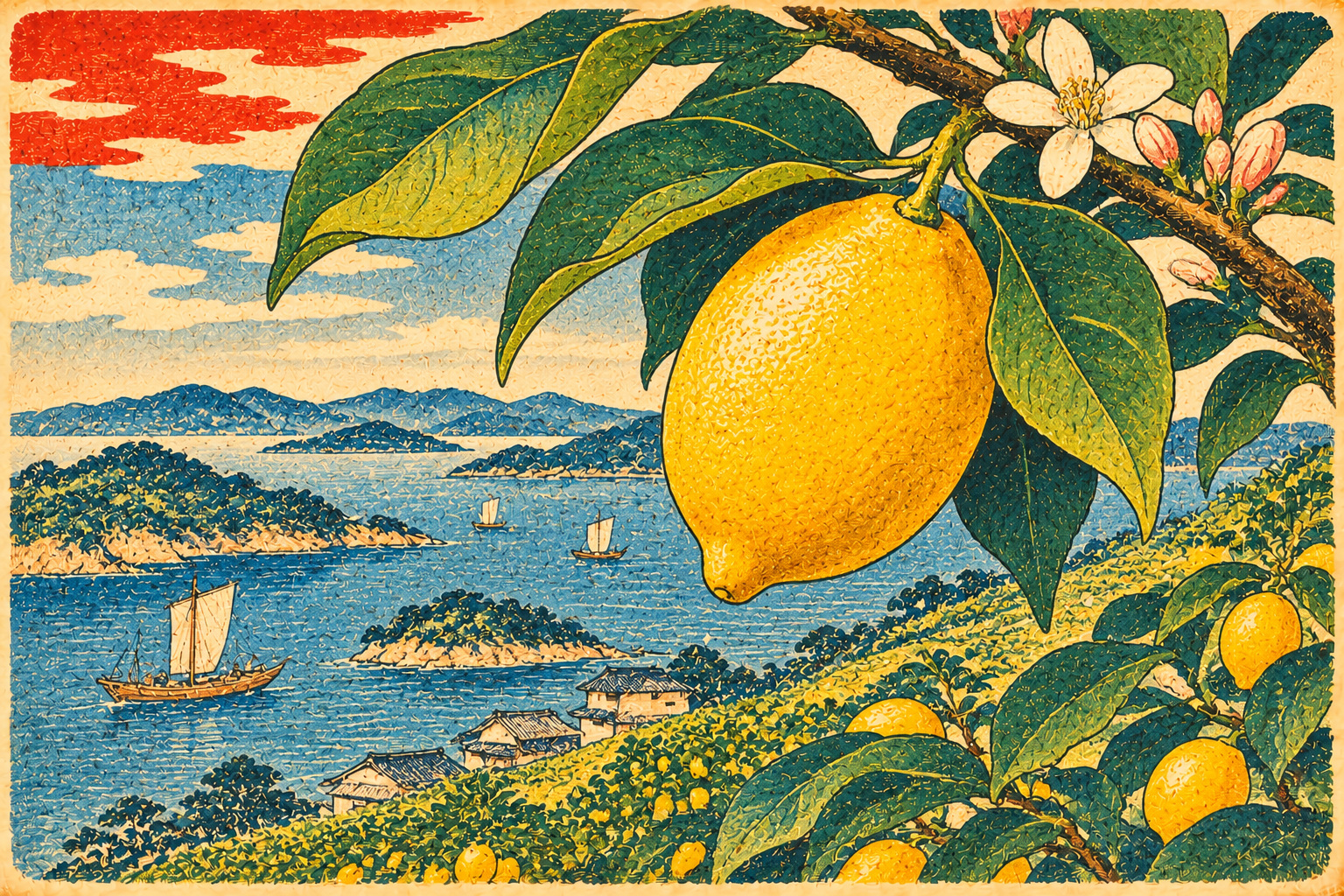
- The journey of a lemon begins in the orchard
- An Okayama orchard in a much larger inland-sea economy
- A late-Meiji experiment that outlived its first boom
- Imports, freezes and the difficult road back
- Why ponzu tells a story of international exchange
- Green, yellow and the realities of harvesting
- Can a food workshop support a farm?
- The same city has a bigger plan for school lunches
- What visitors need to know about November 15
- The next chapter of an inland-sea harvest
The journey of a lemon begins in the orchard
On Sunday, November 15, participants in a small coastal city in Okayama Prefecture are scheduled to pick lemons at K’s GARDEN in Ushimado and later turn the fruit into ponzu at Setouchi City Central Community Center. The itinerary is modest: harvest, move to a kitchen, prepare a condiment, taste it. Yet it offers a surprisingly rich introduction to Japan’s changing relationship with agriculture.
The municipal announcement, issued November 12, describes the event as part of its Shoku no Shiawase Project, or Food Happiness Project. The immediate aim is to bring residents into contact with growers and the ingredients produced around them. Last year, a related experience used harvested lemons to make a hot drink; this year the focus is ponzu.
This is an advance report. Neither the November 15 harvest nor its outcome has been observed by JAPAN.co.jp. The story is what the event reveals about agriculture, food education, and a citrus-growing region that has repeatedly had to remake its economic future.
An Okayama orchard in a much larger inland-sea economy
Setouchi City sits on the southeastern side of Okayama Prefecture, where the Ushimado area looks toward the islands of the Seto Inland Sea. Its relatively mild coastal climate helps support fruit cultivation, but suitable weather alone does not create a functioning agricultural industry.
Okayama Prefecture’s agricultural extension office reported in November 2025 that JA Okayama’s Setouchi lemon producers had begun shipping their seasonal crop. Around 40 growers and market representatives had attended an October quality-assessment meeting. The work involved consistent quality, stable harvests and getting fruit into distribution, none of which is visible in the picturesque image of a lemon hanging from a branch.
Geography requires precision. Ushimado is the location of this particular event; it is not synonymous with Setoda in Hiroshima Prefecture, the more widely known domestic lemon powerhouse. Both belong to the wider inland-sea citrus story, but they are different communities and markets.
A late-Meiji experiment that outlived its first boom
Hiroshima Prefecture traces its local lemon-growing history to 1898. According to an account preserved by the prefecture, three lemon seedlings arrived mixed into a shipment of navel-orange trees from Wakayama and were planted in the old village of Ōchō, now part of Kure. This is a reported origin story, not evidence that no lemon had ever been grown anywhere in Japan before that date.
The islands’ relatively warm winters and well-drained slopes helped the crop spread. In the Setoda area, organized expansion gathered pace around 1927. By 1963, Hiroshima’s lemon output exceeded 600 metric tons and represented roughly half the national harvest, according to the prefecture’s historical account.
The farming tradition was therefore not a timeless local custom. It developed through choices about crops, seedlings, transport, market demand, and the availability of land and labor. The lemon became an inland-sea signature because communities turned a promising plant into a commercial livelihood.
Imports, freezes and the difficult road back
The next transformation was harsher. Japan liberalized lemon imports in May 1964. Imported fruit challenged domestic growers on price, while damaging cold spells in 1976 and 1981 set orchards back. Prefectural histories describe a sharp contraction followed by a gradual recovery as demand for domestically grown lemons expanded.
The story should not be reduced to a simple moral contest between foreign and Japanese fruit. Reliable supply, pricing, post-harvest handling, pesticide protocols, flavor, and consumer preference all shape the market. Domestic producers compete not only on freshness and provenance but on consistent service to restaurants, wholesalers, and ordinary shoppers.
For scale, Hiroshima’s 2023 lemon harvest was 4,659 metric tons, or 48% of Japan’s 9,668 tons, according to figures published by Hiroshima Prefecture in May 2026. Those numbers refer to the 2023 crop and do not measure the size of Ushimado’s 2026 harvest.
Why ponzu tells a story of international exchange
Ponzu seems inseparable from Japanese cooking: a bright, sharp seasoning often used with hot pots, grilled foods, seafood and vegetables. But its name reflects contact with the wider world. An Osaka Prefectural Library reference investigation cites dictionaries linking ponzu to the Dutch word pons, a mixed drink or punch, with its meaning adapted as citrus and soy-based seasonings developed in Japan.
The traditional culinary category can refer to citrus-based acidic liquid, while what many households now call ponzu includes soy sauce and often stock or other seasonings. A fresh lemon version might combine the fruit’s juice with soy, vinegar, or dashi, depending on the recipe.
Setouchi City has not published the precise ingredient quantities for its November 15 workshop, so a plausible recipe should not be presented as the event’s actual formula. The point is more interesting than a recipe: a fruit with a global botanical journey meets a Japanese seasoning whose very name bears a trace of trade and language exchange.
Green, yellow and the realities of harvesting
A commercial lemon does not always resemble the uniformly bright-yellow fruit in a supermarket advertisement. Producers may market green lemons during the early season for their fragrance. JA Hiroshima describes green- lemon sales particularly during October through December, while riper yellow lemons are associated with other seasonal uses.
The fruit’s aroma also comes in part from oils in its peel. When cooks plan to use zest or the whole fruit, they have reasons to pay attention to how a particular batch was cultivated, treated after harvest, and handled in distribution. Such questions cannot be answered simply by the word “domestic.”
Picking an actual lemon also teaches practical things a packaged fruit does not: its weight, the plant’s thorns, variations in color and surface appearance, the judgment needed to harvest without damaging branches, and the work of moving fruit toward a paying market.
Can a food workshop support a farm?
Japan’s Tourism Agency has documented Setoda initiatives in which lemon growers, food businesses and local networks use specialty products and hands-on experiences to widen the value of the crop beyond wholesale fruit sales. This is a broader regional example, not evidence that the same business model is operating at the single-day Ushimado workshop.
For a farm, an educational event may create visibility and a connection with customers. But it can also involve time, staffing, transport, liability management, and costs. A credible economic assessment would need figures on participation, fees, repeat purchases, and benefits reaching producers rather than assuming that a photogenic harvest automatically produces rural revitalization.
The event’s potential lies in a chain of decisions: whether someone who has met a grower remembers the producer, seeks out the fruit again, or is willing to pay enough to sustain local cultivation. Those are questions for follow-up reporting, not accomplishments demonstrated by an announcement.
The same city has a bigger plan for school lunches
Setouchi City’s Food Happiness Project goes beyond seasonal activities. Its municipal materials describe a campaign to increase locally produced ingredients in schools and early-childhood facilities, including a government crowdfunding effort announced again on November 11.
The stated aspiration is 100% local sourcing for school meals. It is a target, not a present achievement. The city acknowledges that the current quantity and share of local produce used in meals remain low despite efforts by growers already supplying facilities.
There is a policy difference between learning where food comes from on a weekend and maintaining an everyday procurement system. Schools need dependable quantities, safety, predictable costs, and menus suited to what farms can deliver. A harvest event can build curiosity, but a sustainable school-meal program must also solve logistics and purchasing.
What visitors need to know about November 15
The announced program takes place Sunday, November 15, at K’s GARDEN lemon orchard in the Kashino area of Ushimado, followed by cooking and tasting at Setouchi City Central Community Center in Oku-cho Owari. Adults are quoted a ¥2,000 fee, high-school students and younger ¥1,000, and preschool children free. The announcement says participants will move from the community center by an organizer-arranged bus.
There is a minor scheduling inconsistency in the original notice: it gives the overall event as 9:50 a.m.–1:30 p.m., but lists harvesting as beginning at 9:45 a.m. and reception from 8:45 a.m. Visitors should confirm their assembly time, whether advance registration is still open, and any capacity restrictions with the organizer.
As of the November 14 publication date, the event remains scheduled for the following day. No attendance, taste-test reactions, or economic benefits have yet been established.
The next chapter of an inland-sea harvest
Setouchi citrus has endured import competition, damaging winter weather and changing demand. Today, orchard operators must also contend with labor shortages, the cost of distribution, plant health, and a climate whose warming may shift cultivation opportunities while introducing other stresses.
The deeper question is whether regional food experiences can strengthen ordinary purchasing relationships, not simply attract attention for a weekend. The aroma of a freshly cut lemon is memorable. A financially viable orchard requires buyers to return after that fragrance fades.
The November 15 event begins with a small act: a hand reaches into the branches for one fruit. The larger story is the network of growers, schools, cooks, merchants and families that determines whether another generation will still be able to harvest it.
Sources and verification
No firsthand attendance or tasting is claimed. Dates, geographic areas and statistical years are kept distinct; the Okayama workshop is not confused with the historical lemon industry of Hiroshima.