The question is not whether city hall can buy AI. It is whether citizens get dependable service from it.
A city hall that fits in a pocket
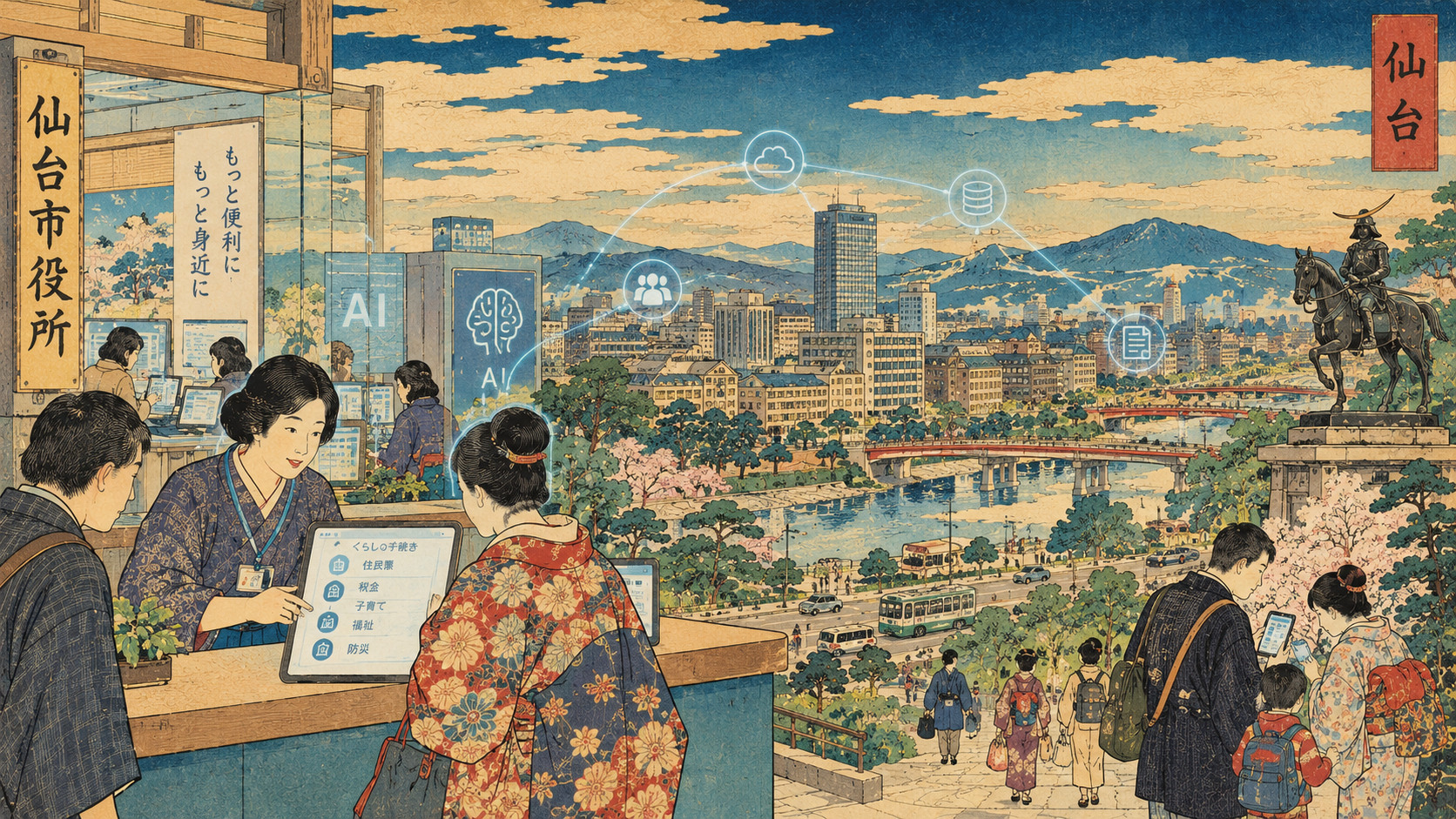
A resident needs a certificate, a parent seeks childcare guidance, or a family needs evacuation instructions. In Japan’s smaller cities, each request must reach a public office that faces the same hard arithmetic: fewer potential workers, but no corresponding disappearance of public obligations. The policy challenge is not whether artificial intelligence looks impressive on a demonstration screen. It is whether it makes those services easier to obtain, accurately and fairly.
What Sendai actually put on the agenda
On October 20, 2026, Sendai City organized TOHOKU DX GATEWAY 2026 at the Sendai International Center Exhibition Building. Its official program listed 104 solution booths, sessions on AI deployment and safety, and workshops on self-directed workplace improvement, one-stop reception procedures, and conversational app design. The city is the organizer; the Cabinet Office, Ministry of Internal Affairs and Communications, Digital Agency and six Tohoku prefectures were listed as supporters. Those details establish a concrete public-sector gathering, but they do not establish that each exhibited product has been bought or put into municipal service.
Mutsu offers the most useful test case
The clearest operational story comes from Mutsu, a city at the northern end of Aomori Prefecture. In its own announcement, Mutsu said it would appear jointly with Bot Express to explain the work behind its official LINE-based “smartphone city hall” (スマホ市役所). It described that channel as a public-service entrance and said it would show both the municipal processes already used and how they were built and improved. This is important because a conversational front door is not itself proof of artificial intelligence: some useful services work through conventional forms, rules and workflow automation. Reporting must distinguish such systems from generative-AI decision support.
Why the region matters
Tokyo can sustain specialist teams and dense networks of contractors. A smaller municipality may have to deliver family benefits, taxes, disaster alerts and elderly-care information with far fewer specialist staff. A single form duplicated across offices wastes scarce labor; a poorly designed automated form can simply push that burden onto residents. The public value of digital modernization should therefore be measured in fewer visits, less repeat entry, shorter staff processing time and fewer mistakes—not numbers of apps purchased.
The less glamorous work behind digital transformation
Japan’s municipal services developed around local ledgers, in-person counters, paper applications and systems procured separately by governments. Digital Japan’s more recent architecture attempts to standardize core administrative systems and make them less dependent on bespoke local implementation. The Digital Agency reported that, of 34,366 systems within scope, 10,013—or 29.1%—were designated for special migration support as of the end of March 2026. That is not an AI adoption percentage. It shows how substantial the underlying systems-transition challenge remains.
Three different technologies, three different promises
The National Institute of Information and Communications Technology (NICT) said it would demonstrate NerveNet, an information network designed for resilience in disasters; environmental sensing using video; and localized audio guidance and multilingual simultaneous interpretation. Those are communications and sensing capabilities, not interchangeable with generative AI. INES, meanwhile, advertised an AI-assisted municipal consultation product that combines speech recognition and generative AI to help prepare consultation records. Its claim of substantial time savings is a vendor statement; the size of the effect, external validation, and conditions for achieving it require independent examination.
When a transcript becomes a public record
Imagine a welfare consultation. Speech recognition produces a rough transcript, and a language model proposes a case summary. That can reduce clerical burden—but it can also omit a crucial qualification or reproduce an error as official fact. High-stakes records need human review, clear responsibility, access controls, retention rules and a process for residents to correct mistakes. Procurement documents should say whether confidential content is transferred to outside services, retained for model training, or processed only in approved environments.
The government has already recognized the hazards
The Digital Agency issued guidelines on government procurement and use of generative AI in May 2025 and revised them to version 2.0 in June 2026, balancing adoption with risk management. Its internally developed Government AI environment, Gennai (源内), illustrates that public-sector experimentation is not limited to city hall. But a national-government environment is not automatically a certified solution for every local authority; legal duties, data sensitivity, costs and local staffing differ.
A history shaped by crisis and geography
Tohoku’s experience of the 2011 Great East Japan Earthquake makes the resilience question more than a marketing slogan. A connected counter is valuable only if residents can still communicate when networks, power or transport are disrupted. The presence of NICT disaster-communications demonstrations at the Sendai event therefore matters alongside document-processing software. A local government cannot trade away emergency preparedness for a convenient chatbot.
The hidden divide: residents who cannot use the app
An online form can spare a working parent an inconvenient weekday journey. It may disadvantage someone with poor connectivity, limited Japanese proficiency, a disability, or little confidence using a smartphone. Municipalities need assisted channels, accessible design and face-to-face alternatives. Success is not 100% digital take-up; it is an improvement in service without forcing the least connected residents out.
How to judge a municipal AI purchase
Before declaring a project successful, ask how much it costs over a full contract, what was measured before deployment, how many citizens benefit, how error rates are audited, who can challenge a decision, what happens during outages, and whether the municipality can change suppliers without rebuilding the entire service. Staff time saved is not automatically budget money saved. A pilot is not a permanent rollout; a trade-show demonstration is not an independent performance test.
The real breakthrough would be ordinary
The most persuasive future photograph may be not a robot at a counter, but a resident completing an accurate request in minutes and a public servant finally able to focus on a complicated human case. Sendai’s gathering shows a regional marketplace and a policy agenda. The bigger story will be proved or disproved later, through service metrics and the experiences of people who use these systems. In Japan’s smaller cities, good AI may ultimately be technology that residents barely notice.
Sources and verification
Based on official programs and named exhibitor announcements; no claim is made of direct attendance or an independently verified post-event deployment.
- Sendai City: TOHOKU DX GATEWAY 2026 announcement
- Official exhibition website and program
- Mutsu City: presenting its operational DX approach
- NICT: disaster-resilient ICT demonstrations
- INES: AI-supported consultation service exhibit
- Digital Agency: municipal system standardization
- Digital Agency: government generative AI guidance, version 2.0
- Digital Agency: Government AI Gennai