What if the unfinished life of a public building were part of its public value?
The door that changes the meaning of a construction site
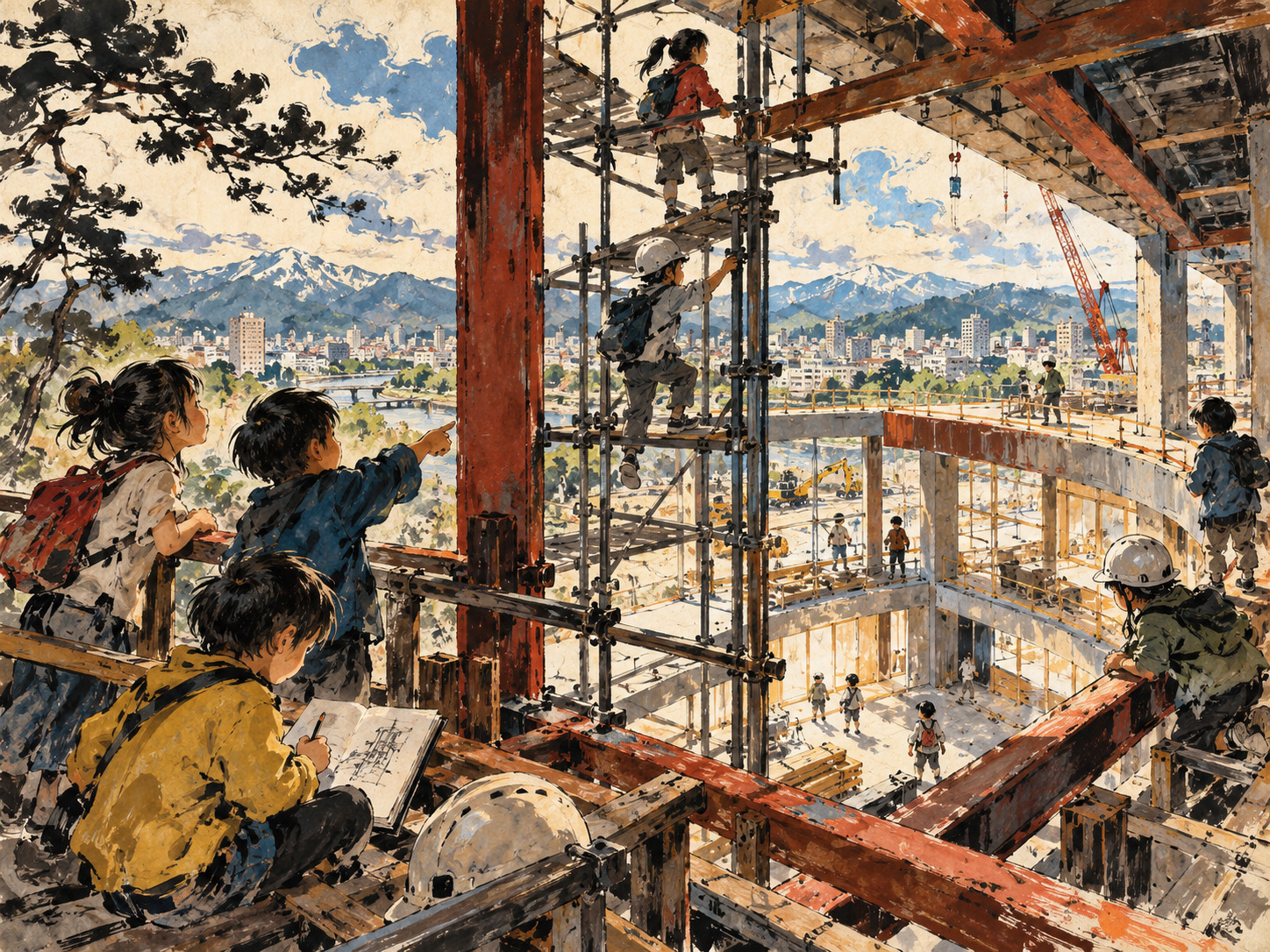
In downtown Sendai, the rebuilding of City Hall has offered children an unusual invitation: come back, watch a public building take shape, and discover how a city is made. On October 15, Tohoku University announced that the Kids on Site Project had won a 2026 Good Design Award. The innovation is not permission for children to wander into a dangerous work zone. It is the deliberate design of a supervised, safe educational space within the wider construction setting.
A prize for a system, not merely a playground
Good Design Award reviewers praised a combination of physical design and operating arrangements that allows learning to continue while a real construction project progresses. Construction sites are typically cordoned off for good reasons. The project asks whether a carefully managed portion can become a public resource without compromising those reasons. Its central insight is organizational as much as architectural: the learning space depends on researchers, municipal officials and builders working together.
March opening, October recognition
The project opened on March 27, 2026, during the local schools’ spring break. According to the university’s October announcement, cumulative child visits have passed 2,000, and some children have returned repeatedly. That figure counts visits rather than necessarily 2,000 unique individuals. The university states that activities are planned through May 2027. The award therefore recognizes work already operating over several months, not an untested idea on a presentation board.
A living lesson that changes week by week
Most public architecture is experienced as a finished product. We use the lobby, walk down a corridor, visit an office and seldom ask how the structure arrived. A site under construction tells a different story. Materials must be delivered, workers coordinate trades, and one phase gives way to another. Children who return can encounter different stages of the same project. That recurring exposure distinguishes the initiative from a special one-day tour.
Who is behind the idea?
The project is led by Associate Professor Tomoya Nishiwaki (西脇智哉) and colleagues in the Department of Architecture and Building Science at Tohoku University’s Graduate School of Engineering. Sendai City and a construction joint venture involving Obayashi cooperate with the researchers. The university’s March announcement described it as both an educational activity and a research effort intended to examine visitor responses and learning outcomes.
Why a city hall matters
A municipal building is not simply another office block. It is where residents encounter local government, from permits to social services. A large rebuilding project provides a visible example of decisions about public resources, accessibility, safety, maintenance and urban form. It could also provide a route into civic literacy: children begin to see that a public building is made by architects, tradespeople, engineers, administrators and ultimately the community that uses it.
The longer history of child-centered public space
Children have long learned through play, but modern cities tend to partition where that play may happen. Dedicated parks, schools and museums are important. They can also make the productive life of a city feel remote. Sendai’s experiment belongs in the broader debate about whether learning can occur in everyday civic settings. It is not proof that every building site should welcome visitors; instead, it expands the possibilities for deliberately planned access.
After 2011, the visibility of infrastructure
Sendai was profoundly affected by the Great East Japan Earthquake of March 11, 2011. Across the region, the reliability of buildings and infrastructure is not an abstract question. That history gives additional resonance to opportunities to learn about construction, though it would be inaccurate to describe Kids on Site as a direct post-disaster reconstruction program. Its documented purpose is education and public connection during the current City Hall project.
Another piece of Sendai’s play agenda
The municipality has a wider policy to improve children’s access to play. Its Sendai Children and Youth Plan 2025 covers fiscal years 2025–29, and the city has published a direction for improving play environments and separate 2026 play initiatives. The construction-site project should not be confused with those separately administered programs. Together, however, they reveal a civic question: how much of the city should children be able to explore and understand?
The demanding economics and safety of openness
Replicating the concept is not as simple as installing a doorway. Traffic routes, restricted work zones, visitor supervision, changing construction hazards, insurance and operational costs all matter. For international planners, the question is which controls make this model sustainable and how they are audited as a site evolves. The publicly available award notice confirms that safety was designed into space and operations; it does not provide us with an independently audited incident record or complete cost breakdown.
Do repeated visits actually change learning?
An award and a visitor total are important early signals, but they do not establish causal educational benefits. Children who choose to return may already have unusually strong interest in buildings. Researchers would need comparative evidence to determine whether visits increase knowledge of construction, civic participation or interest in technical careers. Accessibility, participation from different neighborhoods and the experience of children with disabilities also deserve scrutiny. The most interesting findings may come after the project closes.
The global lesson from one Japanese city
Cities around the world are full of temporary disruptions: construction fencing, blocked sidewalks and the uncertainty of unfinished work. Sendai has treated a small part of that disruption as an opportunity to teach. The model’s potential lies not in turning every construction zone into a playground, but in asking where carefully designed public access could reveal the labor and systems behind the built environment. The award is a milestone; the more consequential test is whether this approach can be evaluated honestly and adapted elsewhere.
Corrections and Further Reporting
We welcome documentation and firsthand accounts about site safety, operating costs, educational outcomes and access for families. Contact our newsroom.