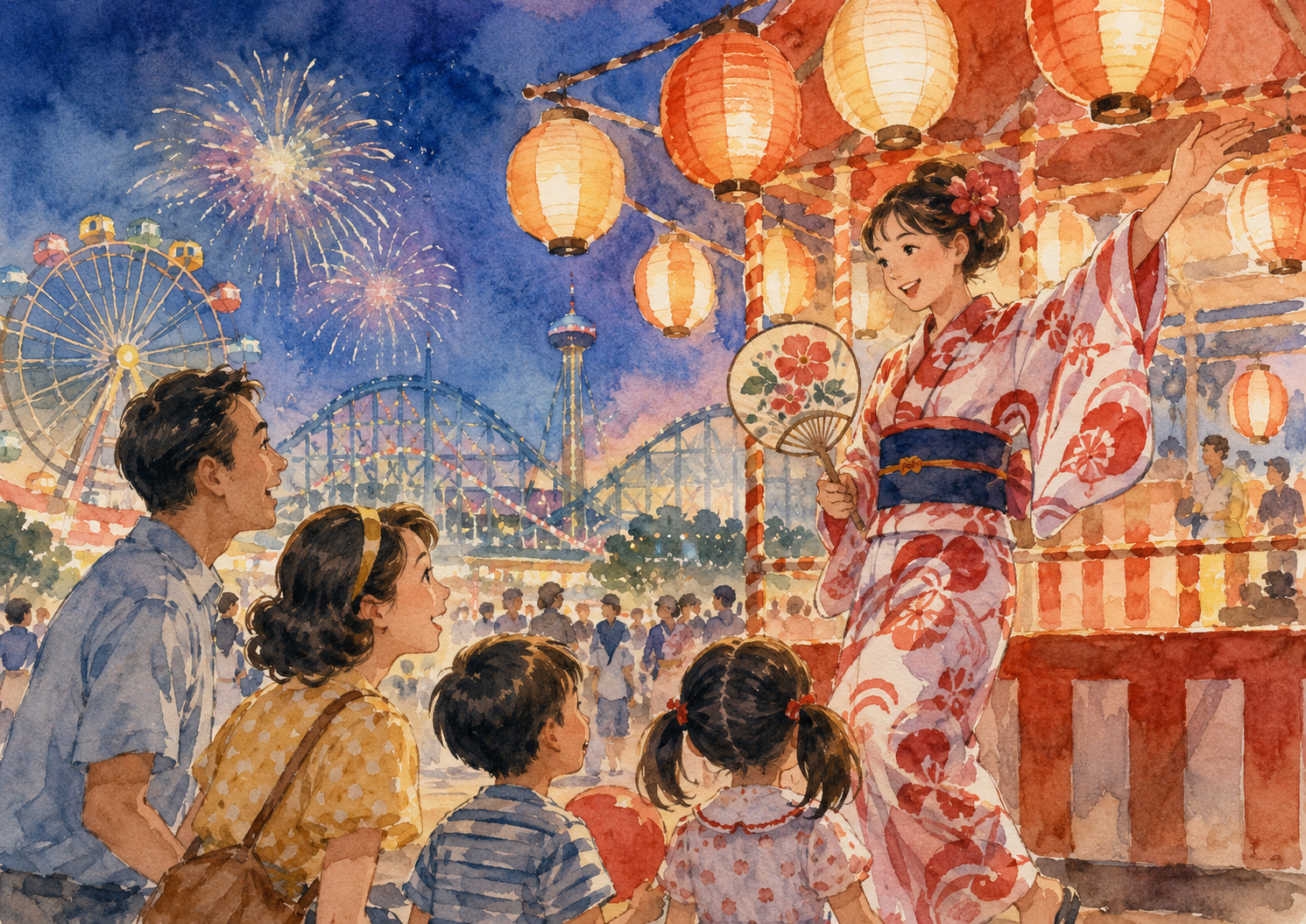
Seibuen Yuenchi’s summer works best when it is a little too much. By day, families can cool down in the pool. In the afternoon, the retro shopping street turns into a splash zone. At sunset, circus acts and street performances pull visitors toward the stage. At night, fireworks rise over Let’s Go! Leoland, and the whole park feels less like a facility than a neighborhood that has decided to throw a party.
For 2026, Seibuen’s “Big Summer Festival” leans fully into that identity. The official program gathers pools, Bon Dance Fever, Fireworks Extravaganza, Miracle Dream Circus, water-splash street shows, a high-collar parade, a Boogie-Woogie festival and Kasuga-themed pool play into one seasonal package. It is water, music, fire, nostalgia, comedy and family leisure all at once.
The setting matters. Seibuen sits in Tokorozawa, Saitama, right beside Tokyo but emotionally far from the polished world of global mega-parks. This is not a park trying to make visitors forget Japan. It is a park trying to make visitors remember a certain kind of Japan: shopping streets, summer evenings, train-line day trips, noisy laughter, children running ahead, parents carrying wet towels, and a final burst of fireworks before the ride home.
A very serious commitment to being ridiculous
The mascot-like center of the 2026 summer is “Keshiga,” presented as the embodiment of Seibuen Yuenchi and linked to comedian Toshiaki Kasuga. The headline event, “Bon Dance Fever — Keshiga Awakens,” runs on selected dates: July 18, 19, 20 and 26; August 2, 16, 23 and 30; and September 5, 6, 12 and 13. It begins at 7:15 p.m. and lasts about 15 minutes at the Let’s Go! Leoland special stage.
That sounds absurd, and that is the point. Seibuen’s modern identity is built around participation, not passive viewing. The Showa-era Sunset Hill Shopping Street is populated by residents who talk, sing, dance, sell food and pull visitors into the act. A Bon dance is not meant to be watched politely from a distance. It is meant to erase the border between performer and guest. Kasuga’s exaggerated public persona fits that world because Seibuen wants visitors to loosen up.
The fireworks are short, but that is why they work
The 2026 Fireworks Extravaganza is scheduled for July 19 and 25; August 1, August 8–15, August 22 and 29; and September 19–23. It begins at 7:30 p.m. and lasts about six minutes. Compared with a major river fireworks festival, that sounds brief. Inside a theme park, however, duration is not the only measure.
Park fireworks are part of a day’s emotional architecture. They are the punctuation mark after the pool, the rides, the food, the shopping street, the circus and the dancing. Because guests watch from inside the park near the stage, the sound and light feel close. For children, the fireworks can become the moment the whole day crystallizes. For adults, they revive the memory of a Japanese amusement park summer, even if the details are newly manufactured.
The shopping street gets soaked
Water is not just a cooling device in this festival. It is choreography. “Super Cooling! Sunset Hill Live” runs from 2 p.m. for about 20 minutes, sending heavy water sprays from the stage while visitors raise their hands to get drenched. “Uchimizu Splash! High-Collar Parade” begins at 12:30 p.m. and turns the Sunset Hill Shopping Street into a moving water fight with the park’s residents.
The word “uchimizu” matters. In Japan, sprinkling water on the street has long been a practical and social gesture: it cools the ground, settles dust and signals welcome. Seibuen turns that old custom into a full-body attraction. This is not quiet cooling. This is cooling as laughter, cooling as participation, cooling as a neighborhood festival where everyone is allowed to be a little undignified.
The pool starts before the festival
Seibuen’s pool season runs from June 27 to September 23, 2026. According to the official pool page, operations are weekends and holidays from June 27 to July 17 and again from September 1 to September 23, while the pool opens daily from July 18 to August 31. The pool lineup includes a wave pool, flowing pool, children’s pool, boat-themed pool and high-speed spinning slide.
Pricing also shapes the visit. The pool-only adult ticket is listed at ¥3,400 under normal pricing, with higher Obon pricing from August 8 to 16. Combined pool-and-park tickets are available for guests who want the full day: water in the morning, retro shopping street in the afternoon, circus or shows toward evening, and fireworks at night.
Showa retro is not just nostalgia
Seibuen Yuenchi opened in 1950 and has long served as a leisure destination for families along the Seibu railway network. In spring 2021, it reopened with a sharper retro identity centered on the energy of the Showa period. Its Sunset Hill Shopping Street is not a museum recreation. It is a theatrical environment: visitors buy food, encounter shopkeepers, watch little dramas and become part of the scene.
That distinction matters. Seibuen is not simply asking older guests to remember the past. It is translating a set of social feelings — neighborhood shops, cream soda, napolitan spaghetti, handwritten signs, friendly meddling, children’s play — into a form younger guests can experience. In a world of screens and polished branding, the park’s rougher human texture becomes its competitive advantage.
Why Tokorozawa is part of the story
Tokorozawa is neither central Tokyo nor distant countryside. It is the suburban threshold where railway culture, family housing, weekend leisure and local identity overlap. Seibuen grew within that private-railway leisure ecosystem: a park connected to trains, neighborhoods and repeat family visits rather than only to long-distance tourism.
That makes Seibuen different from Japan’s largest destination parks. It is not trying to be a once-in-a-lifetime pilgrimage. It is trying to be the place a family can return to, the place teenagers can reach by train, the place grandparents may remember and children can still find strange and new. The 2026 summer festival works because it fits that scale.
The circus brings back the old power of spectacle
The Miracle Dream Circus adds another layer. The official schedule runs from July 18 through September 23, excluding July 22, July 29 and September weekdays. Performances are listed at 11 a.m. and 6 p.m., about 60 minutes each, with a special roughly 90-minute version from September 19 to 23.
Circus belongs naturally beside an amusement park. If rides are mechanical astonishment, circus is human astonishment: bodies, balance, timing, danger, comedy, applause. By placing circus inside a retro summer festival, Seibuen reconnects amusement with older forms of live spectacle. The day becomes more than a list of rides. It becomes a sequence of sensory events.
Kasuga everywhere, and the freedom to laugh
The pool program pushes the joke further. “Kasuga-covered Pool” brings the Keshiga theme across the pool area. “Kasuga’s Special Mission: Everyone Challenge Reverse-Flow Time” asks guests in the flowing pool to resist the current together on cue. “Splash Summer Beat” fires water cannons in the wave pool to music at scheduled times throughout the day.
These are deliberately physical experiences. You move, shout, get wet, look ridiculous, and laugh. That is part of why amusement parks still matter. They offer the opposite of carefully curated digital life. A phone can record the moment, but the memory is made by the body: the splash, the heat, the noise, the brief embarrassment.
How travelers should read the schedule
The key to Seibuen’s 2026 summer is date planning. The pool schedule changes by season, and both Bon Dance Fever and the fireworks run only on selected days. Visitors should check the official calendar, choose whether they want pool-only or pool-plus-park tickets, and decide whether a full-day visit or evening-focused visit makes more sense.
For families, the ideal pattern may be pool in the morning, rest in the afternoon, shopping-street atmosphere and circus toward evening, then fireworks at night. On hot days, pacing matters. Bring towels, a change of clothes, waterproof bags and footwear that can handle water events. Seibuen’s summer is not a place to stay perfectly neat. It is a place to let the day become a little messy.
Japan.co.jp view
Seibuen Yuenchi’s 2026 Big Summer Festival shows why regional amusement parks still matter in Japan. Not every park needs to become a global-IP machine. Some parks can win by understanding the rhythms of local summer: trains, pools, fireworks, festival dances, shopping streets, family routines and a touch of absurd comedy.
In an era of extreme heat, leisure facilities need more than shade and cold drinks. They need to redesign the emotional logic of summer. Seibuen’s answer is deeply Japanese: sprinkle water, dance together, let the neighborhood characters pull you into the joke, and finish the night with fireworks.
That is why this story belongs in the June 30 amusement-park edition. It is not merely a retro park announcing another summer calendar. It is a reminder that the most durable summer memories are often not efficient, polished or quiet. They are wet, loud, slightly silly and shared.
| Item | How to read it |
|---|---|
| Big Summer Festival | A pool, fireworks, dance, circus and retro-shopping-street package for summer 2026. |
| Bon Dance Fever | A participatory dance event built around Keshiga / Toshiaki Kasuga and Seibuen’s shopping-street residents. |
| Fireworks Extravaganza | Selected July, August and September dates, starting at 7:30 p.m. for about six minutes. |
| Seibuen Pool | June 27–September 23, with weekend/holiday and daily operating periods depending on the date. |
| Best visit pattern | Pool by day, retro shopping street and circus toward evening, fireworks at night. |
Sources and references
This article draws on public information from Seibuen Yuenchi, Yokohama Hakkeijima / PR TIMES, Iwafu and local Saitama event coverage. Event details, prices, operations and weather policies may change; check the official site before visiting.
- Seibuen Yuenchi: 大夏祭り2026、盆DANCE FEVER、満天打上花火、水かけイベント、サーカス、プール連動企画の公式情報。
- Seibuen Yuenchi Pool: 2026年プール営業日、プール構成、料金、アクセス、注意事項。
- Seibuen Yuenchi Official Site: 2021年リニューアル後の昭和の熱気、主要アトラクション、基本情報。
- Iwafu: 2026年の満天打上花火の日程、会場、開始時間、アクセス情報。
- PR TIMES / Yokohama Hakkeijima: 2025年の昭和100年大夏祭り、花火・プール・サーカス展開の背景情報。