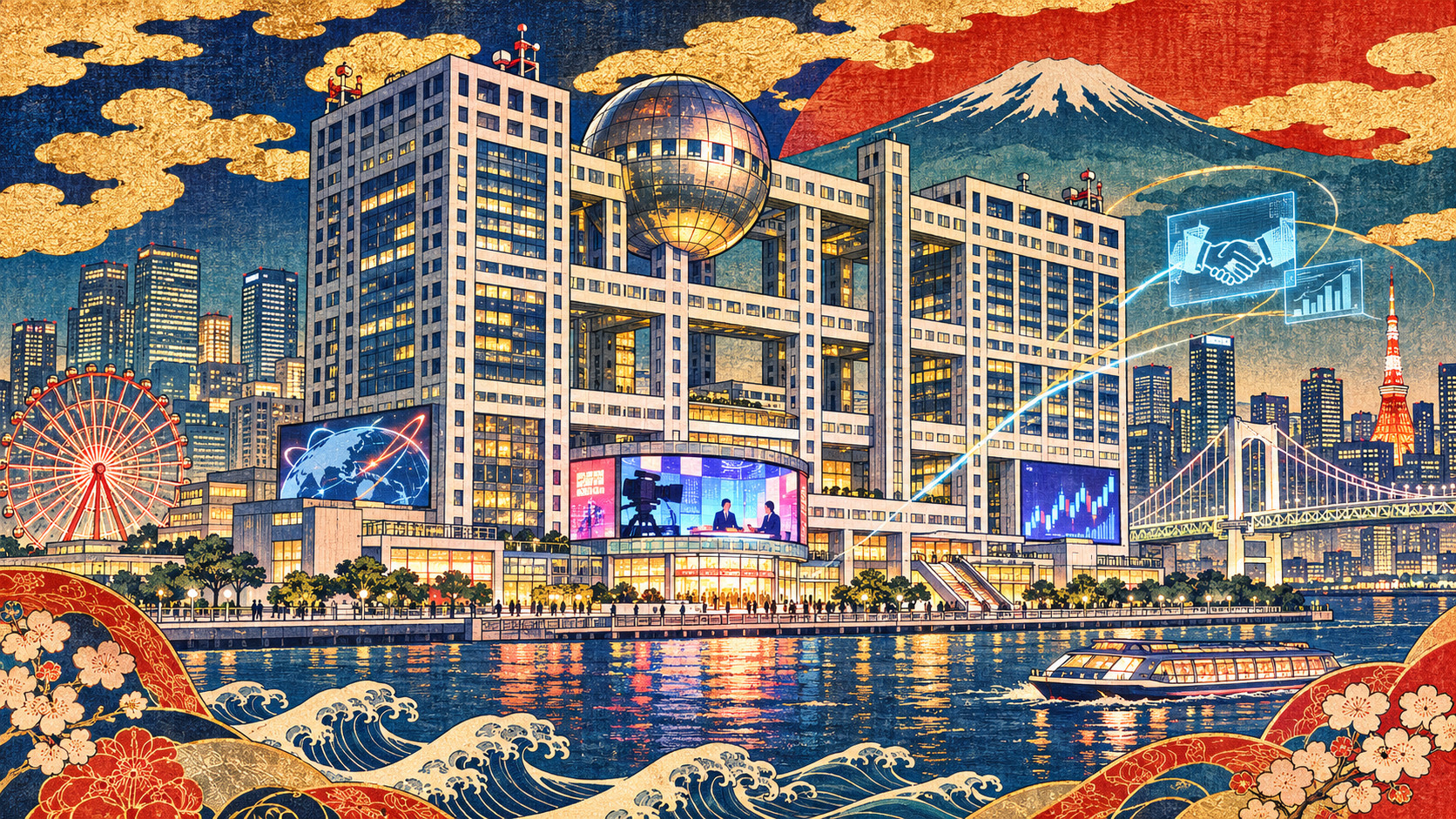
- An alliance built around what happens after the broadcast
- What is actually agreed—and what remains a proposal
- The road to November began with a shareholding
- Two very different corporate histories
- The meaning of “real media”
- Eighty-eight million customer relationships are not eighty-eight million fans
- Why a ¥100 billion content fund changes the conversation
- Yasushi Akimoto and a parallel creator-development effort
- A global opportunity with local complications
- What the deal means for Fuji—and for SBI
- Five tests for the year ahead
An alliance built around what happens after the broadcast
The most revealing feature of the November 2 agreement between SBI Group and Fuji Media Holdings is not that a financial group wants to enter entertainment. It is the idea that a concert venue, sports arena or fan gathering might be as important a media channel as a television screen. The companies want to connect audiences, creators, finance and live experiences in a lasting commercial relationship.
SBI Holdings, SBI Neo Media Holdings and Fuji Media Holdings signed a strategic capital and business alliance. Their planned venture would sit at the intersection of content rights, physical events, digital membership, payments, marketing and investment. It is a blueprint for a new business, not evidence that one is already operating or profitable.
For international readers, the deal offers a window into a larger Japanese question: can a country celebrated for its entertainment franchises build more of the financing, ownership and direct audience relationships that allow creative businesses to endure?
What is actually agreed—and what remains a proposal
The companies propose establishing a holding-type joint venture in January 2027, with equal 50% interests held by SBI Group and Fuji Media Holdings Group. The announced capital including capital reserves is ¥100 million, its name has not been decided, and each side expects to appoint multiple officers. Subsidiaries may follow for distinct lines of business.
The first envisaged line is a fan platform anchored by real-life events, designed to connect performers and audiences throughout the year. A second is joint development of ways to finance ambitious film and other screen content. The groups also identify marketing, regional initiatives and investment in intellectual property as areas for collaboration.
Not all these initiatives are firm operating commitments. Some are expressly under consideration. The initial capitalization must not be confused with the separate ¥100 billion-scale content investment fund in which Fuji Media intends to participate.
The road to November began with a shareholding
This partnership did not emerge overnight. On March 13, 2026, SBI disclosed that it and jointly reporting group entities had crossed the 5% large-shareholding reporting threshold in Fuji Media Holdings. As of March 12, the combined shareholding was 6.20%, and SBI reported a voting-rights percentage of 7.21% under its stated calculation. Those are historical disclosure figures, not a verified current percentage for November.
On June 26, the companies announced the start of discussions over a strategic media and content relationship. The June statement explicitly said that specific equity amounts, services and other details had not been determined. The November agreement therefore represents a progression from discussions to a signed three-party arrangement, though much of the implementation still lies ahead.
That distinction matters. A stock investment, a framework agreement, a planned venture and a launched product are different milestones. Treating them as interchangeable would exaggerate the speed and certainty of the transformation.
Two very different corporate histories
Fuji Media Holdings traces its corporate origins to 1957. In October 2008, the original company became a certified broadcasting holding company under the Fuji Media Holdings name, while the operating television business passed to a newly established Fuji Television Network. The holding company is therefore not identical to the broadcaster, a distinction essential to understanding the deal.
SBI began in July 1999 as SOFTBANK INVESTMENT CORPORATION, initially developing venture capital and incubation activities. Over time it evolved into a major Japanese financial group spanning securities, banking, asset management and investment. Now its stated ambition extends to the development and monetization of intellectual property.
For a broadcaster, the historical model brought mass audiences to scheduled programs and monetized attention through advertising and programming. For a financial firm, the historical skill is gathering capital, pricing risk and deploying investment. This partnership attempts to combine those capabilities across the lifecycle of a creative work. That is the strategic hypothesis—not an outcome already demonstrated.
Related reporting: Japan.co.jp examined SBI’s planned Livedoor acquisition in September. Questions about media ownership, commercial referrals and editorial independence overlap, but that proposed acquisition is a separate transaction from the Fuji joint venture.
The meaning of “real media”
The companies use the term “real media” for experiences such as live music, sports events and physical facilities where people gather around a shared interest. A venue becomes a platform for discovering content and building relationships, rather than merely the site of a ticket transaction.
Picture a concert. A visitor purchases a ticket, then chooses to remain connected through future events, original video, memberships or merchandise. The possible revenue streams multiply—but so do the obligations to the audience. A loyal fan relationship cannot simply be presumed because someone attended once.
This is where the traditional broadcasting business and the emerging direct-to-fan economy meet. It also puts difficult questions on the table: who owns the fan relationship, which entity pays for customer acquisition, who retains the rights, and how do creators share in downstream success?
Eighty-eight million customer relationships are not eighty-eight million fans
SBI cites a group customer base exceeding 88 million at the end of September 2026. The scale gives the company a potential distribution and payments advantage. But it does not establish 88 million unique people ready to subscribe to entertainment products, nor does it prove that banking customers will want offers from media businesses.
Financial customer information is especially sensitive. Cross-selling, consent, purpose limitation and governance over data-sharing would need careful design. The alliance release does not spell out a detailed architecture for merging or transferring individual customer records, and there is no basis for claiming such sharing has begun.
Ultimately, investors will need operating measures: active fan accounts, retention, acquisition costs, revenue per user and creator payouts. Those are more informative than the size of an existing financial customer base.
Why a ¥100 billion content fund changes the conversation
Fuji Media plans to invest in the SBI Neo Content Fund, formally the SBI Neo Content Investment Limited Partnership, described as a ¥100 billion-scale vehicle. The partners also intend to collaborate on identifying investments and working with portfolio companies. The amount denotes the fund’s scale; it is not the amount Fuji has been shown to invest in this announcement, and not capital committed to the new joint venture.
The financing problem in entertainment is structural. Production expenditures arrive long before sales proceeds. A film, show or franchise may require overseas marketing, rights negotiations and distribution investments before its commercial value becomes visible. The financing side can help create alternatives to a narrow set of sponsors and production committees, although every structure brings its own risks.
The unanswered questions are material: How much will Fuji contribute? Who controls investment decisions? How are rights and returns divided? What happens when a project loses money? The November 2 announcement does not provide enough detail to answer them.
Yasushi Akimoto and a parallel creator-development effort
On the same day as the alliance announcement, SBI Neo Media Holdings separately launched CONTENT INNOVATION, a creator and intellectual-property development platform led by lyricist and producer Yasushi Akimoto. It aims to discover ideas and emerging talent in music, film, animation and games, then support production and commercialization.
SBI said it had identified around 400 prospects, held discussions with roughly 150 people or businesses and decided on more than ten investments in connection with its wider content activities. These are figures provided by SBI for its own development pipeline, not a track record of the proposed SBI–Fuji joint venture.
Akimoto brings high-profile experience in Japanese popular entertainment, but celebrity involvement does not settle the important economics of creative work. Who can approve adaptations? Who holds copyright? Does a first-time creator retain an ownership stake? A financing platform will have to answer those questions to earn lasting trust.
A global opportunity with local complications
The partners hope to establish a domestic model and expand overseas, beginning in Asia. That is a plausible ambition given international interest in Japanese popular culture, but the alliance release does not identify a timetable for market entry, a list of targeted countries or revenue projections.
Overseas growth requires more than subtitles and fan enthusiasm. Distribution contracts, music publishing, performance rights, consumer protection, ticketing and promotional practices differ across markets. A complex bundle of rights can become a barrier to exporting a successful franchise.
If financing is combined with rights management and local partners, a wider range of Japanese creators might secure international exposure. Whether the benefits will reach those creators—and not only the corporate intermediaries—is a question to pursue, not a conclusion to assume.
What the deal means for Fuji—and for SBI
Fuji Media Holdings reported consolidated revenue of ¥551.865 billion for the fiscal year ended March 2026 on its corporate profile. Against that scale, a ¥100 million initial joint venture capitalization is not, by itself, a transformation of the group’s finances. The potential significance lies in which intellectual property, production personnel and distribution capabilities ultimately move into new business models.
Fuji also operates as a certified broadcasting holding company, with responsibilities distinct from those of a purely commercial entertainment venture. A new approach to audience monetization must be managed without blurring the public trust expected of broadcasting with promotional commercial activity.
For SBI, moving from financial investment to sustained creative-business building will demand unfamiliar disciplines: commissioning, talent relationships, hit-driven revenue uncertainty and brand stewardship. Capital alone cannot guarantee that an audience will love a story.
Five tests for the year ahead
First, who will lead the holding company when it is formed, and how will joint decisions be made? Second, what exactly will the first fan platform offer, and how will customer data be protected? Third, how will intellectual-property ownership and creator compensation work? Fourth, what will be the relationship between project-level financing, the ¥100 billion fund and the joint venture? Fifth, which measurable overseas milestones will the partners disclose?
The companies have supplied a strategic direction, but not all the commercial terms or performance targets. That leaves considerable work for reporters, investors, creators and consumers who want to judge the project after the announcement cycle has passed.
The deeper possibility is compelling: a Japanese entertainment ecosystem in which original work can find financial backing earlier, build an audience across different formats and travel more easily beyond Japan. The limitation is equally important. An alliance is an opening chapter, not proof of a successful industry model.
Sources and reporting method
Desk research based on the official corporate disclosures below. Analysis is separated from company projections; undisclosed transaction terms are not inferred.
- Three-party alliance agreement — SBI Holdings, November 2, 2026
- Opening of alliance discussions — SBI Holdings, June 26, 2026
- Fuji Media shareholding disclosure — SBI Holdings, March 13, 2026
- CONTENT INNOVATION launch — SBI Neo Media Holdings, November 2, 2026
- Fuji Media Holdings corporate profile and history
- SBI Holdings corporate history
- SBI and Twin Engine initiative — May 19, 2026