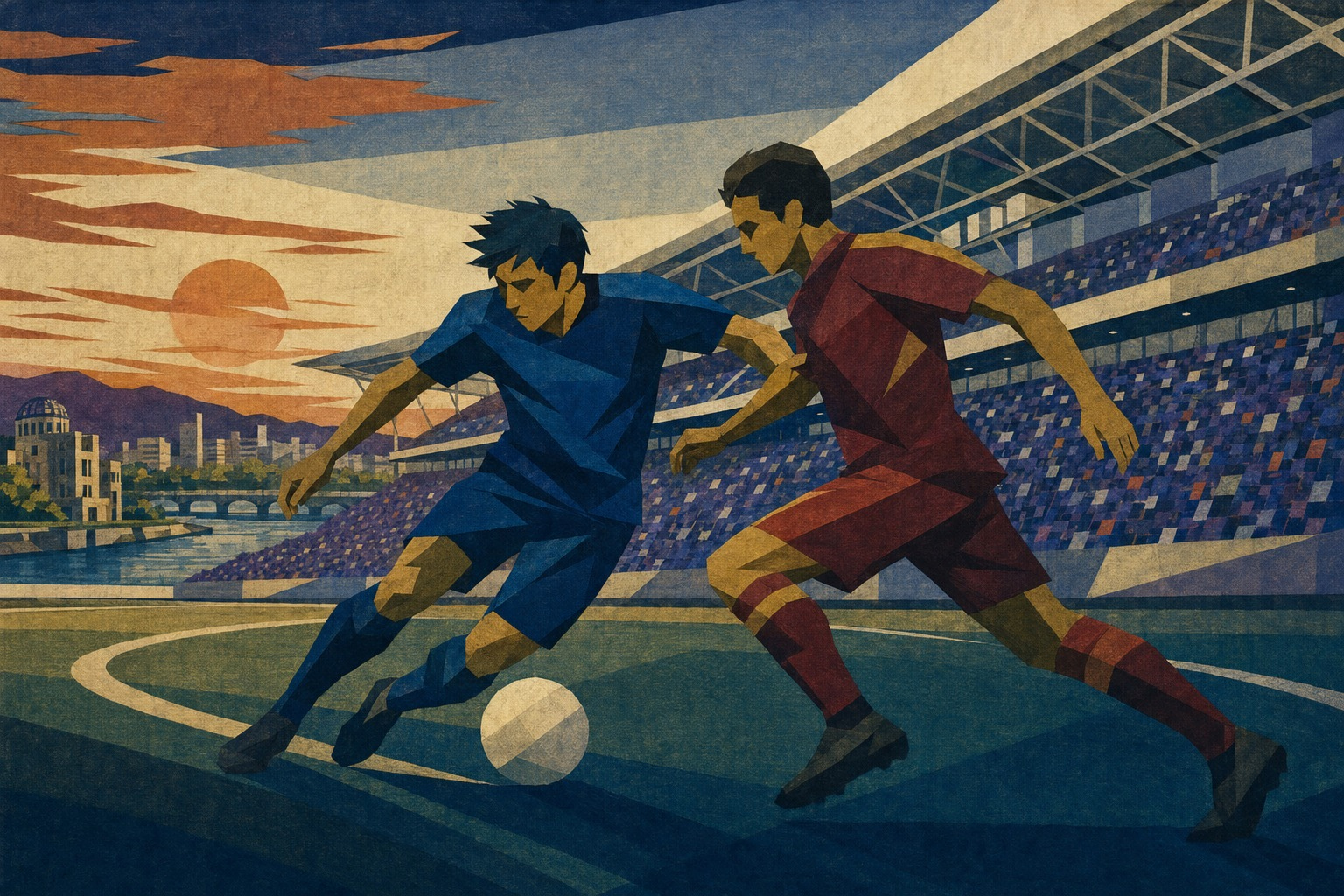
When the whistle sounds in central Hiroshima on a late-September night, two clocks will be running. One is short: 105 days until Japan opens the 2027 Asian Cup against Indonesia in Jeddah. The other is long: nearly 34 years since Japan first became champion of Asia in this city.
Hajime Moriyasu stands at the center of both clocks. In 1992 he was a defensive midfielder in the tournament squad. In 2026 he is a coach who has overseen 108 Japan matches, completed two World Cups and been given one competition before his departure. On July 23, the Japan Football Association extended his contract through the end of the 2027 Asian Cup and announced that U-21 coach Go Oiwa would then take over the senior side. The night in Hiroshima is simultaneously the opening of a new cycle and the beginning of the end of Moriyasu’s.
Starting With the World Cup’s Unfinished Work
Japan did not have a poor 2026 World Cup. It drew the Netherlands 2–2, beat Tunisia 4–0 and drew Sweden 1–1 to finish second in Group F. In the round of 32, it challenged Brazil. Kaishu Sano put Japan ahead in the 29th minute. The 3-4-2-1 shape compressed the middle, and the plan to recover the ball and break forward worked.
Then Brazil increased the pressure. The match turned. Brazil equalized in the 56th minute and Gabriel Martinelli won it in added time, sending Japan out 2–1. It was the fifth time the country had been eliminated in its first World Cup knockout match. The first-half plan had functioned. The failure came after the opponent changed the conditions: Japan was pushed deep, struggled over second balls and crosses, and could not recover territory once it won possession.
At his contract-extension news conference, Moriyasu argued that the team did not need to rebuild from zero. Experience, information, trust and the links to the youth sides should be preserved. There is evidence for continuity. The JFA said Japan had risen from the 50s in the FIFA ranking when Moriyasu took charge to 17th in July 2026. But continuity cannot mean fixing the same personnel and answers in place. If Japan cannot answer the question Brazil left behind—how do you adjust after the opponent’s adjustment?—accumulation becomes inertia.
A National Team That Has Already Dated the Coach’s Exit
Moriyasu’s extension is unusual in Japan. The men’s head coach has generally been appointed around the four-year World Cup cycle. This time, Moriyasu will continue for roughly seven months beyond the 2026 tournament, lead the Asian Cup and then give way to Oiwa, who is being tasked with the road to the 2030 World Cup. Oiwa will also remain responsible for the U-21 group heading toward the 2028 Los Angeles Olympics.
Japan therefore has two duties at once. Moriyasu must polish the strongest available side to win in 2027. Oiwa must create a path and a common football language for young players who could matter in 2030. Those jobs cannot be separated into different meeting rooms. Every September call-up, substitution and positional relationship will affect both timelines.
Pre-announcing a departure can dilute a coach’s authority. It can also make responsibility unusually clear. Moriyasu does not have to make cautious choices to protect the next four years. Oiwa does not have to destroy everything when he arrives. At its best, the six months from Hiroshima to Saudi Arabia can make farewell and preparation part of the same project.
The City Where Japan First Won Asia
Hiroshima matters for more than Moriyasu’s club ties. Japan’s modern Asian Cup history begins here. The country hosted the tenth AFC Asian Cup in Hiroshima Prefecture in 1992, the year before the J.League began. Japan was not yet a team expected to rule its continent.
It drew the United Arab Emirates 0–0 and North Korea 1–1 in the group, then beat Iran 1–0 to advance. It survived a 3–2 semifinal against China. On November 8 at Hiroshima Big Arch, Takuya Takagi scored in the 36th minute and Japan protected the lead to beat Saudi Arabia 1–0. It was the country’s first Asian title. Moriyasu, No. 17, was on the tournament roster.
That victory became the first of a record four, followed by titles in 2000, 2004 and 2011. The cup has not come back since. Japan lost the 2019 final 3–1 to Qatar. The 2023 edition, played in 2024, ended with a 2–1 quarterfinal defeat by Iran. In 2027, Japan has been drawn with Indonesia, Thailand and Qatar—the opponent that stopped Moriyasu’s first Asian Cup run in the final.
Nov. 8, 1992 — Japan beats Saudi Arabia 1–0 in Hiroshima for its first Asian Cup; Moriyasu is in the squad.
2000, 2004 and 2011 — Three more titles take Japan to a record four.
Feb. 1, 2019 — Qatar beats Japan 3–1 in the Asian Cup final.
Feb. 3, 2024 — Iran eliminates Japan 2–1 in the quarterfinals of the 2023 edition.
Sept. 28, 2026 — Japan faces Venezuela in Hiroshima.
Jan. 11, 2027 — Japan opens the Asian Cup against Indonesia in Jeddah.
Jan. 16 and 20, 2027 — Group matches against Thailand and Qatar in Riyadh.
From One Surviving Ball to a “Peace Wing”
Hiroshima’s football history is older than any national-team tournament and inseparable from the city’s reconstruction. Sanfrecce Hiroshima’s official account recalls an early international exchange involving German prisoners of war held on Ninoshima during World War I and teachers in Hiroshima. In 1947, only two years after the atomic bombing, a middle school attached to Hiroshima Higher Normal School won a national tournament. Its school building had been lost, its field used to grow sweet potatoes, and it possessed only one ball.
In the postwar years, Toyo Kogyo won the first four Japan Soccer League titles from 1965 through 1968. A substantial Hiroshima contingent helped Japan win bronze at the 1968 Mexico Olympics. The lineage ran from Toyo Kogyo to Mazda and Sanfrecce. Moriyasu played in Hiroshima for much of his career, then coached Sanfrecce to J1 championships in 2012, 2013 and 2015.
Edion Peace Wing Hiroshima opened in the city center in February 2024. Its name is intended to evoke permanent peace and wings carrying people toward a brighter future. On June 11 that year, the senior men’s national team played its first match in the stadium and beat Syria 5–0. The 2026 Venezuela fixture is not an inaugural international. Its resonance is subtler: an Asian Cup-winning player, now the departing national coach, begins his last tournament journey in a new ground within walking distance of the Atomic Bomb Dome.
Five Meetings, and an Asterisk on Japan’s Only Win
Venezuela was 47th in the July 20 FIFA ranking; Japan was 17th according to the JFA. That gap can create the illusion of a gentle restart. The five meetings say otherwise. Japan’s official record is one victory, three draws and one defeat, with five goals scored and eight conceded. Even the single victory needs a large footnote.
| Date and place | Official result | What the match left behind |
|---|---|---|
| Feb. 2, 2010 · Oita | Japan 0–0 Venezuela | The first meeting; Japan failed to score. |
| Aug. 15, 2012 · Hokkaido | Japan 1–1 Venezuela | Japan led but was held to a second consecutive draw. |
| Sept. 9, 2014 · Kanagawa | Japan 3–0 Venezuela | The match ended 2–2 on the field. FIFA later awarded Japan a 3–0 win because Venezuela fielded a suspended player. |
| Nov. 16, 2018 · Oita | Japan 1–1 Venezuela | Hiroki Sakai put Japan ahead before a late penalty brought Venezuela level. |
| Nov. 19, 2019 · Osaka | Japan 1–4 Venezuela | Salomón Rondón completed a hat trick by the 33rd minute; Japan conceded four before halftime. |
The 4–1 defeat in 2019 is the most direct warning for this game. Moriyasu changed eight starters from the preceding World Cup qualifier against Kyrgyzstan. Venezuela pressed high and disrupted Japan’s attempts to build from the back. Rondón scored in the eighth, 30th and 33rd minutes; a fourth followed in the 38th. Japan was late on crosses and transitions, and the distances between teammates came apart.
A friendly must be used to test players. The problem begins when “experiment” becomes permission to suspend the collective principles. Even with new faces, a team has to know who initiates the press, who protects the space behind it and where the first pass should go after a recovery. Osaka showed that if the team is dismantled to observe individuals, the observation itself can become meaningless.
The Country That Missed the World Cup Is Starting an Eight-Year Plan
Venezuela is the only South American men’s national team never to reach a World Cup. It finished eighth in the 2026 CONMEBOL qualification table, behind seventh-placed Bolivia, which reached the intercontinental playoff. But absence from the World Cup is not the same as an absence of competitive strength. Venezuela finished fourth at the 2011 Copa América, its best result, and beat Mexico on the way to the quarterfinals in 2024.
In January 2026, the Venezuelan Football Federation appointed Oswaldo Vizcarrondo as permanent senior coach. A former defender with more than 80 caps and four Copa América appearances, he had worked with the youth sides and guided the U-17 team to a World Cup. The federation presented his appointment as part of an eight-year, 2026–2034 project connecting generations and methods. His staff brings experience from South American, European and international football.
Hiroshima therefore places two different clocks on opposite touchlines. Moriyasu has a fixed endpoint after one tournament; Vizcarrondo is at the beginning of a long construction. Japan needs to raise its level immediately for the Asian Cup. Venezuela needs to test the bones of a side aimed toward 2030. Their horizons differ, but the underlying task is the same: turn one night’s result into a system that survives it.
Four Tests to Watch in Hiroshima
With no squad yet announced, predicting specific starters would be premature. But the Brazil match, the 2019 Venezuela defeat and Japan’s recent Asian Cup exits point toward structural tests. The following are Japan.co.jp’s analysis, not selection criteria published by the coaches or federation.
- Exits against an aggressive press: Can Japan vary short buildup with a direct pass, a layoff and a switch to the weak side?
- Crosses and second balls: Can the team control not only the first header but the space where the clearance lands—a thread connecting 2019 and the Brazil defeat?
- Readjustment during the match: When Venezuela changes the height of its defense or overloads a flank, can the players solve it before the bench supplies an answer?
- Principles that survive rotation: Can younger and less-used players enter without losing defensive distances, priorities after regaining possession and the method for closing a match?
The point is not possession for its own sake. In the Asian Cup, Japan will sometimes dominate the ball against a low block. Against an opponent such as Qatar, it may also have to absorb rapid attacks. The Hiroshima game becomes most valuable if Japan encounters—and deliberately learns from—both control and discomfort.
The September window includes two games, in Miyagi on the 24th and Hiroshima on the 28th. Fatigue, travel and changes in personnel will matter in the second. Can Japan make extensive changes and still function, unlike in 2019? Or will Moriyasu preserve a spine and rotate around it? The two matches should be assessed as one design, not as isolated scorelines.
The Asian Cup Cannot Be Reduced to “Preparation”
Japan will open against Indonesia in Jeddah on January 11, meet Thailand in Riyadh on the 16th and play Qatar there on the 20th. Four championships remain an Asian Cup record, yet 16 years will have passed since Japan last lifted the trophy. Qatar, the side that stopped Japan in the 2019 final, gives the last group match unusual weight before it even begins.
For Moriyasu, the tournament is not merely a bridge toward 2030. After the 2019 runner-up finish and the 2024 quarterfinal exit, it asks whether a coach who has not won Asia can take the title in his final attempt. For the broader Japanese project, the test is whether the ability to compete with world powers can be converted into the ability to impose control across a continental tournament.
In Asia, one unstable half can close a four-year story. Japan conceded twice before halftime in the 2019 final. It led Iran in the 2024 quarterfinal but was pushed backward and beaten in the second half. In 2026, it led Brazil and lost. Different opponents and competitions, but a common job: turn superiority into a protected result and interrupt an opponent’s momentum before it takes over the match.
A Handover, Not a Commemorative Photograph
Hiroshima tempts the story toward a neat ending. A member of Japan’s first Asian championship side returns to the city where he won three league titles as a coach, entering a new stadium named for peace before his final tournament. But competitive meaning cannot be manufactured from memory alone.
Venezuela is an opponent Moriyasu’s Japan has faced twice without winning. In 2019, his team could not preserve selection breadth and collective intensity at the same time. This match is the first mirror for what Japan has retained from the World Cup and what it has changed. Victory matters. Yet a comfortable win without moments of pressure may test little. A difficult night, if Japan’s adjustments are visible, can leave more for the Asian Cup.
In November 1992, Hiroshima changed Japan into a country that could call itself champion of Asia. In September 2026, the question is not whether Japan remembers that title. It is whether the team can translate an old success into present decisions and recover a trophy absent for 16 years. Moriyasu’s last journey begins in the city of his first Asian crown—not to close a perfect circle, but to pass an open one to the next generation.
Reporting Notes and Principal Sources
This article is based on public information available as of July 29, 2026, 11:30 a.m. JST. Match details, coaching appointments and head-to-head records prioritize official federation material. September squads had not been announced. Tactical themes are editorial analysis drawn from past matches; future results, player availability and injuries are not known.
- Japan Football Association: September 28 Venezuela fixture and Moriyasu comments
- Japan Football Association: Kirin Challenge Cup 2026 match information
- Japan Football Association: 2026 World Cup match report, Brazil vs. Japan
- Japan Football Association: Moriyasu extension and succession by Go Oiwa
- Japan Football Association: Moriyasu contract-extension news conference
- Asian Football Confederation: 2027 Asian Cup match schedule (PDF)
- Japan Football Association: Japan’s complete Asian Cup history
- Japan Football Association: Japan–Venezuela series through 2019
- Japan Football Association: 2019 Venezuela match report
- Venezuelan Football Federation: Vizcarrondo and the 2026–2034 men’s project
- CONMEBOL: 2026 World Cup qualifying table
- Sanfrecce Hiroshima: History of football in Hiroshima
- Sanfrecce Hiroshima: Edion Peace Wing design and name
- Japan Football Association: 2024 Syria match, the first senior men’s international at Peace Wing