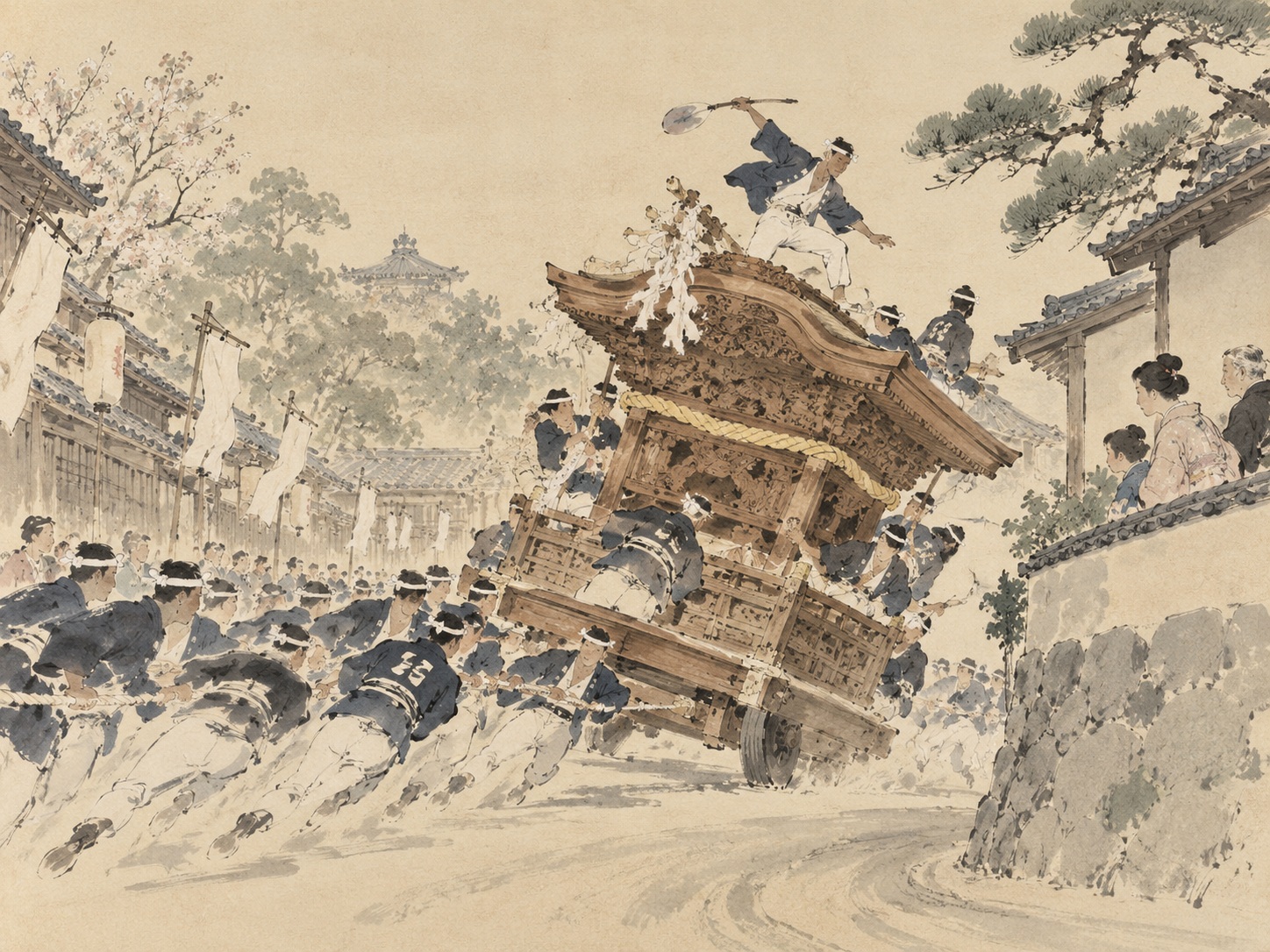
At about 7:40 p.m. on October 3, a danjiri festival float overturned while attempting a turn at an intersection in Fukaisawa-machi, Naka Ward, Sakai. Eleven male participants ranging from their teens to their 60s were injured. Kansai TV reported injuries including blows to the head and arms; none was believed to be life-threatening, and no passerby or nearby resident was reported injured.[1]
Video shows the heavy wooden float leaning sharply while turning before falling onto its side. As of October 4, police and festival organizers had not published a final causal finding. It would therefore be premature to state that excessive speed, a steering error or equipment failure caused the overturn.
The turn is the attraction
To understand the risk, one has to understand the spectacle. Sakai’s tourism organization describes yarimawashi—taking a danjiri through a sharp corner at speed—as one of the defining attractions of the festival tradition. A danjiri has no engine and no steering wheel. Large floats can weigh around four tonnes, and direction is controlled entirely through coordinated human effort: rope pullers, front and rear steering crews, signalers and experienced leaders.[2]
The same physics that creates excitement creates risk. Once a massive wooden vehicle carries speed into a corner, its momentum wants to continue straight. Timing, road surface, wheel condition, the distribution of force through the ropes and the actions of steering crews all matter.
Sakai does not have one single danjiri festival
“The Sakai danjiri festival” is really a network of neighborhood festivals rather than one centrally run event. Sakai City lists autumn danjiri processions associated with numerous shrines, including Otori Taisha, Hibe Shrine, Nonomiya Shrine, Tajihayahime Shrine, Mitami Shrine, Sakurai Shrine, Ishizu Shrine, Suearata Shrine, Tsukuno Hachiman Shrine, Hishiki Shrine, Hachita Shrine and Hagiwara Shrine.[3]
The city says more than 80 danjiri are maintained in Sakai. Neighborhoods own and preserve them, repair wheels and carvings, organize teams and hand roles down across generations. That decentralized structure is one of the tradition’s strengths—and one reason safety cannot be solved by a single event manual alone.
A 300-year tradition larger than one famous city
Kishiwada is the nationally famous center of danjiri culture, but wheeled festival-float traditions extend across Senshu and much of western Japan. Kishiwada City traces one traditional origin story to 1703, when feudal lord Okabe Nagayasu is said to have enshrined Fushimi Inari and held a festival praying for a good harvest. The festival has evolved over roughly three centuries as both religious observance and neighborhood institution.[4]
Sakai’s festivals share that broader cultural world. The ornate woodcarving, lanterns, music and human-powered processions are not merely a tourism show. They are systems of neighborhood participation in which children, young adults, senior crew members and craftspeople inherit different responsibilities.
Sakai saw another 11-person overturn in 2023
The new accident has a recent local precedent. On April 16, 2023, a danjiri overturned near an intersection in Shiroyamadai, Minami Ward, Sakai. Eleven men in their teens through 40s were injured; three men in their 40s suffered serious injuries including leg fractures. No spectators were hurt.[5]
Sakai firefighters were later honored in the Osaka Firefighting Awards for rapidly triaging and transporting the 11 injured people. It was an example of effective emergency response. But from a festival-safety perspective, successful rescue is not the same thing as prevention.[6]
The fact that another Sakai danjiri overturn has now injured 11 participants does not by itself establish a trend. It does, however, provide a strong reason for cross-neighborhood review rather than treating every accident as an isolated local matter.
Tradition has never meant “unchanged”
Safety arguments often collide with the phrase “this is how it has always been done.” But festivals have always adapted. Roads are paved differently, intersections have signals, residential density has changed, spectators carry phones and stand in places earlier generations never did, and modern emergency services and traffic-control rules surround the route.
Kishiwada’s own cultural materials describe its danjiri festival as a tradition preserved for roughly 300 years while changing with the times. Continuity has depended on adaptation.[7]
Where can organizers create a larger safety margin?
There is no single technical fix. Risk can be shaped by intersection-specific speed limits, team size and position, steering training, wheel and axle inspection, route design, weather and road-surface checks, crowd setback lines, radio communication and pre-positioned medical response.
The useful question is not simply whether yarimawashi should be banned. The same maneuver has different risk depending on float mass, corner geometry, road condition, crew experience and crowd density. A risk-based approach can preserve the movement while changing how and where it is attempted.
Human-powered control makes knowledge transfer a safety system
A danjiri does not have electronic stability control. Its control system is people. That makes inherited skill a safety mechanism as well as a cultural one.
Younger participants begin in limited roles and learn signals, rhythm and route behavior before taking greater responsibility. After an accident, the most valuable lesson may be operational knowledge: what signals were given, how speed was judged, what the rear crew saw, when the lean became unrecoverable and whether anyone had authority to abort the maneuver.
If that knowledge is shared across teams rather than kept within one neighborhood, traditional expertise can evolve into a stronger safety culture.
Tourism creates a new duty toward spectators
Sakai actively promotes danjiri as an important cultural and tourism asset. Its English-language visitor information emphasizes the sight of huge carved floats charging through streets and the vitality of Senshu festival culture.[8]
But visitors do not possess the local knowledge that regular participants do. They may not know which side of a corner is dangerous, how far a float can swing, or when filming from the curb becomes unsafe. Growing tourism therefore increases the need for multilingual safety messaging and clearly enforced spectator zones.
Injury should not be treated as the price of authenticity
The power of a danjiri festival comes from watching human beings move something massive together. Turning it into a static museum object would preserve the craftsmanship but change the culture.
That does not mean injury must be accepted as proof of authenticity. A tradition intended to last another century has more reason—not less—to learn from every near miss and every overturn.
The exact cause of the October 3 accident in Fukaisawa-machi remains under investigation. The next useful step is not another dramatic replay of the video. It is a transparent review shared among festival crews, police, fire services and the city, with lessons carried into the next route plan. Safety and preservation are not opposing goals. Without safety, preservation eventually fails.
Sources and references
- Kansai TV, “Danjiri overturn leaves 11 injured in Sakai,” October 4, 2026.
- Sakai Tourism and Convention Bureau, guide to danjiri, yarimawashi and float operation.
- Sakai City, Annual Festivals & Events — Danjiri Festivals.
- Kishiwada City, landscape policy describing the traditional origin and community role of the danjiri festival.
- Mainichi Shimbun, Sakai danjiri overturn injures 11, including three seriously, April 16, 2023.
- Sakai City, recognition of fire crews for triage and transport after the 2023 float overturn.
- Kishiwada City, educational history of the danjiri festival and its evolution over roughly 300 years.
- Sakai City English visitor guide, describing danjiri as a major local autumn tradition.
Reporting cutoff: October 4, 2026. The final cause of the overturn, the formal name of the specific neighborhood festival organization, and any post-accident safety changes had not been publicly established at the cutoff. This article does not infer cause from video alone.