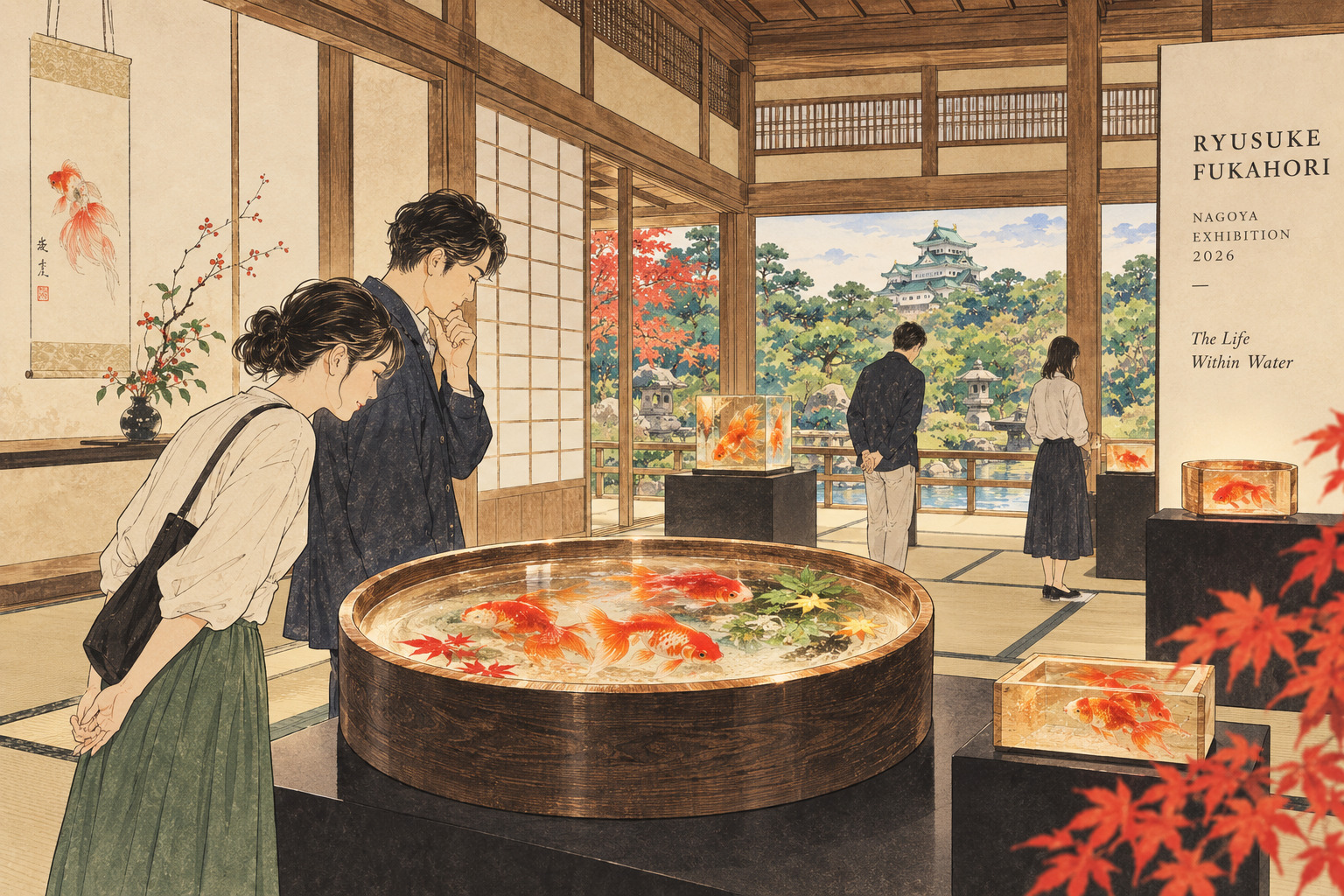
A goldfish appears to be suspended in clear water. There is no water. There is no fish. There is only transparent resin and acrylic paint, built layer by layer until the viewer's eye reconstructs a living body from separated painted fragments. Riusuke Fukahori's technique, developed from 2002 and often called “2.5D Painting,” depends on that perceptual contradiction. His new Nagoya exhibition places it inside another layered object: a historic merchant's residence built from Western rooms, Japanese rooms, storehouses, garden and tea architecture. [1][5][7][8]
Riusuke Fukahori Exhibition—Kingyo no Uta: Co-creation with Kenji Yamada and Keisuke Kitagawa runs from September 18 through October 25 at the Cultural Path Shumoku Museum in Nagoya's Higashi Ward. The museum is the former residence of export-ceramics merchant Tamesaburo Imoto and is both a Nagoya-designated tangible cultural property and a designated important landscape building. Fukahori's layered-resin works, paintings and installations are joined by tatami artist Kenji Yamada's crane work and Nagoya Institute of Technology professor Keisuke Kitagawa's Instant House architecture. [1][2][9][15]
The organizers say the show includes numerous works presented publicly for the first time, among them Kingyo-sake, named Himomo, Kōya, Kicchō, Fusō no Suzumi and Ko-hi Chiri, along with a previously unexhibited kimono work selected for the historical setting. [2][3]
The fish looks sculpted—but it is not a model embedded in resin
Fukahori's best-known resin works are often misunderstood in photographs. A finished three-dimensional goldfish is not placed inside clear resin. Instead, a layer of resin is poured and cured. Part of the fish is painted in acrylic on that surface. Another layer is poured, cured and painted. Repetition distributes different parts of one apparent body at different physical depths. [7][8]
Fukahori calls the resulting category 2.5D Painting. It is neither conventional sculpture nor a single painted plane. Fins, body, eye and scales combine across layers when viewed from above or at an angle, and transparent material plus light generates the illusion of volumetric life. [7]
The artistic problem is therefore larger than technical virtuosity. The earlier retrospective Wavering Boundaries described Fukahori's work through the coexistence of illusion and physical matter: the object appears alive while also insisting that it is only paint distributed through resin. [8]
The career began again with one neglected goldfish
Fukahori was born in Aichi in 1973 and graduated in 1995 from the design and craft program at Aichi Prefectural University of Fine Arts and Music. After leaving salaried employment, he began pursuing art full time in 1999. By around 2000, however, he had reached a creative impasse serious enough that he considered giving up art. [5]
Then he looked into a small tank beside his bed. Inside was a female wakin goldfish he had brought home from a summer festival seven years earlier and barely cared for. Her name was Kim-pin. She had survived in dirty water and grown to more than 20 centimeters. Fukahori has written that seeing her red back from above suddenly struck him as extraordinarily beautiful. He began painting her and calls the event “Kingyo Sukui.” [6]
The phrase plays on Japanese. Kingyo sukui normally means goldfish scooping at a festival; sukui can also mean salvation. The person who once scooped up the fish later describes himself as having been saved by it.
In 2002, Fukahori began presenting works made by pouring resin into containers and painting directly onto successive layers. The method developed into the Kingyo-sake series. He opened his Yokohama studio, Kingyo Yōgajō, in 2007 and has since exhibited in Japan and cities including New York, London, Munich and locations in Taiwan. He is a visiting professor at Yokohama College of Art and Design and a public-relations ambassador for Yatomi City. [5][12][14]
Aichi's goldfish culture is part of the artist's own visual memory
Fukahori's official biography says he grew up seeing the goldfish of Yatomi, west of Nagoya. Yatomi remains one of Japan's major goldfish production and distribution centers. [5][11]
Yatomi City traces its goldfish culture back roughly 150 years, when a goldfish merchant traveling toward the Atsuta station area on the old Tōkaidō route is said to have created a holding pond in Maegasu. Local cultivation expanded in the Meiji period after successful spawning and hatching, supported by the water-rich lower Kiso River region. The city says about 26 varieties of goldfish can be found in its production and distribution network. [11]
In 2016, Yatomi appointed Fukahori a city PR ambassador as part of its 10th-anniversary celebrations, explicitly connecting his internationally visible resin-goldfish work with the city's signature industry. [12]
The Nagoya show is therefore more than a generic hometown return. Aichi's goldfish industry, Fukahori's art education in the prefecture and his childhood visual environment all re-enter the work's exhibition context.
The building remembers the Nagoya that exported objects to the world
Shumoku Museum is the former home of ceramics merchant Tamesaburo Imoto, built from the late Taishō into the early Shōwa period. On an approximately 600-tsubo site, the complex retains a two-story Western house, a single-story Japanese house, tea room, garden and two storehouses. The Western house contains unusually rich stained glass for its time and is said to have received foreign buyers for export-ceramics business meetings. [9][10]
Imoto, born in Nagoya in 1874, entered the ceramics trade as a teenager and established Imoto Shoten in 1897. His business expanded overseas: a San Francisco trading company in 1909, trade in Singapore and Burma around 1920, and a New York company in 1921. He became head of the Nagoya ceramics export trade association in 1924 and began building the residence in Shumoku-chō in 1925. [10]
That history gives the exhibition a resonance that “contemporary art in a historic house” does not fully describe. A century ago, Japanese objects moved outward from Nagoya through commercial networks discussed in this house. In 2026, an Aichi-born artist whose goldfish works circulate internationally returns with them to the same type of mercantile setting.
The building does not merely supply atmosphere. It carries the history of how Nagoya-made objects were shown to overseas buyers and sent abroad.
This is not a white cube
Shumoku Museum combines unlike environments: a wooden two-story Western house, a one-story Japanese residence, eastern and western storehouses, tea room and garden. Spanish roof tiles and dormer windows shape the Western exterior; tatami rooms, storehouse darkness and garden views create very different interior conditions. Nagoya designated the property a tangible cultural property in 1996 and an important landscape building in 2007. [9][15]
That matters for Fukahori because transparent resin is unusually dependent on light, angle and reflection. A layered goldfish in a neutral museum vitrine is not visually identical to the same kind of object seen near stained glass, in a dim storehouse or in a Japanese room.
The exhibition also extends opening hours to 8:30 p.m. on designated Fridays, weekends and holiday periods. The organizers emphasize how the historical residence changes under evening light. It is reasonable to expect the resin's reflections to appear differently after dark, although the public materials do not claim that the works themselves change meaning between day and night. [2][4]
Kenji Yamada makes color by changing the direction of tatami
One collaborator, Kenji Yamada, is the fifth-generation successor to a tatami business founded in 1869 in Gifu-Hashima. He studied architecture and creates nonstandard tatami works that use the angle of natural igusa weaving to produce changes in reflected light and apparent color. [14]
For Kingyo no Uta, Yamada presents a crane made through tatami. Rather than simply painting different colors onto the surface, he calculates woven direction so light generates visual differentiation. That makes an unexpectedly useful pairing with Fukahori: both practices use material structure to create visual information that is not literally present as a conventional painted surface.
The organizers connect Yamada's work with Jun'ichirō Tanizaki's In Praise of Shadows. Fukahori works through transparency and reflected light; Yamada through weave, angle and shadow. The collaboration can therefore be read through a common problem—how light makes material appear to become something else. [14]
Keisuke Kitagawa's Instant House changes function again
The other named collaborator is Keisuke Kitagawa, professor at Nagoya Institute of Technology, whose fields include architectural design, social engineering and disaster engineering. He developed the Instant House concept after the 2011 Great East Japan Earthquake. [13][14]
Nagoya Institute of Technology says the idea was catalyzed when an elementary-school child in an evacuation shelter challenged him: if he was a university professor, why couldn't he quickly build a house? Kitagawa and researcher Tamami Kitagawa developed lightweight structures that can be assembled by one adult in periods ranging from tens of minutes to several hours, with attention to insulation, acoustics, affordability, speed and adaptability. Their work received the 2026 Architectural Institute of Japan Award for achievement. [13]
At the Nagoya exhibition, the Instant House is introduced as exhibition space. An architecture created to provide rapid shelter in disaster conditions becomes a container for art.
That functional shift creates a useful parallel with Fukahori. He turns bowls, boxes and everyday containers into apparent aquatic environments. Kitagawa turns emergency shelter into gallery architecture. Container, tatami and house become not backgrounds but active viewing devices.
A new Kingyo-sake shows that the signature series is still evolving
Among the newly presented works is Kingyo-sake, named Himomo, a 2026 addition to Fukahori's best-known family of layered-resin objects. Other newly announced works include Kōya, Kicchō, Fusō no Suzumi and Ko-hi Chiri. [2][3]
The name Kingyo-sake evokes goldfish inhabiting vessels associated with drink or domestic use. The same underlying process Fukahori developed more than two decades ago continues to generate new individual fish, new containers and new titles.
His practice has also expanded beyond one method. His official site separates 2.5D, 2.25D, other layered-resin works, flat painting and broader installation, suggesting that the goldfish is a subject through which he keeps changing the relationship between image, support and viewer distance. [7]
A previously unshown kimono work—and a limit to what can be claimed
The organizers say a previously unexhibited kimono work appears because of the historical character of Shumoku Museum. The public materials reviewed by Japan.co.jp do not identify its title, date, exact technique or whether the kimono is itself the painted support rather than the subject. [3]
For that reason, this report does not speculate beyond the documented fact that a previously unshown kimono-related work is included.
Its presence is nevertheless conceptually plausible within the exhibition. The house includes Japanese rooms and a tea room; Yamada introduces tatami; the goldfish itself belongs to long Japanese traditions of household display and popular culture. A textile or garment support therefore moves Fukahori's imagery closer to the domestic environment in which the exhibition is staged.
The goldfish is “Japanese” here—but not because the species belongs only to Japan
Goldfish have a longer East Asian history that begins outside Japan. The sources used for this exhibition do not provide a full scholarly history of goldfish transmission, so this article avoids assigning precise early dates that the exhibition itself does not document.
What is documented is Fukahori's personal and regional relationship to the fish. Yatomi has roughly 150 years of goldfish-cultivation history, remains a major distribution center, and made Fukahori one of its PR ambassadors. [11][12]
His goldfish are therefore better understood here not as a generic symbol of “Japan,” but as a subject rooted in a specific Aichi landscape of breeding ponds, summer festivals, household tanks and regional industry.
Realism or illusion?
Photographs of Fukahori's works are often convincing enough that viewers assume real fish are trapped in resin. His official site even warns that forged copies of his work have appeared on the market, evidence of how widely the layered-resin visual language has circulated. [7]
But the point is not to manufacture a perfect fake fish. The body exists only when resin depth, separated painted fragments, refraction and viewing angle line up. From another angle, the illusion can begin to break apart.
Fukahori's realism is therefore less about reproducing the object than about exposing the uncertainty of seeing. The viewer knows there is no fish—and still looks again for one.
Which is the background: the art or the house?
Contemporary-art shows in historic architecture can reduce the building to atmospheric scenery. Kingyo no Uta has more potential than that because Shumoku Museum's history intersects with the themes of material, circulation and transformation.
This was the home of an export-ceramics merchant. It is a hybrid Western-Japanese residence that survived wartime destruction around it. Inside are works by an Aichi-born artist distributed internationally, a crane formed by contemporary tatami craft and a rapid shelter system born from disaster response. [10][13][14]
If these are read only as a collection of “Japanese” textures, the show risks becoming decorative. If they are read as objects whose functions and places have changed—ceramics for export, goldfish imagery from Yatomi to global galleries, disaster shelter converted into exhibition room—the architecture becomes part of the argument.
Dates, prices and evening opening
The exhibition runs for 33 days from September 18 through October 25. Standard hours are 10 a.m. to 5 p.m., with final admission at 4:30. Mondays are closed; when Monday is a holiday, the following weekday closes instead, including September 24 and October 13. Designated Fridays, Saturdays, Sundays and the Silver Week period extend to 8:30 p.m., with final admission at 8 p.m. [1][4]
Same-day exhibition admission is ¥1,200 for adults and free for junior-high-school students and younger. A separate Shumoku Museum admission charge is required; Nagoya's tourism information lists ¥200 in September and ¥300 from October 1 after the scheduled fee revision. [4]
Goods are sold at the venue, but Fukahori's official exhibition notice explicitly states that the artworks themselves are not for sale there. [1]
Why Nagoya matters
Fukahori has exhibited internationally, so showing in Nagoya is not significant merely because a successful artist has returned home. This exhibition is more site-specific than that.
He was born in Aichi, trained at Aichi Prefectural University of Fine Arts and Music and remembers growing up around Yatomi goldfish. The venue preserves Nagoya's export-ceramics history. One collaborator is a tatami craftsman from nearby Gifu; the other is a Nagoya-born architect and professor at Nagoya Institute of Technology. New works and previously unshown material were selected for this particular residence. [3][5][10][14]
“Homecoming exhibition” is therefore too simple. The origin of the work and the present form of the work are being reconnected through a regional network of goldfish, architecture, craft and trade history.
What remains unresolved
As of September 22, the public materials do not provide a complete exhibition checklist, total work count, room-by-room installation list, every new title, detailed information about the previously unshown kimono work, or a full account of where Yamada's and Fukahori's works are positioned relative to one another.
The organizers use the word “co-creation,” but the public materials do not establish that Fukahori, Yamada and Kitagawa jointly authored a single artwork in every instance. Some elements may be spatial collaborations among separately authored works. Japan.co.jp therefore preserves the official “co-creation” terminology without turning it automatically into “joint authorship.”
Fukahori's exhibition history in multiple world cities is documented, but market value and his long-term place in international art history are not quantifiable from the primary materials used here. This article therefore does not turn promotional language about international acclaim into an independent ranking.
The goldfish is not alive. It still swims.
In 2000, one neglected goldfish helped Fukahori continue as an artist. In 2002, he found a way to split an apparent fish across layers of resin. In 2026, those fish have entered a Nagoya house built by a merchant whose business once carried Japanese ceramics overseas.
A tatami crane occupies the same exhibition. An Instant House born from disaster-response research becomes gallery architecture. Old stained glass, Spanish roof tiles, Japanese rooms, storehouses and garden remain around them.
Fukahori's fish do not move. Each body is only a sequence of painted fragments fixed at different depths. Yet step back and the tail appears to turn, the eye appears to look upward, and the resin becomes water.
Perhaps the most meaningful connection in Kingyo no Uta is not the category list—contemporary art, traditional craft, architecture. It is that resin, igusa, emergency shelter and historic house are all inert material until human perception and memory make them become something else. A goldfish, impossibly alive in paint, is the thing that swims between them.
Sources & documents
- Cultural Path Shumoku Museum: Riusuke Fukahori Exhibition—Kingyo no Uta
- TV Aichi: Kingyo no Uta opens Sept. 18 with new works and collaborations (Sept. 15, 2026; Japanese primary release)
- TV Aichi: First look at newly presented works in Kingyo no Uta (Sept. 9, 2026)
- Nagoya City tourism: Riusuke Fukahori Exhibition—Kingyo no Uta
- Riusuke Fukahori official site: Profile
- Riusuke Fukahori official site: Reflections—Kingyo Sukui
- Riusuke Fukahori official site: 2.5D Painting / Layered Resin Works
- Riusuke Fukahori Exhibition: Wavering Boundaries—technique and profile
- Nagoya City: Cultural Path Shumoku Museum—building overview
- Shumoku Museum: Former Tamesaburo Imoto residence and export-ceramics history
- Yatomi City: History of Yatomi goldfish
- Yatomi City: Riusuke Fukahori appointed city PR ambassador
- Nagoya Institute of Technology: Keisuke Kitagawa and Tamami Kitagawa win 2026 AIJ Award for Instant House work
- TV Aichi: Exhibition outline and collaborator profiles (July 29, 2026)
- Nagoya City: Shumoku Museum as a designated tangible cultural property