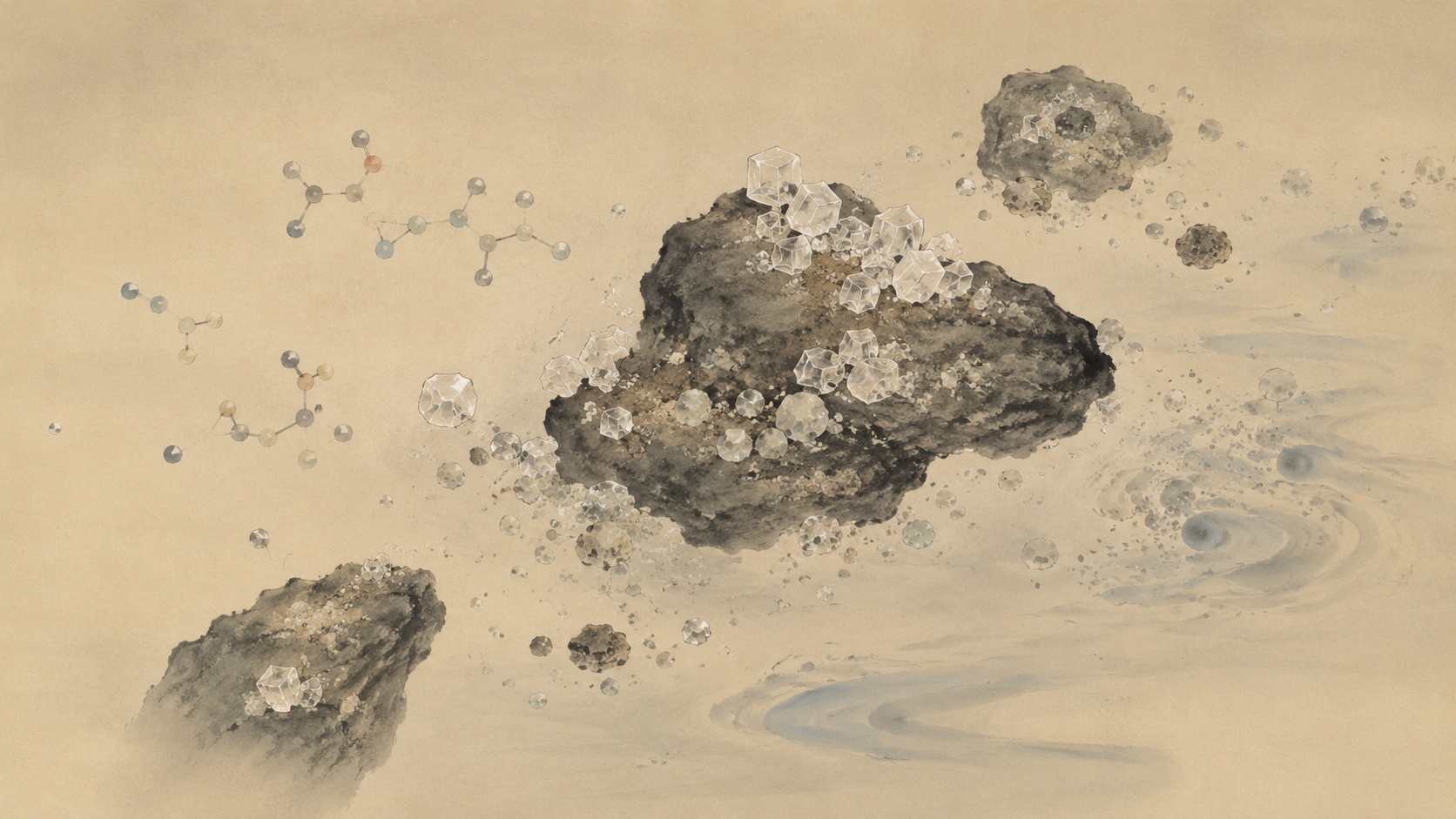
A speck of asteroid dust has preserved a scene from the end of an ancient water cycle. Researchers led by Toru Matsumoto of Kyoto University's Hakubi Center and Graduate School of Science examined material returned from asteroid Ryugu and found several forms of nitrogen tied spatially to sodium-rich salts. The study, published in Nature Astronomy on August 27 and described in a Japanese-language release from Ehime University on September 3, reports ammonium-bearing phyllosilicates, carbon-nitrogen triple-bond species and sodium nitrate associated with sodium carbonate.
The importance is not simply that Ryugu's ancestor once held liquid water. Years of sample analysis had already established extensive water-rock alteration. The new work focuses on what happened near the end: as liquid disappeared through freezing, evaporation or related redistribution, the remaining solution became a concentrated brine. Sodium salts precipitated. Nitrogen species became enriched around them. A small asteroid parent body, in other words, may have acted not only as a container for organic ingredients but as a chemical concentrator.
A record of the water that was left at the end
Today's Ryugu is a roughly kilometer-scale rubble-pile near-Earth asteroid assembled from fragments. The chemistry in its returned grains points back to a larger precursor body that formed from ice-rich, carbon-rich material in the early Solar System. Internal heating melted some of that ice. Water reacted with rock and produced abundant hydrated clay minerals, carbonates, magnetite, sulfides and other phases now preserved in the samples.
That wet phase did not last forever. As the body cooled and its water inventory diminished, dissolved ions became increasingly concentrated. This “last water” is scientifically valuable because late-stage brines can record chemical processes that are easy to erase. On Earth, many of the salts involved are highly water soluble. In meteorites that have sat in soil or rain, they can be altered or lost before a laboratory ever sees them.
In 2024, Matsumoto and colleagues reported sodium carbonates, chlorides and sulfates in Ryugu grains and argued that alkaline, highly saline water had once moved through the parent body before becoming concentrated by freezing or evaporation. Separate work on magnesium carbonates and cation chemistry also reconstructed the evolution toward sodium-rich late fluids. The 2026 study asks the next question: what happened to nitrogen while that brine was concentrating?
Not one form of nitrogen, but several
The answer is chemically richer than the shorthand phrase “ammonia in an asteroid.” The peer-reviewed paper reports ammonium-bearing phyllosilicates, C≡N-bearing species and sodium nitrate, all spatially associated with sodium carbonate. Ehime University's Japanese release explains the broader interpretation in terms of ammonia and multiple nitrogen compounds gathered around water-soluble salts.
Ammonia and ammonium matter, but they are not interchangeable. Ammonia is NH3; in water it can accept a proton and become ammonium, NH4+. The authors infer that reactive ammonia and C≡N-bearing material were incorporated when the parent body formed and persisted through its aqueous history. Near the end of that history, ammonium was incorporated into clay minerals and other nitrogen species became concentrated as the brine disappeared and sodium carbonate precipitated.
The team combined infrared spectroscopy, X-ray spectroscopy and electron microscopy. A key specimen was the sodium-carbonate-rich Ryugu grain C0071. Infrared absorption identified characteristic molecular vibrations. Nitrogen K-edge near-edge X-ray absorption fine structure — NEXAFS — helped distinguish nitrogen bonding environments. Electron microscopy supplied the mineral context. The strength of the argument is therefore spatial as well as chemical: the forms of nitrogen occur where the late-stage salt record says they should.
What the grain preserves
| Phase or species | What it records | Why it matters |
|---|---|---|
| Ammonium-bearing phyllosilicates | NH4+ incorporated into hydrated clay minerals | A mineral reservoir capable of preserving reactive nitrogen |
| C≡N-bearing species | Carbon and nitrogen linked by a strong triple bond | Potential feedstock for prebiotic organic synthesis |
| Sodium nitrate | A nitrogen-bearing salt associated with sodium-rich phases | Evidence for nitrogen concentration and late-fluid chemistry |
| Sodium carbonate | A major water-soluble salt in the analyzed grain | A marker of concentrated, disappearing alkaline brine |
Why losing water can make chemistry more interesting
Water enables chemistry, but abundant water can also dilute it. If a finite reservoir freezes or evaporates, species that remain in solution are crowded into a smaller volume. The everyday analogue is salt left behind as a puddle dries. Inside a primitive asteroid, the consequences can be more complex: ions, ammonia-related species and organic molecules that had been dispersed through a watery matrix can become locally concentrated in residual pockets.
The new paper argues that nitrogen enrichment in those residual brines could have increased the frequency of intermolecular organic reactions. It also raises the possibility of dehydration-driven polymerization as water activity declined. That is not evidence that polymers necessary for life were actually produced in the analyzed grain. It is a mechanism that makes their formation more chemically plausible under the reconstructed conditions.
Concentration is a central problem in origin-of-life chemistry. A planetwide ocean contains enormous amounts of material, but its very size can dilute reactants. Researchers therefore examine settings — drying ponds, ice veins, mineral surfaces, hydrothermal systems — where molecules can meet repeatedly at higher concentration. Ryugu adds a very different natural setting: a small carbonaceous body in which a waning internal brine may have solved part of the same physical problem.
It is how nature concentrated and stored the chemicals that make pre-life reactions possible.
From amino acids to all five canonical nucleobases
The brine result lands in a fast-moving sequence of discoveries from the same precious sample collection. In 2022, JAXA and participating teams reported extensive aqueous alteration, abundant organic matter and amino acids in material that had been protected from direct terrestrial exposure. The unusually clean provenance matters: meteorite studies must constantly separate extraterrestrial chemistry from contamination acquired after falling to Earth.
In 2023, a Hokkaido University-led team detected uracil — one of RNA's nucleobases — and vitamin B3 in Ryugu. Then, in March 2026, Yasuhiro Oba and colleagues reported all five nucleobases used by terrestrial DNA and RNA: adenine, guanine, cytosine, thymine and uracil. They also found related compounds including 6-methyluracil, useful evidence that the molecular inventory reflects abiotic chemistry rather than a neat biological recipe.
The new nitrogen study complements those molecule inventories. Instead of asking only “what organic compounds are present?”, it asks “what environment could keep feeding nitrogen into organic chemistry?” Ammonia and cyanide-related species are chemically important precursors. If late-stage brines gathered them into concentrated pockets, the parent body had both ingredients and a physical process for bringing those ingredients together.
Hayabusa2's decisive advantage was provenance
Hayabusa2 launched from Tanegashima on December 3, 2014 and arrived at Ryugu on June 27, 2018. It sampled the asteroid during touchdowns on February 22 and July 11, 2019, including material associated with the mission's artificial-crater experiment. The spacecraft released its sample-return capsule in December 2020; the capsule landed in Australia on December 6.
JAXA's extraterrestrial sample curation facility measured 5.424±0.217 grams of Ryugu material, far beyond the mission's minimum requirement of 0.1 gram. Five grams sounds trivial until one considers the scale of planetary materials science. Modern spectroscopy and microscopy can extract mineral structures, isotopes, organics and chemical bonding from particles only tens or hundreds of micrometers across.
More important than mass is chain of custody. These grains came from a known asteroid, at known sampling events, inside a controlled return system. JAXA's curation procedures preserved material in conditions designed to minimize terrestrial alteration, and a portion remains archived for future generations of instruments. Water-soluble salts make the value of that approach obvious: the same grains arriving naturally as meteorites might have lost exactly the fragile chemical evidence now driving the brine story.
Dec. 2014: Hayabusa2 launches.
June 2018: The spacecraft arrives at Ryugu.
Feb. & July 2019: Two touchdown sampling operations.
Dec. 2020: The return capsule lands; JAXA later measures about 5.4 g of sample.
2022: Initial analyses report extensive aqueous alteration, organics and amino acids.
2023: Uracil and vitamin B3 are detected.
2024: Water-soluble sodium salts establish evidence for highly saline late-stage fluids.
March 2026: Researchers report all five canonical nucleobases in Ryugu material.
Aug.–Sept. 2026: Nitrogen-bearing clays and multiple nitrogen species are tied to the late brine stage.
A bridge from Ryugu to Ceres
The authors extend the implications beyond asteroids. The dwarf planet Ceres is known from spectroscopy and NASA's Dawn mission to contain ammonium-bearing phases and abundant salts, and models have long considered subsurface brines and cryovolcanic transport. The new paper suggests that concentrated brines on such ammonium- and salt-rich icy bodies could likewise have been favorable sites for nitrogen-related organic chemistry.
The comparison is powerful precisely because the worlds are different. Ryugu today is not an ocean world. Its returned grains are fragments of an older parent body whose water is long gone. Ceres is much larger and may preserve brine reservoirs even now. If both display related signatures of ammonium, salts and aqueous processing, scientists can start asking which chemical pathways are universal consequences of water-rich primitive material and which depend on a body's size, temperature and history.
There are limits. The studied grains are tiny, and a local salt pocket cannot by itself establish uniform conditions throughout the parent body. The exact temperature, pH, redox state, lifetime and geometry of the final brine remain areas for further reconstruction. Nor does a spatial association prove every reaction pathway proposed for prebiotic chemistry actually occurred.
The next step: connect the mineral map to the organic map
The working narrative is now unusually concrete. Nitrogen-rich material was incorporated into the parent body. Water altered rock and organic matter. As that aqueous system faded, a residual brine became sodium-rich. Sodium carbonate precipitated. Nitrogen species concentrated and some ammonium became locked in clay. That late chemical environment could have brought reactive compounds into closer contact and sustained nitrogen sources for organic synthesis.
The missing link is reaction-by-reaction proof. Future work can ask whether specific amino acids, nucleobases or larger organic molecules sit in the same microscopic neighborhoods as the nitrogen-bearing salts and clays; whether their isotopic signatures share a history; and whether laboratory simulations of Ryugu-like brines reproduce the molecular suite actually found in the returned samples.
This is why curation is a scientific strategy, not storage. Hayabusa2 returned a finite archive from an ancient world. JAXA deliberately preserved part of it for techniques that did not exist when the capsule landed. A grain that looked like black dust in 2020 can become, six years later, a chemical map of ammonium, cyanide-related species and evaporating brine.
The origin of life is often framed as a search for a spectacular molecule or a single decisive environment. Ryugu offers a quieter lesson. Before biology, chemistry had to solve mundane problems: obtain carbon and nitrogen, keep them from being lost, move them through water, concentrate them, and let them react. A microscopic salt deposit from an asteroid is compelling because it records one way nature may have done exactly that.
Sources
- Ehime University, “Traces of concentrated brine linked to life's ingredients in Ryugu grains” — September 3, 2026; Japanese primary release for the new study.
- Matsumoto et al., “Ammonium-bearing clays and multiple nitrogen species linked to the late-stage brines of Ryugu’s parent body,” Nature Astronomy — August 27, 2026.
- Kyoto University, discovery of salt crystals in Ryugu grains — November 21, 2024.
- Kyoto University, chemical evolution of primitive brines and Mg carbonates in Ryugu — September 6, 2024.
- Hokkaido University, detection of all five canonical nucleobases in Ryugu samples — March 17, 2026.
- JAXA/ISAS, Hayabusa2 mission record — official launch, arrival, sampling and return chronology.
- JAXA Astromaterials Science Research Group, Ryugu sample curation — sample handling and measured mass.
- JAXA, initial Ryugu analysis and amino-acid findings — June 2022.
This report was checked against public sources available by 2:27 AM JST on September 4, 2026, prioritizing Japanese university and JAXA primary materials for Japanese names, titles and technical terminology. It distinguishes ammonia (NH3) from ammonium (NH4+) and centers the specific species directly reported in the paper: ammonium-bearing phyllosilicates, C≡N-bearing species and sodium nitrate. “Ingredients for life” and “prebiotic” refer to chemical feedstocks and possible reaction environments; they do not indicate the detection of life or prove direct delivery into the origin of terrestrial life.
Image rights: © 2026 Japan.co.jp. AI-assisted editorial illustration. Unauthorized republication or reuse is prohibited. For licensing, use the contact page.