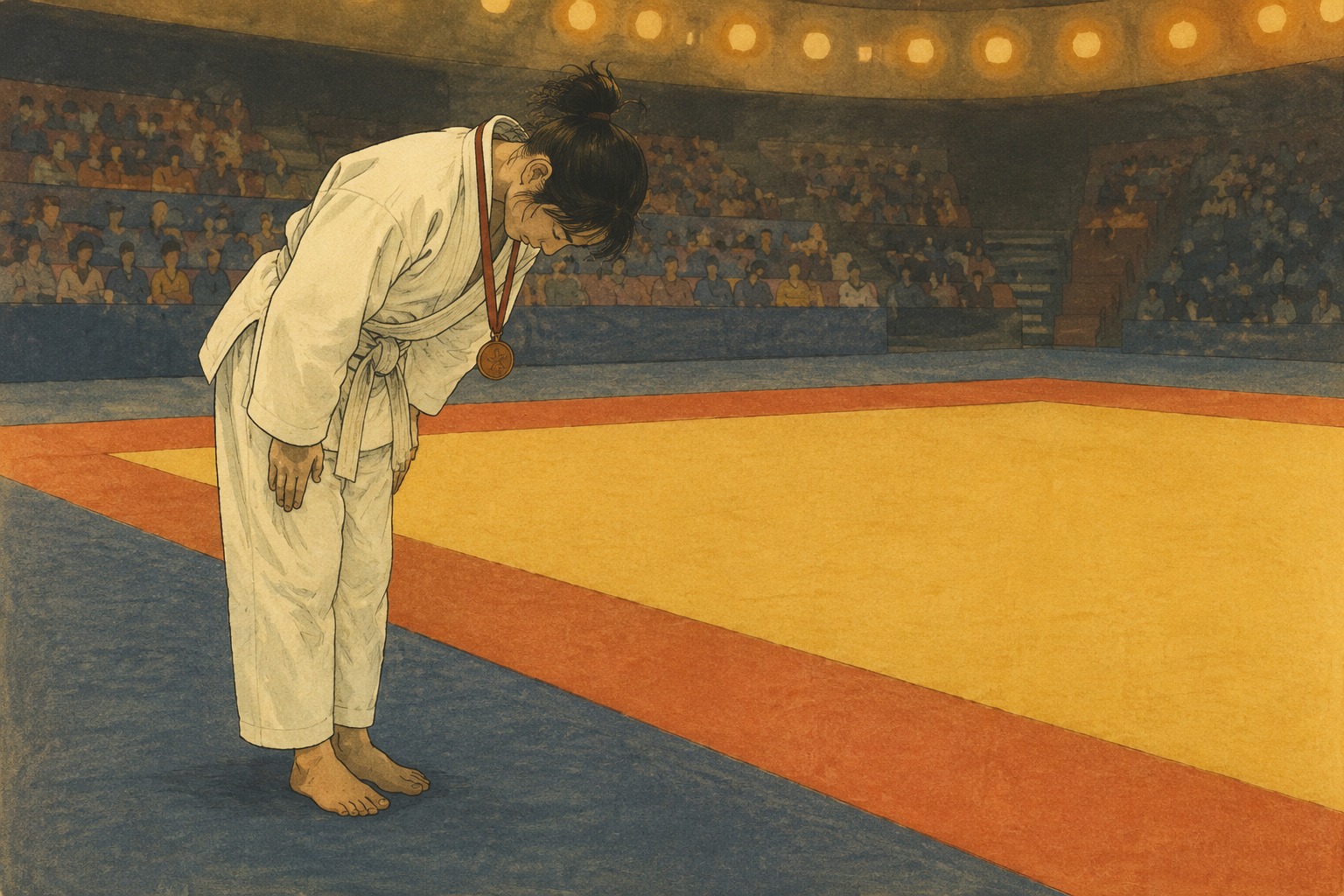
Rio Shirogane’s attempt to defend her world cadet title ended in the semifinal. Her tournament did not. The Japanese 52 kg judoka returned to the tatami in Guayaquil, Ecuador, and defeated Italy’s Matilda Mariello by ippon to take bronze.
According to Shirogane’s school, she beat Brazil’s Lavinia Igaki by yuko in her opening bout and Portugal’s Sofia Gaspar by ippon in the quarterfinal. Kseniia Kyrylchuk of Ukraine beat her by yuko in the semifinal. The school and the All Japan Judo Federation do not identify the decisive techniques in their published 2026 summaries, so this article does not reconstruct them.
A medal viewed through the shadow of gold
Shirogane arrived as the defending individual champion. At Sofia in 2025 she won her first two bouts by yuko, then finished four consecutive opponents by ippon from the third round through the final. She also belonged to the Japanese team that won the mixed-team competition.
That history makes bronze look like decline if medals are treated as a linear performance chart. Cadet judo is not so simple. These athletes are still growing; bodies, weight management, gripping patterns and technical options change. A semifinal defeat is a defeat, and the repeat title was lost. The bronze bout nevertheless required Shirogane to compete again after that loss and finish the day with a win.
From Okayama to consecutive world podiums
Japanese federation records list Shirogane as a third-year student at Soshi Gakuen High School in Okayama, born March 18, 2009, and holding first dan. In September 2025 she was selected for the federation’s C-strengthening, or junior, category after winning the cadet world title.
Okayama City awarded her the Hitomi Kinue Sports Honor special sports award following her 2025 individual and team gold medals. In remarks published by the school at that ceremony, she said she wanted to achieve more domestically and win again internationally. That was a 2025 statement, not a reaction to the Guayaquil bronze.
After the 2026 national high-school championships, the school said she had resumed training in pursuit of a second cadet world title. She did not reach that stated objective. Recording that difference matters more than converting every medal into promotional triumph.
What “cadet” means in Japanese judo
Cadet is an international age category that does not align perfectly with Japan’s middle-school and high-school calendar. Japanese federation material describes it as centered on ages 15 to 17; under the applicable formulation, athletes are at least 15 and under 18 at the end of the competition year.
The mismatch has affected domestic selection. The federation discontinued its standalone All-Japan Cadet Weight Category Championships after discussing schedule collisions with high-school events and the difficulty of fitting the international age band to Japan’s school system. Results from events such as the Inter-High and national middle-school championships now help feed the development structure.
International exposure can be valuable, but the cadet label can also encourage premature Olympic narratives. Naohisa Takato competed at the inaugural world cadets and later became Olympic champion. That example shows what is possible; it does not establish a predictable route for Shirogane or any other teenage medalist.
A 457-athlete championship
The International Judo Federation lists 457 individual competitors from 59 nations and five continents in Guayaquil: 245 boys and 212 girls. The women’s 52 kg field contained 31 judoka, one of the larger women’s categories. Its contests were scheduled on the second day of the August 20–22 individual event.
The numbers demonstrate reach, not equal development conditions. Japan has a dense school, university and corporate judo structure. It also asks teenage athletes to navigate international selection, domestic championships, education and physical growth. A cadet medal is one international comparison, not a table ranking entire national systems.
What a four-line result cannot show
The school summarizes Shirogane’s day as yuko win, ippon win, yuko loss and ippon win. Ippon ends the contest. Yuko is a scoring classification under the current international rules. Neither term alone tells a reader which technique was used, how gripping exchanges developed, whether penalties mattered or who controlled most of a bout.
Without detailed official records or a technical review of complete video, it would be irresponsible to diagnose the semifinal loss or declare a technical transformation. The verifiable record consists of opponents, scoring classifications, final placing and the documented comparison with 2025. Narrative color cannot substitute for evidence.
The value of an unfinished story
Shirogane returned to the championship as the athlete others could measure themselves against. She left without retaining the title but with a second consecutive individual world medal. That is not a completed story of overcoming adversity. It is a teenage athlete’s record containing both wins and a loss.
The next question is not whether she protected a cadet label. It is how her judo develops as her body changes and the field deepens through junior and senior competition. Guayaquil bronze cannot answer that. Like Sofia gold, it is one result inside a career whose decisive stages have not yet happened.
- All Japan Judo Federation: 2026 World Cadet Championships
- Soshi Gakuen: Shirogane’s 2026 bout summary
- International Judo Federation: Guayaquil event and participation statistics
- All Japan Judo Federation: 2025 World Cadet Championships
- All Japan Judo Federation: junior strengthening roster
- Soshi Gakuen: Okayama City sports award
- All Japan Judo Federation: discussion of cadet age and selection
Editorial note: Japan.co.jp did not interview Shirogane, her school, the federations or her opponents. The decisive techniques, bout times, penalties and technical assessments for her 2026 contests were not verified in the Japanese primary material and are omitted. Opponent spellings follow the school release. “Rio Shirogane” follows the international event listing.