- The future of testing may depend on everything around the molecule
- Millions of tiny wells turn molecules into countable events
- A benchtop laboratory, automated from sample to result
- What the infection study actually found—and why the numbers vary
- How the pandemic helped build the platform
- The cancer promise—and the missing clinical evidence
- From national research to a clinical product
- A one-dollar chip is not a one-dollar medical test
- The next milestone will be trust, not another speed record
The future of testing may depend on everything around the molecule
A modern laboratory can detect astonishingly small quantities of biological material. The harder task is making that sensitivity routine. A sample must be prepared without losing its target, reagents dispensed with precision, microscopic reactions imaged, and signals distinguished from noise. Every manual step creates another opportunity for inconsistency. A group led by Japan’s RIKEN has built a tabletop machine intended to bring much of that sequence into one automated workflow.
The platform, called COWFISH2A+, was announced by RIKEN on October 2, 2026, alongside a peer-reviewed paper in Cell Reports Physical Science. A November 20 Science Japan report brought fresh attention to its relevance for liquid biopsy. The research announcement and the subsequent article are separate events: this is a newly highlighted development, not a discovery first made on November 20.
The most important distinction is what has been shown. The team demonstrated highly sensitive analysis of molecules and rapid tests using respiratory specimens. Researchers envision cancer and dementia applications, but the current study did not establish a clinically validated cancer-screening test.
Millions of tiny wells turn molecules into countable events
Digital bioanalysis divides a liquid sample into vast numbers of microscopic chambers. Instead of measuring only an averaged signal across a bulk fluid, scientists can read individual reaction compartments as positive or negative and infer how much target material was present. It is a powerful strategy for sparse biomarkers, provided background signal, assay chemistry and statistical assumptions are properly controlled.
The RIKEN group designed arrays containing roughly a million tiny chambers. Its disposable open-type chips do not depend on elaborate enclosed microfluidic channels. Liquid is dispensed from above, then sealed for measurement. A manufacturing approach adapted from compact-disc injection molding is intended to make the consumables reproducible and inexpensive.
The peer-reviewed study describes chip manufacturing costs of approximately US$1. That is not an all-in price for a patient test. Reagents, collection materials, technicians, quality controls, machine amortization and clinical interpretation remain separate costs. The advance is the combination of sensitive measurement with a potentially more accessible manufacturing and operating model.
A benchtop laboratory, automated from sample to result
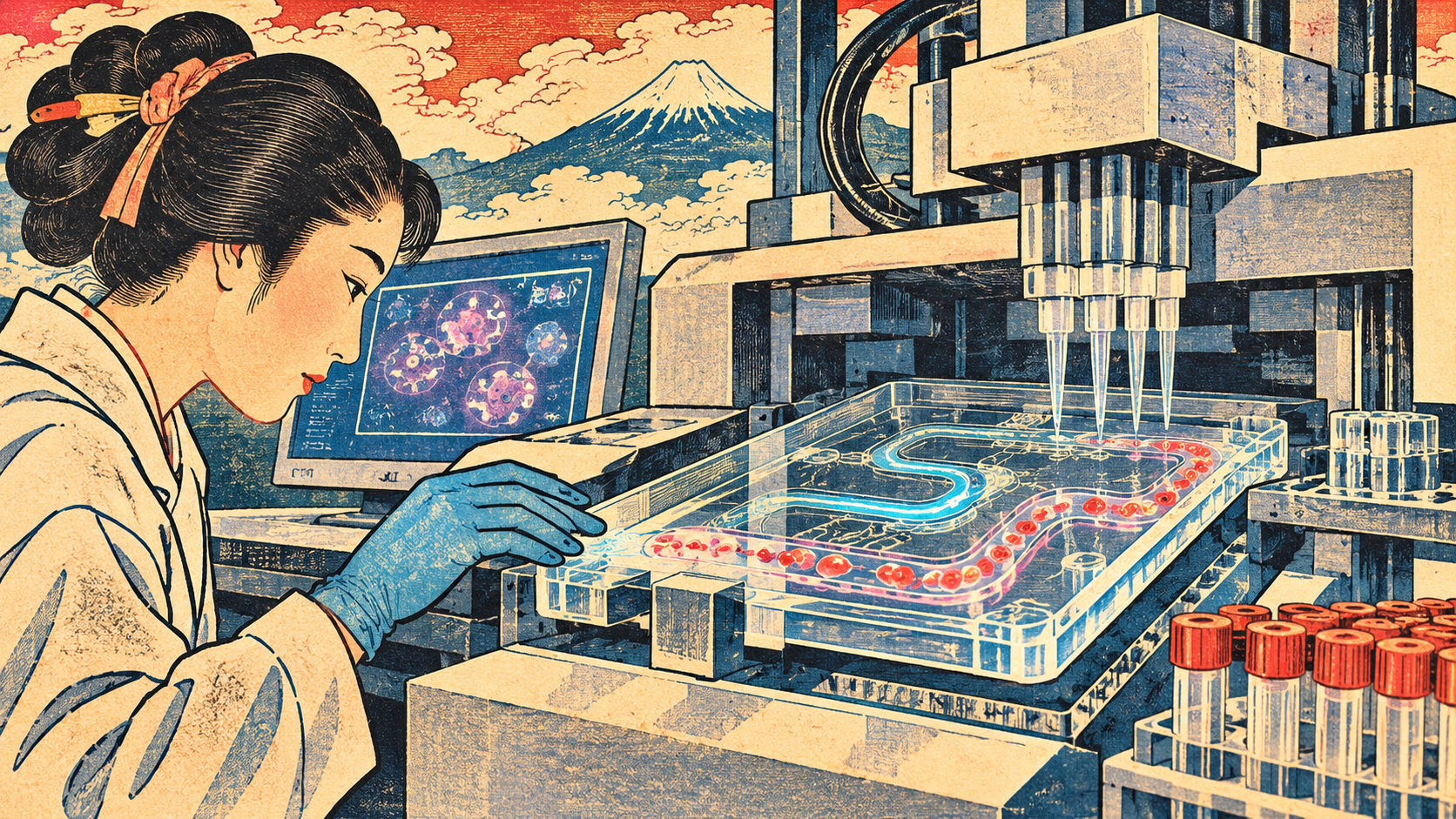
COWFISH2A+ combines sample pretreatment, temperature and magnetic controls, a four-nozzle liquid-distribution mechanism, wide-field fluorescence imaging and software for machine operation and signal analysis. The published device measures approximately 50 by 45 by 57 centimeters and weighs about 40 kilograms—compact enough for a laboratory bench or use in an appropriate biosafety cabinet, though hardly a handheld consumer device.
The machine can handle magnetically assisted purification, mix reagents, distribute liquid across the microchambers, capture images and process the resulting digital signals. Its significance lies partly in the reduction of highly trained manual handling between stages, a longstanding barrier to scaling single-molecule methods.
Automation is not the same as eliminating clinical expertise. Sample quality, contamination control, calibrations, instrument maintenance, result interpretation and local laboratory validation still matter. A platform capable of producing numbers rapidly has to demonstrate that those numbers remain trustworthy across operators, sites and patient populations.
What the infection study actually found—and why the numbers vary
RIKEN’s October 2 announcement described results in about 15 minutes with sensitivity and specificity both around 90% for a rapid respiratory-testing evaluation. The underlying paper offers a more specific result: direct testing of 159 clinical specimens for SARS-CoV-2, producing an answer in approximately 20 minutes, with 92% sensitivity and 85% specificity. The two summaries should not be collapsed into a single identical test result without matching their timing and study definitions.
Sensitivity measures how often a test detects a genuinely positive specimen; specificity measures how often it correctly identifies a negative one. Under comparable conditions, 92% sensitivity could miss roughly eight of every hundred positives, while 85% specificity could incorrectly label roughly fifteen of every hundred negatives. These are illustrative rates, not the actual clinical mix of the 159 specimens or a forecast of results in every population.
The paper itself cautions that specificity in direct swab testing was below what is usually sought for definitive molecular diagnosis. Background signals associated with direct testing, and the need to refine sample preparation and signal thresholds, are plausible issues. The strongest immediate positioning is a rapid screening approach that needs further refinement and validation, not a drop-in replacement for all established molecular tests.
How the pandemic helped build the platform
The current machine sits at the intersection of several research programs rather than appearing from nowhere. Rikiya Watanabe’s laboratory investigated the SATORI method for amplification-free pathogen detection during the COVID-19 period. RIKEN published progress on sensitive viral detection in 2021, portable and automated designs in 2022, and a simplified Direct-SATORI approach in 2023.
The group also pursued different molecular signals: single-enzyme activity, altered biochemical signatures associated with pancreatic cancer and Raman-based discrimination of biomarkers relevant to dementia research. Work reported in 2024 and 2025, and a May 2026 study of blood enzyme activity for potential pancreatic-cancer detection, helped expand the range of assays scientists might eventually place on a common instrument.
This history does not imply all those diagnostic ideas have already been validated on COWFISH2A+ in patients. Rather, the reusable platform provides an engineering route by which distinct single-molecule assays might move beyond specialist laboratory demonstrations.
The cancer promise—and the missing clinical evidence
Liquid biopsy is a broad term for analyzing disease-related signals in a body fluid rather than relying only on an invasive tissue sample. Depending on the condition, the relevant clue might be tumor-derived DNA, RNA, a protein, or an enzyme with unusual activity. The appeal is obvious: repeated sampling could become easier, especially when a disease leaves only a faint molecular trace.
In the present paper, the machine demonstrated a digital enzyme assay that can distinguish forms of alkaline phosphatase at single-molecule sensitivity, along with pathogen-focused nucleic-acid tests. These are analytical achievements. They do not answer whether the machine can identify an early-stage cancer in a diverse clinical population or avoid false alarms in healthy people.
For a real cancer-screening claim, researchers would need to define who should be tested, validate biomarkers in independent cohorts, compare results with accepted standards, assess false positives and negatives, and demonstrate that acting on the results improves care. Pancreatic cancer in particular illustrates how difficult the gap between an intriguing biomarker and a reliable population-level screening strategy can be.
From national research to a clinical product
RIKEN worked with the Tokyo Metropolitan Institute for Geriatrics and Gerontology, BIOTEC Co., Ltd., Institute of Science Tokyo, Kyoto University and Isumi Medical Center. The original announcement names chief scientist Rikiya Watanabe and technical staff member Tatsuya Iida among the leaders. The team combined molecular science, instrument engineering, clinical samples and domestic chip manufacturing.
Commercialization is being pursued initially for laboratory-developed tests, or LDTs, which are developed and validated within testing institutions. Specialist Japanese reporting said BIOTEC began accepting orders in October, while Science Japan’s November 20 account described a planned sale price around ¥7 million. The public records reviewed do not establish verified delivery numbers, final maintenance contracts or pricing for every consumable.
The prototype is not equivalent to a broadly approved in-vitro diagnostic device for all the conditions researchers hope to study. Regulatory pathways, intended use, local validation and clinical responsibility still have to be addressed. Those distinctions are especially important when coverage moves from a laboratory achievement to claims about diagnosis.
A one-dollar chip is not a one-dollar medical test
The project also has an industrial-policy dimension. During the pandemic, Japan faced the vulnerabilities of relying on overseas supply chains for some laboratory equipment and consumables. Developing domestic instrumentation and disposable chips can improve resilience, although it does not guarantee independence from every imported component. Support included Japan Science and Technology Agency CREST funding and the Cabinet Office’s BRIDGE program.
A hospital considering a ¥7 million instrument will ask questions that do not fit neatly into a research abstract: how many specimens can it process in a shift, what controls are required, what does a complete test cost, how often does the machine need service, how are operators trained, and can results be reimbursed or acted upon immediately?
There may be very different use cases in a major reference laboratory and a regional hospital that needs fast answers for a handful of urgent patients. Making each microchip cheaper is useful, but the economics ultimately depend on clinical demand, total workflow expense and reliability—not the most eye-catching component price.
The next milestone will be trust, not another speed record
The technology has moved from exceptionally small experimental chambers toward a self-contained analytical platform. Yet the critical next step is external validation: separate institutions testing real-world specimens, comparing results against appropriate standards and documenting performance when the device is operated routinely rather than under research conditions.
For respiratory infections, that includes how often rapid answers are wrong and when confirmatory testing is necessary. For cancer, the questions are harder: whether a biomarker identifies the disease early enough to matter, who is eligible for testing and whether follow-up procedures produce more benefit than harm. None of those outcomes can be inferred from the claim of single-molecule sensitivity alone.
RIKEN’s achievement is best understood as enabling infrastructure. It is not a declaration that cancer has become easy to diagnose. The most meaningful story will unfold when a technology that can count molecular events proves that those counts improve decisions for actual patients.
Sources, method and limitations
Based on the October 2 RIKEN announcement, the peer-reviewed primary paper, the November 20 Science Japan report and earlier laboratory publications. We did not independently rerun the clinical analysis, evaluate the equipment or interview the team. Commercial deliveries, regulatory approval and clinical cancer-detection performance remain unverified.
- 理化学研究所:2026年10月2日研究発表 / RIKEN official research release (Oct. 2, 2026)
- 飯田龍也氏ら:Cell Reports Physical Science原論文 / Peer-reviewed research paper
- 科学技術振興機構・Science Japan:2026年11月20日記事 / November 20 report
- 理化学研究所:2026年5月、膵がんの酵素活性研究 / Pancreatic cancer biomarker research
- 理化学研究所:2025年、1分子デジタルSERS法 / Single-molecule SERS
- 理化学研究所:渡邉分子生理学研究室・研究の歩み / Laboratory history
- 理化学研究所:2023年Direct-SATORI法 / Direct-SATORI development