Enterprise AI is often described in enormous language: generative AI, AI agents, transformation, DX, AX. But inside a real company, the first questions are smaller and more stubborn. Which system will it connect to? How can we test it without breaking the core business? Where does the data live? How much will the cloud cost? Who will operate it after the demo ends?
On May 11, 2026, Serverworks, an AWS Premier Tier Services Partner, announced a capital and business alliance with Ragate, a Tokyo company specializing in serverless development and generative AI. Serverworks acquired part of Ragate’s outstanding shares and said the agreement also contemplates a future full subsidiary structure. Ragate issued its own announcement the same day, framing the deal as a way to combine its AI and serverless expertise with the larger customer base of the Serverworks group.
The story is not about a flashy foundation model. It is about the implementation layer. Ragate was founded in 2017 with the mission of “popularizing the latest technology.” Its work has centered on full serverless development on AWS, generative AI, IT strategy consulting, and IT due diligence for M&A. Serverworks, meanwhile, is one of Japan’s better-known cloud integrators, with a record of supporting cloud adoption and operations for more than 1,540 companies.
In other words, this is a merger of two things Japanese enterprises need: a specialist that can build modern AI systems quickly, and a larger cloud partner that already has access to the customers, operations, security expectations, and procurement pathways that make enterprise AI real.
What was announced: serverless and generative AI move into the enterprise stack
According to the announcement, Serverworks is an AWS Premier Tier Services Partner, while Ragate has deep expertise in serverless and generative AI. The stated goal is to accelerate enterprise AI transformation, or AX, from both AWS and Google Cloud angles.
Ragate describes itself as an AWS Advanced Tier Services Partner that has developed expertise in full serverless development on AWS and generative AI. Its work also reaches beyond engineering into IT strategy consulting and IT due diligence for mergers and acquisitions. That matters because enterprise AI is not just a software problem. It is a business-architecture problem.
Serverworks brings something different: scale, customer access, and operational credibility. It has helped more than 1,540 companies adopt and operate cloud systems. Through G-gen, the group also has a Google Cloud channel. As AI systems become more multi-cloud and model-agnostic, that broader cloud posture becomes more valuable.
What serverless really means
“Serverless” is an easy term to misunderstand. Servers still exist. What changes is the burden of managing them. Instead of provisioning machines, sizing capacity, patching operating systems, and running infrastructure around the clock, companies compose applications from managed services and event-driven functions.
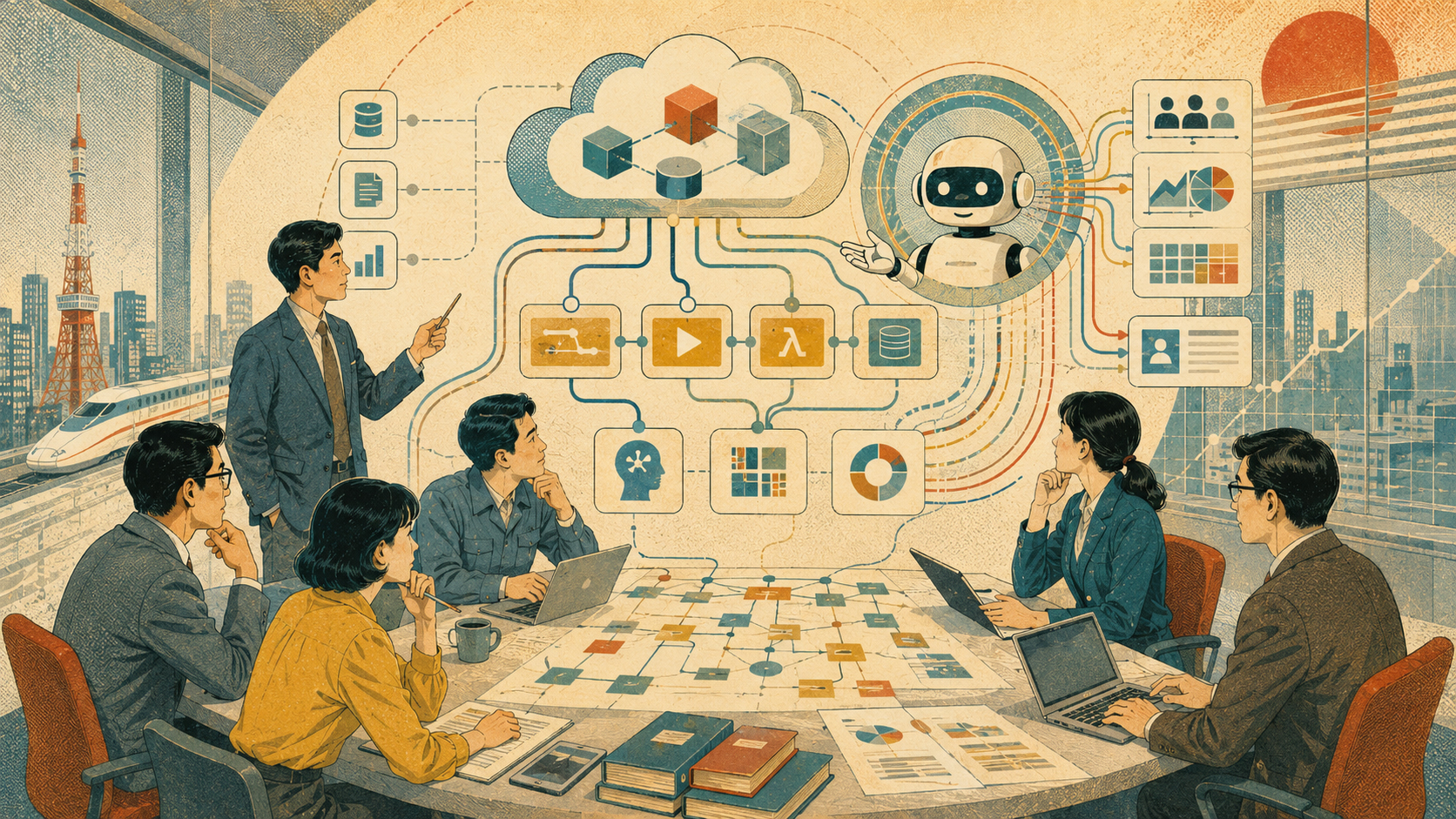
That approach fits the AI era. A generative-AI workflow is often made of small pieces: ingest a document, classify it, retrieve relevant passages, call a model, summarize an answer, request approval, log the event, and send the result back into a business system. These pieces do not always need to live inside a single monolithic application. They can be assembled from cloud services.
As AI agents become more practical, serverless thinking becomes even more important. Agents are not only answering questions. They are calling APIs, reading databases, routing tasks, updating records, and triggering approvals. The small, modular structure of serverless systems maps naturally onto the action units of AI agents.
Why 2017 matters: the cloud-native systems integrator
Ragate’s founding year is part of the story. By 2017, cloud in Japan was moving from an option to a baseline. AWS Lambda, API Gateway, DynamoDB, managed databases, infrastructure as code, and later managed AI services were changing what enterprise software could be. The cloud was no longer just a place to rent servers. It was a new design philosophy.
Traditional systems integration often meant long requirements cycles, dedicated servers, heavy operations, and large sequential projects. The cloud-native generation thinks differently: build smaller, test faster, scale only when needed, and replace weak parts without tearing down the whole system. Ragate’s mission language reflects that shift.
Generative AI makes that shift more urgent. Companies usually cannot define the perfect AI system in advance. They discover the best workflows through experimentation. Which data works? Which department has the most repeatable task? Which approvals are required? Which user behavior creates risk? A serverless and cloud-native approach makes that experimentation lighter.
Serverworks as the enterprise doorway
Serverworks has built its position around helping companies adopt and operate AWS. For large and mid-sized customers, cloud adoption is not just a technical migration. It involves architecture, monitoring, cost management, security, internal education, and often a cultural shift in how IT teams work.
That is why the Ragate alliance matters. Many companies are interested in generative AI but do not know how to move beyond a pilot. Serverworks already has the trusted cloud relationship. Ragate brings the specialized ability to build AI and serverless systems. Together, they can aim at the gap between experiment and production.
Serverworks’ group exposure to Google Cloud through G-gen also matters. Enterprise AI is becoming a multi-cloud field. A company may use AWS for core workloads, Google Cloud for data and AI services, Microsoft for office productivity, and multiple external language models depending on the task. The integrator that can navigate this complexity will have an advantage.
Moving past PoC fatigue
One of the recurring problems in enterprise AI is PoC fatigue. Companies run demonstrations. They test chatbots. They hold workshops. They prove that AI can answer a question. Then the project stalls because production requires security, permissions, data cleaning, monitoring, budget control, user training, and accountability.
The Ragate-Serverworks alliance appears aimed at that exact gap. Ragate can build smaller, practical AI systems around the workflow. Serverworks can provide the cloud operating base, customer access, and implementation trust. If the partnership works, it turns AI from a demo into a managed business service.
This is less glamorous than a new model launch, but it may be more commercially important. By 2026, executives no longer need to be convinced that generative AI is impressive. They need systems that comply with internal rules, use approved data, leave logs, respect access controls, have predictable costs, and actually help employees do work.
RAG, agents, and serverless: the new enterprise triangle
One of the key concepts in enterprise generative AI is RAG: retrieval-augmented generation. Instead of asking a model to rely only on its general knowledge, a RAG system retrieves company-specific documents or data and uses that information to ground the response.
RAG sounds simple, but production RAG is a system of many parts: ingestion, chunking, indexing, embeddings, search, permissions, answer generation, logging, evaluation, updating, and audit. These are exactly the kinds of components that can be built as serverless services. AWS has promoted serverless RAG patterns using services such as Lambda, Bedrock, S3, Step Functions, DynamoDB, and search infrastructure.
AI agents add another layer. Instead of only retrieving documents, the AI may create an application, send a notification, update a CRM record, draft a contract clause, or escalate an approval. That makes serverless orchestration more relevant. The future enterprise AI stack is not one giant brain; it is a chain of small, governed actions.
Timeline: from cloud to AI transformation
| Period | Meaning |
|---|---|
| 2006 | AWS began expanding commercial cloud infrastructure as a mainstream computing model. |
| 2014 | AWS Lambda helped popularize serverless architecture. |
| 2017 | Ragate was founded, focusing on AWS-based full serverless development and modern front-end systems. |
| 2022 | Generative AI moved into public use and enterprises began testing AI workflows seriously. |
| 2024–2025 | RAG, agents, and multi-cloud AI architecture became core enterprise themes. |
| 2026 | Serverworks and Ragate announced a capital and business alliance to connect AI implementation with cloud adoption. |
Japan.co.jp view
This is one of the most practical stories in the AI edition. From outside, it looks like a cloud integrator taking a stake in a smaller specialist. From inside the enterprise, it looks like a sign that Japanese AI adoption is entering the production stage.
The first act of generative AI was about who could build the strongest model. The second act is about who can connect AI to work safely, cheaply, quickly, and without breaking the company. Ragate has the serverless and AI implementation skill. Serverworks has the enterprise cloud base and customer trust. The combination is not loud, but it is strategically sensible.
Japan’s AI revolution will not be built only by giant model companies, chipmakers, or headline investors. It will also be built by the implementers who connect AI to accounting, sales, manufacturing, legal, HR, customer support, and internal knowledge. Ragate and Serverworks are a reminder that the next phase belongs to the builders of the enterprise stack.
Reader takeaways
| Question | Answer |
|---|---|
| What happened? | Serverworks acquired part of Ragate’s shares and announced a capital and business alliance. |
| What is Ragate good at? | Full serverless development on AWS, generative AI, IT strategy consulting, and IT due diligence. |
| What does Serverworks bring? | AWS Premier Tier status, cloud adoption and operation experience with more than 1,540 companies, and a wider group cloud channel through G-gen. |
| Why does it matter? | Enterprise AI is moving from pilots and chat demos into production systems that need cloud architecture, governance, cost control, and operations. |
| What is the strategic signal? | Serverworks is strengthening its ability to deliver AI transformation, with a future full subsidiary path also mentioned in the announcement. |
Sources and references
This article was based on announcements from Serverworks and Ragate, AWS materials, and generative AI market context.