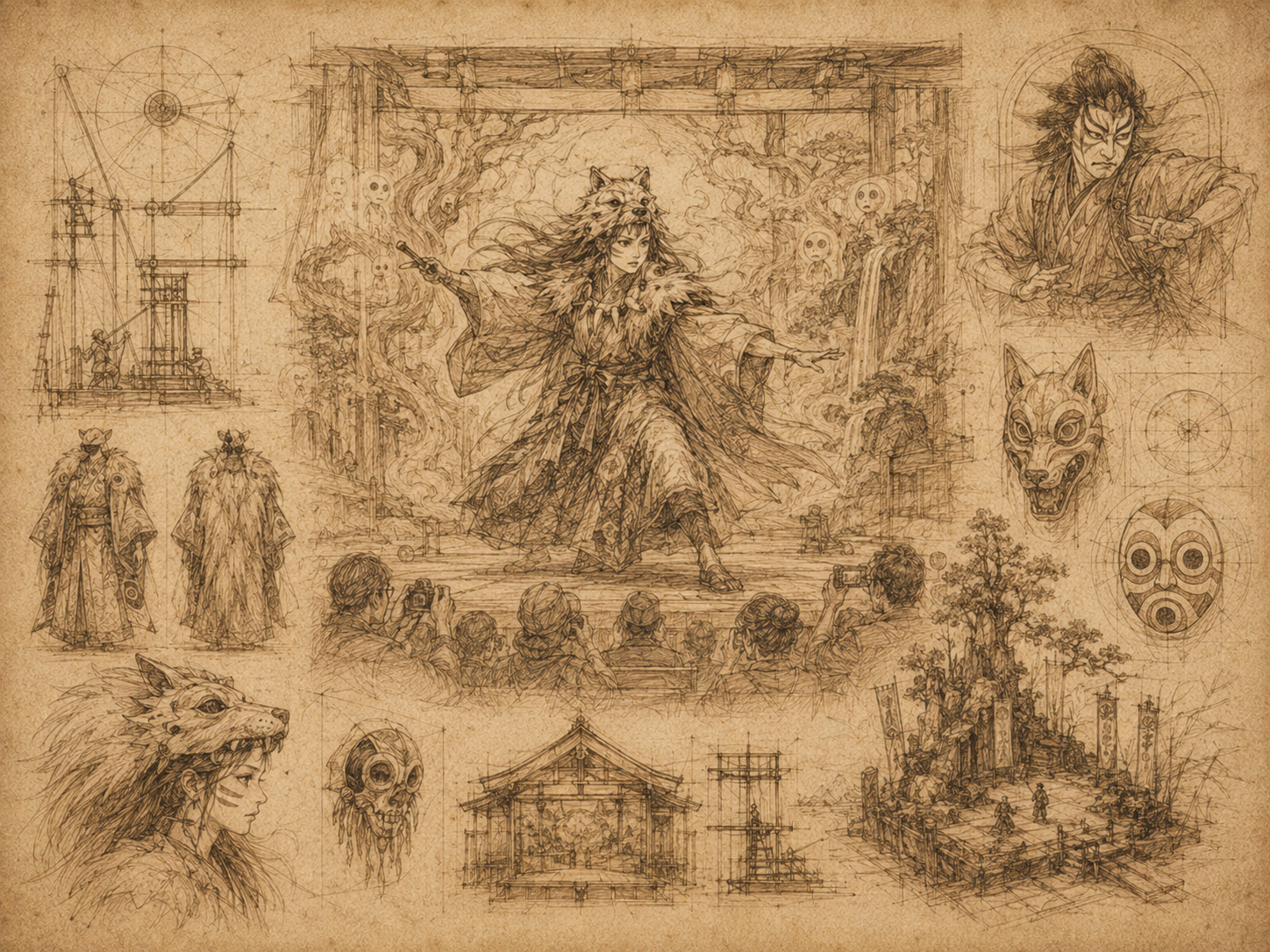
In Tokyo’s Shinbashi Enbujo Theatre, the forest has become a stage. Super Kabuki “Princess Mononoke,” which opened on July 3, 2026, is not merely another adaptation of a beloved anime. It is a cultural translation: Hayao Miyazaki’s 1997 film, born in hand-drawn animation, is being reimagined through kabuki’s bodies, poses, music, costumes, spectacle and theatrical memory.
That matters because “Princess Mononoke” was already a work of cultural excavation. The film reached back into an older Japan of forests, gods, ironmaking, outcasts, disease, violence and uneasy coexistence. Yet its questions were never antique. What does industry owe nature? Can a community save the vulnerable while destroying the world around it? Is a forest a resource, a god, a home, or all three?
Now the story is moving into Super Kabuki. Anime is not simply borrowing the prestige of traditional theatre. Kabuki is absorbing anime into its own dramatic bloodstream. This is not just cultural export. It is cultural recirculation.
What is happening
According to the official production site, Super Kabuki “Princess Mononoke” runs at Tokyo’s Shinbashi Enbujo Theatre from July 3 to July 30 and from August 1 to August 23, 2026. Tickets range from ¥3,000 for third-floor B seats to ¥18,000 for box seats, with a U-30 same-day discount available when seats remain.
KABUKI WEB’s English listing describes the production as a Super Kabuki staging of the Studio Ghibli film, with matinee performances at 11 a.m. and evening performances at 4 p.m. It notes that no English supporting guide is available, but that detailed English synopses are included at the end of the Japanese program. In other words, this is already being positioned as a show that can interest both domestic Ghibli fans and international visitors in Tokyo.
The cast includes Ichikawa Danko as Ashitaka and the Forest Spirit, Nakamura Kazutaro as San, Nakamura Tokizo as Lady Eboshi, Ichikawa En’ya as Jiko, Ichikawa Emisaburo as Moro, and Ichikawa Chusha as Lord Okkoto. The production draws on Miyazaki’s original story, Joe Hisaishi’s music and Studio Ghibli’s cooperation, but its stage vocabulary belongs to kabuki.
Why “Princess Mononoke” mattered
“Princess Mononoke” opened in Japan on July 12, 1997. At the time, it was more than a new Studio Ghibli release. It was a national movie event: large, expensive, grave, violent, ecological and morally complex. It was not a cute children’s fantasy. It was a story of blood, iron, disease, desire, forest gods and political survival.
Commercially, it changed the map. Nippon.com’s box-office ranking of Studio Ghibli films places “Princess Mononoke” second after “Spirited Away,” with ¥20.2 billion in Japanese box office including revival screenings. In its original run, it helped prove that animation could occupy the center of Japanese cinema, not merely a family niche.
It also made awards history. In 1998, “Princess Mononoke” became the first animated film to win the Japan Academy Film Prize for Picture of the Year. Before “Spirited Away” won Berlin’s Golden Bear and the Academy Award for Animated Feature, “Mononoke” had already forced Japan’s own film establishment to acknowledge animation as cinema at the highest level.
What Super Kabuki is
Super Kabuki began in 1986, when Ichikawa Ennosuke III, later Ichikawa En’ō II, premiered “Yamato Takeru.” It kept kabuki’s music, mie poses, stylized fighting, costumes, onnagata technique and visual codes, but added modern spectacle, contemporary storytelling, new stage machinery, aerial movement, lighting, sound and speed.
That was not a rejection of tradition. It was an attempt to recover kabuki’s original energy as popular theatre. Kabuki grew out of Edo-period urban culture. It absorbed fashion, scandal, romance, revenge, ghosts, commerce, politics and laughter. It became classical later. At birth, it was volatile, topical and hungry for audiences.
That is why “Princess Mononoke” is an unusual choice and a natural one at the same time. Super Kabuki has always asked how old theatrical technique can carry new stories. “Mononoke” gives it a story large enough for spectacle, symbolic enough for stylization and emotionally direct enough for a new audience.
Kabuki and anime are closer than they look
Kabuki and anime appear distant. One is live theatre; the other is drawn image. One belongs to the playhouse; the other to cinema, television and streaming. Yet both move audiences through stylized bodies.
A kabuki mie freezes time. An anime key pose does the same. Kumadori makeup marks emotion and character on the face. Anime character design uses line and color to communicate personality instantly. Kabuki combat is not realistic violence; it is rhythm, shape and controlled exaggeration. Anime action also depends on timing, stillness, acceleration and expressive distortion.
“Princess Mononoke” is especially compatible with kabuki. Ashitaka is a cursed young traveler, a natural stage hero. San stands between human and beast, woman and spirit, anger and loneliness. Lady Eboshi is not a simple villain but a charismatic leader, industrialist, protector and destroyer. The Forest Spirit, Moro and Okkoto are not merely characters; they are theatrical presences waiting for a stage language.
How can kabuki stage Miyazaki’s forest?
In the film, the forest is not scenery. It is a character. It breathes through light, moss, silence, movement and death. Animation can build that world through background art, sound design, stillness and microscopic motion. Theatre must use other tools.
Super Kabuki’s advantage is that it does not need to reproduce the forest literally. It can conjure its presence through sound, lighting, costume, ensemble movement, curtains, shadows, flying effects, rapid transformations and choreography. The audience does not need to see a real forest. It needs to feel that the forest has entered the theatre.
Kabuki has long known how to stage seas, snow, ghosts, foxes, dragons, flames and supernatural transformations with stylized means. Even when the machinery is elaborate, the emotional force comes from the actor’s body and the theatrical code. If “Mononoke’s” forest works onstage, it will work not as visual realism but as performed nature.
Lady Eboshi and the hardest moral problem
One of the most modern figures in “Princess Mononoke” is Lady Eboshi. She destroys the forest, but she also gives work, pride and protection to people who have been pushed outside respectable society. If she becomes merely a villain, the story collapses.
On the official production site, Nakamura Tokizo describes Eboshi as a figure of charisma, warmth toward her followers and cold decisiveness when required. That balance is the challenge. The stage must let audiences understand San’s fury and Eboshi’s logic at the same time.
Kabuki has a long tradition of powerful women: women of passion, strategy, loyalty, vengeance and sacrifice. Eboshi can enter that lineage. But for a 2026 audience, she also resembles a corporate leader, a community builder, an industrial reformer, an environmental threat and a social protector all at once. That is why she is so alive now.
Ghibli tourism and a Tokyo night out
The production also matters as tourism. Many visitors now build Japan itineraries around anime, manga, games and film. The Ghibli Museum in Mitaka remains a tightly reserved destination, and Ghibli Park in Aichi has an overseas ticket page that explicitly reminds visitors that park tickets and museum tickets are separate. Demand is global enough that the logistics themselves require explanation.
But Super Kabuki “Princess Mononoke” is different from a pilgrimage to an anime location. Here, the fictional work comes to the traditional theatre. A visitor in Tokyo can experience Ghibli and kabuki in the same evening, near Ginza, Tsukiji and Shimbashi, in a venue that connects pop culture with live performance.
That is an important model for cultural tourism. As Japan debates overtourism, the question is not only how many people come, but how deeply they engage. If a Ghibli fan enters kabuki through “Mononoke,” and then becomes curious about Edo theatre, shamisen music, onnagata performance or stagecraft, anime tourism becomes cultural education.
Japan’s exported culture returns home
Japanese culture in recent years is often discussed as export. Anime streams globally. Games launch worldwide. Films travel through festivals and platforms. Studio Ghibli is now part of world visual culture, and Hayao Miyazaki’s name belongs not just to Japan but to cinema history.
Super Kabuki “Princess Mononoke” moves in the opposite direction as well. A globally beloved anime returns to a Japanese theatre and is reshaped by an older performance system. Culture does not move in one direction. What is exported can come home transformed and then be seen again by the world.
“Princess Mononoke” is particularly suited to that circulation. Nature versus industry, myth versus modernity, youth, exile, female leadership, community, war and regeneration are global themes. But the tatara ironworks, mountain gods, curses, forest presence and kabuki form remain deeply Japanese. The production is international and local at the same time.
Why Mononoke now?
Japan in 2026 is under pressure. Tourism is booming. The yen remains weak. Cities face heat and crowding. Rural areas face depopulation. Companies talk about AI, chips, wages and competitiveness. Climate, labor, culture and infrastructure are all in motion.
“Princess Mononoke” speaks directly to that mood. Protecting the forest alone does not feed people. Making iron alone destroys the world. A community that saves the vulnerable can still harm nature. Justice is not singular. Ashitaka’s instruction to see with “eyes unclouded” remains the moral center of the story.
That is why this production feels more than nostalgic. It asks whether tradition can carry contemporary conflict, whether anime fans can become kabuki audiences, whether tourism can deepen into cultural attention, and whether Japan can keep telling old stories in forms that feel dangerous, alive and new.
Japan.co.jp’s view
Japan.co.jp sees this production as a confluence. One river is kabuki, flowing from Edo popular theatre through UNESCO-recognized intangible heritage and modern stage innovation. Another river is anime, flowing from postwar animation into global pop culture. Into the confluence come tourism, Tokyo, young audiences, international fans, environmental anxiety and the business of culture.
Strong culture is not merely preserved. It changes shape. It risks criticism. Traditionalists may ask why anime belongs in kabuki. Anime fans may ask why Ghibli should become kabuki. But that tension is the point. New audiences are born at the friction line.
“Princess Mononoke” changed Japanese cinema in 1997. In 2026, its Super Kabuki version may not change kabuki by itself, but it can change the distance between traditional performance and pop culture. The forest gods have come to Shinbashi Enbujo. In the middle of a Tokyo summer, old Japan and new Japan are standing on the same stage.
Reader guide
| Item | Details |
|---|---|
| Production | Super Kabuki “Princess Mononoke” |
| Venue | Shinbashi Enbujo Theatre, Tokyo |
| Dates | July 3–30 and August 1–23, 2026 |
| Main cast | Ichikawa Danko, Nakamura Kazutaro, Nakamura Tokizo, Ichikawa En’ya, Ichikawa Emisaburo, Ichikawa Chusha and others |
| Historical meaning | A major Ghibli film enters Super Kabuki in the 40th anniversary year of the form’s 1986 debut. |
| Tourism meaning | A possible bridge from anime fandom to live traditional performance and deeper Japanese cultural travel. |
Sources and references
This article draws on the official Super Kabuki “Princess Mononoke” site, KABUKI WEB’s Shinbashi Enbujo listings, Nippon.com’s Studio Ghibli box-office data, UNESCO and kabuki reference material, and official Ghibli Museum / Ghibli Park visitor information.
- Official Super Kabuki “Princess Mononoke” site: schedule, cast, staff, tickets and introduction.
- KABUKI WEB: July program at Shinbashi Enbujo Theatre.
- KABUKI WEB: August program at Shinbashi Enbujo Theatre.
- Nippon.com: Studio Ghibli box-office ranking.
- UNESCO: Kabuki theatre intangible cultural heritage listing.
- Ghibli Park: Overseas ticket guidance.
- Ghibli Museum: Advance reservation information.