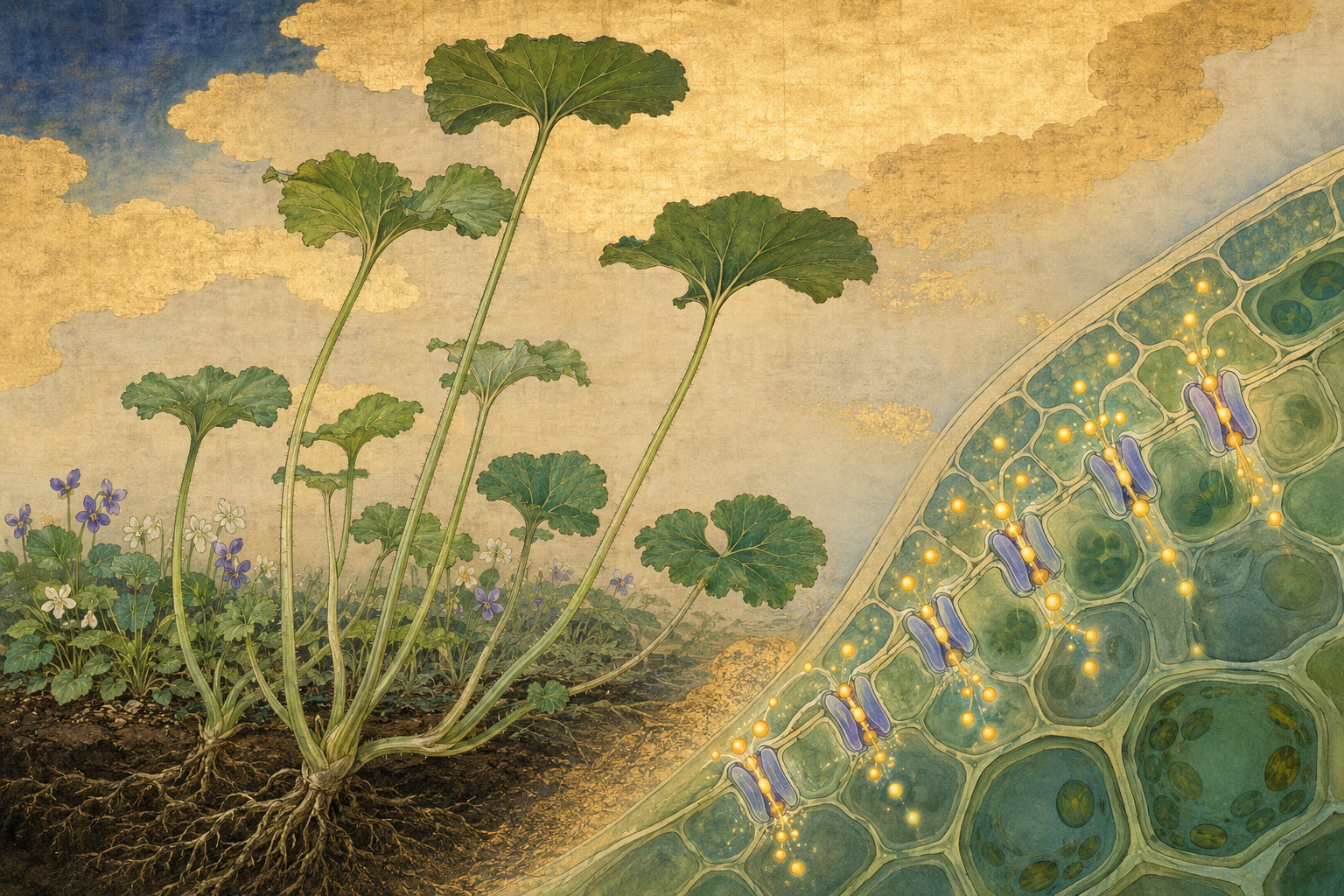
A leaf does not merely face the light; it must reach it. In a crowded rosette, neighboring blades overlap, shadows deepen and a few millimeters of stalk can decide which leaf keeps collecting the energy needed for growth. New research identifies a molecular gate that helps make that reach possible.
A large international team led by Tohoku University has demonstrated that AKT5, a protein encoded by the model plant Arabidopsis thaliana, is a working voltage-dependent potassium-ion channel. The study links the channel to elongation of the petiole—the narrow stalk joining a leaf blade to the stem—and to better growth when plants are packed together.
The finding closes a gap that had remained open for more than three decades. AKT5 belonged to a well-studied family of plant potassium channels, yet previous attempts had not established its transport activity or physiological job. The researchers found that the apparent silence was conditional: AKT5 becomes active after phosphorylation, a chemical modification that changes the protein's conformation.
The paper, led by assistant professor Yuki Muraoka and corresponding author professor Nobuyuki Uozumi of Tohoku University's Graduate School of Engineering, appeared in Science Advances on September 2, 2026, corresponding to 3:00 a.m. on September 3 in Japan. The collaboration included researchers at Tohoku University, the National Institute for Physiological Sciences, Institute of Science Tokyo, Tokyo University of Agriculture and Technology, Wageningen University and institutions in Spain and Germany.
A molecular gate that needed the right key
Potassium is one of the three macronutrients routinely paired with nitrogen and phosphorus in plant nutrition. It is not built into sugars or proteins in the same way those elements are. Instead, potassium ions act as mobile electrical charges and osmotic solutes. They help regulate water balance, enzyme activity, photosynthesis, stomatal movement and cell expansion.
Cell membranes, however, do not allow charged ions to cross freely. Channel proteins form selective pathways through the membrane. Some open or close in response to voltage or biochemical signals, letting potassium move down an electrochemical gradient. That movement changes both electrical state and water relations inside a cell.
AKT5 had the sequence hallmarks of a Shaker-type potassium channel, but resemblance was not proof of transport. The team expressed AKT5 in an animal-cell system and initially detected no current. Activity appeared only when a protein kinase was introduced. The kinase adds a phosphate group to the channel, and the resulting potassium movement could be measured as electrical current.
The published abstract describes phosphorylated AKT5 as an inward-rectifying channel activated at strongly hyperpolarized membrane potentials. In plain language, the channel is biased toward bringing potassium into the cell when the membrane's electrical conditions are sufficiently negative. The work therefore turns AKT5 from a sequence-based candidate into a channel with directly observed transport behavior.
Structure reveals how the lock moves
Electrophysiology showed that ions moved. Cryo-electron microscopy helped explain how. By rapidly freezing purified protein and reconstructing images from electron data, the researchers determined structures for AKT5 in a closed state and for a modified form approaching an open state.
AKT5 assembles as a tetramer—four protein subunits surrounding a central ion pathway—with the familiar architecture of functional potassium channels. The decisive experiment focused on aspartate at amino-acid position 403. Replacing that residue with alanine produced a large structural rearrangement and allowed transport even without phosphorylation.
The result does not mean Asp403 alone is the complete switch. It provides structural evidence that changes around this position are central to the transition from an inactive conformation toward one capable of conduction. The paper's combination of electrical recording and structural snapshots is important: either technique alone would leave more room between molecular shape and physiological interpretation.
The evidence chain
- Activity: AKT5 produced measurable potassium current after kinase-dependent phosphorylation.
- Architecture: Cryo-electron microscopy resolved a canonical four-subunit channel in closed and pre-open conformations.
- Location: AKT5 expression was concentrated in young petioles.
- Loss of function: Plants lacking AKT5 developed shorter petioles and compact rosettes.
- Competition: Under crowded growth, AKT5-deficient plants accumulated less biomass than normal plants.
From potassium entry to a longer leaf stalk
A petiole must be rigid enough to support a leaf yet responsive enough to adjust its position as the plant grows. The study found AKT5 predominantly expressed in young petioles, the tissue in which elongation is actively occurring. Loss-of-function plants showed strongly suppressed petiole elongation across the day-night cycle and formed more compact rosettes.
The proposed physical link is osmosis. When AKT5 brings potassium into petiole cells, the higher solute concentration can draw in water and increase turgor pressure. In a cell wall that is able to yield, turgor drives expansion. Repeated across many cells, that expansion lengthens the petiole and lifts the leaf blade into a more favorable light environment.
This explanation is supported by the channel's transport direction, its tissue expression and the mutant phenotype. It remains a mechanistic interpretation rather than a measurement of every intermediate step in a field-grown crop. The researchers say further work is needed to understand how AKT5 is regulated inside plants and how its activity interacts with other growth signals.
Competition begins before plants touch
Plants detect neighbors through changes in the quantity and quality of light. Leaves absorb red wavelengths while reflecting or transmitting more far-red light, so a declining red-to-far-red ratio can announce nearby vegetation before severe shading occurs. Many species respond by adjusting leaf angle, petiole length or stem growth—a suite of responses often called shade avoidance.
The AKT5 study adds an ion-transport mechanism to this ecological story. In uncrowded conditions, a compact plant can still expose much of its leaf area. In dense stands, shorter petioles allow neighboring leaves to overtop one another. The researchers found that plants without AKT5 became smaller and accumulated less biomass than normal plants under crowding, consistent with impaired access to light.
That result is why the discovery concerns competition rather than appearance alone. AKT5 did not simply alter rosette geometry; losing it carried a growth penalty in the environment where petiole reach mattered most. The study does not establish that longer is always better. Excess elongation can consume resources, weaken architecture or push leaves into the shade of taller neighbors. Useful crop design would require an optimum, not maximum extension.
Three decades from channel genes to channel function
The history begins with a technological shift. In 1992, researchers cloned the Arabidopsis potassium channel gene AKT1 and showed that it could restore potassium transport in yeast. Together with KAT1 work from the same period, this helped establish that plant cells possess voltage-dependent potassium channels related to the Shaker family first characterized through genetics in fruit flies.
The field then expanded from sequence to physiology. A 1998 reverse-genetics study showed that disruption of AKT1 reduced root potassium uptake, connecting a specific channel to whole-plant mineral nutrition. In 2000, the Arabidopsis Genome Initiative published the first comprehensive genome analysis of a flowering plant, cataloguing 25,498 protein-coding genes in the original assembly and accelerating systematic work on gene families.
Yet gene inventories create their own unfinished list. Arabidopsis has nine major Shaker-type potassium channels, and most acquired clear functions in roots, guard cells, vascular tissue or pollen. AKT5 resisted assignment. A 2002 study classed AKT5 among channel relatives whose behavior could not be inferred simply by expressing each subunit alone. The 2026 work resolves that long-standing case by identifying the activation condition and following the channel's effects up through organ growth and competitive performance.
1992: AKT1 and KAT1 help establish the first generation of cloned plant voltage-dependent potassium channels.
1998: Reverse genetics connects AKT1 to potassium uptake and plant nutrition.
2000: The Arabidopsis Genome Initiative publishes the flowering plant's reference genome analysis.
2002: Comparative work highlights silent or functionally unresolved Shaker-family subunits, including AKT5.
2026: Phosphorylation-dependent AKT5 current, structure, petiole expression and crowded-growth phenotype are joined in one study.
The agricultural promise—and the distance to a crop
The practical appeal is easy to see. More plants per square meter can raise output only until competition reduces the performance of each plant. If leaf positioning could be tuned so that a dense canopy intercepts light efficiently without wasting carbon on excessive elongation, breeders might gain another lever for controlled-environment agriculture or field architecture.
Petiole tissue is itself marketable in vegetables including celery, Swiss chard and komatsuna. In Tohoku University's English release, Uozumi suggested that regulating related activity could eventually help tailor the size and texture of edible stalks. That is a research direction, not a demonstrated product. The 2026 experiments did not modify those crops, measure taste or texture, test disease resistance, or report commercial yield.
Translation will also require evidence that crop homologs behave like Arabidopsis AKT5. A channel may be conserved yet expressed in different cells, activated by different kinases or constrained by plant architecture. Altering potassium flux can affect stomata, nutrient balance and stress responses. A change that helps under one planting density or lighting regime may be neutral or costly under another.
There are several possible routes: conventional selection for naturally useful alleles, gene editing, tissue-specific changes in expression, or chemical control of the regulatory pathway. None follows automatically from the present paper. Researchers first need to identify the in-plant kinase or kinases that regulate AKT5 under normal conditions and establish when, where and how strongly the channel should be active.
What comes next
Five questions now opened by the discovery
- Upstream signal: Which kinase activates AKT5 in petiole cells, and what environmental cue controls it?
- Full mechanism: How does phosphorylation reshape the channel around Asp403 during a complete opening cycle?
- Crop conservation: Do AKT5-like channels govern petiole growth in celery, leafy brassicas and other crops?
- Agronomic optimum: Can leaf positioning improve dense-canopy yield without sacrificing stability, nutrient efficiency or stress tolerance?
- Food quality: If edible petioles are changed, what happens to texture, flavor, fiber and shelf life?
AKT5 is a reminder that an annotated genome is not the same as a finished understanding of life. Scientists knew the gene, recognized the channel-like sequence and could compare it with relatives. What was missing was the correct activating condition—and then the experimental bridge from ions, to cells, to a leaf stalk, to a plant facing competition.
That bridge is the durable achievement of the study. It does not yet prescribe a denser farm. It shows how a precisely regulated potassium gateway can alter plant form at the place where light is won or lost. The next phase is to learn whether that mechanism can be tuned in crops without disturbing the many other jobs potassium performs.
Primary research and documents
- Muraoka et al., “AKT5 is a bona fide potassium channel and controls petiole growth in Arabidopsis”, Science Advances 12, eaeh7630 (2026), DOI: 10.1126/sciadv.aeh7630.
- Tohoku University Graduate School of Engineering, Japanese research release — September 3, 2026; names, affiliations, methods, terminology, funding and stated implications.
- Tohoku University, English research release — September 3, 2026; English explanation and Uozumi's crop-development remarks.
- National Institute for Physiological Sciences, Japanese release — Collaborating institutions, researcher titles and technical definitions.
- Hirsch et al., “A role for the AKT1 potassium channel in plant nutrition”, Science 280 (1998) — reverse-genetic evidence linking AKT1 with root potassium uptake.
- Reintanz et al., “AtKC1, a silent Arabidopsis potassium channel α-subunit...”, PNAS 99 (2002) — historical Shaker-channel classification and silent-subunit context.
- The Arabidopsis Genome Initiative, “Analysis of the genome sequence of the flowering plant Arabidopsis thaliana”, Nature 408 (2000) — genome-era context.
- Sentenac et al., “Cloning and expression in yeast of a plant potassium ion transport system”, Science 256 (1992) — early AKT1 history.
Reporting note: This report is based on material available through 6:30 a.m. JST on September 5, 2026. The paper and Japanese institutional releases were used to verify names, titles, affiliations and specialist terminology. Agricultural applications are identified as possibilities, not proven crop outcomes. The Japanese and English editions were written independently.
Image rights: © 2026 Japan.co.jp. This AI-assisted editorial illustration may not be reproduced or reused without permission. For licensing, visit the contact page.