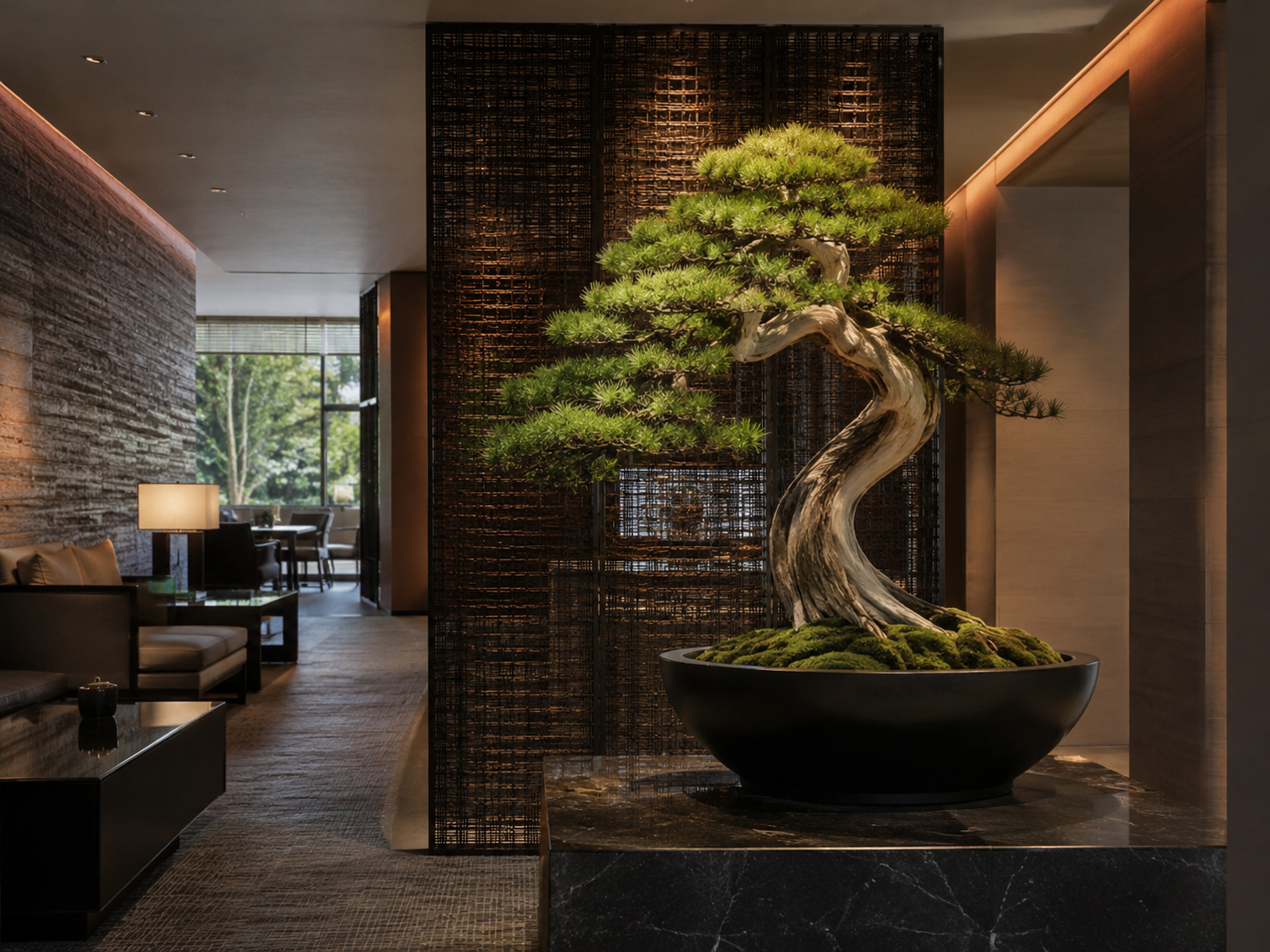
Tokyo hotels are often described by height: what floor the lobby sits on, how far the view reaches, whether Tokyo Tower glows in the window, whether Mount Fuji appears on a clear winter morning. Park Hotel Tokyo, high above Shiodome, has offered a quieter kind of hotel news. It has installed a reborn bonsai artwork called “WITHERS TAIZAN BONSAI,” made from bonsai that had withered, been cleaned, dried, preserved and reconstructed into a new artistic form.
A withered tree returns inside a Tokyo hotel
According to Park Hotel Tokyo’s announcement, the work was installed in cooperation with TAIZAN under the theme of a new sustainable form of Japanese cultural rebirth. The idea is simple and powerful: withered bonsai that might otherwise be discarded are collected, cleaned, dried, reconstructed and combined with preserved plant materials. The result is not a living bonsai in the usual horticultural sense. It is a sculpture of time.
That is why the story belongs in a “Best Hotels in Japan” issue. Many hotels decorate with flowers. Some install seasonal branches, lobby paintings or polished design objects. Park Hotel Tokyo is doing something more Japanese and more contemporary: it is turning an object at the end of its natural life into a new hospitality experience. The guest does not just see a beautiful tree. The guest sees care, memory, waste avoided, time honored and imperfection treated as value.
The paradox of “wabi-sabi luxury”
The press release uses the phrase “Wabi-Sabi Luxury.” At first, the phrase sounds like a contradiction. Wabi-sabi values imperfection, impermanence, quietness, weathering and the beauty of things that have changed. Luxury is often sold as polish, newness, precision and flawless service. But in Japan’s best hospitality spaces, those two ideas can live together.
Real luxury is not only price. It is time. It is the ability to slow down. It is the presence of materials with depth, objects with stories, and spaces that do not shout. Old wood, a slightly asymmetric branch, a handmade vessel, stone under soft light, a view that changes with weather. When those things are edited carefully, the guest is not merely sleeping in a room. The guest is staying inside a culture.
Why Park Hotel Tokyo is an art hotel
Park Hotel Tokyo describes its concept as “Infinite time and space amid cognizant Japanese beauty.” The hotel has long treated art not as an accessory, but as a form of hospitality. Its best-known expression is the Artist Rooms project, where artists paint directly on the walls and ceilings, turning rooms into immersive works. Themes have included sumo, Zen, washi, the Tokaido road, sushi and many other windows into Japanese culture.
This changes what a hotel stay can mean. In a museum, the visitor looks at art. In an art hotel, the guest sleeps inside it. Walking through the corridor, sitting in the lounge, waking up to a painted wall, noticing a detail beside the bed — all of those moments become part of a loose exhibition. The reborn bonsai belongs naturally to that philosophy. At Park Hotel Tokyo, art is not something hung after the design is finished. Art is one of the languages of the hotel.
Why bonsai became a Japanese symbol
Bonsai has roots in the older Chinese traditions of penjing and potted landscapes, but it developed in Japan through Buddhist, literati and Zen-influenced culture. Over centuries, it moved from elite and religious circles into broader Japanese life. By the Edo period, miniature trees in pots had become a refined pursuit among samurai, townspeople and collectors. In the modern era, bonsai became one of the Japanese art forms most recognized around the world.
Bonsai is small, but it is not merely a small tree. It is a concentration of landscape and time. A twisted trunk may suggest a pine clinging to a cliff. Weathered bark may imply decades of wind. A careful gap between branches may suggest emptiness, air and patience. Viewers do not admire bonsai only for miniature scale. They admire the way it makes deep time visible in a limited space.
That is why the idea of reborn bonsai has emotional force. Bonsai has always been about cultivated time. When a bonsai dies, the shape still carries memory: the trunk, the branch line, the human touch, the years of pruning and waiting. To reconstruct it as art is not a gimmick. It is an extension of the same respect for time.
Not discarded, but handed forward
Reborn bonsai art is not the same as simply preserving a dead plant. The process involves cleaning, drying, reassembly and the use of preserved plant materials. It is closer to cultural succession than recycling. It reduces waste, but it also keeps visible the time someone once gave to a tree.
Sustainability in hotels is often discussed through energy, plastics, water use, food waste and sourcing. Those things matter. Yet cultural sustainability matters too. A hotel can preserve not only resources, but meaning. It can keep old forms alive by reinterpreting them. Park Hotel Tokyo’s bonsai installation shows that environmental thinking does not have to look technical or moralistic. It can look quiet, poetic and beautiful.
Why Shiodome matters
Park Hotel Tokyo sits in Shiodome, one of Tokyo’s layered urban zones. Nearby are Shimbashi, Ginza, Tsukiji, Hamarikyu Gardens and Tokyo Bay. The area carries traces of Edo waterways, Meiji railways, postwar business, and late-20th-century redevelopment. From the hotel, guests look out over a city of movement: trains, towers, roads, lights and offices.
Placing bonsai in that setting creates a powerful contrast. Bonsai does not hurry. A trunk does not age overnight. Moss does not obey a schedule. The line of a branch can take years to form. For a traveler staying in one of Tokyo’s busiest business-and-culture corridors, the bonsai offers a different clock. It slows the room down.
An art hotel has to be more than photogenic
Around the world, art hotels, boutique hotels and design hotels have multiplied. Some are visually striking but emotionally thin. They photograph well, then vanish from memory. The best hotel art does something deeper: it makes the guest think after looking.
The reborn bonsai works because it changes as soon as the guest understands it. At first, it may look like a sculptural tree. Then the story arrives: it was a withered bonsai, once alive, then rescued and reworked. The viewer begins to ask questions. Is it nature or artifice? Is it dead or continued? Is sustainability only about reducing consumption, or can it also mean carrying forward the memory of things? A small tree starts a surprisingly large conversation.
The difficulty of “Japanese” hotel design
As international travel to Japan grows, hotels face a difficult question: how should they express Japan? Tatami, lanterns, Mount Fuji, cherry blossoms, samurai and sushi are easy symbols, but they can become shallow if repeated without thought. Deeper Japanese hospitality often lives in material, seasonality, silence, craft, proportion and restraint.
Park Hotel Tokyo’s Artist Rooms and reborn bonsai answer that problem in a more sophisticated way. The hotel does not simply paste Japanese motifs onto walls. It invites artists and cultural objects to reinterpret Japan inside a contemporary urban hotel. The experience is accessible at first glance, but it has depth for guests who want to look longer.
The meaning of “beautiful even after withering”
The phrase “beautiful even after withering” reaches beyond bonsai. It touches many Japanese aesthetic traditions: an old tea bowl, worn wood, a late-season flower, a winter branch, the quiet after a festival. Japanese beauty has never belonged only to peak bloom. It has also lived in aftermath, patina, change and trace.
Hotels usually try to erase signs of age. They repair, polish, replace and hide wear. Cleanliness and maintenance are essential, of course. But cultural spaces must also decide how to handle time. The reborn bonsai does not hide age. It turns age into the work itself. That is why it feels dignified.
How to read the artwork as a traveler
| Element | How to see it |
|---|---|
| The curve of the trunk | Imagine the time it took for the form to develop and the hands that shaped it. |
| The withered material | See sustainability as transformation, not just disposal avoided. |
| The lounge setting | Enjoy the contrast between Tokyo’s vast view and the small tree’s slow time. |
| The art-hotel context | Walk the hotel as a loose museum, from rooms to corridors to lounge. |
| Wabi-sabi | Look for beauty in age, trace, imperfection and quiet presence. |
What Japanese hotels may compete on next
Tokyo’s hotel market is crowded and ambitious. International luxury brands, historic Japanese hotels, design hotels, serviced apartments, airport hotels and hot-spring properties all compete for travelers. Some compete on view, some on room size, some on restaurants, some on brand power. Increasingly, the strongest hotels will compete on cultural specificity.
Park Hotel Tokyo’s advantage is not the biggest new development or the loudest opening. Its advantage is the accumulated language of art. Reborn bonsai adds another layer to that language: sustainability, tradition, contemporary art and lounge experience in one quiet object. It is a small installation, but a large editorial idea.
Meeting the time of a tree in the sky over Tokyo
Imagine the end of a day in Tokyo. Outside the window: towers, roads, trains, office lights. Inside the lounge: a tree that has already lived, ended, and been reintroduced as art. That contrast is deeply Tokyo. The city is fast, vertical and constantly remade. The bonsai is slow, small and full of remembered time.
Park Hotel Tokyo’s reborn bonsai art does not announce itself loudly. But good hotel art often does not need to. It waits for the guest to notice, to come closer, to read, and then to look again. If a hotel can create that kind of pause in Tokyo, it has offered a real luxury.
The tree is not simply dead. It has been given a new vessel, a new audience and a new role. Above Shiodome, it welcomes travelers into the quiet side of Japanese hospitality.
Sources and references
This article draws on Park Hotel Tokyo and Shiba Park Hotel announcements, Park Hotel Tokyo’s official art and room pages, the WITHERS TAIZAN BONSAI exhibition page, and general historical references on bonsai culture.
- PR TIMES: Park Hotel Tokyo announcement of WITHERS TAIZAN BONSAI.
- Park Hotel Tokyo: WITHERS TAIZAN BONSAI.
- Park Hotel Tokyo: Artist Rooms / Artist Floor.
- Park Hotel Tokyo: Artist Floor completed.
- Bonsai Empire: Bonsai history overview.