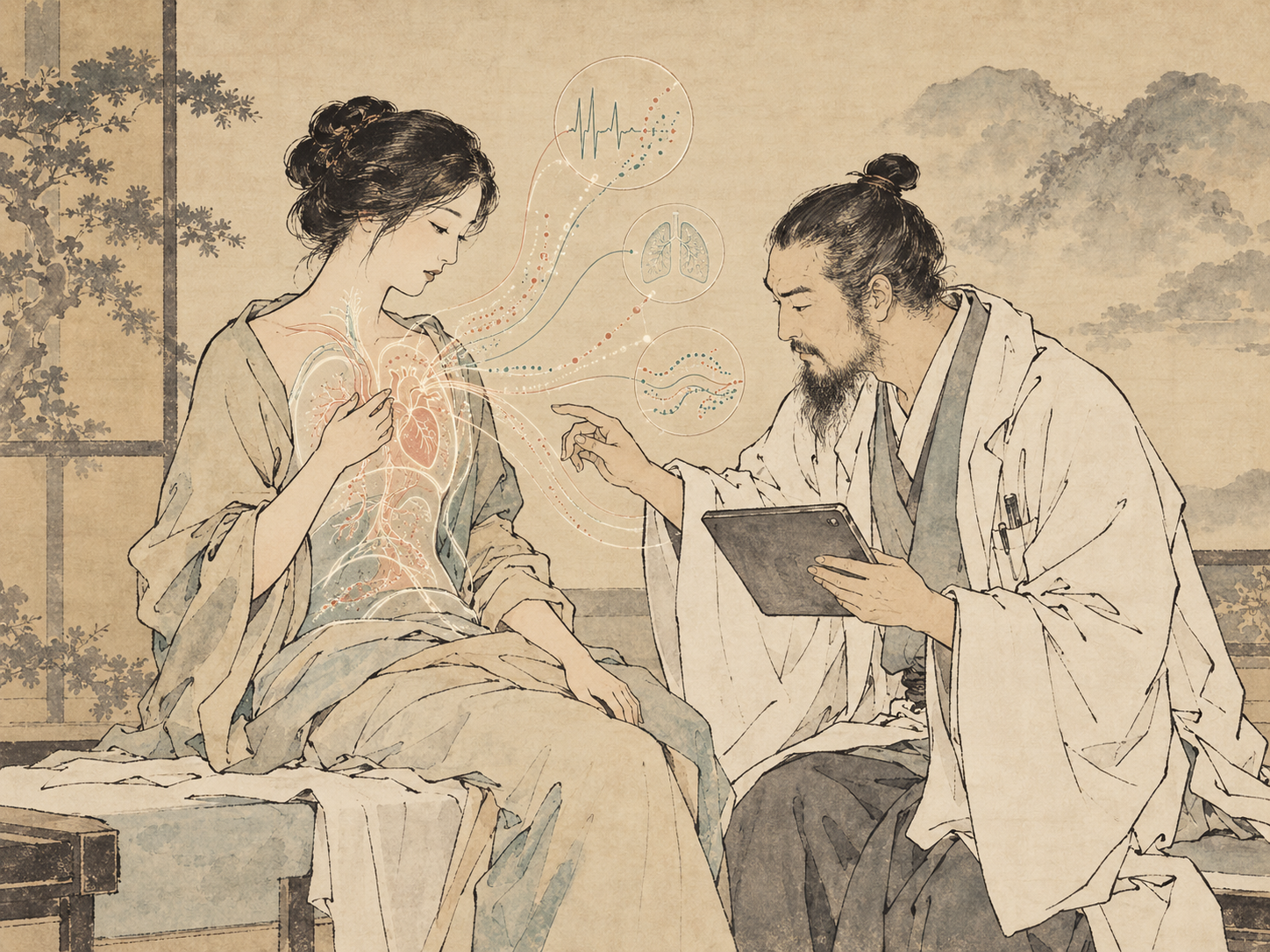
Health deterioration in an older person does not always begin with a dramatic event. Sleep changes. Nighttime movement increases. Breathing or heart rate drifts from the person’s usual pattern. Experienced care workers sometimes recognize the vague signal that “something is different,” but that judgment is difficult to standardize and can be missed in an understaffed facility.
Panasonic Holdings’ new “predictive-sign solution,” announced Oct. 5, is designed to look for that earlier layer of change. It analyzes heart rate, respiratory rate, body movement, sleep and bed-presence data, compares each resident with his or her own baseline, and gives care staff a reason to take another look.
Looking for deviation, not a diagnosis
The system has two AI components. A health-change analysis model looks for changes in biological and daily-life sensor data. A report-generation model then explains the underlying signals, compares them with past patterns and organizes observation points for care and nursing staff.
The individualized baseline is important. Older residents differ enormously in chronic disease, mobility, medication, sleep and normal physiology. A universal threshold can therefore be less useful than a model that asks whether this person is behaving differently from his or her own recent history.
What 89.4% does — and does not — mean
Panasonic reports 89.4% recall in an evaluation of about 2,000 people: the proportion of time points with a health-status change documented in past care records that the analysis model also flagged. It reports a 10.5% false-alert rate at time points where no change was recorded.
Those figures are promising, but they are not the same as clinical sensitivity and specificity for a diagnosed disease. The reference standard was the timing of entries in historical care records, not a medically confirmed onset point. Retrospective records can also vary with observer practice and documentation frequency. The field question is therefore still open: what happens when staff receive these alerts in real time?
Why elder care is the test bed
Japan’s labor arithmetic makes the problem urgent. The Ministry of Health, Labour and Welfare estimates that the country will need about 2.40 million care workers in fiscal 2026 and 2.72 million by fiscal 2040, roughly 570,000 more than the 2022 workforce.
Government policy has consequently pushed monitoring sensors, ICT and other care technologies as tools to reduce indirect work and preserve more staff time for direct care. Panasonic is already active in this market through LIFELENS, a facility monitoring service that uses sensors to track room status and daily rhythms.
The new project moves one step beyond “what is happening now.” Its ambition is to identify a pattern that says “this person may be changing” before the deterioration is obvious to the eye.
A sensor-agnostic platform could matter
Panasonic says the new system is being designed as a common platform rather than something locked to one monitoring product. Different sensor signals can be normalized and combined, with the eventual goal of working across monitoring systems already installed in care facilities.
That architecture matters commercially. Care homes have already invested in different bed sensors, monitoring systems and record platforms. An AI that requires wholesale replacement of existing infrastructure is much harder to deploy than an analysis layer that can sit above it.
The report generator may be the more practical AI
A raw anomaly score does not tell a care worker what to do. Panasonic’s report-generation AI is intended to translate sensor evidence into a concise explanation: what changed, how it differs from prior patterns and what staff may want to observe.
That makes the generative-AI component less of a “medical oracle” and more of an interpreter. If it works, the benefit may be as much organizational as predictive—giving night staff, day staff, caregivers and nurses a shared description of why a resident has been flagged.
Now comes the real-world test
Beginning in October 2026, Panasonic Holdings is working with social-welfare corporation You-I 21 to test the system in actual care settings. The study will examine how alerts and explanatory reports are used in resident checks and care decisions, and whether the system is useful and operationally workable.
The critical measures will go beyond model accuracy. Does alert volume create alarm fatigue? Do staff understand why an alert was generated? Does it fit into night-shift and day-shift routines? Does it prompt earlier observation? And, eventually, does earlier observation improve outcomes?
| Item | Detail |
|---|---|
| Developer | Panasonic Holdings Corporation |
| Technology | “Predictive-sign solution” for health-status changes |
| Inputs | Heart rate, respiratory rate, movement, sleep, bed presence and other monitoring data |
| AI components | Health-change analysis AI + report-generation AI |
| Field test | Begins October 2026 with social-welfare corporation You-I 21 |
| Intended role | Reference information to support observation and care decisions, not diagnosis |
It is too early to call this predictive medicine
The phrase “early warning” can easily turn into a stronger claim that an AI predicts disease. Panasonic does not make that claim. Its release does not provide disease-specific prediction accuracy, a validated lead time before clinical deterioration, or evidence that the system reduces hospitalization or severe outcomes.
Heart rate, breathing, sleep and movement can change for many reasons: infection, pain, medication, room temperature, stress or ordinary variation. The AI may identify a deviation; interpreting the cause remains a human clinical and care task.
Standardizing the first moment of concern
Experienced caregivers often notice deterioration through subtle changes in expression, gait, appetite, sleep or conversation. The weakness of that model is not the expertise—it is that expertise cannot be perfectly replicated across every shift, every facility and every new employee.
Panasonic’s project is therefore best understood as an attempt to make part of that “something is different” judgment more shareable. The goal is not to replace experienced staff, but to use sensor history to raise an earlier, explainable prompt.
The hard part begins in the facility
An 89.4% recall figure is an attention-grabbing research result. In elder care, however, a technically strong model can still fail operationally. Too many false alarms consume staff time; missed changes destroy trust; opaque alerts are ignored.
Panasonic is now testing whether the loop can work in practice: sensor data notices a small deviation, AI explains it, a human checks the resident and care begins earlier if needed. In an aging country facing a structural care-worker shortage, that workflow may matter more than the headline number.
Sources & Reference Material
- Panasonic Holdings, development of the “predictive-sign solution” for changes in health status, Oct. 5, 2026 (Japanese primary release).
- Panasonic, LIFELENS elder-care monitoring service (Japanese).
- Ministry of Health, Labour and Welfare, projected care-worker requirements, July 12, 2024 (Japanese).
- Ministry of Health, Labour and Welfare, promotion of care technology (Japanese).
- Ministry of Health, Labour and Welfare, care-technology utilization training material (Japanese).
Reporting cutoff: Oct. 6, 2026, 1:21 PM JST. Public materials do not establish disease-specific prediction performance, validated lead time, improvement in clinical outcomes, the number of field-test sites or participants, or a commercialization date and price.