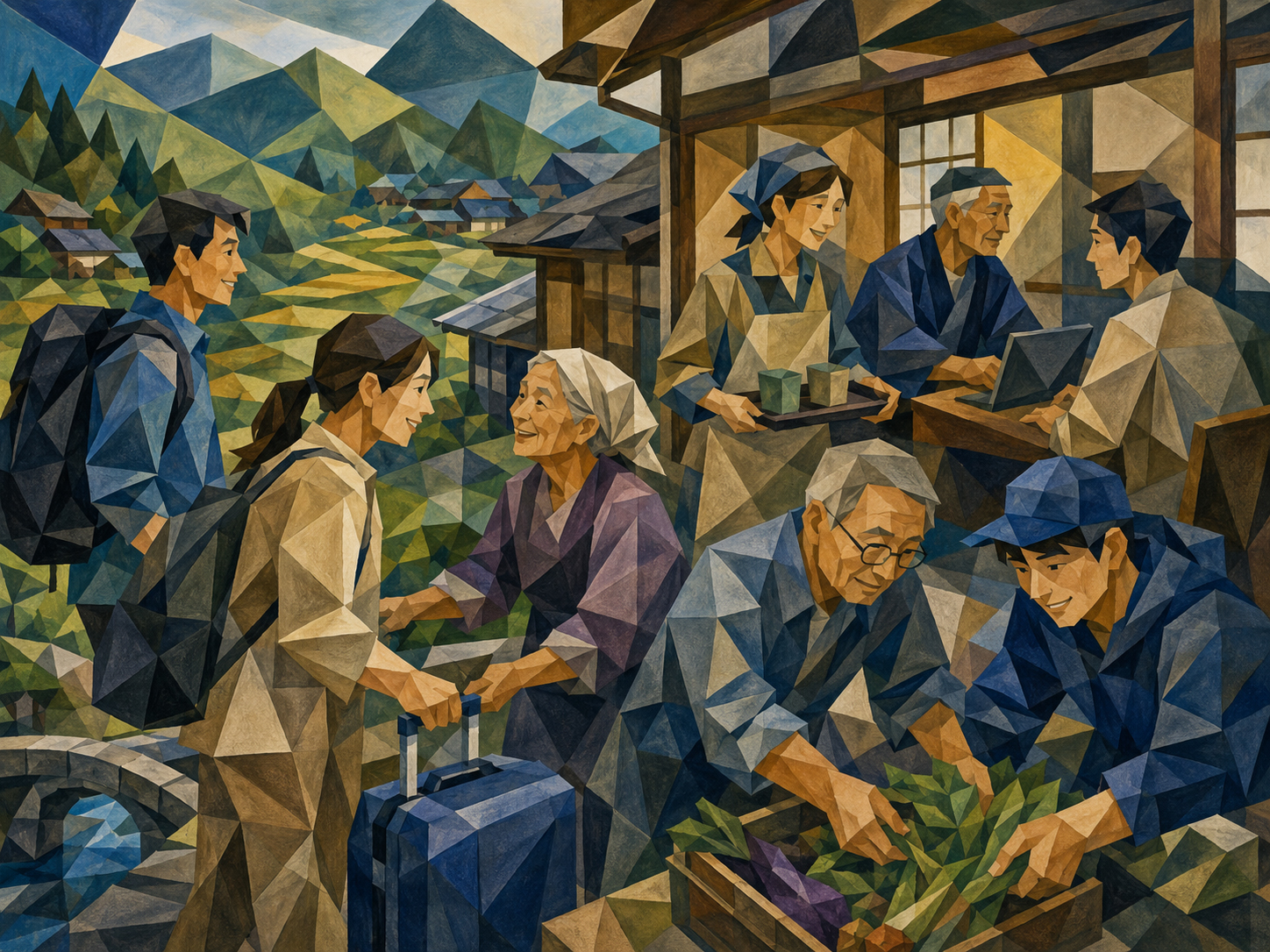
What rural Japan lacks is not only visitors. It lacks hands. Hands to carry breakfast trays at an inn. Hands to harvest fruit before the weather changes. Hands to make beds, pack seafood, prepare a festival, clean rooms, greet guests, and get a family business through the peak season. Otetsutabi took that shortage and reframed it not only as a job, but as a reason to travel.
Otetsutabi, the company whose name blends otetsudai, meaning helping, and tabi, meaning travel, says its registered users have passed 100,000. The growth curve is striking: about 5,000 users in 2021, more than 50,000 in 2024, 70,000 in 2025, around 95,000 to 97,000 in early 2026, and then the 100,000-user threshold. Related June announcements put the figure above 106,000.
The more interesting shift is who is using it. The service still has a strong youth base, with roughly half of participants in their teens and 20s. But it is no longer only a student-and-backpacker idea. Otetsutabi says users in their 50s and above have grown sharply; as of February 2026, roughly 29% of participants were 50 or older. Early retirees, people whose children have grown up, and would-be rural migrants are using the service as a low-risk test of regional life.
What Otetsutabi Actually Does
The model is simple. A regional business that needs short-term help posts work. A traveler applies. The host provides pay and lodging; the traveler usually pays their own transport. The work can last from a short one-night, two-day assignment to a period of less than two months, depending on the host and the season.
At first glance, it sounds like a travel bargain. But the business is more subtle than that. Otetsutabi connects hotels, ryokan, farms, fisheries, guesthouses, campgrounds, breweries, seafood processors, restaurants, and tourism facilities with people who want to experience a place from the inside. For the host, the problem is concrete: there are too many rooms, too many apples, too many customers, or too few local workers for a specific peak. For the traveler, the reward is not only money. It is access.
Traditional tourism is built around seeing, staying, eating, and leaving. Otetsutabi adds helping. That changes the emotional contract. A traveler who folds futons, sorts vegetables, packs fish, or helps at a festival sees the town differently. The place is no longer just a backdrop. It becomes a system of people, tasks, weather, fatigue, food, and conversation.
Why the Model Is Growing Now
Three forces are pushing Otetsutabi forward. The first is cost. Travel in Japan is more expensive than it used to be. Food, transport, lodging, and energy costs have all risen, while a weak yen has changed the tourism economy. A trip that includes paid work can make travel possible for students, younger workers, retirees, and people watching their budgets.
The second force is a change in what people want from travel. Famous views are now endlessly visible online. Photos of shrines, hot springs, waterfalls, and old streets are easy to find. What is harder to get is the feeling of being useful in a place. A morning at a farm, a night shift at an inn, a conversation with a fisherman, or lunch with a family business can feel more memorable than another perfect viewpoint.
The third force is work itself. Remote work, workations, side jobs, spot work, early retirement, second careers, and location-flexible lifestyles have made the border between working and traveling softer. Otetsutabi did not invent that shift. It gave the shift a very Japanese shape: a small job, a local host, a place to sleep, and a reason to care.
Why Senior Participation Matters
The rise of older users is the most important part of the story. Japan is often described as a super-aged society. The Cabinet Office says people aged 65 and over account for 29.3% of the population. The government has also encouraged companies to secure work opportunities up to age 70 through elderly employment reforms. But the question is not simply whether seniors can keep working. It is what kind of work gives people meaning, flexibility, health, income, and social connection.
Some older people want to remain in their old company. Others do not. Some want part-time work. Some want travel. Some want to feel useful without returning to a rigid office structure. For them, short regional assignments can be a different path: lighter than full reemployment, more purposeful than ordinary tourism, and more social than staying home.
For communities, older travelers can bring steadiness, communication skills, experience, and responsibility. A retired sales worker may be good with guests. A former office manager may be reliable with scheduling. A parent or grandparent may understand hospitality in a way a young student does not. The appeal is not that seniors are cheap labor. The appeal is that they are a large, underused reservoir of time, skill, curiosity, and care.
A Longer History: Travel and Work Were Never Far Apart
Japan’s new work-travel platforms look modern, but the deeper pattern is old. In the Edo period, travel moved through post towns, temple routes, hot springs, ports, and merchant roads. Seasonal labor also moved: farmers, fishers, brewers, forestry workers, apprentices, peddlers, and people leaving home for temporary work. Rural Japan was never as static as nostalgia suggests.
During the high-growth decades after World War II, the flow became one-directional: young people left villages for factories, offices, construction sites, and service work in the cities. Group employment, manufacturing, urban housing, and mass tourism remade the country. Rural towns became places people came from, not always places people returned to.
Since the 2000s, Japan has searched for ways to reconnect city and countryside. Furusato tax donations, migration programs, regional revitalization grants, workation policies, two-location living, volunteer tourism, farm stays, and community-building projects all belong to this larger experiment. Otetsutabi is part of that history. Its difference is practical. It does not begin with a speech about saving the countryside. It begins with a listing: this inn needs help next week.
What Hosts Get From It
For a rural ryokan or farm, labor shortage is not theoretical. Reservations may be full but rooms cannot be serviced. Fruit may be ready but not picked. A festival may bring visitors but not enough staff. A restaurant may have customers but no extra hands. Local recruitment often fails because the town itself has aged.
Otetsutabi sends short-term workers into that gap. The model does not remove the cost of training. It does not eliminate the need for clear safety rules, fair wages, insurance, working hours, and good lodging. But when it works, it gives a host more than labor. It creates possible repeat visitors, future migrants, local fans, customers, and storytellers.
This matters especially in tourism. A person who has worked inside a ryokan understands more than the price of a room. They know the smell of the kitchen before breakfast, the difficulty of changing rooms quickly, the local vegetable supplier, the view from the staff entrance, and the jokes exchanged after the shift. When they go home, they carry a story that advertising cannot easily manufacture.
The Japanese Idea of “Related Population”
Japan has a useful phrase: kankei jinko, often translated as related population. It means people who are neither residents nor ordinary tourists, but who maintain an ongoing relationship with a place. They may visit repeatedly, volunteer, buy local products, help during busy seasons, donate after disasters, or someday move there.
In a shrinking country, not every town can grow its resident population. But many towns can grow their related population. That is why Otetsutabi matters. It turns abstract affection into a task and a stay. A traveler does not simply say they like the countryside. They spend three days doing something useful there.
The Risks: A Good Story Still Needs Good Rules
There is a danger in romanticizing work-travel. Work is still work. Pay, minimum wage rules, rest time, safety, insurance, job descriptions, lodging quality, cancellation rules, and communication must be clear. If regions lean too heavily on travelers’ goodwill, the model will not be sustainable.
Short-term workers also cannot solve every structural problem. Rural Japan still faces low wages, limited housing, shrinking schools, weak transport, medical-access concerns, successor shortages, and the challenge of keeping young families. Otetsutabi is not a cure-all. It is an entry point.
But entry points matter. A city resident who says “rural Japan has no workers” has one level of understanding. A traveler who wakes up at 5 a.m. to help harvest vegetables has another. A business owner who believes no one will come has one kind of despair. A host who receives applications from across the country has a different kind of hope.
Japan.co.jp’s View
Otetsutabi’s 100,000-user milestone is a small but important sign of Japan’s changing future. Travel is moving from consumption toward participation. Work is moving from the company toward the community. Seniors are moving from retirement toward re-entry. Regional revitalization is moving from subsidies toward relationships.
Japan’s labor shortage will become more severe. Recruit Works Institute has projected a labor-supply shortage of about 11 million people by 2040. The pressure will arrive first in the places where the population is already oldest: farms, fishing towns, mountain villages, hot-spring inns, islands, and small manufacturers.
Robots and AI will help. Foreign workers will matter. Higher wages and better productivity will be necessary. But human contact will still be part of the answer. Someone has to meet the host, learn the task, taste the local food, notice the empty school, talk to the grandmother at the inn, and decide that the place matters.
Otetsutabi is not merely cheap travel or clever staffing. It is one of the ways population-decline Japan is testing a new social contract between cities and regions. Help makes travel deeper. Travel makes help more human. If that loop can be protected with fair rules and good hospitality, rural Japan still has stories to tell.
Reader Guide
| Topic | How to read it |
|---|---|
| What happened | Otetsutabi passed 100,000 registered users; related June announcements put users above 106,000. |
| Why it matters | The service links work-travel, rural labor shortages, travel costs, senior participation, and related-population building. |
| Senior angle | Users age 50 and over are growing, including early retirees and people exploring regional life. |
| Regional value | Hosts gain short-term help, but also possible repeat visitors, future migrants, and local advocates. |
| Caution | Fair wages, safety, lodging quality, clear job descriptions, and communication are essential. |
Sources and references
This article draws on Otetsutabi announcements, PR TIMES, Mainichi, JapanGov, Recruit Works Institute, the Cabinet Office’s ageing-society report, MHLW elderly-employment materials, and Reuters reporting on Japan’s labor shortage. User counts, host counts, and age-distribution figures reflect each announcement date and may change.
- PR TIMES: Otetsutabi passes 100,000 registered users.
- PR TIMES: JR East Otona no Kyujitsu Club senior partnership.
- PR TIMES: Turning labor shortage into a purpose for travel.
- Mainichi Japan: Japanese service matches traveling workers with inns seeking staff.
- Recruit Holdings / Recruit Works Institute: Future Predictions 2040 and worker shortage estimate.
- Cabinet Office: Annual Report on the Ageing Society, FY2025 summary.
- MHLW: Current state of employment measures for the elderly.
- Reuters: Japan’s labor crunch and small-town businesses.