The artist behind a surviving painting
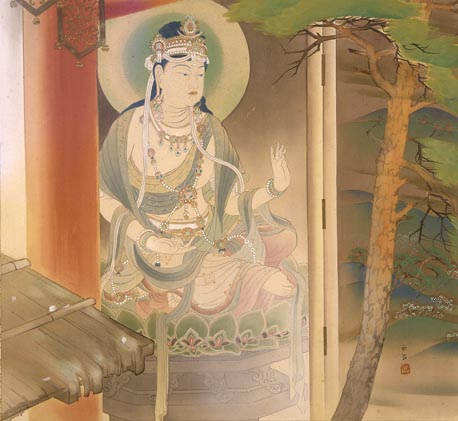
A Japanese painting from 1942 offers a different route into Fukushima history. Its title is Butsutan Kannon, officially catalogued in English as Avalokitesvara. It was painted in color on silk by Ota Shumin, a Fukushima-born artist whose work survives in public museum collections but whose biography is less familiar than those of Japan’s most heavily reproduced modern painters.
His story is not simply one of a forgotten genius suddenly rediscovered. It is a case study in how artists from regional Japan helped build a national modern art world—and in how museums, exhibition catalogues and old newspapers preserve evidence that popular art histories often leave in the margins.
First, the name and a contested birth year
Japan’s Art Platform Japan authority file identifies the painter as Ōta Shūmin (太田秋民, おおた・しゅうみん), born in Fukushima Prefecture in 1884 and deceased in 1950. The National Museum of Modern Art’s own catalogue uses the same dates. That makes 1884 the strongest supported date for this report.
A separate regional art-history account instead says he was born in Fukushima City in 1881 and gives his personal name as Masusaburō. It is useful evidence of a research discrepancy, but not a reason to silently revise the official museum record. Archival documents such as family registers or contemporary school rolls would be needed to establish the year decisively.
Learning to paint while Japan reinvented art education
Ota came of age in an era when the concept of nihonga—Japanese-style painting—was evolving alongside national academies, exhibition juries and new ideas about what counted as modern art. Techniques grounded in ink, silk, paper and mineral color did not disappear when Japan modernized. They were taught, adapted and evaluated through institutions that themselves were relatively new.
According to regional research, Ota enrolled in the Japanese-painting department of the Tokyo Fine Arts School in 1904 and studied with Araki Kanpō. He subsequently participated in official exhibition circuits including the Bunten and Teiten. These biographical details are drawn from a regional secondary account; the concise national authority record confirms neither each enrollment detail nor every exhibition result.
A Fukushima network in the capital
One overlooked aspect of modern Japanese art is the importance of artists who shared a regional origin but worked in Tokyo. Regional art histories identify Ota among the figures associated with the Fukuyō Art Association, established in 1919 to bring Fukushima-born Japanese painters into dialogue and mutual study. Other names included Katsuta Shōkin and Ogyū Tensen.
The association complicates the notion that an artist must belong exclusively to Tokyo or to the provinces. A painter could learn and exhibit through metropolitan institutions while continuing to draw energy from hometown colleagues. Following those networks may reveal more about artistic opportunity than the familiar account of solitary exceptional talent.
A woman, painted in 1932
Fukushima Prefectural Museum of Art owns a large silk painting titled Woman (女), dated 1932 and measuring 188.0 by 140.0 centimeters. Art Platform Japan records the signature and seal at lower right, and notes the museum acquired the work in fiscal 1999. A museum annual report later listed the picture in an exhibition of early twentieth-century Japanese painting.
What can be said from the record is precise but limited. The catalogued title does not identify the sitter, and the existence of a museum entry alone does not authorize claims about the figure’s mood, social standing or clothing. The piece matters as evidence of Ota’s sustained work in figural painting and of a prefectural museum actively assembling a collection connected to Fukushima’s artists.
Avalokitesvara, 1942: the featured work
The selected artwork, Avalokitesvara (仏誕観音), is in the National Museum of Modern Art, Tokyo. The museum gives its medium as color on silk, framed, and dimensions of 65.5 by 70.7 centimeters. A seal and signature are recorded at lower right. Its exhibition history includes a 1942 Ken’nōten at Mitsukoshi in Nihonbashi, Tokyo.
The work’s religious title evokes Kannon, or Avalokitesvara, a bodhisattva widely represented in Buddhist art. But the English museum title should not be stretched into an unsupported description of a precise sacred narrative. Equally, one painting cannot establish its maker’s religious beliefs or the artist’s response to wartime politics. Those questions require documents beyond the artwork’s catalogue.
What wartime provenance can—and cannot—tell us
The date 1942 places this work amid Japan’s Pacific War. Artists, exhibitions, collectors and museums were operating under wartime conditions, and the record of a presentation at a Ken’nōten merits study within that context. Yet a catalogue entry proves participation in a named exhibition, not what its artist privately believed or intended.
A serious history would compare exhibition programmes, reviews, archival correspondence and surviving preparatory drawings. To leap straight from the label of an exhibition to an accusation or an endorsement would be to confuse historical setting with personal evidence. The limits of the present record matter as much as the information it contains.
An intriguing newspaper trail to Mount Ryōzen
A particularly evocative piece of local evidence comes from the Fukushima Prefectural Library. A 2026 reference inquiry traced a possible article in the October 23, 1927 morning edition of Fukushima Minpō about painters visiting the striking rock formations of Mount Ryōzen. The response mentions a side view of a peak credited to Ota Shumin.
The library carefully states that the identification is a possibility rather than a final certainty. That caution prevents us from turning a newspaper clue into a fully reconstructed itinerary. Still, it suggests an avenue of investigation into how Fukushima landscapes were named, pictured and circulated by professional artists in the interwar period.
Return, displacement and postwar art life
Regional scholarship says Ota relocated to Fukushima City in 1945 and served as a judge for the first three editions of the prefectural art exhibition. If supported by surviving programmes, that would place him in the work of rebuilding an arts infrastructure after the war: not merely making paintings but helping evaluate and encourage others.
He died in 1950. Public collections preserve several named works, but a searchable list of three holdings does not represent a complete catalogue raisonné. The full number of extant works, private collections and exhibition appearances cannot be inferred from the handful of records currently visible online.
How an artist’s work enters the public domain
Japan generally protects copyright for the author’s lifetime plus 70 years. For an artist who died in 1950, the ordinary domestic term calculation places the original works outside protection from January 2021, subject to the usual legal qualifications. That is not the same as a promise that every museum-supplied photograph can be republished without considering its separate terms or other applicable rights.
The image used here is presented as a reproduction of the documented 1942 painting, not an AI-created Ota artwork. Contemporary editorial illustrations elsewhere in this Fukushima edition may draw on Japanese painting traditions, but should be clearly marked as interpretations rather than authentic works by the historical artist.
The value of looking again
Ota Shumin deserves attention not because his name can be attached to exaggerated claims, but because his documented life crosses important boundaries: provincial origins and metropolitan training, official exhibitions and peer associations, wartime visual culture and postwar institutions. The surviving catalogue entries invite questions rather than closing them.
For a Fukushima edition in the prefecture’s 150th-anniversary year, that is a valuable form of cultural reporting. Begin with the painting, read its label closely, trace the documents behind it, and let the region’s artists emerge as historical actors in their own right.
Sources & reporting note
Based on Japanese prefectural, municipal, archival and memorial-organization sources. No original on-site reporting or direct interviews are claimed.
- Art Platform Japan: Ota Shumin artist authority record
- National Museum of Modern Art, Tokyo: Avalokitesvara (1942)
- Art Platform Japan: three recorded museum works
- Art Platform Japan: Woman (1932), Fukushima Prefectural Museum of Art
- Fukushima Prefectural Museum of Art: 2007 annual report
- Fukushima Prefectural Library: archival inquiry into a 1927 Ryōzen newspaper article
- UAG art-history research: Fukushima Nihonga painters
- National Museum of Modern Art, Tokyo: artist index