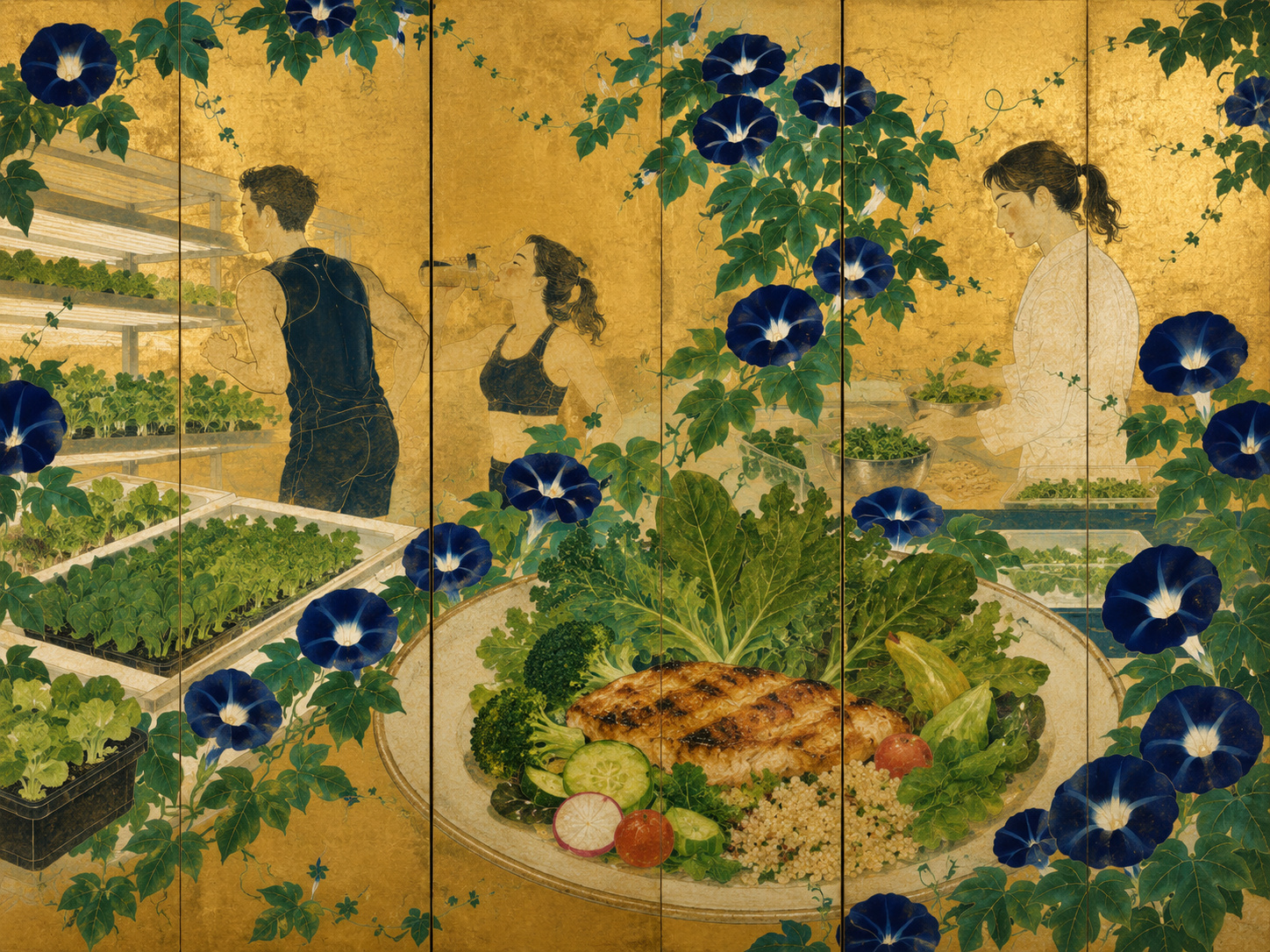
The sun will not rise over these vegetables.
They do not need it to.
In Oi, Fukui Prefecture, kale, watercress, celery-family greens and mizuna can grow inside a fully enclosed plant factory under artificial light. Temperature, humidity, nutrients and illumination are controlled rather than left to the weather. Insects and soil are largely removed from the production equation. Harvest can be planned in a way that outdoor farming can rarely promise.
On August 22, four of those crops—kale, watercress, white celery and mizuna—are scheduled to appear in Osaka at the third Sports & Nutrition Festa at Soai University’s Nanko campus.
The event is organized by Soai University’s Department of Nutrition, Red Hurricanes Osaka and Osaka Port Promotion Association, with Lotte and the Suminoe Ward Council of Social Welfare as co-organizers. The plant-factory vegetables, sold under Nippon Yamamura Glass’s “Kira Kira Vege” brand, are being supplied for a sports-nutrition lunch supervised by the dietitian of Red Hurricanes Osaka. Fifty meals are planned.
That sounds like a small food event.
It contains three large Japanese stories.
One is the professionalization of sports nutrition: the move from “eat a lot because you train a lot” toward meals adjusted for energy demand, recovery, body composition, micronutrients and timing.
The second is the long Japanese effort to turn plant growth into an engineering system—a project that began decades before the phrase “vertical farming” became fashionable.
The third is harder: whether an agricultural system that can deliver vegetables at a stable time, quantity, price and quality can also become economically and environmentally sustainable once the electricity bill is counted.
The athlete needs food before the athlete needs a “superfood”
Sports nutrition is vulnerable to magic words.
Protein. Electrolytes. Antioxidants. BCAAs. Functional foods. Superfoods.
Each can describe something real. The danger begins when a useful component is promoted as if it were the architecture of the entire diet.
Japanese sports-nutrition guidance starts from a more ordinary picture. The Japan Sports Association describes the basic athlete meal through staple food, main dish, side dish, dairy and fruit. Staple foods such as rice, bread and noodles supply much of the carbohydrate needed for training. Main dishes provide protein and other nutrients through meat, fish, eggs, soy and similar foods. Side dishes—including vegetables, mushrooms and seaweed—help supply vitamins, minerals and dietary fiber. Dairy contributes calcium and protein; fruit contributes carbohydrate, vitamins and other nutrients.
The structure matters because an athlete’s first nutritional problem is usually not the absence of an exotic ingredient. It is matching energy intake to energy expenditure while still supplying enough carbohydrate, protein, fat, vitamins, minerals and fluid to support training, adaptation and recovery.
That is particularly obvious in rugby.
A professional rugby player may combine repeated high-intensity running, collisions, strength training, tactical sessions and the body-mass demands of a position. A prop and a winger do not necessarily need identical portions. A hard training day and a recovery day are different nutritional environments. A young fan attending the university event does not need to eat the same volume as a League One player simply because the menu is “sports nutrition.”
Soai’s previous festival materials made this distinction explicit: the public lunch reproduced the idea of a rugby player’s meal, but portion sizes for participants were adjusted according to life-stage nutrition rather than copied directly from professional players.
That is good sports nutrition.
Not imitation. Translation.
The athlete’s plate is not a list of powerful foods. It is an energy budget, a recovery plan and an ordinary meal at the same time.
Where vegetables fit on a performance plate
Vegetables are important, but not because they are a hidden fuel tank.
Leafy vegetables generally contribute micronutrients, phytochemicals, fiber and variety to the diet. They can help athletes meet broader health and nutritional needs. But a plate dominated by low-energy vegetables can become a problem if it displaces the carbohydrate and total energy required by an athlete training heavily.
This tension is increasingly recognized in sports nutrition. A “healthy-looking” meal can still be under-fueled.
The Japan Sports Association’s recent guidance on athlete nutrition emphasizes not only meal composition but adequate quantity. A meal can contain all the right categories and still be insufficient if the athlete’s total energy intake falls below demand. In female sport, the association explicitly warns about Relative Energy Deficiency in Sport—REDs—when energy availability becomes chronically inadequate.
That is why the four Fukui vegetables should be read as one part of the lunch rather than the story of the lunch.
Kale, watercress, white celery and mizuna can add color, texture, vitamins, minerals and phytochemicals. They do not replace rice. They do not replace a protein-rich main dish. They do not rehydrate an athlete by themselves. They do not determine whether the entire day’s energy intake matches training load.
The Red Hurricanes dietitian’s role is precisely to place ingredients into that larger system.
A glass-bottle company decided to grow kale
The agricultural half of the story begins in an unlikely place.
Nippon Yamamura Glass was founded in 1914 in Nishinomiya, Hyogo Prefecture. Its traditional business is glass containers, and the company says it holds the leading share of Japanese glass-bottle shipments.
A century-old bottle manufacturer is not the obvious ancestor of a salad.
But manufacturing culture created the bridge.
The company describes its original interest in plant factories through two ideas familiar from industrial production: safety and sustainability. It began small-scale vegetable cultivation research in 2007, treating plants partly as another production system whose variables could be measured and improved.
That did not mean agriculture suddenly became easy.
The company tested varieties, worked with seed companies, lighting manufacturers, universities and food businesses, built internal analytical capability and learned how light, nutrients, temperature and humidity changed crops. Its research center says it has accumulated cultivation experience across more than 380 varieties of leafy and fruiting vegetables.
The strategic problem was also commercial.
Most Japanese artificial-light plant factories grow lettuce. Competing with other factories and field producers in the same commodity would make an already expensive production system harder to justify. Nippon Yamamura Glass looked for crops that could carry a higher value proposition.
Kale became one answer.
At the time, kale in Japan was strongly associated with aojiru, the famously bitter green drink. The company instead worked toward kale that could be eaten raw as a salad vegetable. It took samples to prepared-food businesses, received criticism, adjusted cultivation, and eventually began commercial sales of vegetables in 2014 as ingredients for prepared foods and cut salads.
In May 2018, it launched the consumer brand “Kira Kira Vege,” initially gaining a route to shoppers through the rebuilt food floor at Osaka’s Hanshin Department Store.
The company later pursued vegetables with deliberately managed nutrient profiles, including a lutein-focused kale notified under Japan’s Foods with Function Claims system.
The story is not “a glass company discovered farming.”
It is more specific: a manufacturing company tried to apply process control, quality analysis and product differentiation to living plants.
1914 — Nippon Yamamura Glass’s predecessor business begins in Hyogo.
1970s — Research and development of artificial-light plant factories accelerates in Japan.
1983 — Miura Farm becomes Japan’s first commercial plant factory using artificial light, according to historical reviews.
2005 — Commercial LED-based artificial-light plant factories begin operating in Japan.
2007 — Nippon Yamamura Glass begins small-scale vegetable cultivation R&D.
2014 — The company starts commercial vegetable sales for prepared-food and other customers.
2018 — “Kira Kira Vege” launches as a consumer brand.
2021 — Nippon Yamamura Glass and JR Freight establish Yamamura JR Freight Kira Vege Station.
March–April 2023 — The new plant factory in Oi, Fukui, is completed and begins operation.
August 22, 2026 — Four Kira Kira Vege crops are scheduled for Soai University’s third Sports & Nutrition Festa.
Japan was building vertical farms before “vertical farming” was a trend
Modern controlled-environment agriculture can look like a Silicon Valley invention: LED racks, sensors, hydroponics and software inside a warehouse.
Japan’s history is much older.
Research into vegetable production under artificial environments expanded in Japan during the 1970s. Commercial artificial-light production appeared in the 1980s. One historical review identifies Miura Farm, established in 1983, as the first Japanese commercial plant factory using artificial light. Another notes that by 1985 a plant factory was operating in the vegetable-sales area of a shopping center.
The technology evolved with lighting.
Early systems relied heavily on high-pressure sodium lamps. Fluorescent tubes later made multi-layer cultivation easier because they reduced some of the heat and spacing problems. LEDs changed the engineering again: they could be placed closer to plants, generate less infrared radiation toward the crop and provide more precise spectra.
Commercial LED plant factories appeared in Japan by 2005, years before LEDs became a ubiquitous symbol of vertical farming.
The purpose of a fully enclosed plant factory is not to imitate a field indoors.
It is to create a different production equation.
Instead of accepting sunlight as variable, the producer buys electricity and specifies light. Instead of waiting for rain, water and nutrients circulate through controlled systems. Instead of adapting the plant to each season, the facility tries to hold the season still.
That can produce what Japan’s Agriculture Ministry now calls the “four constants”: scheduled time, quantity, price and quality.
For foodservice, hospitals, prepared-food manufacturers and institutional kitchens, predictability itself has value.
The Fukui factory is a ¥2.2 billion wager on predictability
The Oi plant is the industrial-scale expression of that idea.
In 2021, Nippon Yamamura Glass and Japan Freight Railway Company—JR Freight—formed Yamamura JR Freight Kira Vege Station. Nippon Yamamura Glass owns 51%; JR Freight owns 49%.
The joint venture chose Oi in Fukui Prefecture for a new fully enclosed plant factory. When the project was announced in January 2022, the planned investment was approximately ¥2.2 billion. The site was about 7,500 square meters, with approximately 3,400 square meters of floor space. Planned crops included kale, watercress and celery, with planned annual output of about 260 tonnes.
The factory was completed in March 2023 and operations began in April.
JR Freight’s participation is not decorative. Logistics is one of the plant-factory proposition’s hidden variables.
A crop can be perfectly standardized when it leaves a growth room and still lose quality in transport. The Kira Kira Vege business now emphasizes container transportation and quality preservation over longer distances. Pairing a controlled crop with a freight company is an attempt to extend process control beyond the growing rack.
For the Soai lunch, the geography is visible: vegetables grown in Fukui travel to Osaka, where they become part of a public nutrition experience linked to a professional Osaka rugby team.
What “fully enclosed” really buys
A fully enclosed plant factory trades one kind of uncertainty for another.
It largely removes rain, storms, drought, seasonal temperature swings and many insect pressures from the immediate cultivation space. It allows environmental settings to be repeated. It can reduce or avoid pesticides during cultivation. It can produce leafy crops when outdoor supply is unstable.
Nippon Yamamura Glass says its closed system grows vegetables without sunlight using LED lighting while tightly managing temperature, humidity and other conditions. Its mizuna and shungiku products are marketed as grown without pesticides during the cultivation period because insects are kept out of the sealed environment.
Controlled conditions also make nutritional R&D possible in a way that is more difficult in an open field.
Light spectrum, light intensity, photoperiod, nutrient solution and harvest timing can influence plant morphology and concentrations of some phytochemicals. That does not mean a producer can dial “nutrition” like a volume knob with perfect precision. Plant biology remains complex. But the facility provides a repeatable experimental platform.
This is part of the logic behind Kira Kira Vege’s higher-nutrient and function-claim products.
It also explains why a sports-nutrition event is a natural marketing destination. Controlled-environment vegetables and athlete diets share a vocabulary: measurement, consistency, optimization and function.
That vocabulary can also mislead if it becomes too seductive.
The athlete is not a plant factory
Performance science increasingly measures athletes in extraordinary detail.
GPS tracks movement. Force plates measure output. Sleep can be logged. Blood tests can identify iron status. Sweat testing can estimate sodium loss. Dietitians can model energy and carbohydrate needs around training.
It is tempting to imagine that the athlete can be controlled like the plant factory: inputs optimized, outputs stabilized.
Human bodies resist that metaphor.
Athletes differ by body size, sex, age, position, training history, injury status, menstrual status, heat exposure, appetite, gastrointestinal tolerance, culture and food preference. The same player can need different food on Monday and Saturday because the training load changes.
This is why sports nutrition is management rather than manufacturing.
Even the “right” nutrients can arrive at the wrong time, in the wrong quantity or in a meal the athlete does not want to eat.
Food also has social and sensory functions. Athletes travel. They eat with teammates. They get tired of repetitive menus. Taste determines intake. A nutritionally perfect meal that remains on the plate has zero performance value.
That human variability is not a flaw to eliminate.
It is the reason professional dietitians exist.
The plant factory’s strongest promise may be boring consistency
Food innovation often advertises novelty.
Institutional food buyers often want the opposite.
A catering business needs the ingredient on Tuesday. A hospital kitchen needs predictable specifications. A prepared-food company wants similar leaf size and quality from one shipment to the next. A sports team planning meals for a large squad values ingredients that are available when the schedule says they will be.
Outdoor farming can deliver excellent food, but weather can disrupt timing, yield, appearance and price.
The Agriculture Ministry’s 2026 growth-strategy material explicitly identifies the strategic value of plant factories as the ability to provide produce at stable times, quantities, prices and quality—the “four constants.” It also links plant factories to food security under climate change and labor and land constraints.
That is the strongest connection to sport.
Not “this leaf makes you faster.”
“This supply chain may make it easier to build the same planned meal when outdoor conditions are unstable.”
Then comes the electricity bill
The walls that keep weather out also keep sunlight out.
That is the central economic contradiction of fully artificial plant production.
A conventional field receives solar energy for free. A fully enclosed factory purchases electricity to create photons, then often purchases more electricity to remove the heat created by lighting and plant metabolism, circulate air, pump water and operate environmental controls.
LED efficiency transformed the economics, but it did not erase them.
Japan’s Ministry of Agriculture, Forestry and Fisheries said in its 2026 growth-strategy materials that rising electricity and heating costs have damaged profitability across the sector; it cited data indicating that around 60% of Japanese plant factories are operating at a loss. Commercial crops also remain concentrated heavily in leafy vegetables, while many fruiting crops are still mainly in the R&D stage.
This is why plant factories repeatedly go through boom cycles.
The engineering can be impressive before the business model is durable.
The ministry nevertheless sees strategic potential. Japan has accumulated decades of commercial operations, environmental-control technology and patents. Its current policy ambition is not simply to grow more lettuce indoors but to package plant design, operating know-how, cultivation data and produce into exportable systems.
For a glass manufacturer and a freight railway, the same lesson applies: growing the plant is only half the business. The crop must justify the capital, energy, logistics and selling price.
- Can strongly control: light schedule, temperature, humidity, nutrient delivery, production timing and many sanitation conditions.
- Can reduce exposure to: storms, drought, seasonal temperature swings and many insects.
- Can support: repeatable experiments with varieties, light and nutrient conditions.
- Cannot eliminate: electricity cost, capital cost, equipment failure, labor, logistics or market risk.
- Does not guarantee: superior taste, superior nutrition or lower total environmental impact compared with every field-grown alternative.
- Does not make every crop economical: artificial-light factories remain concentrated in fast-growing, compact, higher-value leafy vegetables.
The glass bottle and the rugby lunch share an obsession with reproducibility
A bottle manufacturer lives by specification.
The neck diameter must fit. The glass thickness must meet requirements. A container cannot be “roughly the same” every production run.
A professional sports organization also lives by repeatability, though its subject is much less controllable.
Training starts at a certain time. Recovery has to begin after it. Food must be available whether a player feels inspired or not. A dietitian builds systems so that good choices are routine rather than heroic.
The plant-factory vegetable sits neatly between those cultures.
Its growth environment is industrially controlled, but its destination is a biological system—the athlete—that requires flexibility.
That makes the August 22 lunch a useful educational object.
Students in Soai University’s dietetics program can discuss not only what nutrients are in a vegetable but where the ingredient came from, how stable its supply is, how it is transported, how much it costs and whether its production method changes the meaning of “sustainable food.”
That is closer to the real work of a dietitian than memorizing nutrient tables.
Soai has been turning nutrition into a public event
The Sports & Nutrition Festa is now in its third year.
Soai University, Red Hurricanes Osaka and Osaka Port Promotion Association have used the event to bring professional rugby, dietetics education and local residents into the same space. Osaka’s Suminoe Ward lists it as part of the broader “Sakishima Ai no Mori” collaborative project linking Soai University, Morinomiya University of Medical Sciences, Red Hurricanes Osaka and the ward.
In the 2025 second edition, the public program included rugby and nutrition quizzes, rugby experiences and a sports-nutrition lunch at Soai’s student cafeteria Foresta. Participants were able to eat with Red Hurricanes players and experience a meal modeled on what the team eats, while the university’s nutrition students helped provide it.
The 2026 edition adds the plant-factory ingredient story and is also advertising activities around chewing and a bubble-gum competition.
That combination may sound playful because it is supposed to.
Nutrition education faces a communication problem: the science is detailed, but people eat meals, not diagrams. Letting children and families see athletes, taste food, answer quizzes and experience portioned meals turns abstract nutrition advice into something physical.
The student role matters too.
A future registered dietitian must eventually translate technical knowledge into food that a real person can afford, understand, enjoy and actually eat.
“Functional” is a regulated word, not a halo
Kira Kira Vege includes products marketed under Japan’s Foods with Function Claims and Foods with Nutrient Function Claims systems.
That requires careful language.
A function claim applies to the specific notified or qualified product and its specified component and conditions. It does not convert every vegetable grown in the same factory into a clinical intervention.
The four ingredients supplied to Soai should therefore not inherit claims merely because some Kira Kira Vege kale products are designed around lutein, GABA or vitamin C.
Nor does the phrase “high nutrition” prove superiority over all conventional vegetables. Nutrient content varies by crop, cultivar, growing condition, harvest timing, storage and preparation. A properly grown field vegetable can be extremely nutrient-rich.
The more defensible value proposition is narrower.
A controlled environment allows a producer to pursue and reproduce specified crop traits with fewer weather variables. If the producer wants to develop a particular nutrient profile, the system offers a strong research tool. Whether the resulting product is worth the additional production cost is a market and life-cycle question.
| Claim | What the evidence supports | What it does not establish |
|---|---|---|
| “Factory vegetables improve sports performance.” | The vegetables can contribute micronutrients, fiber and food variety inside a balanced athlete diet. | That these four vegetables directly improve performance or outperform equivalent conventional produce in athletes. |
| “The Fukui factory supplies vegetables reliably.” | Its controlled environment is specifically designed for year-round, planned production with reduced weather exposure. | That supply can never be interrupted by electricity, equipment, labor or logistics problems. |
| “Plant factories are sustainable.” | They can reduce some resource and pesticide pressures and offer high land-use productivity and stable production. | That every factory has a lower total environmental footprint; electricity source and energy use can dominate the comparison. |
| “Kira Kira Vege is high-function produce.” | The brand includes specific nutrition-function and Foods with Function Claims products developed under controlled conditions. | That every product in the brand, including every item used in the August 22 lunch, carries the same regulated claim. |
The future of food may be hybrid, not indoor
The most useful question is not whether plant factories will replace farms.
They will not grow Japan’s rice, wheat and potatoes economically under artificial light at national scale with current technology. Leafy vegetables fit the system because they are compact, fast-growing, high-value and largely edible biomass. Staple crops carry far more calories per yen and require a different agricultural equation.
The future is more likely to be mixed.
Fields will remain essential. Greenhouses will use sunlight with increasing environmental control. Fully enclosed facilities may concentrate on leafy greens, seedlings, high-value crops, special nutrient profiles, pharmaceutical materials or production where climate instability and sanitation justify the energy cost.
Data generated indoors may also move back outdoors. Japan’s Agriculture Ministry explicitly sees value in transferring optimized cultivation knowledge and varieties developed in controlled systems into conventional agriculture.
That is another reason the word “factory” can be misleading.
The important output may not only be vegetables.
It may be cultivation knowledge.
Fukui grows the ingredient; Osaka teaches the meal
On Saturday, the most visible object will probably be the plate.
Perhaps the kale-and-pumpkin salad shown in the sponsor materials will catch a child’s eye. Perhaps a rugby player will make the nutrition lesson memorable. Perhaps a student dietitian will explain why the portion on a professional athlete’s tray is different from the one served to a child.
Behind the plate sits a much longer chain.
A glass company that began experimenting with vegetables in 2007. A freight railway that entered a farming joint venture. A ¥2.2 billion building in a small Fukui town. LEDs replacing sunlight. Environmental controls holding temperature and humidity in range. Researchers trying hundreds of cultivars. Containers carrying greens toward the Kansai market. A university department turning those ingredients into a public lesson.
And then the chain ends in the least controllable machine of all.
A human being decides whether to eat it.
The plant factory can make Tuesday’s kale resemble Monday’s. Sports nutrition begins where that control ends: with a different athlete, a different training day and a different appetite.
A meal is where two optimization cultures meet
There is a final irony in the sports-nutrition lunch.
Controlled-environment agriculture and elite sport are both obsessed with marginal gains. Change the light spectrum. Adjust the nutrient solution. Alter the training load. Move the carbohydrate timing. Measure the outcome.
Both fields are also learning the limit of optimization.
A plant factory that grows perfect lettuce at an impossible electricity cost is not a successful food system.
An athlete diet that looks perfect in a spreadsheet but does not supply enough energy—or is too complicated, expensive or unpleasant to follow—is not a successful nutrition system.
Optimization has to survive reality.
That may be the best lesson available from fifty lunches at a university cafeteria.
The vegetables were grown in a room designed to remove uncertainty.
The meal is being served to teach people how to live with it.
- Nippon Yamamura Glass — August 20, 2026 sponsorship announcement for the third Sports & Nutrition Festa
- Soai University — Third Sports & Nutrition Festa
- Suminoe Ward, Osaka — Sakishima Ai no Mori project and Sports & Nutrition Festa history
- Soai University — nutrition department product development and community nutrition activities
- Nippon Yamamura Glass — Kira Kira Vege development history
- Nippon Yamamura Glass Research & Development Center — plant-factory timeline and cultivation R&D
- Yamamura JR Freight Kira Vege Station — joint-venture and factory company profile
- JR Freight / Nippon Yamamura Glass — 2022 Fukui plant investment, site and planned production figures
- Ministry of Agriculture, Forestry and Fisheries — 2026 plant-factory strategy, opportunities and profitability challenges
- Toyoki Kozai, Proceedings of the Japan Academy — resource-use efficiency and history of Japanese artificial-light plant factories
- Acta Horticulturae — history of light-controlled plant cultivation and LEDs in Japan
- Japan Sports Association — sports and nutrition; basic athlete meal structure
- JSPO Plus — energy availability, balanced meals and athlete nutrition management
- JSPO Plus — post-exercise recovery, carbohydrate, protein and balanced meals
Editorial note: The August 22 Sports & Nutrition Festa had not yet taken place when this feature was prepared. The four supplied vegetables, 50-meal limit, organizers and dietitian supervision are drawn from the August 20 sponsor announcement and Soai University’s published event information. The complete 2026 lunch menu and nutrient analysis were not public, so this article does not invent them. Claims about plant-factory stability are separated from life-cycle sustainability: Japan’s Agriculture Ministry identifies high capital and electricity costs as continuing bottlenecks and reports that roughly 60% of domestic plant factories are loss-making. Specific function claims associated with some Kira Kira Vege products are not generalized to all four vegetables used at the event.