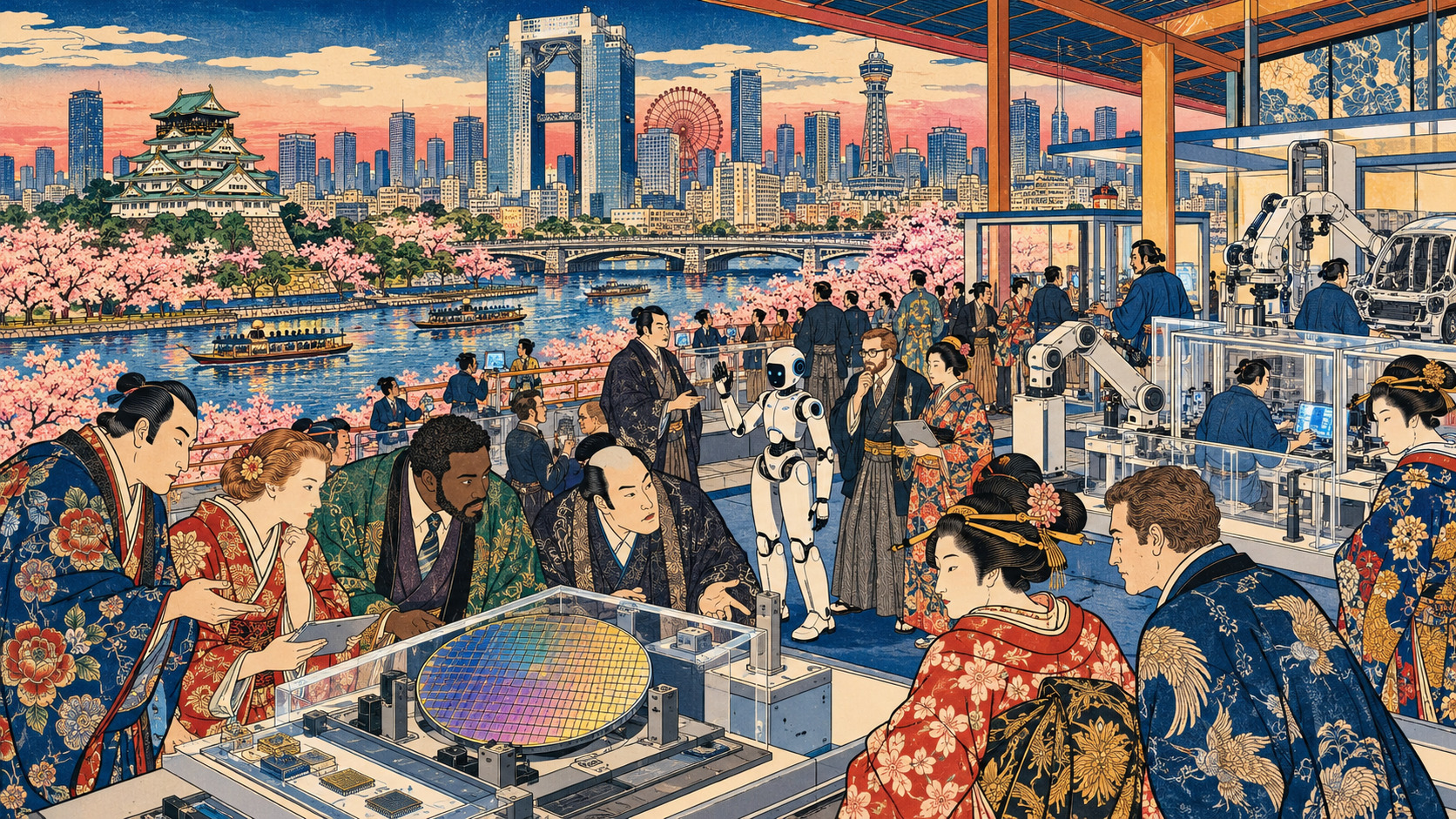
The world's fair is over. The economic experiment is not.
An expo can bring millions of eyes to a city. It cannot, by itself, create the next globally competitive medical-device company or persuade an international investment fund to stay. Osaka is now confronting that distinction as it tries to convert the international connections of Expo 2025 into something measurable: investment, customers, commercially viable research and lasting businesses.
In a release dated October 29, the Osaka Prefectural Government described an October 4–6 innovation tour for three overseas investors and entrepreneurs. They met local companies and ecosystem organizations, received an official briefing and participated alongside Global Startup EXPO 2026, held October 5–7. The tour was small. The strategy behind it is considerably larger.
Osaka is promoting a chain that connects researchers to manufacturers, entrepreneurs to their first corporate customers, and both to financial firms capable of supporting expansion. The prefecture says it has attracted 39 foreign financial and related companies as of October 5, 2026. That number matters as a signal of recruitment activity, but should not be mistaken for 39 new deals, verified investments or jobs. The government's statement does not provide a company-by-company breakdown of capital committed, headcounts and local spending.
A trading city long before it was a technology city
Osaka's ambitions have unusual historical roots. During the Edo period, feudal domains shipped rice to warehouses around Osaka, where merchants traded claims on grain known as rice certificates. Japan Exchange Group traces the city's trading tradition to merchants around Yodoyabashi and the movement of the rice market to Dōjima in the late seventeenth century. In 1730, authorities formally recognized spot and futures-style transactions at the Dōjima Rice Exchange, a landmark in the history of organized derivatives markets.
Modern Osaka later developed a dense industrial base in textiles, machinery, chemicals, pharmaceuticals and sophisticated parts manufacturing. Its current pitch is that this heritage makes it unusually good at converting difficult science into useful products. That claim is plausible, but it needs testing: a skilled factory supplier and a leading research institute do not automatically create an investable startup together.
From expo showpiece to business matchmaking
Global Startup EXPO 2026 operated across Osaka's Umekita and Nakanoshima districts. The official program focused on six broad technologies: biotechnology and healthcare; quantum technology; fusion energy; space; artificial intelligence and advanced robotics; and semiconductors and telecommunications. It mixed speeches and pitches with exhibitions and meetings intended to produce business relationships.
This was the event's second year. The official site reports more than 10,000 participants at the 2025 event, staged during Expo 2025. That is not a verified attendance figure for October 2026. Separating the two years is vital when judging whether the event is gaining commercial momentum.
The University of Osaka said its president, Atsushi Kumanogoh, and distinguished honorary professor Shimon Sakaguchi joined former prime minister Fumio Kishida for an October 6 discussion about translating scientific knowledge into social impact. For an investor, the crucial question is less who spoke than what follows: research licenses, pilot customers, regulatory clearances, repeat orders and follow-on financing.
In Nakanoshima, the space between laboratory and clinic
One tangible addition to the city's innovation infrastructure is Nakanoshima Qross, a concentration of medical, research and commercialization activity that aims to help turn healthcare advances, including regenerative medicine, into viable services and products. Its importance is not simply that researchers occupy an impressive building. Bringing together clinicians, developers, investors and commercialization specialists can reduce the friction that separates a laboratory result from a regulated product.
Inside the complex, Osaka Life Science Nexus by Nippon Life and CIC, known as O-Nexus, opened on May 28, 2026. Its organizers reported approximately 3,100 square meters, 123 private offices, 25 coworking seats and 14 meeting rooms. In June, Osaka Prefecture, Nippon Life, CIC Japan Innovation Services and the Future Medical Promotion Organization announced a four-party cooperation memorandum to develop the life-sciences innovation ecosystem.
The October tour included presentations from MaRI, Setolabo and TxPPIE, illustrating areas such as medical devices, diagnostics and research data. These encounters show the range of activity officials wish to showcase. They do not establish the companies' revenues, financing results or international sales. Those are precisely the measures on which the initiative should eventually be judged.
Why Kyoto and Kobe matter to Osaka's proposition
The Kansai story extends beyond Osaka city or prefecture. Kyoto contributes research-intensive universities and entrepreneurial science; Kobe contributes medical and industrial capabilities; manufacturers throughout the region supply the precision skills essential for bringing prototypes into production. The Osaka–Kyoto–Hyogo/Kobe consortium was selected under Japan's startup ecosystem hub program in 2020 and selected again in June 2025 as a broad metropolitan global hub in the second phase.
Deep-tech businesses often fail at the passage from demonstration to production. Biotech firms require clinical evidence, manufacturing and regulatory expertise. Hardware ventures require reliable components, testing and painstaking quality control. A region with established producers has a potential advantage—provided those companies are willing and able to become paying customers or development partners, rather than merely attending networking events.
Finance is the missing connective tissue
Osaka's Global Financial City OSAKA effort seeks to create a more international finance base capable of supporting this industrial ecosystem. Its promotion committee was established in March 2021; the strategy was first adopted in 2022 and revised in March 2026. The second phase covers fiscal years 2026–2030, with a longer horizon extending to 2050.
The prefecture promotes English-language consultation, help navigating financial licensing, introductions to local partners, and certain office-establishment subsidies and local tax incentives for qualifying businesses. These are not universal entitlements: eligibility, licensing and tax treatment require individual assessment. The intent is to reduce the practical costs of setting up operations and finding a route into the Kansai market.
Yet the government's own 2026 strategy document is unusually frank about its weaknesses. It identifies the concentration of corporate headquarters, capital and information in Tokyo; limited growth-stage finance; relatively few venture capital and private-equity investors; and shortages of specialized financial and English-language talent. It also acknowledges regulatory and tax competitiveness challenges.
Thirty-nine firms: a starting point, not a balance sheet
What should readers make of Osaka's 39-company figure? First, it is an official cumulative attraction claim measured as of October 5, not a count of businesses founded during Global Startup EXPO. Second, the category includes financial and related businesses, not exclusively major banks or venture funds. Third, the release does not document aggregate assets managed locally, new employment, investment in Kansai startups or a comparable baseline for judging the program's net contribution.
A responsible assessment therefore keeps two thoughts together. The recruitment effort is real, with published programs and a reported total. Its economic return has not been established by the figure alone. A meaningful annual scorecard would disclose operating presence, actual financing of local companies, headquarters functions, skilled jobs, and commercial partnerships that survive beyond initial visits.
Osaka, Tokyo and Singapore: different strengths, not the same race
Tokyo remains Japan's dominant headquarters, investment and information market. Singapore has an established role as an international financial and regional operating center. Osaka cannot simply declare itself another version of either. Its more credible opportunity is to become an effective point of connection among universities, hospitals, production specialists and international investors who need access to complex technology.
Comparative startup-city rankings can provide context but are imperfect proxies for financing outcomes. Different publishers count funding, founder networks, patents, exits and market reach in different ways. The more interesting contest is sector-specific: can an Osaka-based medical venture secure clinical partners and a global purchaser faster than a comparable company elsewhere? Can a quantum or advanced-manufacturing startup reliably reach industrial scale?
There is a second tension. Corporate matching can help young companies find customers, but corporate decision cycles can also be slow. Investors can catalyze growth, but only when an investable pipeline exists. For international founders, multilingual assistance matters, yet it is rarely as important as a paying local customer. Osaka's package will be persuasive if these pieces work together.
The long view: a city betting on what follows the spectacle
The 1970 Osaka Expo presented a vision of technology during Japan's high-growth era. Expo 2025 again made the region a meeting point for ideas about medicine, sustainability and international cooperation. Global Startup EXPO 2026 is an attempt to move from presentation to implementation. Its practical legacy will emerge less visibly—in laboratories, procurement departments, clinics, manufacturing lines and financing agreements.
Through 2030, Osaka has an opportunity to report evidence that can be checked: startup survival, research commercialization, business purchases, employment and financing volumes. Those results will matter more than comparisons of skyline photographs or attendance claims. Osaka once helped invent the institutional tools for trading the future value of rice. The question now is whether it can build the institutions needed to finance the future value of difficult science.
Sources and reporting notes
This analysis is based on official policy documents, organizer announcements, corporate disclosures and external comparison material. It does not claim on-site reporting or interviews. The reported 39-company attraction count is not evidence of a particular investment or job total.
- 大阪府・Osaka Prefectural Government, 29 October 2026
- Global Startup EXPO 2026 — 公式開催記録・official program
- 経済産業省 — Global Startup EXPO 2026
- 大阪府 — 国際金融都市OSAKA戦略 第2期(2026年)
- 国際金融都市OSAKA推進委員会 — 戦略の沿革
- 大阪府 — ライフサイエンス四者連携(2026年6月26日)
- O-Nexus — 2026年5月28日開業のお知らせ
- 大阪大学 — GSE2026参加報告
- 大阪市 — スタートアップ・エコシステム拠点都市事業(2026年10月2日)
- 内閣府 — 2025年 第2期拠点都市選定
- 日本取引所グループ — 堂島米会所の歴史
- 2026 StartupBlink ecosystem rankings — methodological comparison