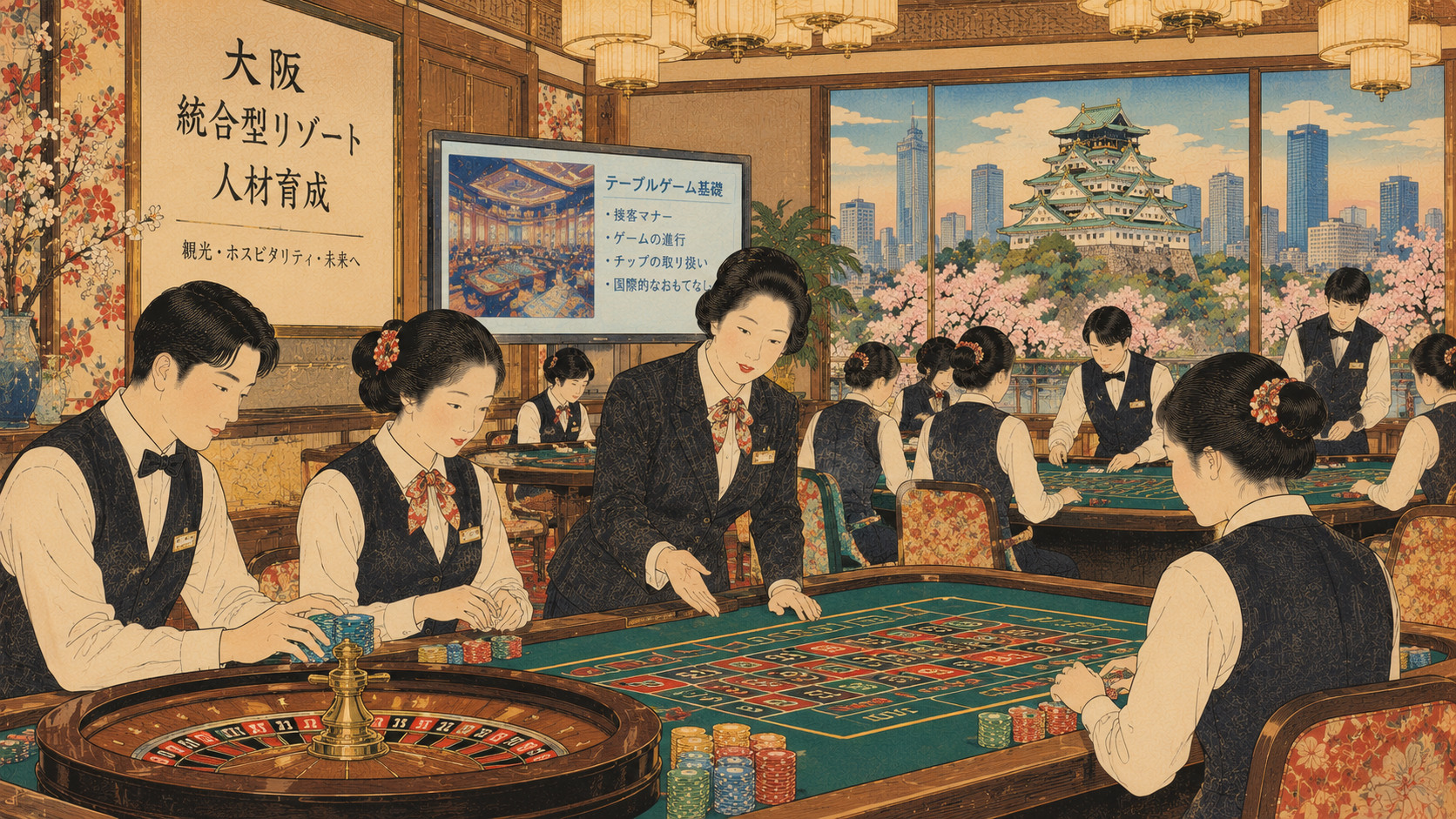
An endorsed training course is now on the calendar. A job offer is not.
The casino has no customers yet. The school already has a timetable.
On October 15, 2026, Japan Casino School announced a partnership with MGM Osaka Corporation to launch an ‘MGM Osaka Certified Course’ in April 2027. The announcement preceded the resort’s currently targeted autumn 2030 opening by more than three years. It is a concrete step in the creation of a Japanese casino workforce, although no resort casino has opened and a place in the course is not an offer of employment.
The school says its curriculum will address dealing techniques alongside gaming protection, hospitality, foreign languages and gambling-addiction safeguards. Kansai TV reported on October 17 that the school hopes to train 500 dealers a year. That is an institutional ambition, not an independently verified enrollment forecast or MGM hiring commitment.
A real announcement, not a newly opened campus
The October 15 event included MGM Osaka president Edward Bowers and Osaka University of Commerce president Ichiro Tanioka. Coverage appeared in subsequent days, including on October 19, but the underlying agreement was announced on October 15—not first unveiled this week. That chronological distinction matters for an October 23 report.
The school, which describes itself as having operated since 2004, already offers programs at sites in Tokyo and Osaka. The new operator-endorsed course is distinct from those existing classes. Pricing and schedules listed for older courses cannot safely be quoted as the approved 2027 program’s fees until that specific information is confirmed.
What does a dealer actually need to learn?
An accurate hand with cards or chips is only the visible surface of the work. A licensed casino must keep games fair, reconcile transactions, prevent collusion and respond to suspicious conduct. Dealers also need an ability to communicate precisely with guests, often in more than one language, while observing internal rules under pressure.
The Japanese term ‘gaming protection’ refers broadly to integrity and security controls surrounding gambling operations; it should not be confused with addiction-prevention education, although both can appear in a training syllabus. The distinction between completing a private-sector course and being eligible to work within a licensed operator’s regulatory system also needs to remain explicit.
How Japan moved from rejecting casinos to constructing one
Japan’s road to an integrated resort was long and contested. Legislation promoting integrated resorts passed in 2016. The 2018 Act on Development of Specified Integrated Resort Districts established a regulatory framework in which limited casino operations could be paired with convention facilities, hotels, entertainment and tourism infrastructure. Licensing and safeguards were central to making a previously prohibited commercial activity possible.
Osaka chose Yumeshima, an artificial island in Osaka Bay, as the location for its ambitions. The prefecture and city developed a resort plan, won national approval and announced the beginning of full construction in April 2025. The target opening remains around autumn 2030, rather than a promise that doors will open on a fixed day.
The scale of the promise—and the size of the assumptions
Osaka City's published project overview describes planned initial investment of roughly ¥1.513 trillion, excluding tax; approximately 20 million annual visitors; and projected yearly sales of about ¥520 billion. These are planning estimates, not operating results. Its description also places gaming areas within 3% of the total floor area of integrated resort facilities.
The wider resort is meant to host conventions, performances, dining, hotels and other activities. All of those may require recruitment. But a casino-dealer school should not be presented as though it will train or guarantee employment across the entire hospitality complex.
Why training starts years before opening
Large tourism projects are built on two clocks. One tracks construction, permits, systems testing and commissioning. The other follows the time needed to develop supervisors, dealers, security staff, customer-service teams and a dependable compliance culture. Teaching casino procedures before opening may reduce a future scramble for trained personnel.
That gap also raises an uncomfortable student question: what happens between graduating from a 2027 program and the resort's projected 2030 debut? Practical placements, transferable qualifications, interim employment and transparent hiring pathways would matter at least as much as the prestige of a course title. Current public statements do not resolve those issues.
A new profession is not necessarily a secure career
Potential applicants deserve to know the price of training, selection requirements, who issues completion certificates, what employers recognize them, and whether graduation confers any advantage in MGM Osaka hiring. They also need realistic details about shifts, physical demands, compensation, promotion and opportunities outside the proposed resort.
The school’s current admissions pages identify eligibility and tuition for existing offerings, but not every provision automatically transfers to the new course. Prospective students should not be encouraged to mistake an announcement for an employment contract.
Addiction prevention belongs at the center of the syllabus
Japan’s IR legislation created a framework of operator licensing and restrictions on access. Among its safeguards are limits on entry frequency for certain domestic visitors, described in the legislation in terms of three entries in seven days and ten in 28 days, alongside other eligibility rules. Osaka's policy materials acknowledge concerns about gambling-related harm.
Whether the new course effectively teaches prevention is a question of content and assessment, not branding. How many classroom hours address risky behavior? Who trains students to escalate concerns, document incidents and protect vulnerable customers? What support is available to employees exposed to difficult interactions? The disclosed partnership alone does not answer these questions.
The trade-off for Osaka
Advocates expect new demand for accommodation, international meetings, restaurants and city services, with possible spillovers to regional suppliers. Critics worry about public costs, gambling-related harm and whether projected benefits will reach residents broadly. Both positions deserve measurable evidence rather than slogans. Osaka has established oversight mechanisms for monitoring implementation over the life of the project.
Workforce development offers particularly testable promises: enrollment, completion, fees, placements, retention, wages and promotion rates. A public-facing report of those outcomes would be much more informative than a count of how many individuals have sat in a classroom.
Why a university president matters—but does not settle the facts
Ichiro Tanioka's participation at the launch underscores the interest of higher education in a new regulated sector. It does not, on its own, establish that Osaka University of Commerce is jointly teaching this course, granting academic credit or guaranteeing graduates work. Specific institutional roles require confirmation from the university and program partners.
Teaching gaming can be a serious interdisciplinary undertaking: statistics, regulation, consumer protection, security, service management and ethics all have a place. A credible training system must prepare staff for obligations as well as opportunities.
The first test is transparency
The April 2027 program gives Osaka's emerging integrated-resort industry something tangible to judge before a single gaming table opens to the public. The next useful disclosures would be precise tuition, instructional hours, student numbers, independent assessments, hiring arrangements and protections for employees and customers.
The central question is no longer simply whether Japan can build a casino. It is whether it can establish a well-trained, fairly employed and accountable workforce around a business that has long existed elsewhere but remains new—and contentious—at home.
Sources and documentation
Based on published announcements, official plans and news reporting. No original interviews with the operator, school or prospective students were conducted. Forecast project figures are not outcomes.
- 日本カジノスクール、2026年10月15日の発表 / Japan Casino School, Oct. 15, 2026
- MGM大阪株式会社、ニュース / MGM Osaka Corporation, company news
- 関西テレビ、2026年10月17日 / Kansai TV, Oct. 17, 2026
- 大阪市、大阪IR事業計画 / Osaka City, IR project overview
- 大阪府、大阪IRよくある質問 / Osaka Prefecture, IR FAQ
- 大阪府、2025年4月24日着工発表 / Osaka Prefecture, groundbreaking notice
- 参議院、特定複合観光施設区域整備法案 / House of Councillors, 2018 IR law
- 大阪府、大阪IR基本構想 / Osaka Prefecture, original IR concept
- 日本カジノスクール募集要項 / Japan Casino School admission and tuition
- 大阪府市IR事業評価委員会 / Osaka Prefecture and City IR oversight