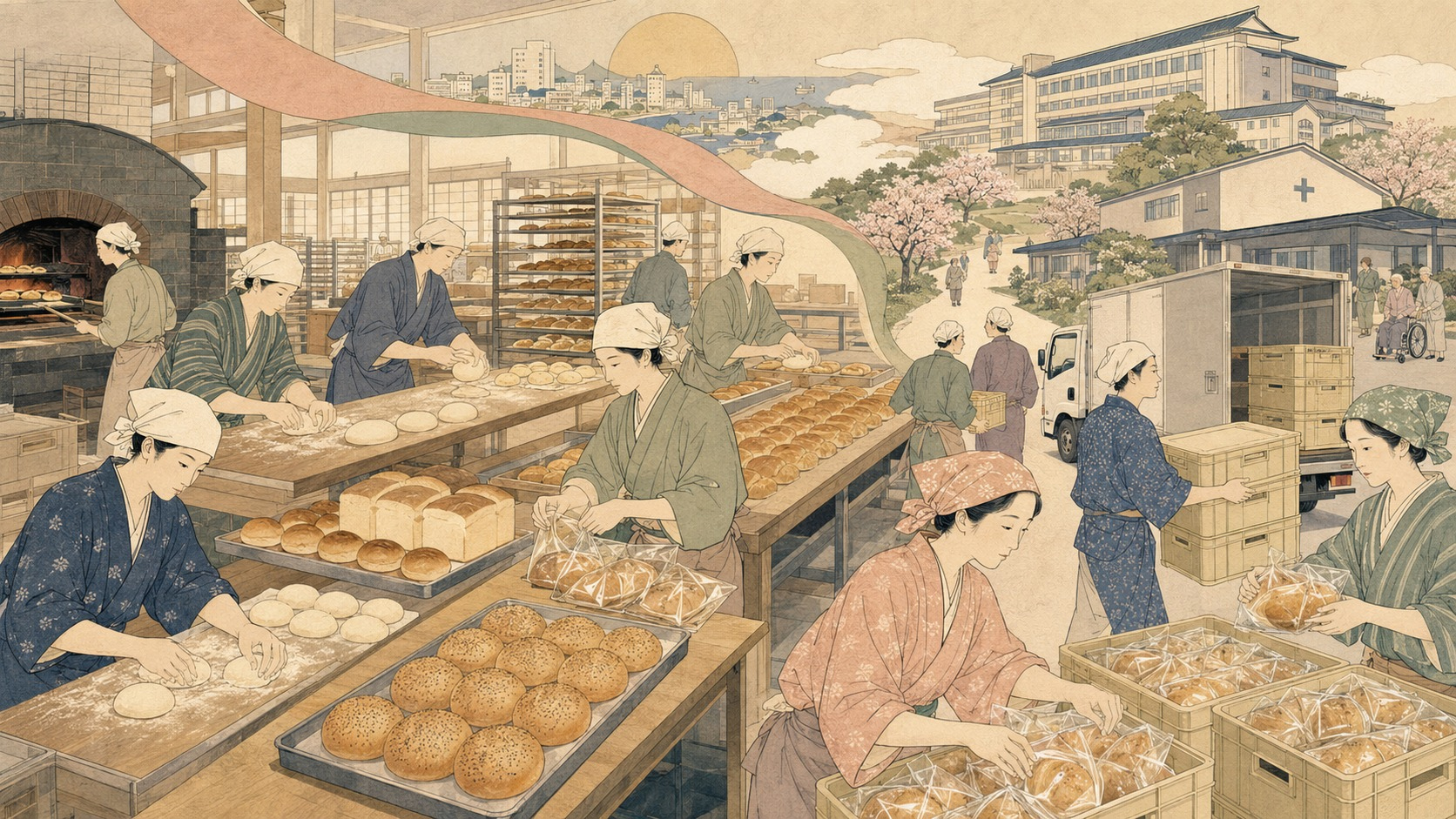
Many people have eaten Oriental Bakery’s bread without knowing its name. They ordered toast in an Osaka coffee shop, picked up a roll at a Kansai hotel breakfast, opened an airline meal or tore the wrapper from a hospital tray. This is not a company that built itself by shouting its brand from supermarket shelves. It works behind kitchens, dietitians, procurement desks and meal carts, making bread fit a customer’s operation.
That invisibility became a life-saving strength. In the spring of 2020, COVID-19 stopped food service, travel and aviation at once. Oriental Bakery’s April–June sales fell to about half their pre-pandemic level. President Yukihiro Harada later told J-Net21, the business-support site operated by Japan’s SME agency, that he felt the company might collapse and considered layoffs. Orders from coffee shops, restaurants and airline caterers nearly vanished. Hospitals and welfare facilities, however, could not stop serving breakfast. The institutional business the company had spent three decades building—by then about half of sales—continued, preserving roughly half the revenue and helping employment-support measures keep the company alive.
Before the crisis, annual sales of about ¥9 billion had placed the ¥10 billion threshold within reach. After a long detour, sales crossed ¥10 billion in fiscal 2023. For the year ended March 2026, Oriental Bakery reports group sales of ¥14.433 billion and standalone sales of ¥12.702 billion. Its workforce includes 318 regular employees and 1,234 part-time and casual workers. The next destination is ¥20 billion in group sales in fiscal 2030. Yet the most revealing question is not the size of the target. It is why a difficult, unglamorous hospital-bread business proved so resilient—and how individually wrapping a roll and driving it farther every morning became competitive advantages rather than costs to eliminate.
A company that sells uses, not loaves
Japan’s large retail bakers gain scale by shipping a limited family of mass-market products from big plants and competing for shelf space. Oriental Bakery’s model points in the opposite direction. It supplies hotels, airline catering, restaurants, cafés, kissaten coffee shops, hospitals, nursing homes and kindergartens. A roll may be served intact, built into a sandwich or counted as one component of a medically managed meal. Size, salt, allergens, texture, wrapper, case quantity and delivery hour all change with the setting.
That is why the catalogue has grown past 1,400 items: white bread and plain rolls, sweet and savory filled bread, salt-free and reduced-salt products, egg-free bread, and products formulated with protein or iron. Harada describes the sales function as more than delivering what a buyer requests. Representatives are expected to ask how a café can improve a menu, how a facility can reduce work and how a meal can satisfy its eater.
Variety complicates production and small deliveries raise logistics expense. But serving several customer types in the same district lets the company place a hospital, hotel, coffee shop and care home on one route. Scattered points become an area. By calling every day on places competitors considered too distant, inconvenient or small, Oriental Bakery built an infrastructure that is hard to copy.
Born from cakes carried between Kobe and Osaka
The company began in 1950. Harada’s father had been an electrical engineer in Japanese-ruled Taiwan before the war and returned to work for an optical-equipment maker in Osaka. His mother helped the household by transporting cakes from Kobe to Osaka coffee shops. Seeing those still-rare Western sweets sell, his father left salaried employment, hired bakers and began production in Namba. He handled sales; she ran the factory.
The moment mattered. Japan revived school lunches after the war using relief food, and bread and powdered milk entered children’s routines. During rapid growth, urban coffee shops, Western restaurants, hotels and family restaurants multiplied. Bread moved from scarce Western novelty and emergency nutrition into the infrastructure of breakfast, eating out and institutional meals. Oriental Bakery captured that change from behind the kitchen rather than from the retail shelf.
Harada’s father canvassed the kissaten of Osaka’s Minami district one by one. Repeated visits turned rejection into orders. The product center shifted from cakes toward white bread. As family restaurants and corporate food service expanded in the 1970s, the company began supplying an airline caterer at Itami Airport. In 1987, bread it had made was served aboard an aircraft carrying Diana, Princess of Wales, during her visit to Japan. For a little-known business supplier, the story opened sales conversations and conferred credibility.
“Far away, every day” becomes a moat
When Harada joined the family company in the early 1970s, it had about 50 employees and sales of ¥220 million. While competitors defended local territories, Oriental Bakery pushed into districts other bakers disliked serving. It opened a Hanshin sales operation in 1982, began production at Izumisano and opened South Osaka sales in 1983, then expanded through East Osaka, North Osaka, Kyoto, Nara and Himeji. Plants and depots gradually connected an area from Kyoto in the north to Wakayama in the south, Himeji in the west and Shiga in the east.
The economics resemble a physical network effect. A long trip for one customer loses money. Add ten and then one hundred stops along the route, and delivery cost per item falls. Combine hotels, coffee shops and hospitals with different order patterns, and vehicle use becomes steadier. The customer gains access to small lots drawn from 1,400 products and a dependable supply close to fresh. A competitor must reproduce not just a factory, but the density of stops and the discipline of its timetable.
The moat is also an exposure. Fuel, drivers and wages directly affect daily delivery. Baking at night and distributing early in the morning makes recruitment difficult. More items mean more changeovers, stock decisions, picking errors and allergen controls. Growing to ¥20 billion is therefore not simply a matter of drawing a larger map. The company has to extend the network without sacrificing density or productivity.
Hospitals changed the company in the 1990s
Oriental Bakery made its serious move into hospitals and elder-care institutions in the 1990s. Those customers wanted more than a soft, pleasant roll. They demanded contamination controls, consistent nutrition, individual packaging that made distribution safer and faster, lot traceability and delivery that arrived when the meal system required it. Wrapping every unit adds material and labor, but a ward buys hygiene and minutes of staff time as well as bread.
The requirements matched the company’s manufacturing philosophy. Harada says Oriental Bakery industrialized a “100 percent sponge” method that was harder to adjust and automate than common production but yielded stronger flavor. Roughly two decades ago it also adopted the yudane scalded-dough method, producing a gently sweet, moist texture that resists drying. When a patient or airline passenger eats hours after baking, texture over time is part of the product. Workers were expected to eat the company’s bread daily and record the effect of temperature, humidity and water temperature, turning tasting into process control.
Meeting hospital standards became a reference for winning the next institution. Healthcare and welfare eventually grew to roughly half of revenue. In ordinary times the segment might appear less glamorous than hotels and tighter on price. But its demand is tied to patients, beds and residents who need meals every day. It does not move only with tourism or discretionary spending. That stability revealed its full enterprise value in 2020.
The spring when everything nearly disappeared
A bread plant cannot switch off its fixed costs. Ovens, buildings, vehicles, sanitation and employment remain when orders vanish. Later accounts by company executives put the brief monthly loss after the pandemic struck in the range of ¥200–300 million. Hotels closed, flights disappeared and restaurants suspended service. A commercial baker’s order book evaporated overnight.
Management used “turn fixed costs into variable costs” as an internal rallying cry and reviewed distribution, inventory and work. Government employment support also helped. The largest breakwater, however, was the hospital and care-home order. Patients and residents did not leave the system, and three meals were still required. As infection controls intensified, the logic of hygienic individual packaging became even easier to understand.
Harada calls the survival a matter of a “small difference” and good fortune. It is a modest judgment, but fortune had somewhere to land because of a choice made in the 1990s. A business optimized around one customer, industry or channel would not have kept half its revenue. Resilience came from diversity that may have looked redundant in normal times.
¥10 billion as a mark of survival, not a finish line
When sales finally exceeded ¥10 billion in fiscal 2023, Harada said relief outweighed triumph. Group revenue is now more than 60 times the level when he joined. He nevertheless discounts the headline growth. Flour, fats, packaging, energy, distribution and labor have risen, prompting four post-COVID price increases. At pre-pandemic prices, Harada told J-Net21, the current business would calculate to only about ¥10 billion.
That candor matters. Moving from fiscal 2026 group sales of ¥14.433 billion to ¥20 billion requires another ¥5.567 billion, or 38.6 percent. If one simply treats the period to March 2030 as four years, the implied compound rate is about 8.5 percent annually. That is a Japan.co.jp calculation, not company guidance. Inflation could make the nominal target easier while leaving volume and profit behind. The quality of the target will be visible in units sold, new customers, productivity, wages and operating profit—not revenue alone.
| Growth engine | What Oriental Bakery is doing | The obstacle |
|---|---|---|
| Kanto | Tokyo, Yokohama and Chiba sales coverage plus a Chiba plant; build route density first through healthcare customers. | Lower recognition, startup delivery cost and a stronger preference for rice in metropolitan hospitals. |
| Premium hotels | The NukumOri daily brand, regional ingredients, domestic wheat, small ambient-temperature lots and breakfast presentation. | Deliver quality, narrative and reliability while escaping price-only competition. |
| Healthcare and care | Individual packs, salt-free and reduced-salt bread, egg-free products, nutrition adjustment and less kitchen work. | Tight meal budgets, individual nutrition and swallowing needs, staff shortages and regulated reimbursement. |
| E-commerce and frozen | Rapid freezing after baking; direct sales to former patients, health-conscious households and small businesses. | Parcel and advertising costs, customer acquisition and unfamiliar consumer-marketing skills. |
| Productivity | Plant capacity, route optimization, one-to-one training and younger staff leading digital marketing. | Night baking, early distribution, wage pressure, skill transfer and the complexity of 1,400 products. |
Kanto is a battle for density, not just a factory
Oriental Bakery entered Tokyo in 2016, opened in Yokohama in 2020 and added a Chiba sales office in 2023. Its Chiba plant began production in 2022. Local baking improves freshness and shortens delivery. But a plant alone cannot transplant the Kansai advantage. The missing asset is enough customers to fill every vehicle route.
The opening wedge is the market the company understands best: hospitals and welfare facilities. Harada believes hospital patients in metropolitan Tokyo are more oriented toward rice and that bread remains underdeveloped. The pitch is not simply a cultural argument over rice and bread. Individually wrapped bread can be placed on trays the previous day. It reduces early-morning rice cooking and preparation; a filled savory bread can replace one side dish. The economic buyer is the kitchen struggling to staff an unpopular hour.
Bread is not appropriate for every patient. Swallowing ability, allergies, kidney disease, diabetes, sodium and cultural preference require individual judgment. Its value is not replacing rice wholesale. It is expanding the dietitian’s options while making the kitchen workable.
Supporting “I can eat it myself” in a super-aged Japan
Japan has 36.24 million people aged 65 or older, 29.3 percent of its population. More than 6.8 million people have been certified as needing support or long-term care. Healthcare and institutional food are among the few sources of structural demand in a shrinking country. They are also among the most constrained by budgets and labor.
An individually wrapped roll is easy to hold, relatively hard to spill and manageable with one hand. For some residents, that preserves the act of eating without assistance; for a caregiver, it can reduce workload. Salt-free and reduced-salt bread, egg-free products, items with about eight grams of protein and iron-fortified options give dietitians components that can be fitted into a limited menu. A moist yudane texture matters when food will be served well after the oven.
In this setting, pleasure is not ornamental. Whether an older person looks forward to a meal and finishes it affects nutrient intake and quality of life. As Japan’s 2025 dietary-reference standards emphasize malnutrition, frailty and protein in older adults, bread can become more than a block of carbohydrate. It is a platform for delivering a designed amount of nutrition.
The failed sports bread that found a care market
Oriental Bakery launched its Protein Custard bread in 2019 as a snack for student athletes. It struggled. Compared with a banana or a homemade rice ball, it cost too much and sold only a few dozen units a month. The formulation was not necessarily wrong; the customer and the job were.
After hearing that geriatric-health facilities were struggling to meet revised protein requirements within existing meals, the company repositioned the product as part of its Karada Omoi, or Body-Caring Bread, range and took it to dietitians. One item could help balance protein, fat and carbohydrate and simplify menu planning. Monthly volume rose to roughly 5,000 units; cumulative orders exceeded 270,000 by 2025, and the product received a jury-chair award in Japan’s nursing-food competition.
The pivot is a compact lesson in innovation. Rather than discard the failed product, Oriental Bakery searched for the problem that made its function valuable. For a student, the competitor was a cheap banana. For a facility, the competitors were a nutrition shortfall and staff time. Value did not reside in the recipe alone. It emerged from the recipe’s relationship with a workplace.
Beyond the hospital: e-commerce changes the distance to the eater
Commercial bread contained a contradiction: a patient could like a salt-free or nutrition-adjusted roll in hospital and be unable to buy it after discharge. Oriental Bakery expanded online sales from 2025 and completed a broader site overhaul in February 2026 around health, support for small businesses and food culture. A product once confined to an institutional procurement contract could reach the former patient at home.
Rapid freezing immediately after baking pushes the service radius beyond a one-day truck route. A household can store bread and thaw only what it needs. Food trucks and small restaurants gain a low-lot option. For hotels, the company’s NukumOri brand takes the opposite approach—small ambient-temperature deliveries baked every day, avoiding freezer capacity and thawing work. Preservation technology is selected for the channel rather than imposed on every customer.
E-commerce is nevertheless foreign territory for an organization built on representatives walking into kitchens. Search, advertising, photographs, repeat orders, parcel economics and customer data determine success. Frozen delivery is costly. The digital-marketing work led by younger employees is therefore not merely another shop window; it is an organizational experiment for the ¥20 billion company.
Premium hotels sell margin and meaning
Healthcare can provide stable volume; premium hotels can provide value added. The NukumOri brand launched in 2025 uses domestic wheat and fillings with identifiable regional origins, presentation equipment for the buffet, pre-cut products and small daily lots. It seeks to reduce freezer use and waste while giving a guest regional identity and a sense of fresh baking.
This is a modern version of the company’s original network logic. A hospital buys nutrition and hygiene. A hotel buys aroma and an exceptional morning. A café buys a menu idea. The underlying plant skills overlap, but the language of value changes. A 1,400-item range is merely expensive complexity if salespeople cannot translate it into uses. If they can, it becomes a barrier to entry.
Profit has to come before the sales trophy
The ¥20 billion target was set before COVID. Since then, flour, fats, wrapping, energy, distribution and labor have become more expensive. Recruitment requires higher wages. Harada warned in 2026 that prioritizing revenue in this environment could produce growth without profit; management must emphasize earnings first. A ¥20 billion top line looks impressive, but layering unprofitable routes onto the network can exhaust the operation.
Training is production capacity too. Oriental Bakery pairs a salesperson with an experienced colleague and teaches factory work one to one. It has sent more than 200 employees in total to programs at Japan’s SME university. The company also says it shares profit-and-loss information internally, down to departments. Because night production and morning delivery cannot be solved entirely by machines, reducing turnover and improving judgment can matter as much as adding an oven.
- Volume: Unit sales and plant utilization rise, rather than prices alone.
- Density: Revenue and customers per delivery route improve in Kanto.
- Profit: Flour, fuel and wage costs are priced adequately, leaving funds to reinvest.
- People: Pay, days off and training make night and early-morning work sustainable.
- Social value: The company earns for solving patient, resident and kitchen problems—not merely for producing more bread.
Resilient companies can look slightly inefficient in normal times
Oriental Bakery’s history offers a small challenge to conventional efficiency. Distant customers, tiny orders, laborious wrappers and an excessive catalogue all look like targets for pruning. Yet distance became a regional network, small stops became route density, wrapping became healthcare credibility and multiple industries became pandemic insurance.
Not every complication creates value. An unused product, an empty vehicle and a permanently loss-making account still require action. The lesson is not to preserve inefficiency. It is to avoid cutting a capability that solves a difficult customer problem merely because a quarterly spreadsheet cannot yet see its option value.
In 1950, cakes carried from Kobe found customers in Osaka coffee shops. In 2020, individually wrapped rolls carried to hospitals helped save the company. The question for 2030 is what Oriental Bakery carries next, and to whom. Price increases and market recovery may help it reach ¥20 billion. Becoming the national leader requires something harder: reproducing in the Tokyo region the trust it built in Kansai over 75 years—one vehicle, one institution and one meal at a time.
Primary sources and methodology
This article is anchored in the July 24, 2026 J-Net21 interview with President Yukihiro Harada and cross-checked against company materials, healthcare-product information and government data. Oriental Bakery is privately held; detailed profit, customer-segment and unit-volume data are not public. The revenue gap and implied compound growth rate to ¥20 billion are simple Japan.co.jp calculations from reported sales, not company forecasts.
- J-Net21: Kansai’s commercial-bread leader survives COVID and targets Japan, July 24, 2026
- Oriental Bakery: company profile and fiscal 2026 sales
- Oriental Bakery: president’s message and founding history
- Oriental Bakery: company chronology
- Oriental Bakery: plants, sales offices and logistics facilities
- Shachomeikan: Harada interview on production, sales and the 2030 target
- Oriental Bakery: labor-saving bread meals for healthcare and welfare
- Oriental Bakery: the Protein Custard pivot into elder-care nutrition
- Oriental Bakery: NukumOri hotel strategy
- Oriental Bakery: e-commerce overhaul and three-stage model
- Kinki economic-development program: the COVID loss and fixed-cost response
- Ministry of Agriculture: school lunches and the postwar history of bread
- Cabinet Office: 2025 Annual Report on the Ageing Society—population
- Cabinet Office: long-term-care certification data
- Health Ministry: Dietary Reference Intakes for Japanese, 2025 edition
- Agriculture Ministry-supported project: Oriental Bakery’s rice-flour roll