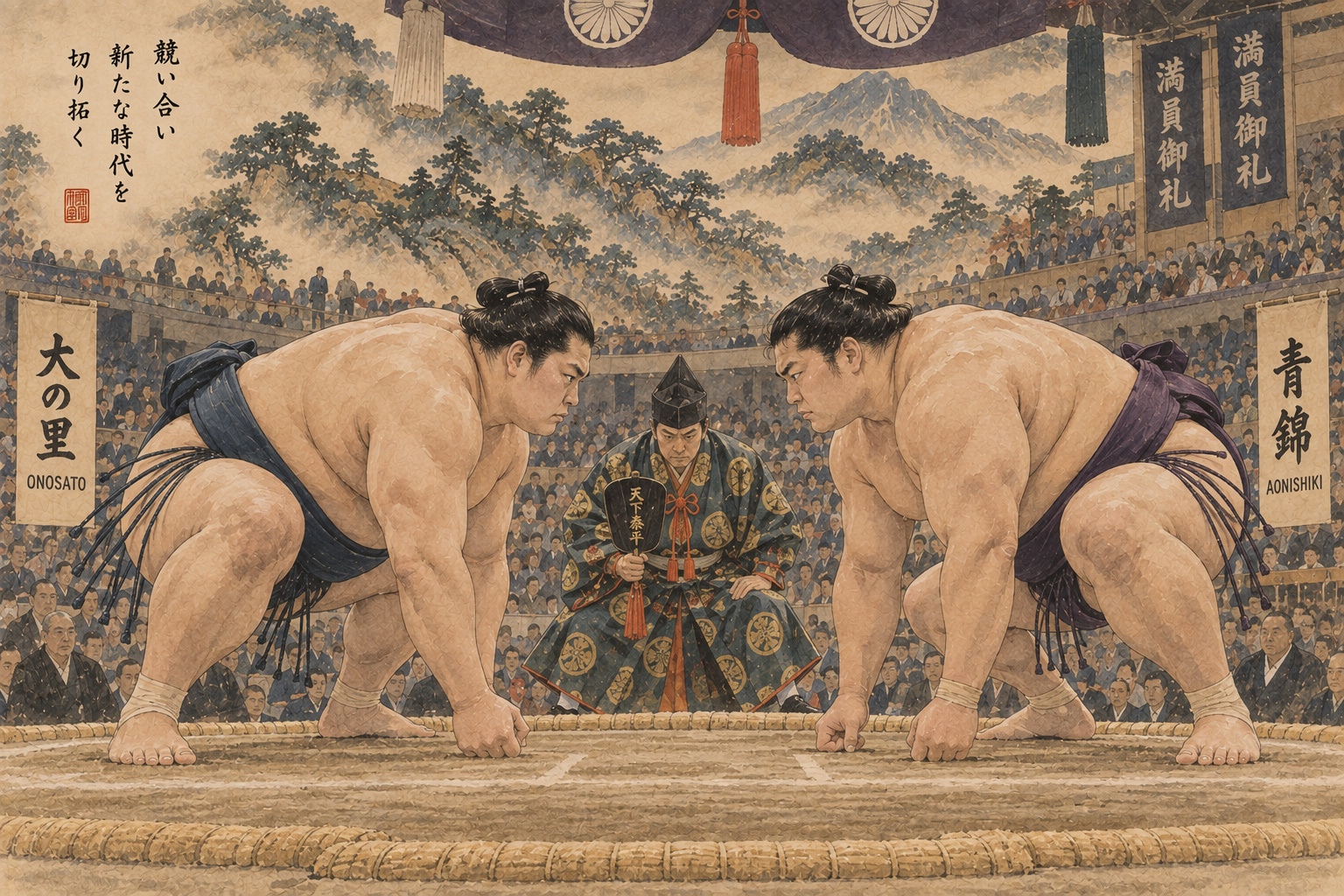
On September 27 at Tokyo’s Ryogoku Kokugikan, the final bout of the Autumn Grand Sumo Tournament was also the championship match. Yokozuna Onosato and ozeki Aonishiki entered the day tied at 11–3. Onosato drove Aonishiki out by tsukidashi to finish 12–3 and secure his sixth top-division championship, his first title in six tournaments.[1]
The Japan Sumo Association’s bout commentary describes Onosato striking with both hands, preventing Aonishiki from securing the left front of the mawashi, then extending his thrusts to raise the smaller man’s center of gravity and drive him backward. At 190 centimeters and 188 kilograms, with thrusting, pushing, right-hand inside grappling and forward force among his listed strengths, the yokozuna won in the most recognizably Onosato way possible.[2]
First, it is too early to declare a historic rivalry
Grand sumo does not turn two wrestlers into era-defining rivals because of one dramatic final-day bout. The great pairings remembered across decades—Tochinishiki and Wakanohana I, Kashiwado and Taiho, Akebono and Takanohana—were built through years of meetings near the top of the rankings, repeated championship races and bouts that affected promotion and legacy.
Onosato and Aonishiki have met only four times in official competition. The Japan Sumo Association’s recent head-to-head display gives Onosato a 3–1 advantage.[3]
But the ingredients are unusually promising. Onosato is a 26-year-old yokozuna. Aonishiki is a 22-year-old ozeki. Both already have multiple championships. And in September, they arrived at the final bout level on wins, with the Emperor’s Cup determined directly between them.
Onosato after the fastest rise to yokozuna
Onosato Daiki was born June 7, 2000, in Tsubata, Ishikawa Prefecture. His birth name is Daiki Nakamura and he belongs to Nishonoseki stable. The Japan Sumo Association currently lists him at 190 centimeters and 188 kilograms, with thrusting, pushing, right-yotsu and yorikiri-style forward sumo among his strengths.[4]
He entered professional sumo as a makushita tsukedashi entrant in May 2023, reached juryo that September, the top division in January 2024, ozeki in November 2024 and became the 75th yokozuna from the July 2025 tournament.[4]
His promotion after only 13 tournaments from professional debut was the fastest for a wrestler entering under the six-tournament system established in 1958, breaking a long-standing benchmark associated with Wajima. He was also the first Japan-born new yokozuna since his own stablemaster, former yokozuna Kisenosato, eight years earlier.[5]
That extraordinary speed also raised expectations after promotion. The Association’s tournament history records Onosato withdrawing after four losses in March 2026 and sitting out the entire May tournament.[6]
That is why September mattered as more than championship No. 6. Japanese reporting described him in tears at the ceremony, recalling that he had wondered whether he would be able to win again. The six-tournament gap included the first sustained adversity of his yokozuna career.[7]
Aonishiki is no longer merely “the young challenger”
Aonishiki Arata was born March 23, 2004, in Vinnytsia, Ukraine. His birth name is Danylo Yavhusishyn, and he belongs to Ajigawa stable. The Association lists him at 182 centimeters and 142 kilograms, with right-yotsu and yorikiri as his preferred sumo.[8]
He made his professional debut in September 2023, reached juryo in November 2024, makuuchi in March 2025 and sanyaku in September 2025. After winning his first top-division championship at sekiwake in November 2025 with a 12–3 record, he was promoted to ozeki for January 2026.[9]
The Association’s official channel described the 14 tournaments from debut to ozeki as the fastest such promotion in the modern six-basho era for a wrestler without a special amateur entry position.[9]
He already has three top-division championships. After dropping back to sekiwake, he won the July 2026 tournament at 12–3 and returned to ozeki for September. At 22, he has moved beyond the category of prospect. He is already one of the men most capable of taking championships away from the yokozuna.[8][10]
From wartime Ukraine to the top of sumo
Aonishiki’s route to professional sumo carries a history far larger than sport. He began sumo in Ukraine at age seven and won bronze at the 2019 world junior championships. After Russia’s invasion of Ukraine, he left the country, traveled through Germany and came to Japan, where he trained with Kansai University’s sumo club beginning in 2022. He later entered Ajigawa stable and debuted professionally in autumn 2023.[11]
Accounts of his shikona explain that “A” and “nishiki” come from stablemaster Ajigawa’s former ring name Aminishiki, while the character for blue, ao, references the Ukrainian flag.[11]
That story understandably draws attention. But it should not be confused with the reason he holds ozeki rank. Promotion in sumo is earned through results, and Aonishiki’s rapid accumulation of wins and championships is what put him there.
A 46-kilogram contrast that spectators can see instantly
Onosato weighs 188 kilograms. Aonishiki 142. Onosato is 190 centimeters; Aonishiki 182. The physical contrast gives their bouts an intuitive structure.
Onosato wants to create force immediately—heavy contact, upward pressure and forward movement. Whether thrusting or grappling, his best sumo compresses the dohyo before an opponent can establish a preferred shape.
Aonishiki is listed as a right-yotsu wrestler. In the Association’s six-basho kimarite breakdown, roughly 40% of his recent wins have come by yorikiri, but his results also include oshidashi, yoritaoshi, katasukashi, uchimuso, shitatehineri and throws. He is smaller but structurally versatile.[12]
In July 2026, Aonishiki beat Onosato by uwatedashinage, redirecting the larger man rather than allowing him to simply drive straight through. Onosato’s other wins in the matchup have come through forward-force techniques including oshidashi, yorikiri and yoritaoshi.[3][10]
The tactical question is easy to see: can Onosato raise Aonishiki before the ozeki establishes his grip, or can Aonishiki enter low enough to secure the mawashi and create angles?
The September final displayed that contrast perfectly
On the last day, Onosato prevented Aonishiki from taking the left front of the mawashi. He never allowed the bout to settle into Aonishiki’s right-yotsu game. Instead, his initial impact became a sequence of thrusts that forced the ozeki upright and out.[2]
July had shown the reverse possibility. Aonishiki’s uwatedashinage demonstrated that if he can survive the initial pressure and attach himself to Onosato’s body, the larger wrestler’s momentum can become something to redirect.
Only four meetings have occurred, but the victory conditions are already distinct enough to make each future bout tactically legible.
A lone yokozuna and a very young ozeki
Onosato entered the September tournament as the sole yokozuna. Yokozuna cannot be demoted, but that permanence creates a different obligation: sustained championship-level performance. Ozeki can lose rank, and Aonishiki has already experienced leaving and regaining it.
The difference in rank creates part of the potential rivalry. Aonishiki’s next possible destination is yokozuna. Onosato is already there. If Aonishiki begins a formal yokozuna promotion run, a late-tournament bout against Onosato could affect not only a championship but whether the younger wrestler reaches sumo’s highest rank.
The promotion standard is championship-level performance at ozeki
The Yokozuna Deliberation Council’s traditional guideline looks for two consecutive championships at ozeki or an equivalent performance. Onosato himself met the clearest version of that standard by winning the March and May 2025 tournaments consecutively before becoming yokozuna.[5]
Aonishiki already owns three championships, but a future yokozuna challenge would depend on what he achieves while holding ozeki rank and on the quality and consistency of those results.
If those campaigns repeatedly end with Onosato across the dohyo on days 14 or 15, the rivalry thesis will stop being speculative.
Sumo eras are often remembered through pairs
Professional sumo history frequently compresses complicated eras into opposing names. Tochinishiki and Wakanohana I became the “Tochi-Waka” era; Kashiwado and Taiho the “Hakuho” era in Japanese shorthand; the 1990s are inseparable from the collision of Akebono and Takanohana. The Association’s list of historical yokozuna shows how these champions overlapped at the top and accumulated major title totals during the same periods.[13]
It would be premature to place Onosato and Aonishiki beside them. Those historical rivalries involved years and dozens of high-level meetings. Onosato and Aonishiki have four.
What can reasonably be said is that the structural ingredients have appeared unusually early: youth, high rank, championship ability, contrasting physiques, different tactical strengths and direct relevance to the Emperor’s Cup.
Onosato had to return for the matchup to matter
A rivalry requires both athletes to remain strong at the same time. Aonishiki could surge through the rankings, but there would be no enduring head-to-head story if Onosato were repeatedly absent.
Association records show Onosato pulling out after an 0–4 start in March 2026 and missing May entirely. His 12–3 September championship therefore restored more than his personal title count. It returned the yokozuna to the center of the competitive hierarchy.[6]
For Aonishiki, that means the man at the very top is once again present to be challenged.
Aonishiki’s return to ozeki was fast too
Aonishiki held ozeki rank from January through May 2026, returned to sekiwake, then won the July tournament at 12–3. The Japan Sumo Association’s September banzuke notes his return to ozeki after two tournaments away.[14]
Three championships by age 22 suggest something more durable than one hot tournament. And the speed of his rise creates an obvious parallel with Onosato: both reached elite rank unusually quickly.
The routes were different. Onosato came through elite amateur sumo and entered professional competition with makushita status. Aonishiki started in jonokuchi and moved through every division. Their careers converged only after taking very different paths upward.
What to watch the next time they meet
The tachiai. If Onosato gets Aonishiki upright immediately, the smaller wrestler loses much of his leverage. If Aonishiki enters low and reaches a front grip or right-yotsu position, his range of techniques expands.
The tournament context. A day-two bout is not the same as a day-15 tie for first. Rivalries are made when meetings repeatedly decide championships.
Aonishiki’s yokozuna trajectory. A 22-year-old ozeki with three championships will naturally draw promotion attention if he strings together elite records. Onosato could become both the benchmark and direct obstacle.
An era that does not have a name yet
“Tochi-Waka” and “Akebono–Takanohana” were not labels born on the first day those men met. They were created by repetition—years of shared title races until fans could not tell the story of one wrestler without mentioning the other.
Onosato and Aonishiki are nowhere near that point.
But September 27, 2026 may eventually look like an early marker: a 26-year-old sole yokozuna reclaiming the Emperor’s Cup after a difficult year by beating a 22-year-old ozeki in a final-day winner-take-all bout.
If the same two names keep appearing beside each other on the leaderboard in Kyushu, Tokyo and beyond, the question will gradually change. It will no longer be whether sumo has found a new rivalry. It will be which of them defines the era.
Sources
- Japan Sumo Association, September 2026 champions
- Japan Sumo Association, final-day Onosato–Aonishiki bout commentary
- Japan Sumo Association, recent Onosato–Aonishiki head-to-head
- Japan Sumo Association, 75th yokozuna Onosato Daiki profile
- Japan Sumo Association, Onosato yokozuna promotion
- Japan Sumo Association, Onosato tournament record
- Daily Sports, Onosato’s September comeback championship
- Japan Sumo Association, ozeki Aonishiki Arata profile
- Japan Sumo Association, Aonishiki promoted to ozeki
- Japan Sumo Association, Aonishiki tournament record
- Nippon.com, Aonishiki’s route from Ukraine to his first championship
- Japan Sumo Association, Aonishiki kimarite profile
- Japan Sumo Association, historical yokozuna list
- Japan Sumo Association, September 2026 banzuke topics