A new factory, and a much bigger question
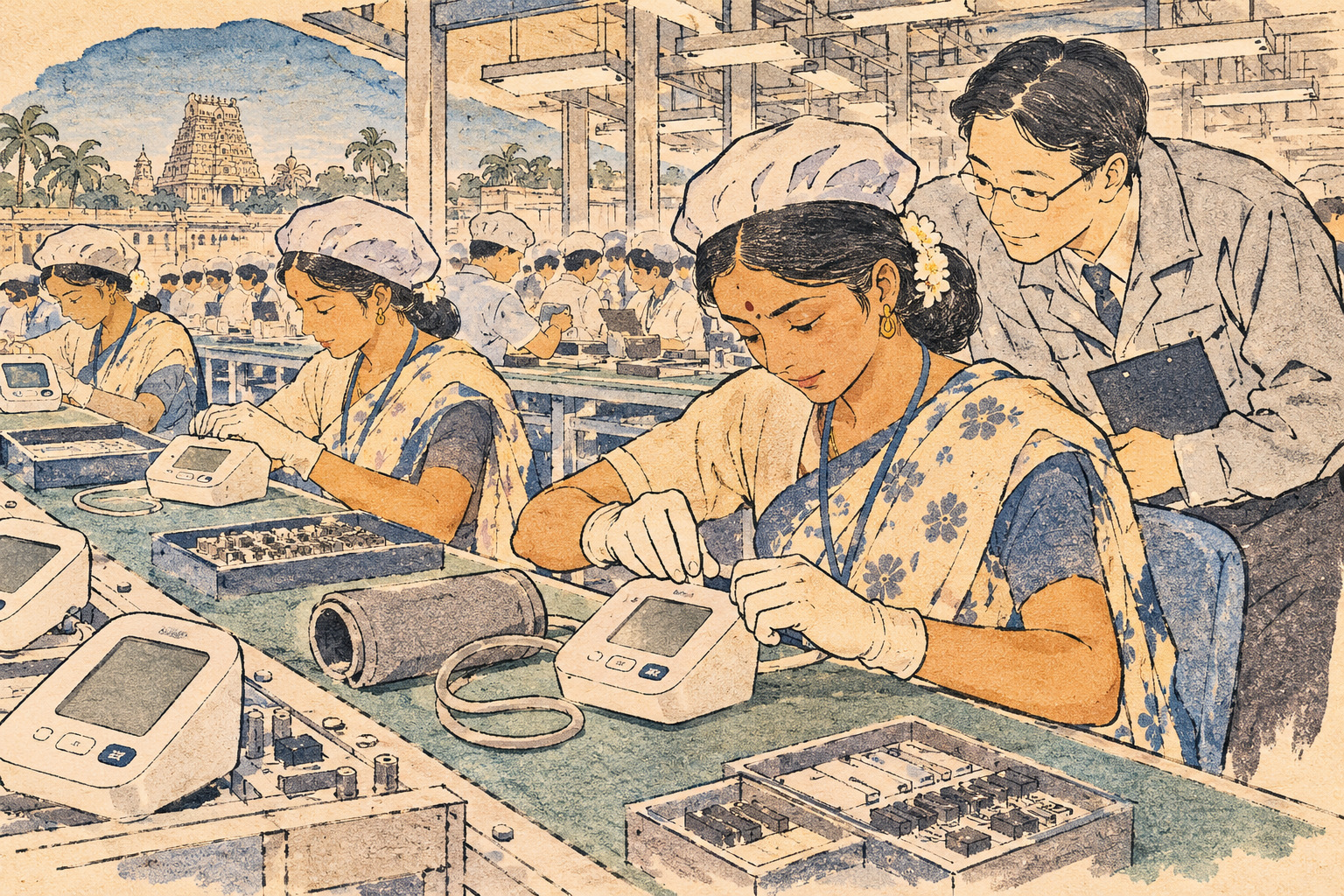
On October 30, 2026, Japan’s OMRON Healthcare opened its Indian blood-pressure monitor production operation to journalists as full-scale manufacturing began near Chennai. The five-line facility in Tamil Nadu is the first OMRON Group factory in India. Its output is meant initially for local customers, a major shift for a company that spent years building the market through sales, physician partnerships and public education before adding manufacturing capacity.
The obvious headline is a Japanese device maker expanding its global footprint. The more consequential question lies beyond the factory gate: can a reliable, affordable home-monitoring device become part of a healthcare system capable of identifying high blood pressure and keeping it controlled? India offers a vast test of how consumer medical technology can support—and where it cannot substitute for—public health.
What opened near Chennai
OMRON HEALTHCARE MANUFACTURING INDIA Pvt. Ltd. was incorporated in July 2022. The facility began mass production in October 2026 at ORIGINS Mahindra World City, in the Tiruvallur district north of Chennai. OMRON lists a site of about 24,000 square meters, five production lines, approximately 120 employees as of November 2026 and capitalization of INR 1.91 billion. The company identifies Takuto Iwanaka as managing director.
The opening is a manufacturing milestone, not the announcement of a wholly new consumer brand. OMRON has operated a healthcare business in India since 2010. And the plant is described by the company as the group’s first production site in India—not proof that no other Japanese medical-device companies manufacture there. Geographic precision matters: the operation is near Chennai, not in the city center.
Three monitors, three levels of connected care
At launch, the facility manufactures upper-arm blood-pressure monitors across the HEM-7090, HEM-7181 and HEM-7183T series. The 7090 is positioned as a straightforward option for people new to home monitoring. The 7181 adds a memory feature and a trend indicator. The 7183T has a Bluetooth link to OMRON Connect and a cuff designed for easier application. All three are described as products for the Indian market.
This range reflects a practical distinction. A connected model can help store readings, but some customers may lack a compatible smartphone, reliable connectivity or the desire to share health data. A simpler, validated upper-arm monitor may be more appropriate for them. The company has not disclosed a common retail price, the initial annual output of the lines or an independent comparison of affordability across India.
A tenfold goal is not tenfold production
OMRON says it aims to increase the Chennai site’s production capacity tenfold by 2028. That is a target, not a reported achievement. Because the current annual unit capacity was not provided, a tenfold increase cannot responsibly be translated into a specific number of future monitors. Earlier speculation about three million units a year is not corroborated by the October 30 primary release and should not be treated as confirmed.
In the longer term, the company envisages serving export markets from India and adding nebulizers used in respiratory treatment. Those changes would expand the site’s role in OMRON’s international manufacturing network. They also raise questions about sourcing, regulatory requirements, technical training and quality systems that have yet to be answered with quantitative disclosures.
The hypertension gap in numbers
The World Health Organization’s 2025 country profile estimates that India had 210.2 million adults aged 30–79 with hypertension in 2024, equivalent to about 30% of that age group. Of those, approximately 82.2 million were diagnosed, 68.5 million treated and only 36.3 million—17%—had their blood pressure controlled. Around 173.9 million people in the same estimated group therefore did not have it controlled.
These are more informative than treating India as simply a giant market. A monitor may help someone recognize a concerning pattern, but diagnosis requires a pathway to clinical care; treatment requires accessible medicines and follow-up; sustained control requires persistence. OMRON’s announcement references approximately 300 million people with hypertension, without establishing that its population definition matches the WHO’s age-limited estimate. The two figures must not be casually combined.
Why home readings matter—and what they cannot do
Blood pressure varies across the day and in different settings. Repeated readings at home can complement clinic measurement, help clinicians evaluate trends and sometimes reveal discrepancies between readings in different environments. The value depends on appropriate device validation, correct cuff fit, positioning and recording technique. A reading is information; it is not a diagnosis by itself and does not justify self-adjusting medication.
The 2025 WHO profile shows why the next step matters: only a minority of Indians with hypertension were estimated to have adequate control. India’s public-sector programs have sought to scale standardized treatment, registration and follow-up. A government training module describes the “75 by 25” initiative, begun in 2023, with a target to bring 75 million people with hypertension and diabetes under standard care by 2025. That target should not be mistaken for a verified outcome.
A company founded around precision, not medicine
OMRON’s roots stretch to 1933, when Kazuma Tateishi founded Tateishi Electric Manufacturing Works in Osaka. Its early work included timers for X-ray photography, equipment where reliable control was essential. The company later moved to Kyoto, developed switching and automation technologies, and built a broad electronics business. The name OMRON traces to the Omuro district of Kyoto and became the corporate name in 1990.
From factory controls to healthcare, the connecting idea was measurement deployed for a human purpose. The company’s own historical accounts describe medical-device research from the early 1960s and a concept it called health engineering. That pedigree does not automatically validate every later device or service; it does explain why a company associated with industrial automation became deeply involved in home health monitoring.
The 1973 turning point
OMRON introduced its first manometer-type blood-pressure monitor for home use in 1973, at a time when routine measurement was far more closely associated with medical facilities. Later digital and increasingly automated models reduced the skill and effort required from users. Improvements in cuffs, user interfaces and memory made it more practical for individuals to record readings repeatedly rather than rely exclusively on a once-in-a-while clinic number.
The scale of adoption is striking. According to OMRON’s 2025 announcement, cumulative global sales rose from 100 million monitors in 2009 to 200 million in 2016, 300 million in 2021 and over 400 million by September 2025. Cumulative devices sold are not the number of active users, households owning functioning monitors or people whose blood pressure improved. Nevertheless, the trajectory captures the expansion of a once-specialized instrument into a familiar household object.
The production knowledge moving from Japan and Vietnam
OMRON says the Chennai operation draws on expertise from its Matsusaka factory in Mie Prefecture and its Vietnamese manufacturing base. Making a blood-pressure device is not merely assembling plastic, a display and a cuff. Reliable production demands consistent components, process controls, tests and traceability. Replicating standards across plants is a technical and organizational undertaking that depends on skilled local staff.
Its Indian production plan also aligns with the government’s Make in India policy and a desire to use local materials and develop talent. But OMRON has not provided a breakdown of domestic versus imported parts, detailed supplier lists, local-content percentages or a cost comparison with devices imported into India. Claims of lower prices or strategic self-sufficiency therefore remain hypotheses to test, rather than established outcomes.
Sixteen years in India before the first local factory
The new operation follows an Indian healthcare business launched in 2010. OMRON says it has promoted awareness of home blood-pressure measurement and worked with the Indian Society of Hypertension on early home-monitoring guidelines. This sequence is significant: distribution and professional engagement preceded local mass production, rather than the company simply entering a market with a factory.
There is a broader business model at work. OMRON also develops connected records, cardiovascular monitoring and services that can help connect patients with care teams. However, a device with a phone app is not automatically a telemedicine program, and not every model built in Chennai is connected. The test for adoption will be whether different users can measure accurately, interpret the results appropriately and reach a clinician when needed.
The distance between factory output and access
Producing locally can shorten some supply chains, but the price on a pharmacy shelf is shaped by far more than freight: components, taxes, distribution, regulation, retailer margins, service networks and purchasing power matter. Rural coverage, language support, battery replacement, repairs and clear measurement instructions will influence whether monitors are used after their first purchase. Independent retail and utilization data are needed to assess what the new plant changes.
OMRON says fewer than 5% of Indian households practice home blood-pressure monitoring, but the announcement does not identify a public primary survey establishing the figure’s denominator and reference year. It is best attributed to the company. Even if device ownership rises, hypertension control requires continuity of medication and care. An industrial success metric and a public-health success metric are related but not interchangeable.
How to judge this manufacturing bet in 2028
The factory could become a meaningful node in India’s medical-device ecosystem if it trains a sustainable workforce, achieves consistent quality, develops local suppliers and actually expands capacity as promised. Export production and nebulizer lines would deepen that role. None of those future expansions is yet a fact. Investors will want details on investment, capacity, revenue, margins and sourcing; clinicians will ask about validation and access.
At the center of the story is a simple device and a complex system. The factory creates the possibility of more monitors reaching Indian homes. What happens afterward—repeated measurements, informed clinical decisions and sustained treatment—will determine whether that industrial capacity translates into better health. The October opening is an important beginning, not the final evidence of success.
Sources and reporting method
Desk research using OMRON Healthcare announcements in Japanese and English, company historical records, WHO statistics and Government of India materials. No independent visit to the factory, interviews with workers or product validation testing were performed. Unreported capacity and price figures were not estimated.
- OMRON Healthcare, Japanese announcement, October 30, 2026
- OMRON Healthcare, English announcement, October 30, 2026
- WHO, Global report on hypertension 2025, India profile, page 171
- OMRON Corporation, Japanese corporate chronology
- OMRON Corporation, origin of the name
- OMRON Healthcare, 400 million cumulative monitors sold, October 2025
- OMRON Healthcare, Japanese history of home blood-pressure monitoring
- OMRON Healthcare, cardiovascular business overview
- India National Health Mission, NCD medical-officer training module
- OMRON Healthcare, product-development history
- OMRON Corporation, integrated report 2025: innovation and company history