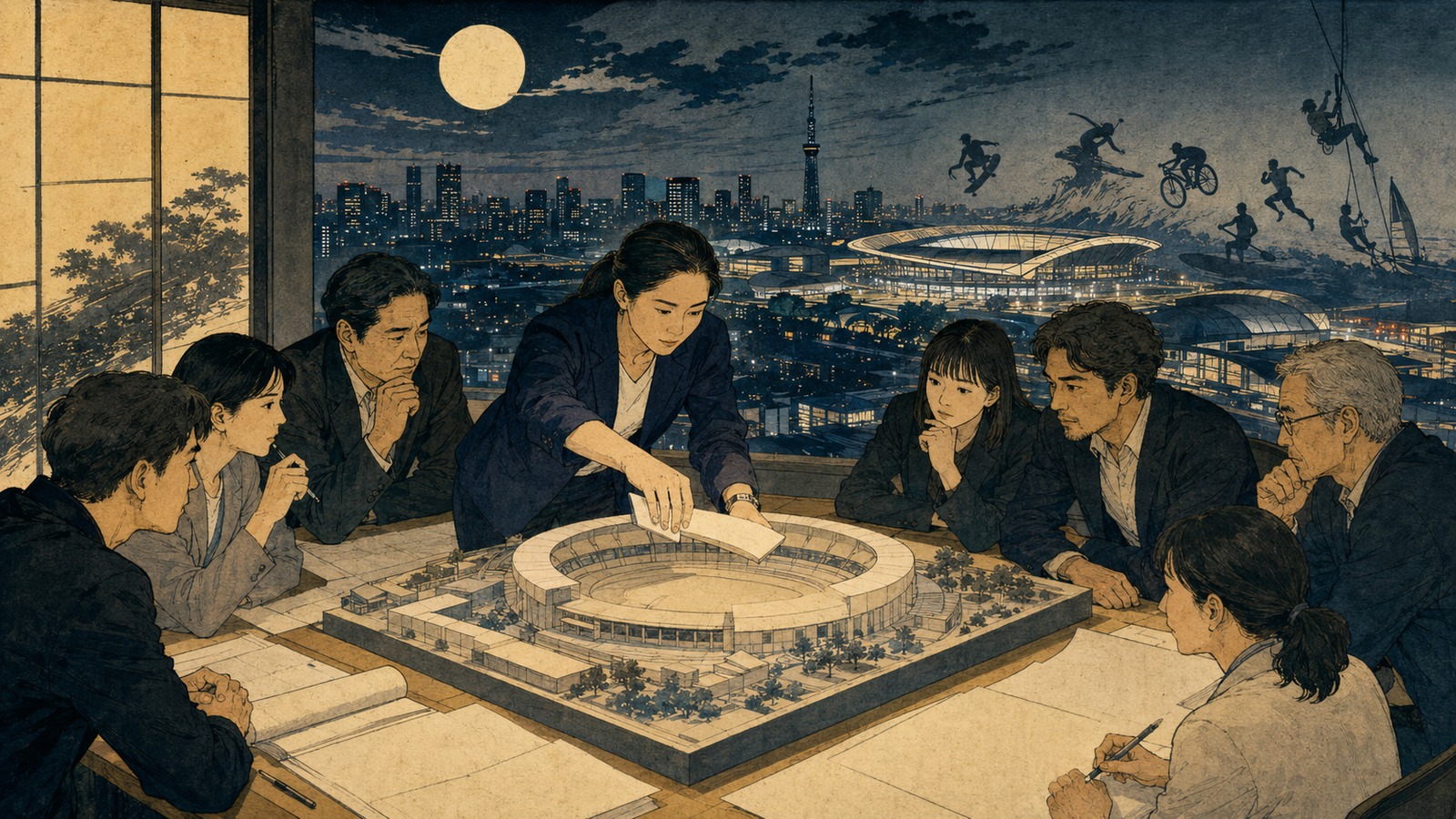
In a meeting room at Japan Sport Olympic Square, beside the old National Stadium precinct, Tokyo began building a bridge between two Olympic memories.
Behind it lies Tokyo 2020: the Games in which skateboarding, BMX freestyle, sport climbing and 3x3 basketball made dazzling Olympic debuts in almost empty venues. Ahead lies Los Angeles 2028, where those same sports will help carry an Olympic movement increasingly shaped by short-form competition, music, public parks and athletes who learned their first tricks outside traditional clubs.
On August 3, the Japanese Olympic Committee established the Olympic Q-Series 2028 Tokyo Foundation and selected Yuki Ota—Japan’s first Olympic fencing medalist and now a JOC managing director—as representative director and chair. Vice Governor Tomohide Sato and Visional president Soichiro Minami became vice chairs; former vice governor Shoichi Kurioka was named secretary-general. A first board meeting approved the operating framework, agreements with JOC and Tokyo, a first-year plan and budget, and the beginning of roughly two years of preparation.
The assignment is compact on a calendar but large in consequence. From May 4 through 7, 2028, Tokyo will open the four-city Olympic Q-Series at a Yoyogi Urban Park spanning the Yoyogi Park and National Yoyogi Stadium area. Athletes in 3x3 basketball, BMX freestyle, sport climbing and skateboarding—both street and park—will compete on the road to LA28. Shanghai follows a week later; Montreal and Orlando complete the series in June.
What the “Q” means
The letter is short for qualification. The competition began as the Olympic Qualifier Series before Paris 2024 and has been renamed the Olympic Q-Series for the Los Angeles cycle. It is not a travelling miniature Olympics, although it borrows the multi-sport spectacle. Its essential function is to gather decisive Olympic qualification events in one place and present them as a festival rather than a sequence of isolated federation tournaments.
The inaugural 2024 series put breaking, BMX freestyle, skateboarding and sport climbing together in Shanghai and Budapest. A total of 464 athletes from 120 national federations were entered. Points from the two stops carried heavy weight, and more than 150 athletes were expected to secure Paris quota places in Budapest. The format gave spectators a single urban park in which climbing walls, ramps, bowls and dance floors could operate side by side.
For 2028, the IOC has expanded the concept to six sports and four cities. The full roster comprises 3x3 basketball, beach volleyball, BMX freestyle, flag football, sport climbing and skateboarding. Each stop stages four sports, not all six. Tokyo’s program is the most complete expression of the Tokyo 2020 urban-sports cluster; beach volleyball and LA28 newcomer flag football appear elsewhere.
| Stop | Dates | Announced sports |
|---|---|---|
| Tokyo | May 4–7 | 3x3 basketball, BMX freestyle, sport climbing, skateboarding street and park |
| Shanghai | May 11–14 | 3x3 basketball, beach volleyball, BMX freestyle, sport climbing |
| Montreal | June 1–4 | Flag football, beach volleyball, BMX freestyle, skateboarding park |
| Orlando | June 8–11 | Flag football, beach volleyball, sport climbing, skateboarding park |
“Final qualifier” is an institutional description, not a guarantee that every Tokyo winner automatically receives an Olympic place. Olympic qualification is sport-specific. International federations determine how rankings, continental representation, national caps and Q-Series results combine, subject to IOC approval. The detailed LA28 systems and the exact number of places available at each stop should be read from the final federation documents when issued. The foundation’s job is to deliver the Tokyo competition, not to rewrite those rules.
Yoyogi is not a neutral backdrop
The planned venue is a piece of Olympic archaeology. Before the 1964 Games, much of the Yoyogi district had been Washington Heights, a U.S. military housing compound. Tokyo’s first Olympics in 1964 transformed it into an athletes’ village and sports precinct. The Games were the first held in Asia and became a televised declaration of Japan’s postwar return, linked in public memory with the Tokaido Shinkansen, expressways and a newly international capital.
Kenzo Tange’s National Yoyogi Gymnasium was the architectural emblem. Its vast suspended roof seemed to turn concrete and steel into motion. Built for swimming and basketball in 1964, the complex survived as a working arena and returned for handball during Tokyo 2020. Part of the athletes’ village site became Yoyogi Park, an open civic landscape between Harajuku and Shibuya.
That history makes the Q-Series location almost too perfect. The old Olympic model placed a monumental building at the center and asked the city to modernize around it. The new model places modular competition fields in and around a public park and asks sport to mingle with the city already there: fashion from Harajuku, music and digital culture from Shibuya, pedestrians arriving by rail rather than a new highway.
The foundation calls the project an “urban festival,” with sport intersecting art, music, fashion and digital culture. Its stated vision, “Reach the NEXT,” promises a stage for athletes and a creative public space for younger spectators. That ambition matters because Tokyo 2020’s urban sports were designed for precisely this chemistry—and then lost their live audience.
The Games Tokyo saw through a screen
Tokyo 2020 was postponed for a year by the COVID-19 pandemic and held in 2021 with almost no spectators. The sport itself often succeeded magnificently. Skateboarding’s young medalists congratulated one another after falls and landed tricks. BMX riders used the Ariake park as three-dimensional theatre. Climbers combined speed, bouldering and lead. 3x3 compressed basketball into ten-minute bursts.
But the local relationship was broken. Japanese fans watched athletes compete in their city from television screens. Empty grandstands swallowed cheers. Ariake Urban Sports Park, built for the debut of skateboarding and BMX freestyle, later reopened for public use in 2024, helping preserve a physical legacy. Yet the emotional promise—that young people would encounter these sports together, in person—remained unfinished.
The Q-Series is not formally a “make-up Olympics,” and organizers do not call it one. Still, its symbolism is unmistakable. The same city gets a second chance to put spectators beside the ramps and walls. The event arrives during Golden Week, when families and young people are free to travel. It uses Yoyogi rather than the Tokyo Bay cluster, placing the festival inside one of Japan’s densest youth-culture corridors.
1964: Tokyo hosts Asia’s first Olympic Games; Yoyogi’s gymnasium and athletes’ village embody a modernizing capital.
2017: The IOC confirms youth-focused additions including 3x3 basketball and BMX freestyle for Tokyo 2020.
2021: Skateboarding, BMX freestyle, sport climbing and 3x3 debut in Tokyo, largely without spectators.
2024: The first Olympic Qualifier Series is staged in Shanghai and Budapest before Paris.
May 2026: The IOC names Tokyo, Shanghai, Montreal and Orlando as Q-Series hosts.
August 2026: JOC establishes the Tokyo foundation.
May 2028: Tokyo opens the four-stop road to LA28.
Why Yuki Ota was chosen
Ota’s biography crosses the worlds the foundation must connect. He competed at four Olympics. His individual foil silver at Beijing 2008 was Japan’s first Olympic fencing medal; he helped win team silver at London 2012 and became Japan’s first individual fencing world champion in 2015. He later led the Japan Fencing Federation and moved into national and international sports administration.
Fencing is old Olympic Europe: masks, blades, formal rules and a lineage stretching to Athens 1896. Yet Ota became known as a reformer who treated presentation as part of the sport—lighting, commentary, entertainment and closer engagement with spectators. Chairing an event built around skateboards and BMX bikes is therefore less incongruous than it appears. He understands both the athlete’s terror of a qualification contest and the administrator’s need to make that contest legible to a new audience.
The board was designed to be broader than a circle of sports officials. It includes Tokyo administrators, climber Akiyo Noguchi, Olympic weightlifting medalist Hiromi Miyake, business leaders, lawyers and governance specialists. Three councillors include swimming champion Kosuke Kitajima. The published selection policy set a target of at least 40 percent representation for each gender among officers, reflecting the foundation’s stated commitment to diversity.
The money: a beginning, not the final event price
The first board approved a ¥766 million budget for the period from August 3, 2026 through March 31, 2027. All ordinary revenue in that budget is recorded as subsidies or similar receipts. Planned expenses comprise ¥200 million in program costs and ¥566 million in administration, including staffing, rent, professional services and commissioned work.
JOC also offered to contribute up to ¥1.45 billion, including the foundation’s ¥3 million base endowment, for preparation and operation. The board accepted that framework. The upper limit should not be mistaken for the complete Tokyo event budget. The foundation says it will develop a financial plan after completing the basic event plan; sponsorship, ticketing, IOC responsibilities, Tokyo support and later-year spending are not yet presented as one final cost in the released documents.
| Published figure | Meaning | What it does not mean |
|---|---|---|
| ¥3 million | Initial base property endowed by JOC | Not the operating budget |
| ¥766 million | FY2026 budget, Aug. 3 to Mar. 31 | Not the total cost through 2028 |
| ¥200 million | Program expenses within that first budget | Not all venue construction or competition delivery |
| ¥566 million | Administration, including staffing, rent and outsourcing | Not automatically waste; it requires itemized scrutiny |
| Up to ¥1.45 billion | Maximum JOC contribution offered for preparation and operation | Not a published all-in event ceiling |
The distinction matters. A festival can look “small” beside an Olympics while still requiring security, temporary structures, broadcasting, athlete services, transport, technology, medical operations and brand controls. The public will need updated budgets as plans become concrete, not only a launch-day ceiling.
Governance written in the shadow of Tokyo 2020
The foundation’s most revealing pages are not the renderings of ramps and climbing walls. They are the pages about contracts.
Tokyo 2020’s afterlife included bribery convictions linked to sponsorship and criminal proceedings over alleged bid-rigging for test-event and venue contracts. The scandals damaged public trust and contributed to the collapse of Sapporo’s pursuit of the 2030 Winter Games. Tokyo and the Japan Sports Agency subsequently built stricter guidelines for major event organizations.
The new foundation explicitly adopts those lessons. It promises information-disclosure rules modeled on Tokyo ordinances; an independent review body for withheld information; a compliance committee and whistleblowing channel; external legal and accounting review of contracts; and coordinated internal, statutory and external audits. A joint contract-and-procurement council is planned with the foundation, Tokyo and JOC.
One provision is unusually direct: the marketing department will not accept secondees from advertising agencies. Sponsors are to be recruited principally by JOC under fair procedures, with a prior-review meeting for sponsorship programs and individual agreements. Initial professional-services contracts used multiple quotations, with the foundation promising to disclose bidders, prices and results.
- Publish important decisions beyond the minimum required by law.
- Use an independent committee to review non-disclosure decisions.
- Screen conflicts of interest and avoid ad-agency secondees in marketing.
- Submit procurement to legal and accounting checks.
- Coordinate the audit office, statutory auditors and external auditor.
- Publish contract results and the quotation process.
- Maintain disciplinary rules, compliance education and a reporting channel.
Rules on paper are not vindication. Their value will be measured when the foundation awards large contracts, negotiates sponsorship categories, explains cost increases and releases minutes before—not after—controversy. Transparency is a continuing practice, not an organizational chart.
A qualification contest and a cultural wager
The Q-Series solves several problems for the IOC at once. Qualification events usually attract committed fans but little general attention. Combining them creates broadcast scale. Urban sports attract younger audiences but can feel alien when boxed into conventional arenas. A festival lets their music, fashion and community travel with the competition. Host cities gain an Olympic event without constructing an Olympic Village or accepting the cost of an entire Games.
There are tensions. Skateboarding grew from cultures suspicious of institutional control; turning it into a branded qualification product can flatten what made it attractive. Festival programming can distract from athletes facing the most consequential contest of their lives. Public parks must remain accessible, local residents need clear information, and high ticket prices could contradict the promise of openness. May weather, crowd circulation between Harajuku and Shibuya, noise, temporary venue approvals and heat planning will all test the compact concept.
There is also a sporting equity question. A global series in four wealthy metropolitan areas concentrates travel demands. Federations must ensure that rankings, continental paths and financial support do not turn access to qualification into access to airfare. The 2024 field represented 120 national federations; maintaining or expanding that reach matters as much as attendance.
Tokyo’s third Olympic language
Tokyo has spoken two famous Olympic languages. In 1964 it spoke in concrete, steel and national infrastructure. In 2021 it spoke through screens, a global spectacle rescued from a pandemic but separated from its host-city audience.
The 2028 Q-Series proposes a third language: the park. It is smaller than the Games, more temporary than a stadium and closer to ordinary urban life. Athletes will not march behind national flags in an opening ceremony. They will arrive with rankings, accumulated points and only days to secure a place in Los Angeles.
That may make the event more honest than an Olympic celebration. Qualification is where the dream is still uncertain. Every run can change a career; every fall has arithmetic attached. Place that drama beside Yoyogi’s 1964 roof, fill the park with the spectators absent in 2021, and Tokyo can connect its Olympic past to a different future.
The foundation established on August 3 is only the machinery. Its deeper task is to prove three things at once: that elite qualification can become a public festival without losing sporting seriousness; that urban culture can enter the Olympic system without being reduced to decoration; and that Japan can again ask citizens to trust a major sports organization because the contracts, money and decisions are visible.
Reporting notes and principal sources
This article distinguishes the foundation’s first-year budget and JOC contribution cap from a final event cost. It also treats “final qualification series” as a formal role; exact LA28 quota allocation must be confirmed in each sport’s approved qualification system.
- Olympic Q-Series 2028 Tokyo Foundation: establishment announcement, August 3, 2026
- Foundation board materials, charter, FY2026 plan and budget
- Official Tokyo event overview
- IOC: four hosts and dates for the expanded 2028 Q-Series
- IOC: sport program for each 2028 stop
- IOC: Olympic Qualifier Series 2024 Impact Report
- JOC athlete profile: Yuki Ota
- Tokyo Metropolitan Government: Yoyogi National Stadium history
- Tokyo’s expert process for strengthening international-event governance