She was not a forgotten artist in her own time. She was famous. The real puzzle is how someone so accomplished became less visible in the story modern audiences tell about Japanese art.
Look at the landscapes, then ask who painted them
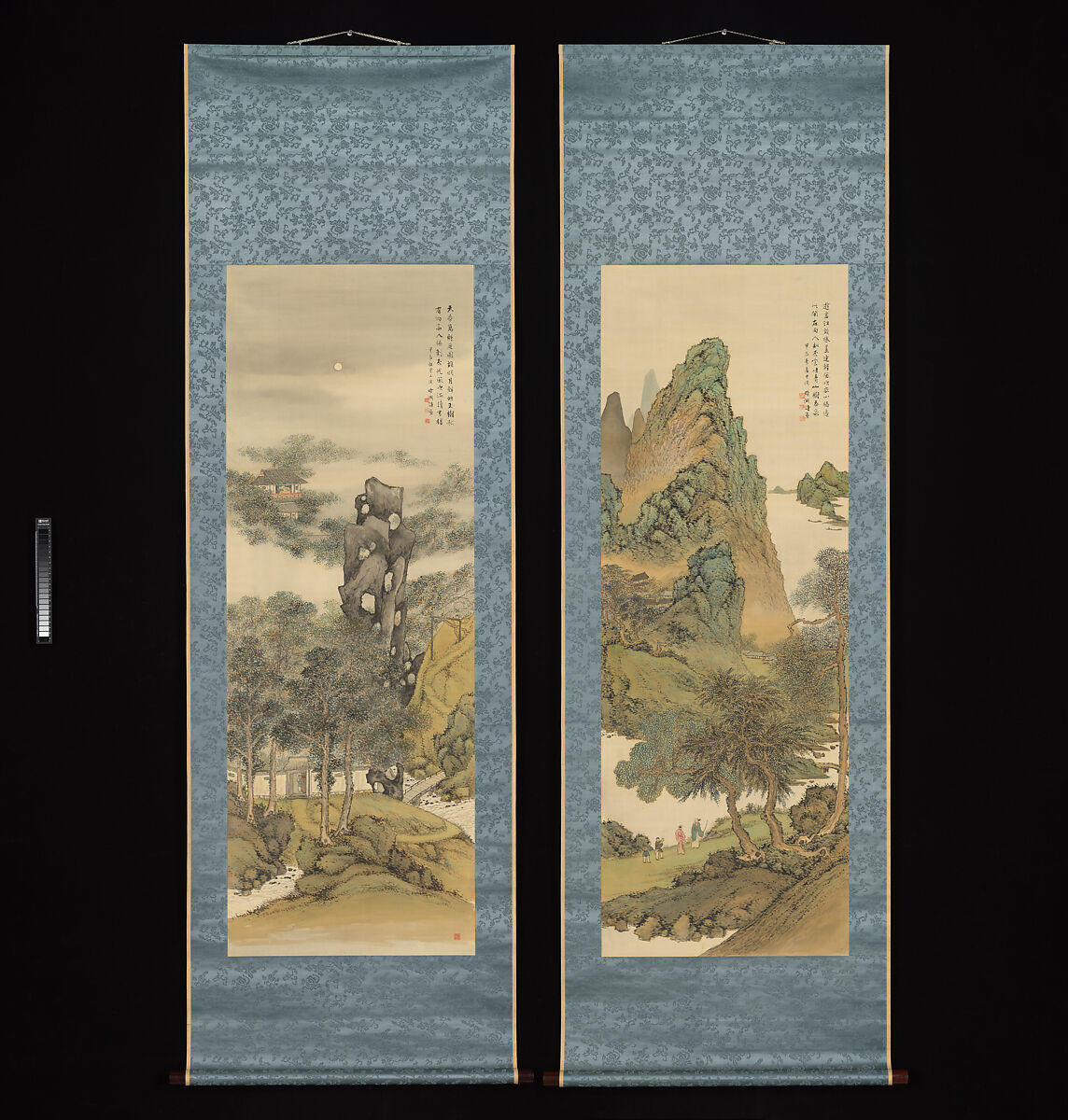
In a pair of paintings created in 1904, mountain forms, trees, water and changing seasons emerge from delicate layers of ink and color. The works belong to a Japanese tradition in which the landscape is not simply scenery but a place for learning, imagination and reflection. Their artist, Okuhara Seiko (1837–1913), was among the most prominent women painters of nineteenth-century Japan. Yet outside specialist circles, her name is far less familiar than those of the country's best-known printmakers and modern painters.
The diptych, Summer and Autumn Landscape, is now in the Metropolitan Museum of Art in New York. The museum dates it to 1904 and identifies it as a pair of hanging scrolls in ink and color on silk. Viewers are meant to read the paintings from right to left. They offer an unusually revealing place to begin Seiko's story: the art of a woman who, late in life, was still exploring what a painted landscape could become.
Born into one world, determined to enter another
Seiko was born in 1837 in the castle town of Koga, in what is now Ibaraki Prefecture. Her original name was Ikeda Setsu, according to the Tokyo Fuji Art Museum. She was the fourth daughter of a samurai household. A young woman of her background could be educated in poetry, calligraphy and painting; turning those accomplishments into an independent urban profession was a different undertaking.
She studied with Hirata Suiseki, an artist connected to the lineage of celebrated Edo painter Tani Bunchō, and had contact with Takami Senseki, a senior Koga retainer known for his engagement with Western learning. Rather than separating literature and art, these influences introduced her to the literati ideal: the cultivated person who expresses the mind through poetry, brush writing and painting.
In Japan this approach is often called Nanga, or Southern School painting, and is related to Chinese literati painting. Mountains and waterways in Nanga are rarely just topographical portraits. Empty space, brush rhythm, inscriptions and deliberately imagined geography are all part of the meaning. Seiko would make this language her own, sometimes with an exuberant force, sometimes with unexpectedly refined color.
The legal obstacle between a woman and a career
There was a practical barrier to the life she wanted. The Tokyo Fuji Art Museum records that women of Koga domain could not simply travel alone to Edo. Seiko arranged to enter the Okuhara family, associated with a neighboring domain, as an adopted daughter. The change in household affiliation allowed her to proceed. It was a consequential choice, not merely a picturesque story of individual determination: formal political and family structures still regulated what opportunities were open to her.
In 1865, she established a studio in Edo, in the Ueno area. It was called Bokuto En'unrō, usually written 墨吐烟雲楼 or a close variant in historical records. The expressive name evokes ink exhaling clouds and mist—an apt description of the painterly world she built. Her adopted name, Seiko, became a professional identity.
She was entering the capital at a moment of profound instability. The Tokugawa shogunate would fall in 1868, and Edo would become Tokyo. Political institutions, patronage networks, education and the public status of artists were about to change. Seiko did not watch that transformation from the margins: she became part of Tokyo's lively intellectual culture.
A painter, entrepreneur and teacher
Seiko's bold handling of ink attracted powerful patrons and fellow intellectuals. Local government histories record her associations with statesman Kido Takayoshi and former domain lord Yamauchi Yōdō. She developed a teaching practice and a network of students; the Tokyo Fuji Art Museum says her pupils numbered as many as 300 at one time. That is a reported peak figure, not a precise count of everyone she taught across her career.
Her visibility was not merely retrospective. Kumagaya City notes that she was placed prominently among women painters in the 1879 Kōkoku Meiyo Shoga Jinmeiroku, a contemporary register of distinguished artists and calligraphers. Her career is therefore a corrective to the simplistic assumption that important women artists of Meiji Japan were uniformly unknown or excluded from public artistic life. The restrictions were real, but so too were Seiko's reputation, patrons, studio and professional success.
She also challenged social conventions in her presentation. A Tokyo National Museum feature quotes an early account describing her short haircut in 1871, soon after a rule permitted men to cut their traditional hair. Such testimony invites caution: colorful biographical anecdotes are not a substitute for examining the art. But the account helps explain why her independence made an impression in an age of changing gender codes.
When the definition of Japanese art began to change
Seiko's popularity took shape during a period when literati painting enjoyed strong support among members of Japan's educated elite. Then the institutional landscape shifted. Western exhibition methods, academic art training and competing visions of a national art history gained influence. The Tokyo Fuji Art Museum links a decline in Nanga's prestige to the climate following an 1879 address by American educator and art adviser Ernest Fenollosa to the Ryūchikai arts association.
That account is useful as an indication of how reputations changed, but it would be too simple to attribute the fate of a whole painting tradition to one lecture. Art movements rise and fall through shifting taste, collecting patterns, state institutions and the narratives museums choose to tell. Seiko was a successful artist working within a tradition whose position in the canon was being contested.
Her own art also changed. The Kumagaya Digital Museum contrasts the vigor of her earlier brushwork with the more precise, colorful paintings of her later period. The Met's Landscape in Blue and Green of 1899 offers one example, drawing on the blue-green Chinese landscape mode and including poetry. It shows an artist fully conversant with inherited traditions yet still determined to find new effects.
Railways, retreat and reinvention
In 1891, Seiko moved from Tokyo to the area around Kumagaya, in today's Saitama Prefecture. The official Koga City history of her studio explains that her Ueno property was taken for railway land, making relocation necessary. Some interpretations also emphasize dissatisfaction with rapid Westernization or a wish to withdraw from central art-world pressures. Those may illuminate the cultural climate, but the evidence does not allow us to assert a single private motive.
Her new studio became known as Shūsui Sōdō (繍水草堂). Later life is frequently summarized as retirement or seclusion, yet the work tells another story. She kept painting, writing poetry and training younger artists. Her late landscapes traded some of the dramatic energy of her earlier manner for subtle structure and fine color. The shift was not necessarily a retreat. It was a different artistic ambition.
How to see Summer and Autumn Landscape
The Met describes Summer and Autumn Landscape as a pair of hanging scrolls, each painted image about 140 centimeters high and 50 centimeters wide. Those proportions reward close viewing. Unlike a wide panoramic print, a scroll encourages the eye to travel slowly through vertical space—following terrain, water, trees and mist as if moving through an imagined landscape.
The pair's seasonal structure matters too. Summer and autumn are adjacent but not identical worlds. In the space between two paintings, the viewer experiences the passing of time. This is an interpretation of the composition, not a documented statement of the painter's private intentions. Seiko's work rewards such careful looking because the feeling of a landscape emerges from brushwork and the arrangement of forms as much as from its subject.
The museum's accession numbers are 2025.981.54a and b. The work is designated public domain and is not currently on view. Its presence in a major New York museum creates a valuable opportunity for readers worldwide to encounter her art through authenticated documentation rather than through modern imitations or loosely attributed images.
A studio survives where celebrity faded
Seiko died in 1913 and was buried at Ryūenji temple in Kumagaya. Her physical legacy extends beyond the paintings. Kumagaya City has preserved the memory of the route to her final residence, known today as Seiko's Path. In Koga, her former studio has been relocated and partly reconstructed near the local history museum.
Koga City explains that the studio was moved from Kumagaya to the grounds of her family home in 1929 and later preserved through a further relocation and reconstruction. These local efforts matter. They protect the lived circumstances of artistic work: a place where a person taught, wrote, received visitors and made paintings. Such histories are easily lost when art is viewed only through the collections of large metropolitan institutions.
The question is not whether she mattered
Seiko mattered to her contemporaries. The evidence is unusually clear: contemporary recognition, influential supporters, a studio, scores of pupils, surviving paintings and regional institutions that have worked to preserve her memory. The better question is why a major artist can fade from general awareness when art history is condensed into a handful of famous names.
Rediscovery should not turn her into a legend stripped of historical complexity. She worked inside social constraints, but she was not without agency or support. Her artistic fortunes rose and shifted alongside the reputation of Nanga itself. Her paintings moved between different traditions and moods. She was a woman in a male-dominated professional environment, but also a respected teacher with students, clients and cultural authority of her own.
Look again at the paired landscapes from 1904. The careful balance of brush, color and atmosphere belongs to an artist who had lived through the fall of the shogunate, the making of modern Tokyo, the arrival of railways and a wholesale rethinking of what Japanese art should be. Through all of it, Okuhara Seiko kept painting. Her freedom was neither effortless nor complete. It was something she made, patiently, through the work of an entire life.
Sources and References
- Kumagaya City: Okuhara Seiko biography
- Tokyo Fuji Art Museum: artist biography
- Koga City: Seiko’s restored studio, Shūsui Sōdō
- Kumagaya Digital Museum: biography and literary works
- Tokyo National Museum: women painters and Seiko
- The Met: Summer and Autumn Landscape, 1904
- The Met: Landscape in Blue and Green, 1899
- Tokyo Fuji Art Museum: From the Deep Sky, 1869
- Tahara City Museum: Seiko and the Nanga lineage
- Kumagaya City: site of Seiko’s final years