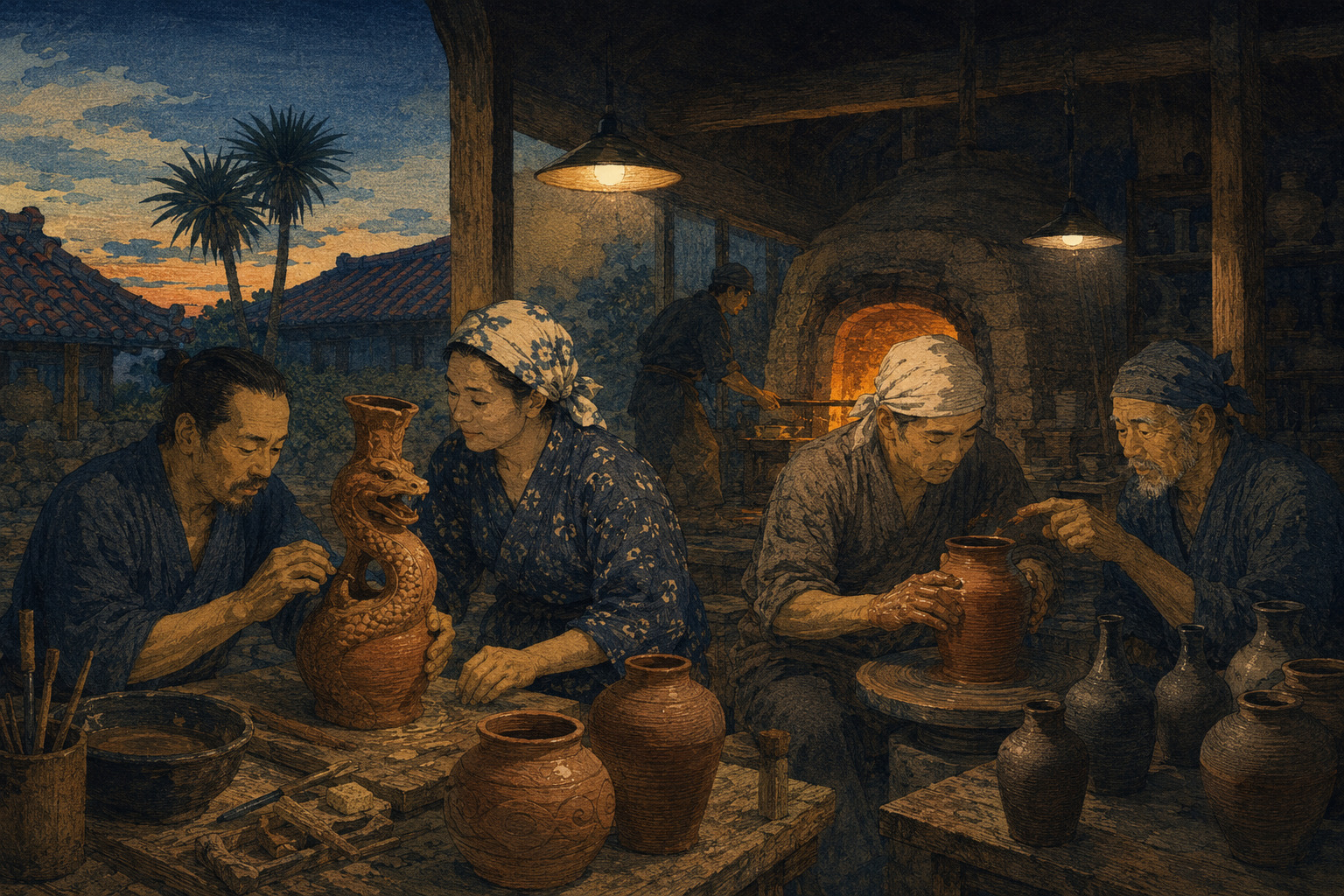
Before a new ceramic object reaches a dining table, it acquires a geography. Clay comes from somewhere. A mold embodies decisions made somewhere. A kiln, a craftsperson and a designer each leave different kinds of evidence. Tsuboname asks what happens when those places no longer coincide—and whether a product can describe that complexity without reducing two living industries to a tidy origin story.
Ikutouen, a workshop in Naha's Tsuboya pottery district, announced the project on August 26. Its name, 壺滑, is read Tsuboname, joining the first character of Tsuboya with the last character of Tokoname. Koji Takahashi, whose design office is based in Tokoname, Aichi Prefecture, provided creative direction and product design. Tokoname kiln Yamagen Toen is credited with technical cooperation. Ikutouen's craftspeople make the objects.
The first release consists of habu, a tubular single-flower vase, and tatara, a group of one bowl and two deep plates. They are scheduled to appear September 2–4 at FOCAL POINT, a section of the 102nd Tokyo International Gift Show Autumn 2026 at Tokyo Big Sight. The show is for domestic and international distribution professionals and requires advance registration; it is not a public retail launch. Ikutouen says store, e-commerce and wholesale sales are planned from October, with the confirmed timing to be announced later.
One project, two ideas of control
The most revealing contrast is not between Okinawa and Aichi. It is between the two ways Tsuboname handles variation.
Habu begins with a difficult manufacturing problem: how to make a continuous, hollow tube curve into a compact vase without assembling it from visibly separate parts. The answer is deishō ikomi, or slip casting, using a plaster mold. Clay suspended in water is poured into the porous mold. The plaster draws water from the slip, leaving a clay wall against the mold surface; the excess can be removed before the form is dried, released and finished.
A mold makes repetition possible, but it does not eliminate craft. Slip consistency, casting time, wall thickness, release, seam finishing, drying and firing all require control. Yamagen Toen's own TOKONAME brand describes a comparable philosophy: plaster molds allow efficient, stable production, while delicate work by craftspeople remains essential to the finished object. That corporate account helps explain the sort of expertise Tokoname has accumulated. It does not, however, disclose which specific steps Yamagen Toen performed for Tsuboname. The project announcement does not say whether its role involved mold engineering, slip formulation, firing advice or another task.
The vase's exterior is left unglazed to expose the clay body. Clear glaze is applied inside to retain water. Ikutouen's release shows Okinawan red-clay and white-clay versions. The form refers to the islands of Okinawa and the habu snake that inhabits parts of the archipelago, but it avoids a literal painted reptile. Its allusion is structural: a body bending, enclosing water and occupying an irregular route through space.
Tatara takes the opposite attitude toward exact repetition. A very thin slab of clay—the Japanese ceramic term tatara—is laid over a form. Ikutouen says slight distortions produced during forming, drying and firing are retained rather than corrected into uniformity. Okinawan red clay is unglazed on the outside; glossy white glaze covers the food surface. The series includes a small bowl and medium and large deep plates.
| Product | Documented method | Material and finish | Variation strategy | Not yet published |
|---|---|---|---|---|
| habu flower vase | One-piece slip casting in a plaster mold | Okinawan red or white clay; unglazed outside, clear glaze inside | Shared mold establishes a repeatable continuous form | Dimensions, weight, capacity, price, clay recipe, firing schedule |
| tatara bowl S | Thin clay slab placed over a form | Okinawan red clay; unglazed outside, glossy white glaze inside | Minor warping and individual differences retained | Dimensions, capacity, price, food-contact testing information |
| tatara deep plates M and L | Same slab-forming method | Same red-clay and white-glaze arrangement | Handmade differences treated as part of the surface | Weight, care instructions, dishwasher and microwave guidance |
Put together, the two families reject an easy opposition between industrial sameness and handmade uniqueness. Habu uses a repeatable tool to make a form that would be cumbersome to reproduce by hand alone. Tatara uses a form but declines to erase every difference produced by clay and firing. The project is less interested in choosing between industry and craft than in deciding where consistency is useful and where variation carries meaning.
Why Tokoname brings more than a famous red teapot
Tokoname is often represented by the compact red shudei teapot. That icon is genuine, but too small for the region's industrial history.
According to Tokoname Tō no Mori, the city's ceramics museum and research complex, kilns were operating on the Chita Peninsula around 1100, at the end of the Heian period. Tokoname became the largest of the Six Ancient Kilns. Early hillside tunnel kilns produced unglazed bowls, basins, storage jars and large vessels. Archaeological finds show those objects traveled widely, reaching major medieval sites across Japan.
The product mix changed as society changed. Climbing-kiln development and teapot making took hold in the late Edo period. During the Meiji and Taishō eras, clay pipes and tiles made Tokoname a major ceramics industry rather than a settlement devoted only to studio ware. Aichi Prefecture now lists tea ware, flower vessels, sake ware, ornaments and flowerpots among its principal products, while the region's longer record also includes sanitary ceramics and architectural material. Tokoname ware was designated a national Traditional Craft in 1976.
This matters to Tsuboname because an industrial ceramic district develops knowledge that is not visible in a finished surface: how to make a mold release cleanly, how to control a hollow wall, how to keep production stable, and how to divide labor without losing the finishing intelligence of experienced hands. Yamagen Toen, formally identified by the Tokoname ceramics cooperative as Yamagen Tōen, works within that history. Its own brand explicitly treats mold production and craft finishing as complementary.
But a source must not be made to say more than it does. Yamagen's white-clay blends and teaware processes belong to its TOKONAME brand description. Ikutouen does not say those materials were used in Tsuboname. Technical proximity is evidence for understanding a partner's competence, not permission to transfer every feature of one product line to another.
Tsuboya was never an island of ceramic purity
Ikutouen frames the collaboration as a contemporary version of a recurring Okinawan pattern: accepting knowledge from outside, then adapting it to local material, climate and use. The claim is promotional, but the broad historical foundation is sound.
The Naha Municipal Tsuboya Pottery Museum dates the formal creation of the Tsuboya production district to 1682, when the Ryukyu royal government consolidated dispersed ceramic activity in what became Tsuboya. Ikutouen's history names the Wakuta, Takaraguchi and Chibana kiln areas. The reorganization came after centuries in which the Ryukyu Kingdom traded throughout East and Southeast Asia and after ceramic technologies associated with Korean potters had entered the islands through the kingdom's changing political relations.
Tsuboya ware is commonly divided into arayachi and jōyachi. Arayachi is associated with high-fired storage vessels, often unglazed or treated with restrained slips; jōyachi encompasses glazed table and household wares. The distinction records more than style. It reflects the practical work ceramics performed—holding water, miso and awamori, serving meals, pouring tea—and how demand shifted when piped water and new domestic goods altered daily life.
In 1945, Tsuboya's survival became consequential. Much of Naha was destroyed in the Battle of Okinawa, while the pottery district escaped the same degree of devastation. Ikutouen's historical account says more than 100 potters returned in November, about three months after the war ended, to resume tableware production. They repaired homes, made vessels and supplied people rebuilding ordinary life. Pottery in this setting was neither luxury nor heritage display. It was infrastructure for eating.
The postwar production map did not remain fixed. Urban growth and kiln smoke helped drive some potters to Yomitan in the 1970s. Okinawa Prefecture's chronology marks that movement and the 1976 designation of Tsuboya ware as a national Traditional Craft. In other words, the tradition survived partly by moving people, kilns and skills beyond the district whose name it carries.
- Ikutouen: Okinawan clay, Tsuboya making, workshop labor and the manufacturing responsibility for the released objects.
- Koji Takahashi: Okinawa research, creative direction and product design, informed by a practice based in Tokoname since 2015.
- Yamagen Toen: technical cooperation from a Tokoname kiln with experience combining plaster molds and craft finishing.
- Not documented: Tokoname clay in the products, a precise task-by-task technical division, or a 50–50 material “fusion.”
There is more than one clock inside Ikutouen
The launch describes Ikutouen as a Tsuboya workshop continuing for more than 300 years. Its corporate history is more specific. Ikutouen says the Takaesu family has practiced pottery in Tsuboya for generations and identifies current kiln head Tadashi Takaesu as the sixth generation. The same official page dates Ikuo Takaesu's independent founding of Takaesu Seitōsho, or Takaesu Pottery Workshop, to April 1963. The present limited company, Ikutouen, was incorporated in January 2006.
Those dates need not conflict. They measure different institutions: a regional tradition, a family line, an independent workshop and a legal corporation. Treating them as interchangeable, however, turns history into an ambiguous brand age. Precise craft reporting should distinguish the continuity of knowledge from the age of the entity selling the product.
That distinction also sharpens the purpose of collaboration. Ikutouen is not a sealed 17th-century survival. It is a 21st-century company, with 37 employees as of April 2025, operating within a family practice and a district with older roots. Its task is to make objects people will buy and use now while deciding which inherited techniques, materials and relationships remain essential.
The power—and risk—of an outsider's view
Takahashi was born in Oita Prefecture in 1980, studied product design at Tama Art University and later worked on household goods. He moved his base to Tokoname in 2015. For Tsuboname, Ikutouen says, he began by visiting Okinawa and researching the islands' nature, life and pottery history. The project turns familiar local forms—red earth, red roof tiles, shisa, island geology and the habu—into design prompts.
An outsider can notice what routine makes invisible. Product design can also connect a workshop's material knowledge with actions a user performs: holding, pouring, cleaning, stacking and storing. The danger is that “discovery” becomes extraction—local animals and colors converted into marketable motifs while the people and manufacturing behind them recede.
Tsuboname's published credits help resist that erasure. They identify Ikutouen as owner, Takahashi as creative director and product designer, and Yamagen Toen as technical partner. Yet credit is only the beginning. A durable collaboration should leave knowledge, agency and economic value with the producing workshop, not simply deliver a finished concept from outside.
What the press release cannot test
Promotional photographs can establish color and contour. They cannot answer how the objects behave after six months of use.
For habu, stability, capacity and cleaning access will matter as much as the elegance of the continuous tube. Clear interior glaze is intended to hold water, according to Ikutouen, but no water-retention test, absorption figure or care protocol has been released. For the thin tatara pieces, weight, edge comfort, stackability, resistance to chipping and suitability for microwave or dishwasher use remain practical questions. No prices, measurements or weights were in the August 26 announcement.
There are production questions too. What exactly did technical cooperation transfer? Can Ikutouen adjust the casting process independently? Will molds and working knowledge remain available for later products? How much hand finishing is required per piece, and can that labor be reflected in a viable retail price? Those details are not reasons to withhold the story. They are the questions that separate a promising launch from a proven new production model.
The October plan is also provisional. Ikutouen says it expects to ship to retailers and sell through its stores and e-commerce operation, and that it will announce the timing once confirmed. Reporting “on sale in October” without that qualification would turn a schedule into a guarantee.
About 1100 — Kiln production expands on the Chita Peninsula, beginning the long history of Tokoname ware.
1682 — The Ryukyu royal government consolidates pottery production in Tsuboya.
1945 — Potters return to Tsuboya and restart urgently needed tableware production after the Battle of Okinawa.
1963 — Ikuo Takaesu establishes the independent Takaesu Seitōsho workshop.
1976 — Tsuboya ware and Tokoname ware receive national Traditional Craft designation.
2006 — Ikutouen is incorporated as a limited company.
August 26, 2026 — Ikutouen announces Tsuboname.
September 2–4, 2026 — Scheduled trade presentation at FOCAL POINT, Tokyo Big Sight.
October 2026 — Retail and wholesale launch planned; final timing remains to be announced.
Tradition is a chain of selective changes
Tsuboya and Tokoname have different histories, yet each undermines the idea that authenticity means immobility. Tsuboya was organized through consolidation and developed through exchange. It answered war, reconstruction, urban pressure and changing household needs. Tokoname carried medieval storage jars across Japan, then moved through teapots, pipes, tiles and other industrial ceramics as markets changed.
The lesson is not that every change preserves a tradition. Some changes hollow one out. A regional name can become decorative language attached to outsourced production; a craft variation can be simulated as surface styling; an outside designer can receive visibility while workshop labor disappears. The useful question is not whether change occurred, but what the change preserves and who controls it.
Tsuboname offers an unusually legible test. The clay remains Okinawan. Ikutouen's craftspeople retain manufacturing responsibility. Tokoname contributes a designer's perspective and technical cooperation from a kiln accustomed to connecting molds, stable production and skilled finishing. The first objects make that division visible: one holds a continuous contour steady; the other keeps a measure of distortion alive.
At the September trade show, the pieces will be evaluated as new merchandise. On the eventual dining table, they will face a slower and more demanding review. A flower must be placed and the water changed. Food must be served, the plate washed and the rim handled repeatedly. If those ordinary acts feel natural, the collaboration will have done more than unite two place names. It will have turned knowledge carried across the sea into another usable layer of Okinawan ceramic life.
- Ikutouen — official Tsuboname announcement, products, materials, methods, credits and launch plan
- Ikutouen — kiln head, family continuity, workshop founding, incorporation and company history
- Ikutouen — family account of the Takaesu lineage and workshop development
- Tsuboya Pottery Business Cooperative — official reading, title and career of Tadashi Takaesu
- Ikutouen — account of Tsuboya history, arayachi and jōyachi, and postwar production
- Naha Municipal Tsuboya Pottery Museum — the 1682 consolidation and introductory Tsuboya history
- Naha Municipal Tsuboya Pottery Museum — Arakaki family residence and Tsuboya production history
- Okinawa Prefecture — postwar kiln migration and the 1976 Traditional Craft designation
- Tokoname Tō no Mori — origins of Tokoname kilns, early products, kiln technology and distribution
- Aichi Prefecture — Tokoname history, shudei, production methods and principal products
- Tokoname Ceramics Cooperative — industry history and 1976 designation
- Tokoname Ceramics Cooperative — official reading and location of Yamagen Toen
- Yamagen Toen — its own account of plaster molds, production stability and craft finishing
- Koji Takahashi Design Office — official profile
- Tokyo International Gift Show — dates, venue, intended visitors and admission conditions
- 20th LIFE×DESIGN — official FOCAL POINT exhibitor guide