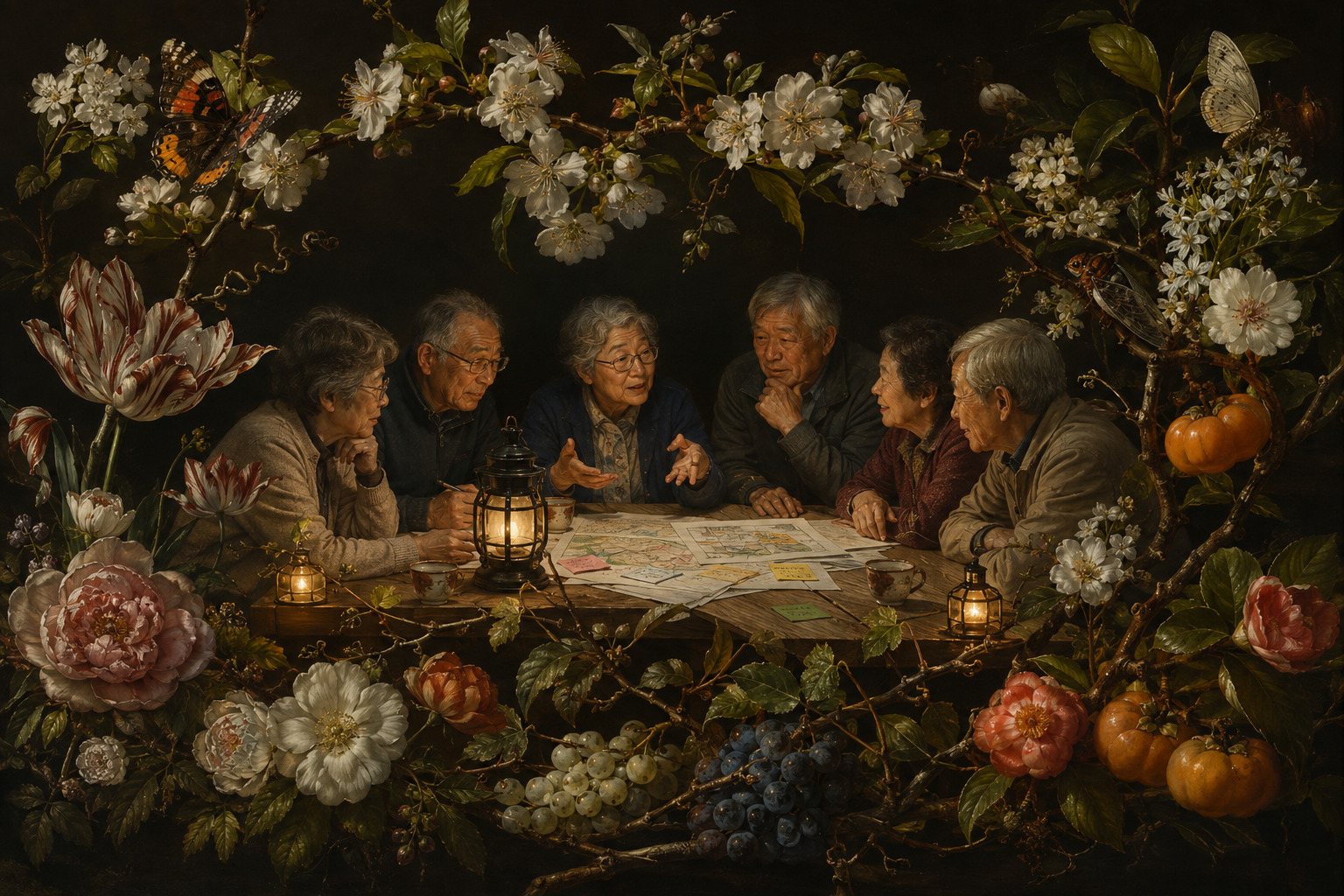
A familiar face has not appeared for several days. Mail is accumulating. The usual light is no longer on. How far can neighbors act on small changes like these without turning concern into intrusion? Okayama’s Tomiyama Community Center placed that question at the center of an August 29 learning forum.
The city announced the 19th Tomiyama ESD Niko-Niko Cafe under the title “Community Power to Prevent Solitary Death: What We Can Do, Seen From the Front Line of Estate Clearance.” It was scheduled for 10 a.m. to noon in two lecture rooms at the city-run center in Naka Ward. Capacity was 30 on a first-come basis, with a ¥100 tea-and-snack charge.
The advertised speaker was Mayumi Fujiwara of Kokopia, an Okayama estate-clearance company. The company’s official profile identifies her as a director responsible for public relations and planning, a household-closure adviser and an SDGs consultant. Separate city pages list her as an instructor in Okayama’s ESD and SDGs outreach program. The Tomiyama District Women’s Association and Tomiyama SDGs were named as co-organizers.
Learning From What Estate Clearers See
The city described the purpose in careful terms: participants would hear from an estate-clearance specialist and think together about what a community can do to prevent solitary death. Estate clearance normally begins after a death. The forum’s premise was to bring what may be visible at that late stage—an interrupted life, weakened ties or help that did not arrive—back into a conversation about support while people are still living at home.
That is an editorial reading of the published purpose, not a quotation from Fujiwara or the organizers. No slides, audio, transcript or post-event interview were available. It would be unsupported to state which cases were presented, what advice the speaker gave or how participants responded.
Okayama describes the Tomiyama ESD Niko-Niko Cafe as a community program for learning about local and global issues. ESD stands for Education for Sustainable Development. In the city’s formulation, it is learning that balances economic, social and environmental concerns and develops people able to act toward a sustainable society. Placing isolation on that agenda treats it not only as a specialist welfare issue, but as a question about how a neighborhood is organized.
“Solitary Death” Is Not One Statistical Category
The event uses the common Japanese term kodokushi, or solitary death, in its title. National policy work has tried to distinguish loneliness—a subjective feeling—from isolation, an objective condition of limited social connection. A Cabinet Office working group concluded that the more objective idea of koritsushi, or isolated death, is better suited to measurement, while stressing that this does not prohibit use of the familiar term kodokushi.
Japan’s National Police Agency reported in March that 76,941 of the 204,562 bodies handled by police in 2025 were “people living alone who died at home,” a share of 37.6 percent. That figure is not a national count of solitary deaths. It is a precisely defined administrative category based on living arrangement and place of death; it does not establish how long discovery took, the state of a person’s relationships or whether support was available.
| Official event title | “Community Power to Prevent Solitary Death: What We Can Do, Seen From the Front Line of Estate Clearance” |
|---|---|
| National measurement | A Cabinet Office working group favors the more objective concept of “isolated death” for fact-finding |
| Police category | Police-handled bodies of people who lived alone and died at home |
| 2025 total | 76,941 people; not synonymous with all solitary deaths in Japan |
| Policy framework | The Act on Promotion of Measures for Loneliness and Isolation defines national and local responsibilities |
| This forum | A community learning and discussion event; no reduction in deaths has been demonstrated |
Tomiyama Has a History of Organized Mutual Aid
The district already has a documented example of residents turning concern into a defined service. A 2021 city report described the Tomiyama Mutual Aid Team, created with local neighborhood associations, welfare commissioners, health volunteers, women’s groups, nutrition volunteers, senior clubs and a federation supporting people with physical disabilities.
Before the service was designed, a questionnaire went to 5,095 member households and drew 2,210 responses. According to the city, 67 percent considered a mutual-support system necessary, 55 percent said they would use it and 32 percent were willing to register as helpers. As of the end of October 2020, the team had 47 registered helpers and five coordinators. The city counted 220 instances of help in the year through September 2020, including medical accompaniment, shopping and garden care.
Those are historical figures, not a current operating report. Japan.co.jp did not verify the team’s 2026 membership, fee or activity level. Nor does the forum announcement say that the Niko-Niko Cafe was formally part of the mutual-aid service. The older program nevertheless illustrates an important structural point: a resident identifies a need, a coordinator receives it and a helper is matched to the task. That is more durable than leaving every response to improvised goodwill.
What Turns a Conversation Into Prevention
A two-hour forum cannot by itself be credited with preventing a death. For community discussion to become a continuing response, residents and institutions need to know who receives a concern, how consent is obtained, when a case should move to medical, care, welfare or housing professionals, and who acts in an emergency.
Neighborhood watchfulness must not become surveillance. Low-pressure contact—greetings, invitations and agreement on a preferred way to check in—can preserve autonomy. When there is evidence of danger, abuse or serious health risk, residents need a route to trained services rather than an expectation that they manage the situation alone. Privacy rules and defined roles are part of prevention, not bureaucratic extras.
Japan’s Act on Promotion of Measures for Loneliness and Isolation, effective since 2024, defines responsibilities for national and local government and establishes a framework for coordinated action. The priority plan was partly revised in July 2026. The city announcement does not identify this forum as a formal project under that framework, so the link should not be overstated. A trusted local venue can still serve as an entry point—if it connects concern to services and records what happens next.
What the Published Record Does Not Show
- Whether the August 29 event proceeded exactly as scheduled
- The number or profile of participants, or a record of the talk and questions
- Any action, deadline or responsible organization agreed by participants
- How referral, reduced isolation or another outcome would be measured
- The Tomiyama Mutual Aid Team’s current 2026 status
To treat isolation as a problem only after a person dies is to begin too late. A community response needs both the human ability to notice absence and an agreed route for passing concern to appropriate support. Tomiyama’s forum placed that question on a shared table. Whether the conversation became sustained action requires a post-event record and later evaluation.
- Okayama City: 19th Tomiyama ESD Niko-Niko Cafe (official title, date, venue, speaker, capacity and organizer-stated purpose; Japanese)
- Okayama City: Tomiyama ESD Niko-Niko Cafe (official center name, location and program background; Japanese)
- Okayama City: What ESD Means (the city’s definition of Education for Sustainable Development; Japanese)
- Okayama City: Tomiyama Mutual Aid Team (2020 structure, survey and activity figures; Japanese)
- National Police Agency: people living alone who died at home in 2025 (the official administrative category and national total; Japanese)
- Cabinet Office working group on solitary and isolated death (terminology and measurement; Japanese)
- Cabinet Office: Act on Promotion of Measures for Loneliness and Isolation (national and local responsibilities; Japanese)
- Kokopia: Mayumi Fujiwara profile (reading of her name, role and credentials; company self-description in Japanese)
Japan.co.jp reviewed primary materials published by Okayama City, the National Police Agency and the Cabinet Office through August 30, 2026, plus the speaker’s official company profile. The Japanese reading Tomiyama, the center’s formal name, and Mayumi Fujiwara’s name and roles were checked. Because no post-event report or transcript was found, the article uses no event quotation and reports no attendance or decision. The NPA figure of 76,941 is retained under its exact category and is not relabeled as a national solitary-death count. Mutual-aid figures are identified strictly as a 2020 historical snapshot.