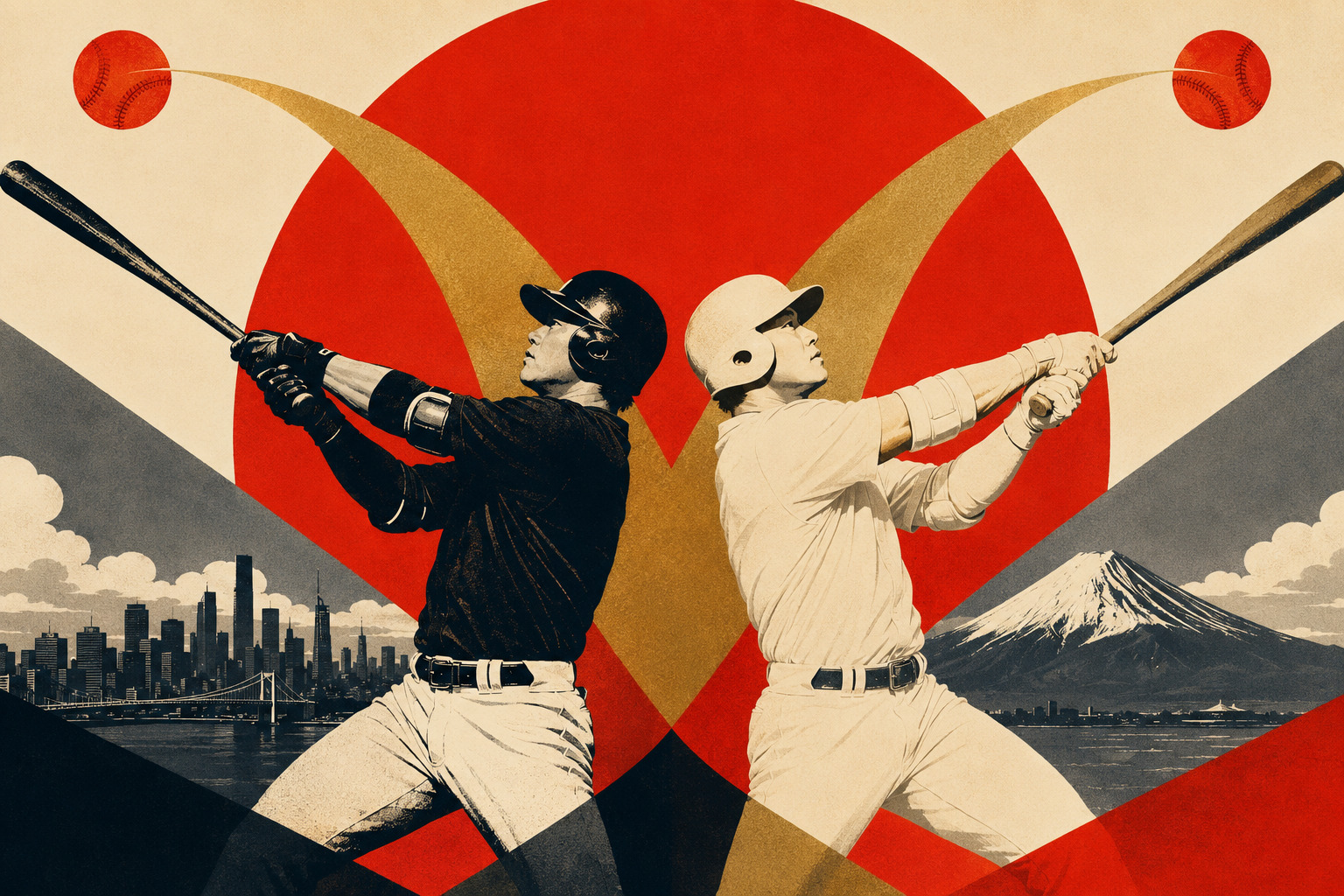
The ball traveled toward straightaway center at Fenway Park. On July 24, Kazuma Okamoto broke an 0-for-22 skid by driving a 96.3 mph sinker an estimated 407 feet. The three-run shot was not enough to win the game for Toronto. It was enough to make No. 23 the swing that carried him beyond a line Shohei Ohtani had held for eight years.
Four days later in Washington, Okamoto entered on what had been scheduled as a rest day. In his first plate appearance, with two strikes, he sent a 98.4 mph fastball 414 feet to right-center. No. 24 extended the Japanese-born rookie mark and tied Eric Hinske’s Blue Jays rookie record. The right-handed slugger’s path was no longer limited to the towering pulled drives that had characterized much of his season.
The next night in Chicago, Munetaka Murakami crossed the same threshold. The White Sox trailed the Yankees 4–3 with one out in the eighth when Paul Blackburn delivered an 81.2 mph first-pitch curveball. Murakami lifted it 403 feet to center at 104.6 mph. His 23rd homer tied the game; Chicago eventually won in 12 innings.
One record now held two different sounds. Okamoto broke through first with the swing that ended a cold spell. Murakami arrived after a summer interrupted by injury and pulled a game level. Calling one the record holder and the other merely the pursuer misses what made 2026 remarkable. A number once difficult for any Japanese newcomer to reach had been passed by two of them before July ended.
| At 2:05 p.m. JST, July 31 | Kazuma Okamoto | Munetaka Murakami |
|---|---|---|
| Club and position | Toronto Blue Jays / third base | Chicago White Sox / first base |
| Home runs | 24 | 23 |
| AVG / OBP / OPS | .231 / .308 / .761 | .240 / .381 / .924 |
| Runs batted in | 68 | 49 |
| MLB debut | March 27, 2026 | March 26, 2026 |
| NPB career | 248 HR, 717 RBI | 246 HR, 647 RBI |
The record belongs to two men now
The contrast between No. 24 and No. 23 is richer than the standings. Okamoto is a 30-year-old right-handed hitter who batted cleanup and served as captain for the Yomiuri Giants. He had played 106 games for Toronto, with 24 homers and 68 RBI. Murakami is a 26-year-old left-handed hitter who lost roughly six weeks to a right hamstring strain, yet reached 23 with about two-thirds as many at-bats and an OPS of .924.
Okamoto is the figure of accumulation. He had made 102 appearances at third and continued to drive in runs when his average sagged. The cost of adjustment was visible: his 133 strikeouts ranked fourth in the American League at the cutoff, a striking change from the 11.3 percent strikeout rate he posted in his final NPB season. Yet his power survived, and 24 homers ranked fifth in the league.
Murakami is the figure of extremes. He homered in each of his first three MLB games and tied a Major League rookie record with a five-game homer streak in April. He was tied for the AL lead with 20 when he injured his leg on May 29. Six weeks disappeared. Then came a Home Run Derby appearance, a two-homer, six-RBI day on July 26, and the game-tying 23rd three nights later.
Rookies, but never beginners
To read the achievement correctly, MLB’s “rookie” should not be treated as a synonym for “new professional.” Under the official rule, a player generally retains rookie status if, before the current season, he has not exceeded 130 Major League at-bats, 50 Major League innings pitched, or 45 days on an active MLB roster, excluding time on the injured list. NPB service does not count toward those thresholds.
Okamoto and Murakami are therefore Major League rookies, not baseball rookies. Okamoto played 11 NPB seasons and 1,074 games, hitting 248 home runs. Murakami hit 246 in eight seasons. Together, they had 494 in Japan before their first North American season. The regulatory category and the athlete’s maturity are two different facts.
That distinction does not cheapen the record. It restates the challenge. This is not an 18-year-old prospect learning a first long season. It is an accomplished hitter dismantling the assumptions that made him accomplished—then rebuilding against greater velocity, new pitch shapes, unfamiliar ballparks, longer travel and a clubhouse operating in another language.
- MLB rookie: A player who had not exceeded MLB’s at-bat, innings or service-time limits before this season.
- Japanese-born: A birthplace-based category used in MLB and Elias record descriptions, not a statement about citizenship or national-team eligibility.
- NPB experience: It does not remove rookie eligibility, and it does not make a player inexperienced.
- Overall rookie record: The all-MLB mark is a separate, much higher record.
Kazuma Okamoto and the craft of accumulation
Okamoto’s NPB career was not a story of instant stardom. A first-round pick from Chiben Gakuen High School in 2014, he moved between Yomiuri and the Eastern League. His full breakthrough arrived in 2018: at 22, he hit .309 with 33 homers and 100 RBI, becoming the youngest player in NPB history to combine a .300 average, 30 home runs and 100 RBI.
What followed was repetition at an elite level. He hit at least 30 home runs in six consecutive seasons from 2018 through 2023, led the Central League in homers in 2020, 2021 and 2023, and led it in RBI in 2020 and 2021. His 41 homers in 2023 were a career high. In 2024 he batted cleanup in every game and helped Yomiuri win the pennant. A collision while playing first base limited him to 69 games in 2025, yet he hit .327 with a 1.014 OPS.
The Blue Jays’ four-year, $60 million contract purchased repeatability as much as impact. Okamoto has handled both corners and demonstrated power beyond pulled fly balls. His 24th came in his first plate appearance off the bench, after he fell behind 1–2 against 98.4 mph. It was not a record built only on mistakes.
The rough edges matter. A .231 average, 133 strikeouts and an 0-for-22 stretch prevent an easy triumphal narrative. The 24 home runs do not prove that adjustment is complete. They prove he can keep producing runs while it remains visibly incomplete. Okamoto’s achievement is not the absence of problems. It is what endured through them.
Munetaka Murakami and the question after 56
Murakami’s name was attached to numbers before he reached MLB. A first-round pick out of Kyushu Gakuin High School in 2017, he won Central League Rookie of the Year after hitting 36 homers as a 19-year-old in 2019. In 2021, he led the league with 39, won MVP and helped Yakult win the Japan Series. Then came 2022: a .318 average, 56 home runs, 134 RBI and the youngest batting Triple Crown in NPB history.
Fifty-six broke Sadaharu Oh’s 58-year-old record for a Japanese-born player. Murakami also carried the pressure to the final day. After tying Oh at 55 on September 13, he went 13 games without another homer. His 56th came in his final plate appearance on October 3, off DeNA’s Taisei Irie. A 22-year-old completed the season and the ordeal together.
MLB evaluators never doubted the top-end power. The question was velocity and strikeouts. Whiffs increased after 2022, and doubts about third-base defense narrowed his market to a shorter-than-expected two-year, $34 million deal with Chicago. The early answer has inverted the scouting concern. Through July 29, Murakami had a 1.249 OPS in the 34 plate appearances that ended on fastballs of at least 97 mph—the best mark among the 144 qualified hitters in MLB’s analysis.
The misses remain. Against that high velocity, his whiff rate was 45 percent and his strikeout rate 32 percent. The exchange is that contact causes enormous damage and pitches outside the zone can become walks. His .381 on-base percentage was 141 points above his batting average. MLB Murakami is not a hitter who erased his weakness. He is one who makes attacking that weakness expensive.
The 22 Ohtani left behind
Ohtani’s 2018 was never merely a home-run season. In 104 games as an Angels hitter, he batted .285/.361/.564 with 22 homers, 61 RBI and 10 steals. At the same time, he made 10 starts as a pitcher, going 4–2 with a 3.31 ERA and 63 strikeouts in 51⅔ innings. He won the American League Rookie of the Year Award.
Before 22, the mark was Kenji Johjima’s 18. Ohtani’s 19th on September 7 moved him past the Seattle catcher’s 2006 total. He reached 22 even though a damaged ulnar collateral ligament interrupted his work on the mound; Tommy John surgery followed after the season. This was not a number assembled under perfect health.
Passing 22 does not make Ohtani’s rookie year smaller. Okamoto and Murakami surpassed it as hitters. Ohtani hit 22 while also starting 10 games. There is one column in which they can be ordered and another that should not be flattened into comparison. Baseball records create rankings. They do not make the meaning of equal numbers identical.
Johjima, Matsui and Iguchi: the power lineage
Japanese-born hitters’ first MLB seasons have never been measured only by power. Ichiro Suzuki produced 242 hits and 56 steals in 2001, becoming Rookie of the Year and MVP at once. But sluggers have long arrived under a particular test: how much of the NPB home-run total would survive translation?
Hideki Matsui had hit 332 home runs for Yomiuri when he joined the Yankees in 2003. He batted .287 with 16 homers and 106 RBI as a rookie, then hit 31 the next year and eventually became the 2009 World Series MVP. His career warned against treating the first translation as a final verdict.
Tadahito Iguchi became a rookie at 30 in 2005. He hit 15 home runs and drove in 71 while performing the unglamorous work of a No. 2 hitter for the White Sox team that won its first World Series in 88 years. Johjima followed in 2006 with 18 as Seattle’s catcher, establishing the mark Ohtani would break while simultaneously managing a pitching staff.
Seiya Suzuki hit 14 with a .770 OPS for the Cubs in 2022 and later developed into a 30-home-run hitter. A first MLB year is not a conclusion; it is the first draft of a translation. Okamoto and Murakami moved beyond 22 in that first draft. Their fuller evaluation will be written after opponents adjust and their bodies learn the 162-game calendar.
| Notable Japanese-born MLB rookie hitters | Year | HR | Context |
|---|---|---|---|
| Kazuma Okamoto | 2026 | 24* | Tied Toronto’s rookie record with No. 24 on July 28 |
| Munetaka Murakami | 2026 | 23* | Reached the mark despite roughly six weeks out with a hamstring strain |
| Shohei Ohtani | 2018 | 22 | Made 10 pitching starts; won AL Rookie of the Year |
| Kenji Johjima | 2006 | 18 | Previous Japanese-born rookie high, achieved as a catcher |
| Hideki Matsui | 2003 | 16 | 106 RBI; second in AL Rookie of the Year voting |
| Tadahito Iguchi | 2005 | 15 | Helped the White Sox win the World Series |
| Seiya Suzuki | 2022 | 14 | .770 OPS; added more power in later seasons |
* Through the reporting cutoff of July 31, 2026, at 2:05 p.m. JST. The season is ongoing.
Two swings, two adaptations
Right-handed Okamoto and left-handed Murakami fit beneath the same “Japanese slugger” label, but they solve different plate-appearance problems. Okamoto’s gift is balance and the ability to redirect the ball. His 24th went to right-center, his 23rd to center. The high drives to left that defined much of his NPB and early MLB power were not enough to answer Major League velocity and outside pitching by themselves.
Murakami’s gift is concentrating enormous rotation into the chosen pitch. Before his move, NPB tracking measured a 116.5 mph maximum exit velocity and an 85.7 mph maximum bat speed. Scouts wondered whether he could react to elite heat; in MLB his average bat speed has ranked near the top, and he has damaged 97-plus mph fastballs. Breaking-ball recognition and swing-and-miss remain avenues of attack. The irony of No. 23 arriving on a first-pitch curveball was almost too neat.
For neither hitter does adaptation mean discarding the Japanese version of himself. Okamoto brought contact quality and repeatability; Murakami brought selection and extreme impact. They changed how those tools operate amid new velocity, travel, ballparks and positions. They are not finished exports. They are craftsmen being rebuilt in public.
March 26–29: Murakami homers in each of his first three MLB games.
April 22: His five-game homer streak ties an MLB rookie record.
May 29: Murakami injures his right hamstring and goes on the IL the next day.
July 10: Murakami returns; Okamoto hits No. 22 to tie Ohtani.
July 24: Okamoto’s 23rd sets the Japanese-born rookie record.
July 28: Okamoto reaches 24 and ties the Blue Jays rookie mark.
July 29: Murakami reaches 23 and moves beyond Ohtani.
Why NPB-to-MLB translation is not arithmetic
The temptation to multiply an NPB home-run total by a fixed conversion rate is powerful and mostly useless. Ballpark shapes, baseballs, strike zones, rotation schedules, bullpen depth, travel and the frequency of new opponents are different. Most important, pitchers use video and data; once a weakness appears, they can return to the same location until the hitter supplies an answer.
The average MLB four-seam fastball in 2026 was near 95 mph, the highest level of the pitch-tracking era. That gives Murakami’s high-velocity performance real significance. It does not end the adjustment. Pitchers can show velocity and finish below the zone, or avoid walks by changing the breaking-ball mix. Every answer invites the next question.
Okamoto’s .231 and Murakami’s .240 are not the same low average. Okamoto’s on-base percentage was .308; Murakami’s was .381. Murakami has limited the cost of hitless plate appearances with walks, while Okamoto has compensated through availability and run production. Similar home-run totals do not imply identical hitters. The point is that they crossed the same wall with different tools.
For Japanese baseball, the lesson is not a simple new ranking of which NPB star will succeed. Two different cleanup hitters moved at 29 and 25, then passed a historical standard in four months. Youth is not the only form of transfer value; polish is not a guarantee of seamless adaptation. The valuable judgment is knowing what a player must preserve and what he can change.
What the record can—and cannot—tell us next
At the cutoff, Okamoto shared Toronto’s rookie record at 24 and Murakami was one behind. Both had about two months left, making 30 the obvious next boundary. But projected totals are not present facts. Fatigue, injury, counter-adjustments and playing time make quick work of summer arithmetic.
The Rookie of the Year race will not be settled by home runs alone. Murakami’s slugging and on-base production make him a strong candidate; Okamoto adds near-everyday availability and RBI. Defense, baserunning, pitchers, other position-player candidates and game context matter. Ohtani did not win in 2018 because 22 existed in isolation, and neither 24 nor 23 ends the 2026 argument.
Still, one week changed the comparison ladder. For years, Japanese power arrivals were measured against Matsui’s 16, Johjima’s 18 and Ohtani’s 22. Now Okamoto’s 24 occupies the top step, with Murakami’s 23 beside it. Neither number is final.
A record is most beautiful not when it diminishes the past, but when the next player gives a different answer to the question the past created. Ohtani hit 22 inside a two-way season. Okamoto converted 11 years of repetition into 24. Murakami carried the rotation that once produced 56 through injury and the velocity test to reach 23. They share a line without sharing a story.
At the end of July, a record passed from one owner to two men writing it while running. Whether Okamoto stays ahead or Murakami catches him is a compelling race. The larger result already exists: two cleanup hitters formed in Japan are being called Major League rookies, and making the word “rookie” itself look old.
Reporting notes and sources
Information was checked through July 31, 2026, at 2:05 p.m. Japan Standard Time (5:05 a.m. UTC). The 2026 statistics cover games completed by that cutoff. Okamoto’s and Murakami’s totals will change as the season continues. “Record” is limited to MLB and Elias’s birthplace-based Japanese-born category; it is separate from citizenship, national-team eligibility and the overall MLB rookie record.
- MLB: Kazuma Okamoto official profile, 2026 statistics and NPB history
- MLB: Munetaka Murakami official profile, 2026 statistics and NPB history
- MLB: Okamoto’s 23rd and the Japanese-born rookie record
- MLB: Okamoto’s 22nd ties Ohtani
- MLB video data: Okamoto’s 24th, pitch and batted-ball measurements
- MLB video data: Murakami’s game-tying 23rd and Statcast measurements
- Full-Count: Murakami passes Ohtani with No. 23
- MLB Glossary: Official rookie-eligibility definition
- MLB: Ohtani’s 2018 AL Rookie of the Year award and two-way statistics
- MLB: Ohtani’s Rookie of the Year, 22 homers and batting line
- MLB: Ohtani official profile and Johjima’s previous record
- MLB: Okamoto’s four-year Toronto contract and Yomiuri career
- MLB: Murakami’s two-year Chicago contract and 2022 Triple Crown
- NPB: Okamoto official year-by-year statistics
- NPB: Murakami official year-by-year statistics
- MLB: Murakami’s five-game homer streak and rookie record
- MLB/Statcast: Murakami against pitches of at least 97 mph
- MLB: Murakami’s NPB tracking data and pre-MLB analysis
- MLB: Notable rookie seasons by Japanese-born players
- MLB: Hideki Matsui official profile
- MLB: Tadahito Iguchi official profile and 2005 rookie statistics
- MLB: Seiya Suzuki’s 2022 rookie season
- MLB: Murakami’s 2026 Home Run Derby appearance
- Reuters: Murakami’s two-homer, six-RBI game after returning