A root crop with a distinctly industrial backstory
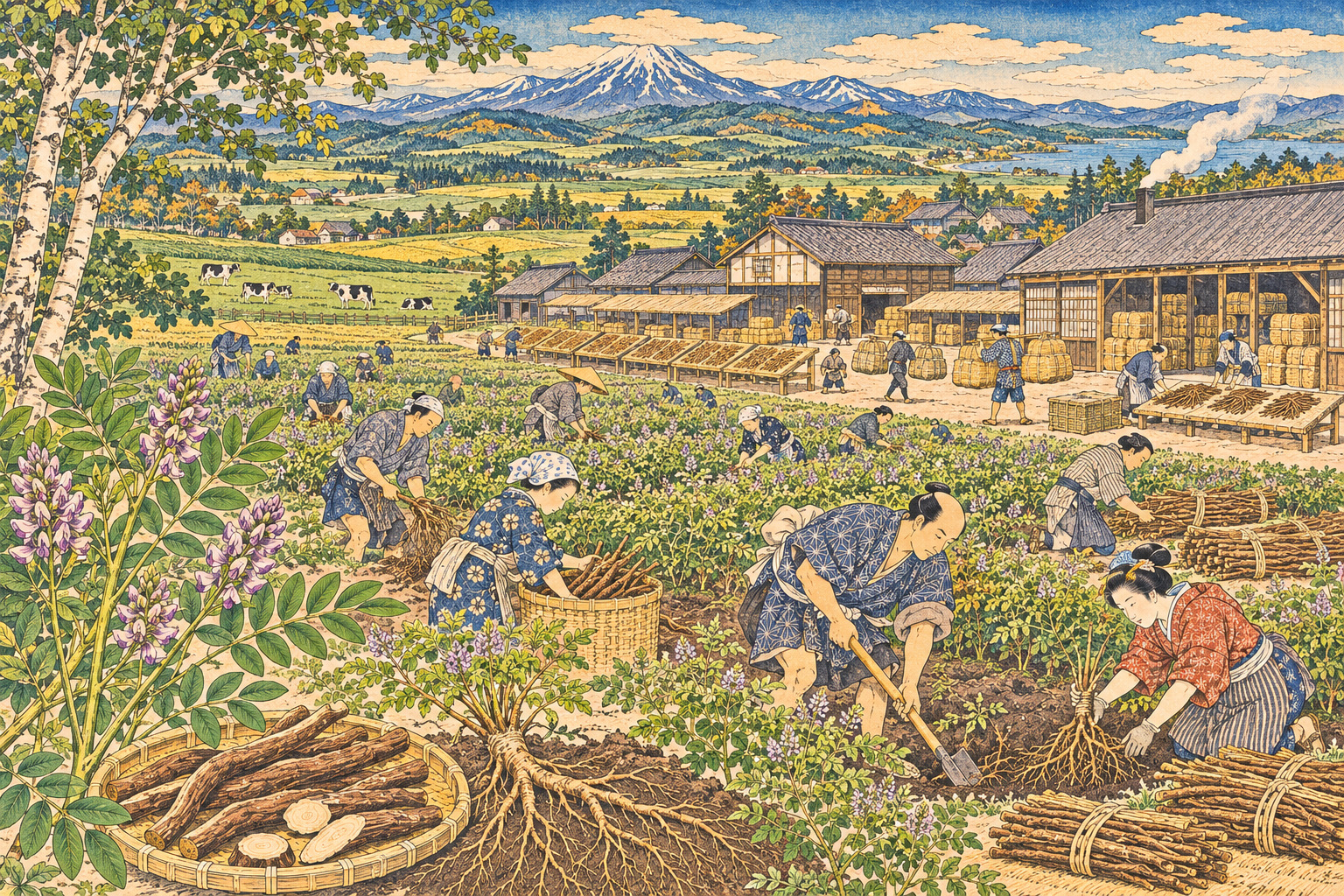
On October 20, machinery worked through a field in Abira, Hokkaido, lifting long roots from the soil. The crop was licorice, a medicinal plant familiar in Japan as kanzo. The grower was an unlikely one: a subsidiary of Oji Holdings, the Japanese company group whose history is entwined with the nation’s paper mills, timber operations and modern industrialization. The roots would be dried in Ebetsu and processed in Nayoro, according to local reporting. What looked like a farm harvest was also a small test of industrial supply-chain reinvention.
Oji is trying to establish a more dependable domestic source of a material used in traditional Japanese Kampo formulations, cosmetics and food. The ambition is not unique to Japan: companies around the world seek more traceability in botanical ingredients. The challenge is that licorice takes years to grow, its commercially valuable portions are underground, and it must compete with an international supply network established over generations.
First, what actually happened in Hokkaido
Tomakomai Minpo reported that harvesting started on October 20 at an Oji-owned site in Abira measuring approximately six hectares. The plants harvested this season had been put into the ground in 2023. After extraction, the roots were scheduled to travel to an Ebetsu facility for drying and then to Nayoro for processing. The company also grows licorice on roughly ten hectares near Nayoro, the newspaper reported.
There is a useful numerical distinction in the reporting. A subsequent Jiji Press account described approximately 7,000 square meters being harvested this season. That is not a contradiction with the six-hectare figure: the larger number refers to the Abira company site, while the smaller figure is reported as the area harvested in the current operation. Neither figure establishes how many tons of pharmaceutical-grade dry root were produced, and neither should be used to infer Japan’s future import substitution without further evidence.
Why licorice matters far beyond candy
The licorice relevant here is a perennial plant in the legume family whose roots and underground runners are used as medicinal and other ingredients. In Japanese botanical and commercial contexts Oji identifies its crop as ural kanzo, or Glycyrrhiza uralensis. Its product range includes root powder, chopped dried root and extracts for food and beverage uses, while other preparations serve cosmetics and medicinal applications. Standards are specific to the intended use; a powdered food ingredient cannot simply be assumed equivalent to an approved pharmaceutical raw material.
Licorice is present in many Kampo formulas. A 2021 cultivation manual issued through Japan’s agricultural research network says it appears in roughly 70% of Kampo formulations. That is a count of formulas, not a claim that licorice represents 70% of all ingredients by weight or value. Its chemistry includes glycyrrhizin, an intensely sweet constituent that also helps explain why licorice requires careful medical risk management.
The centuries behind the modern supply chain
Kampo developed in Japan from medical traditions originating in China and evolved into a distinct system with its own diagnostic practices and formulations. During the Edo period, herbal scholarship and the study of medicinal substances formed part of medical culture. The contemporary business is different: standardized ingredients move through regulated procurement, testing, extraction, manufacturing and distribution. A root harvested in Hokkaido joins a chain that long relied heavily on plants sourced from outside Japan.
Japan’s Ministry of Agriculture, Forestry and Fisheries reports that approximately four-fifths of imported crude drugs, as a broad category, originate in China. That share must not be treated as a verified 2026 import percentage for licorice alone. Government materials note concerns over harvesting pressure on wild plant populations, demand within supplying countries and restrictions related to conservation. They also chart changes in prices for licorice imported from China, illustrating exposure to overseas supply conditions without proving any single factor caused those movements.
A paper company founded to reduce another dependency
Oji’s own industrial history provides a revealing parallel. Its corporate predecessor was established in 1873, encouraged by entrepreneur Eiichi Shibusawa, to build Japan’s domestic modern paper supply. Production began in Tokyo’s Oji district in the 1870s; later milestones included wood-pulp processing and a major Hokkaido paper operation at Tomakomai in 1910. It was an enterprise built around raw materials, production systems, logistics and repeatable quality.
The analogy has limits. Growing a medicinal crop is not the same as operating a pulp mill, and pharmaceutical ingredients bring chemistry, safety and regulatory obligations of their own. But a paper-and-forestry group may have assets—knowledge of plant growth, land management, processing and process engineering—that can be applied to a different biological raw material. The result is an instructive example of how established industrial capability can be redirected without assuming a seamless technological transfer.
Twelve years of trials before an October harvest
Oji began licorice cultivation trials in Hokkaido around 2014 and later moved into larger-scale demonstrations. In 2021 it established Oji Medicinal Plant Research Institute. The company and regional reporters describe a long learning process involving crop performance, fertilizer, mechanized digging and reliable processing. Three growing seasons separated the 2023 planting from this October’s harvest in Abira.
Jiji Press reported that Oji adapted machinery originally used to remove stones from fields to handle the roots. That detail captures the core economic hurdle: mechanization may help make repeated large-scale harvests practical, but crop quality, root breakage, drying yields and machine costs still need to be quantified. The group has expressed interest in shortening the growing cycle from three years to two; that is an objective rather than a proven standard production schedule.
The emerging markets: skin care, food and Kampo
The project is no longer only an agronomic trial. In 2026 Oji announced that a domestic licorice-derived flavonoid ingredient was adopted for a Domohorn Wrinkle-related quasi-drug skin-care formulation by Saishunkan Pharmaceutical. Oji emphasized traceability and reduced reliance on wild-sourced material. The collaboration provides evidence of a real commercial customer, although it does not establish the size, margin or long-term scale of the transaction.
The group also announced in September that its subsidiary Oji Pharma had launched an over-the-counter Kampo brand, Oji no Kampo, sold through its own online channel. The company described cooperation with the licorice-growing subsidiary, but it did not establish that every crude-drug component in every finished medicine comes from Oji fields. A botanical ingredient business, a skin-care ingredient supply relationship and a branded finished-medicine operation are distinct economic activities.
The economics of replacing an imported root
Traceability can be valuable to customers who want to know where their inputs were grown and how they were processed. Cultivation may also reduce pressure on wild botanical resources. Yet a domestic field carries labor, machinery, land and processing expenses; Hokkaido weather and a multiyear growing cycle create real financing risks. Oji director Shigeru Sato, quoted in local reporting, identified cost competitiveness against imported wild-harvested licorice as a central obstacle.
An Oji investor presentation issued in late 2024 set out a 2030 aspiration of 20 tons of annual licorice harvest and annual sales of at least ¥500 million in this business area. Those were forward-looking targets at the time, not achieved 2026 results. A serious commercial assessment needs consistent definitions of fresh versus dried yield, ingredient quality, off-take contracts, testing costs and how much of the output qualifies for pharmaceutical rather than food or cosmetic uses.
The health qualification that should not disappear
Licorice may be a traditional botanical, but it is not risk-free. Japan’s health authorities have warned for decades that glycyrrhizin-containing medicines can contribute to pseudoaldosteronism, which may involve high blood pressure, fluid retention and low blood potassium. The Japan Endocrine Society’s updated 2026 clinical explanation details the mechanism by which glycyrrhizin can interfere with local cortisol metabolism.
Domestic cultivation provides information about provenance; it does not make a substance automatically medically safer or more effective. This is a story about industrial agriculture and supply, not advice to take licorice preparations. As with other medicinal ingredients, labeling, combinations of medicines and professional medical guidance remain important.
The next question is not whether Oji can grow it
The October harvest shows that Oji can bring a crop through several years of cultivation and move it into processing. It does not yet establish whether Japan can source a meaningful fraction of its medicinal licorice requirements domestically at competitive cost. The critical unanswered metrics are output by dry weight, tested pharmaceutical-grade yield, customer demand and profitability across multiple harvests.
For a company launched in the nineteenth century to supply a young industrializing nation with paper, the new crop is an intriguing echo of its beginnings. Oji is again examining an imported material and asking whether accumulated expertise in biological resources can support a domestic alternative. The significance will ultimately be measured not by the novelty of a paper company growing roots, but by whether the new supply chain endures.
Sources and reporting method
Desk research based on company materials, Japanese agricultural and medical authorities, local Hokkaido reporting and Jiji Press. No firsthand field visit, interview or independent laboratory analysis was undertaken. The precise 2026 dry-weight yield and pharmaceutical-grade share remain unverified.
- Tomakomai Minpo: licorice harvest in Abira, October 22, 2026
- Oji Holdings: Oji Kanzo product information
- Oji Medicinal Plant Research Institute: products and medicinal plants
- Oji Holdings: Oji Pharma launches Oji no Kampo, September 10, 2026
- Oji Holdings: domestically grown licorice adopted for Domohorn Wrinkle products
- Oji Holdings: corporate history from 1873
- Oji Holdings: December 2024 investor presentation and 2030 licorice targets
- Ministry of Agriculture, Forestry and Fisheries: medicinal crop supply and imports
- NARO consortium: licorice cultivation manual, 2021
- Japan Endocrine Society: pseudoaldosteronism, updated 2026
- Japan health ministry: safety guidance for glycyrrhizin-containing medicines
- Jiji Press: November 2026 field reporting on Oji licorice cultivation