A fox never has to become human to tell a wonderfully human-sized story.
A fox, a leaf, and the suggestion of a dance
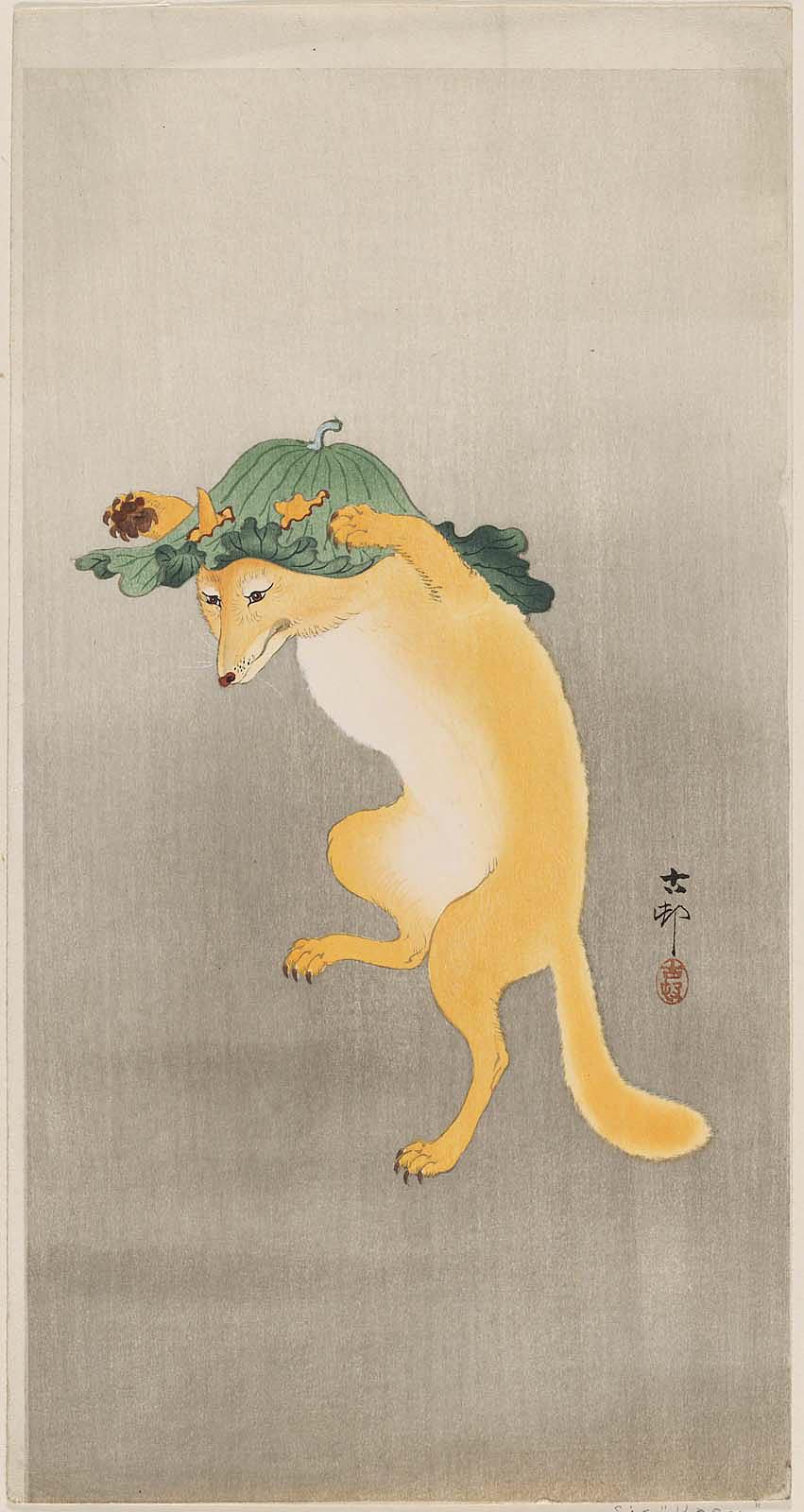
A fox balances on its hind legs in the rain. An improbably large green leaf tilts above its head, and a shallow pool catches its reflection. There is no human audience, no speech bubble, no theatrical costume. Yet the little creature seems to have stumbled into a performance. In Ohara Koson’s Dancing Fox, delight arises not from exaggeration but from the painter’s extraordinary economy: posture, weather, and one wonderfully placed leaf.
The work, rather than the legend
The Cleveland Museum of Art catalogues its impression as Dancing Fox, a color woodcut from the 1900s–1910s, accession 2016.546. Its description identifies a fox dancing in rain with a leaf upon its head. Japanese institutions use the title 踊る狐, read odoru kitsune. Ishikawa Prefectural Museum of History dates a version to 1904–1913; the Sano Art Museum checklist records multiple impressions and even a trial printing. These are compatible broad datings, not evidence that every surviving impression has identical provenance or appearance.
Why the fox is unusual
Koson is best known for birds. An owl against moonlight, sparrows on wet branches, herons and ducks in winter: animals inhabit his prints with a startling degree of individual presence. They are never merely decorative marks added to a landscape. The fox is exceptional because the composition grants its subject an almost comic action. But it remains recognizably a fox, not a human performer in disguise. That balance between careful observation and a single imaginative leap makes the scene memorable.
From Kanazawa into a changing print world
Born in 1877 and associated with Kanazawa, Koson studied painting under Suzuki Kason. His career unfolded as the market for Japanese prints was changing. Traditional woodblock methods endured, but audiences, publishers, and export networks were evolving. Publishers including Matsuki Heikichi and Akiyama Buemon issued his early nature prints. Much later he worked under other signatures, notably Shōson and Hōson, in publishing relationships documented by Japanese museum exhibitions. These names are not three unrelated artists: they describe stages of a career whose commercial and stylistic conditions shifted over time.
Softness created by wood, pigment and skilled hands
At first glance, a Koson print can seem like watercolor. Feather edges dissolve gently into mist; a sky appears washed with pale pigment; snowfall seems suspended in the air. But the illusion comes from a collaborative technology. A design must be translated into carved blocks, registered and printed in successive colors, with subtle gradations carefully controlled. Japanese museums emphasize that his delicate palette was achieved using techniques inherited from Edo-period ukiyo-e. Celebrating the artist need not erase the largely anonymous contributions of carvers and printers who helped realize the image.
The natural world as drama
Koson gives narrative weight to minute encounters: a bird lowers its head against weather, another studies a fruit, an owl’s silhouette is held against a luminous disc. The blank areas matter as much as the detailed animal. In Dancing Fox, the puddle acts as a second stage, while tall grass frames the performance without overwhelming it. This is not an ecological field note or a photograph. It is an artistic invention made persuasive by close attention to how creatures actually hold themselves.
An audience across the ocean
Japanese nature prints traveled abroad, and Koson developed a following outside Japan. His international presence and later uneven recognition at home offer a reminder that an artist’s reputation is not a fixed historical verdict. Museums and collectors shape what can be seen, compared, and understood. It is safer to speak of international circulation and subsequent Japanese reassessment than to claim that every particular print was made solely for an overseas buyer.
The 2025 return to Tokyo
Tokyo’s Ota Memorial Museum of Art mounted its exhibition Koson Ohara: Paradise of Birds from April 3 to May 25, 2025, marking 80 years since his death. The museum highlighted approximately 130 early bird-and-flower prints, rotating every work between the exhibition’s two halves. About a quarter had not appeared in its earlier Koson show. This was a retrospective held in 2025—not a newly opened October 2026 exhibition. It followed a 2019 exhibition and other museum efforts to bring his accomplishments to a broader Japanese audience.
How to spend a minute with Dancing Fox
Look first at the small angle of the raised paw. Follow the body up toward the green leaf. Then look down, not at another character but at the reflection. The sequence turns a solitary animal into a story with a beginning, a pause, and a possible next movement. Compare published impressions carefully: the Cleveland example includes grasses behind the figure, and museum catalogues document other examples and trial printings. Reproduction rights and the identity of a particular museum impression should never be conflated with rights to every photograph taken of the design.
A different kind of Japanese animal story
Koson’s achievement is not that he made animals behave like people. It is that he made their ordinary existence worth looking at, and occasionally allowed imagination to bloom inside observation. A century later, one rainy fox can still surprise a viewer who has never heard of the artist. The pleasure lasts longer than the joke: after smiling at the fox, we begin to notice the rain, the leaf and the fragile balance of the creature beneath it.
Sources and collection records
Based on museum collection and exhibition records; no original curator interview or direct artwork inspection.