- Gold you are meant to see through silk
- A double screen from 1935
- What is backing gold leaf?
- Why conservation became difficult
- The difference between restoring and recreating
- From newspaper sketches to the Japan Art Institute
- A painter of landscapes and presences
- Gold has never played just one role in Japanese art
- Why a regional museum matters
- Planning a visit without missing the exhibition
- The public deserves to know how it was saved
Gold you are meant to see through silk
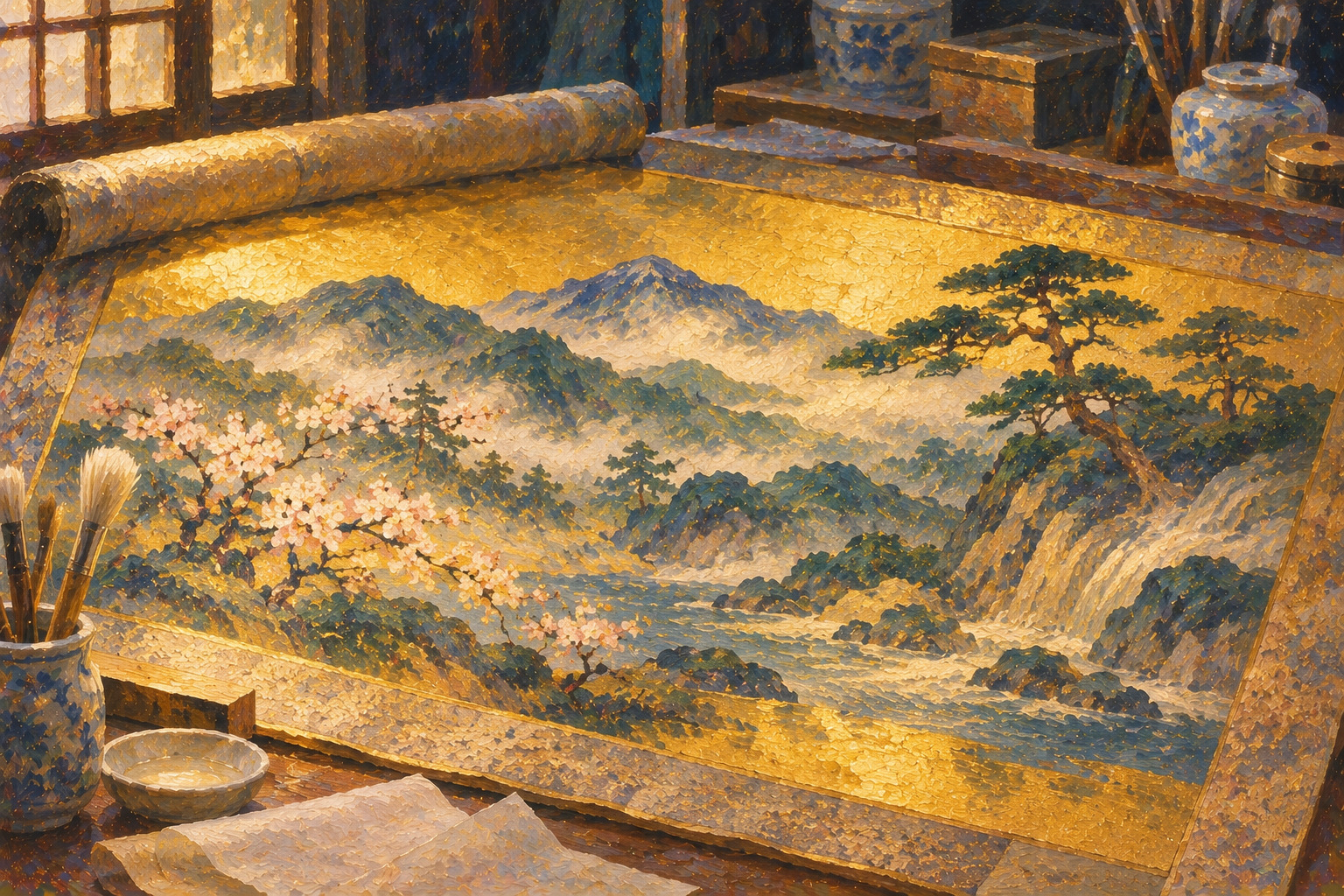
At first glance, gold in Japanese painting might suggest a brilliant metallic surface. The effect in Ogawa Usen’s late masterpiece is more elusive. The gold lies behind the silk, not over the ink painting on its face. Light passes through the painted support, giving mountains, mist and water a gentle radiance that is as much about restraint as splendor.
The Museum of Modern Art, Ibaraki, in Mito opened The World of Gold on November 12, 2026, to present the freshly conserved work for the first time after treatment. Running through January 11, 2027, the collection exhibition also considers different ways Japanese painters and craftspeople have worked with gold. The milestone matters because the picture’s construction made conservation unusually difficult.
A double screen from 1935
The artist was Ogawa Usen (1868–1938), a Japanese painter with deep ties to the waterways around Ushiku in Ibaraki Prefecture. The museum gives the work’s Japanese title as Kōson Rokugatsu, Unran Ensui (江村六月 雲巒烟水). Its component titles evoke a riverside village in June and mountains veiled by cloud and misty water. These are interpretive translations, not an official English title verified from the museum.
The painting dates to 1935, toward the end of Usen’s life. Historical records describe it as a pair of six-panel folding screens; the museum’s presentation identifies the individual sections, Kōson Rokugatsu and Unran Ensui. This was a major late undertaking, not a newly discovered ancient painting. Its return to view offers an opportunity to examine an established work through the unusual engineering of its materials.
What is backing gold leaf?
Japanese conservators call the technique urahaku (裏箔): gold or silver leaf is applied to the reverse of a paper or silk support. In this case the application extends across the entire painted surface, a form known as sō-urahaku (総裏箔). The museum notes that such full-surface backing is found in examples from the modern period onward.
For viewers, this changes the character of the light. The gold is filtered through fibers and pigment rather than exposed as an uninterrupted metallic foreground. Ink becomes part of the luminous effect rather than simply sitting beside it. For a conservator, however, the same layered structure complicates the task of separating deterioration from original materials.
Why conservation became difficult
The institution’s most consequential technical statement is straightforward: pigments and ink used in making the painting penetrated as far as the metallic-leaf layer. Its notice describes treatment as extremely difficult and says comparable cases are barely known. In other words, the appearance and physical structure of the picture cannot be regarded as two easily separable problems.
Silk paintings can raise questions about weakened supports, adhesive behavior, pigment stability and past repairs. Those are general conservation concerns, not verified steps in this project. The public exhibition text does not identify the exact adhesives, solvents, cleaning methods, conservators, project budget or treatment timeline. Describing any of those as established facts would go beyond the available evidence.
The difference between restoring and recreating
What should a museum seek to recover when it treats a damaged work? The brightest possible color? The artist’s presumed first appearance? Or the most faithful preservation of the object that has actually survived? Conservation often requires careful decisions among those competing aims. A picture is both a visual experience and a physical historical record.
Here the museum confirms that restoration is complete and the painting is receiving its first post-treatment public display. That is significant, but it does not demonstrate that every layer has been returned to exactly its 1935 condition. Without a published conservation dossier, it is also impossible to assess individual interventions or their long-term reversibility.
From newspaper sketches to the Japan Art Institute
Usen’s biography is strikingly different from the stereotype of a painter raised solely in an art academy. Born in Edo in 1868, he grew up in the Ushiku area, trained for a period in Western-style painting at Shōgidō, and later worked in agriculture while drawing cartoons and illustrations for newspapers. In 1917 he became a member of the Japan Art Institute, known for its revival of Japanese painting.
His subject matter frequently returned to marshes, fields and rivers, peopled sometimes by farmers and sometimes by fantastic creatures such as kappa, the water spirits of Japanese folklore. This was not merely whimsy. The Museum of Modern Art, Ibaraki has interpreted his work as revealing a sustained concern with the relationship between people and nature during Japan’s modernization.
A painter of landscapes and presences
Usen’s achievement lies partly in his ability to make familiar countryside feel inhabited by more than its visible occupants. Scholars and museums have long pointed to his interest in East Asian thought, poetry and the imagined world of spirits. Riverbanks could become places where observation and storytelling met.
The 1935 work can be viewed in that context. The gold behind the silk creates a quiet spatial ambiguity: landscape appears real and dreamlike at once. That is a reading of the materials and subject, not a statement by Usen about what he personally intended. The line between documented technique and artistic interpretation remains essential.
Gold has never played just one role in Japanese art
In Japanese screens, Buddhist painting, decorative arts and lacquerwork, gold can signal wealth, sacredness, sunlight or an imagined space outside ordinary time. The effect depends on where the metal is placed, how it is worked, how light reaches it and what the artist puts alongside it. A screen seen in changing room light is not the same experience as an image on a phone.
The exhibition positions Usen’s screen as an entry point to this larger vocabulary of gold. That makes the event more substantial than the return of a single object. It invites visitors to compare decorative brilliance with the low, filtered luminosity of gold hidden behind silk, and to see modern experimentation as part of a much longer artistic history.
Why a regional museum matters
The Museum of Modern Art, Ibaraki has long foregrounded artists associated with the prefecture, including Usen, Yokoyama Taikan and Nakamura Tsune. In 2012, it mounted a major exhibition reconsidering Usen’s work in the aftermath of the 2011 earthquake. Sustained collection management and research allow such institutions to preserve local cultural memory as well as showcase famous national names.
For a painter whose imagination was shaped by the Ushiku landscape, stewardship in Ibaraki has particular resonance. Conservation keeps open the possibility that future viewers will ask different questions—about changing wetlands, the cultural meanings of folklore, or the visual values of Japan’s early twentieth century.
Planning a visit without missing the exhibition
The World of Gold: Commemorating the Restoration of Ogawa Usen’s Kōson Rokugatsu, Unran Ensui runs November 12, 2026–January 11, 2027 in Gallery 1 of the Museum of Modern Art, Ibaraki. The museum lists hours of 9:30 a.m. to 5 p.m., with entry until 4:30 p.m. It is normally closed on Mondays, except where holiday rules apply. Monday, November 16—the date of this article—is a regular closure day; visitors should check the official calendar.
Rather than searching only for glitter, look for the way ink and the gold-colored light interact across the silk. Exhibition lighting or display conditions may be adjusted for preservation reasons. The museum’s own visitor guidance and current display list should take precedence over any general description in this article.
The public deserves to know how it was saved
An exhibition celebrating conservation provides one kind of public accountability; a technical record could provide another. Details of examination, condition before treatment, decision-making and long-term monitoring would help other museums confront similarly difficult objects. The publicly available announcement does not yet supply a full account of those steps.
The achievement should nevertheless be appreciated for what the museum has confirmed: a remarkably complex, full-gold-backed painting has been conserved sufficiently to return to public display. The deepest story is not simply that a 1935 screen glows again. It is that a fragile relationship between silk, ink, pigment and hidden metal remains available for future generations to study.
Sources and reporting method
Methodology: This report draws on the Ibaraki museum’s exhibition notice, collection records, a prior retrospective and institutional artist histories. No conservator interviews or independent inspection of treatment records were conducted.
- Museum of Modern Art, Ibaraki — official exhibition description
- Museum of Modern Art, Ibaraki — 2012 Usen retrospective
- Ibaraki museum — artist and collection database
- Art Platform Japan — Ogawa Usen
- Aichi Prefectural Museum of Art — artist biography
- Museum opening calendar, November 2026
- Museum annual program, fiscal 2026
- Tokyo National Research Institute for Cultural Properties — historical obituary archive