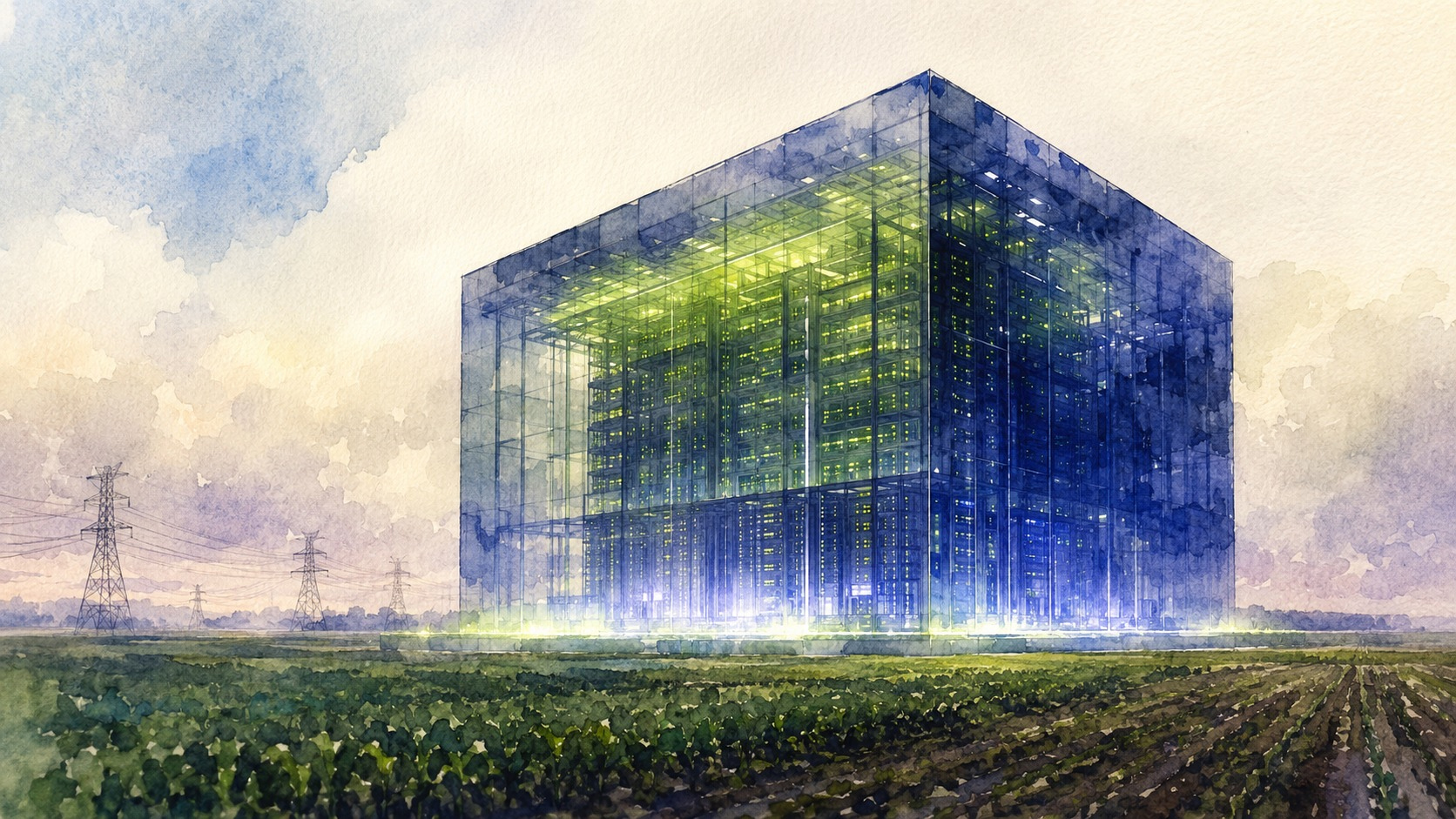
A $250 billion guarantee. Ten gigawatts of computing load. At least 9.2 gigawatts of new gas-fired generation. And, once Nvidia systems are included, a campus that could cost more than $500 billion. The AI project taking shape in southern Ohio stretches the meaning of “data center” to the scale of a power system and a national industrial policy.
But the most important verb is not “guaranteed.” It is “discussing.” The Wall Street Journal reported that Nvidia is considering backing roughly $250 billion of financing tied to OpenAI’s use of computing capacity developed by SoftBank Group’s SB Energy. Reuters relayed the report; no participant has announced a final contract. Amount, conditions, phases and liability could all change.
A guarantee is not $250 billion in cash
A credit guarantee does not mean Nvidia wires $250 billion to SB Energy. It means that if OpenAI cannot meet covered lease obligations, Nvidia would support payments to creditors or the project company under specified terms. If the promise is strong enough, lenders can price the debt partly against Nvidia’s credit rather than OpenAI’s standalone capacity.
OpenAI is growing rapidly, but it is a private company, not an investment-grade public utility with decades of rated bonds. Nvidia, by contrast, has extraordinary cash generation from its dominance of AI accelerators. Wrapping a proposed 20-year OpenAI lease in Nvidia’s credit could let SB Energy borrow more cheaply and for longer.
The reported $250 billion infrastructure financing excludes Nvidia hardware. A separate arrangement of roughly $350 billion for chips is also said to be under consideration. Those figures should not simply be added and described as committed cost. They are distinct negotiations; orders, rollout, technology generations and pricing can change dramatically.
How SoftBank’s solar developer became an AI builder
SB Energy traces its lineage to the renewable-energy push SoftBank launched after Japan’s 2011 earthquake and Fukushima disaster. In the United States it grew into a developer of utility-scale solar and battery projects. The AI boom is turning it into an integrated developer of land, power, transmission and data-center construction.
In January 2026, OpenAI and SoftBank Group announced investments of $500 million each in SB Energy. OpenAI selected the company to build and operate a 1.2 GW site in Milam County, Texas. SB Energy said it was developing several multi-gigawatt campuses and acquired Studio 151 to bring construction management, engineering, procurement and operations in-house.
Ohio is the extreme extension. SoftBank invests in OpenAI; SB Energy builds the campus and power; Nvidia supplies the machines and may guarantee the customer. The boundaries between tenant, supplier, shareholder, developer and creditor begin to overlap.
How large is 10 gigawatts?
Ten gigawatts is ten million kilowatts. At continuous use it would consume 87.6 terawatt-hours a year—closer to a small country than a conventional industrial campus. It resembles the output of roughly ten large nuclear reactors and the average electricity use of several million American homes.
The Energy Department says SB Energy plans 10 GW of new generation, including at least 9.2 GW of natural gas, connected to the regional grid. Excess generation and transmission would be available to consumers, while AEP Ohio participates in network expansion. Officials say the data-center development will bear costs rather than shift them to families.
Dedicated generation does not eliminate system effects. The complex needs pipelines, transmission, reserves, water, cooling and emissions permits. Running 9.2 GW of gas capacity at high utilization would create immense carbon emissions. Future carbon policy, gas prices, methane leakage, noise and water all enter the financing model.
From a Cold War uranium factory to an AI factory
The location is the Energy Department’s Portsmouth Site in Pike County. Construction began in 1952; at its peak, 23,000 workers logged 69 million hours. From 1954 to 2001, the plant used gaseous diffusion to enrich uranium for nuclear weapons and later commercial reactor fuel. The federal property exceeds 3,700 acres, and decontamination, demolition, groundwater and soil work continue.
The symmetry is striking. During the Cold War, Portsmouth consumed enormous power to separate atoms for national security. In the AI era, it may consume enormous power to perform matrix calculations for national competitiveness. Both missions combine federal land, giant electricity demand, long contracts and state purpose.
Federal ownership offers acreage, infrastructure and coordinated leasing. It does not erase environmental history. Residents can welcome jobs while demanding transparency on contamination, health, electricity rates and land use.
Why OpenAI needs a 20-year promise
AI consumes compute not only during model training but every time users request an answer. OpenAI’s planned compute spending through 2030 has reportedly climbed to about $750 billion. Securing first-party-designed capacity reduces dependence on outside clouds and gives OpenAI more control over supply, speed and unit cost.
Lenders to a power plant and data center need to know who pays after construction. A 20-year take-or-pay-style lease creates predictable cash flow and makes project financing possible. The mismatch is that GPUs age faster than concrete or turbines. Equipment refreshed every three to five years may sit atop debt extending two or three decades.
Rational for Nvidia—and dangerous
A guarantee would help Nvidia’s largest customer deploy more Nvidia systems. Chip demand cannot become revenue without buildings and electricity. Vendor financing has a long history in railways, telecom equipment and aircraft: suppliers help customers finance the products that create their markets.
The danger is circularity. If Nvidia invests in OpenAI, helps it borrow and the borrowed money returns through Nvidia purchases, independent demand becomes harder to see. If AI revenue disappoints, OpenAI’s lease, SB Energy’s debt, Nvidia’s guarantee and Nvidia’s chip sales could weaken together.
Nvidia has already supported AI infrastructure companies through equity, guarantees and purchase commitments, including CoreWeave and Nscale. Credit enhancement accelerates construction, but large contingent liabilities can extend a semiconductor company’s risk far beyond inventory and receivables.
Masayoshi Son’s next giant wager
SoftBank founder Masayoshi Son has repeatedly concentrated capital around what he believes will be the next computing platform: PC software distribution, Yahoo, Alibaba, mobile networks and the Vision Fund. Success created extraordinary gains; WeWork and portfolio write-downs exposed the cost of conviction.
SoftBank’s roughly $30 billion additional OpenAI bet is testing its borrowing limits. Investors watch loan-to-value, the rising share of unlisted assets and the credit outlook. The Ohio project needs layers of support—an OpenAI lease, Nvidia credit and government power arrangements—because its scale exceeds a conventional corporate balance sheet.
The largest risk may be time
- Guarantee scope: full principal, selected lease payments, cap and termination rights.
- Phasing: whether construction can stop below 10 GW as demand changes.
- Technology refresh: who pays to replace and reuse obsolete accelerators.
- Power exposure: allocation of gas, emissions and grid-upgrade costs.
- Credit hierarchy: the order of Nvidia, SoftBank and government support if OpenAI cannot pay.
Demand can grow while construction still misses its moment. Turbines, transformers and transmission equipment face long global lead times. Before a first phase in 2028, GPU generations, model efficiency, competition, regulation and capital markets will change. Better software may require less compute—or inference demand may grow even faster than expected.
Microsoft’s decision to pause or reduce some data-center plans, including in Ohio, is a reminder that infrastructure forecasts are not straight lines. Staged funding, cancellation rights and the ability to serve other tenants are essential safety valves.
The financial architecture is the real invention
If this project proceeds, Nvidia will not simply be the supplier, OpenAI the user, SoftBank the investor, SB Energy the developer and Washington the landlord. Each will support the others’ capital cost and continuity.
Portsmouth was once a factory built by the state for the atomic age. Private AI and chip companies now want to build a factory for the computing age on the same federal ground. The reported $250 billion guarantee shows how expensive, interconnected and difficult to unwind that future may be. Until contracts appear, readers should look past the magnificent number and ask who guarantees what, for how long, and under which conditions.
Sources and further reading
- Reuters: Reported Nvidia guarantee talks
- Wall Street Journal: Original report on the financing talks
- U.S. Department of Energy: Ohio power and data-center partnership
- SB Energy: Partnership with OpenAI and SoftBank Group
- U.S. Department of Energy: Portsmouth Site history
- Reuters: OpenAI compute spending and revenue outlook