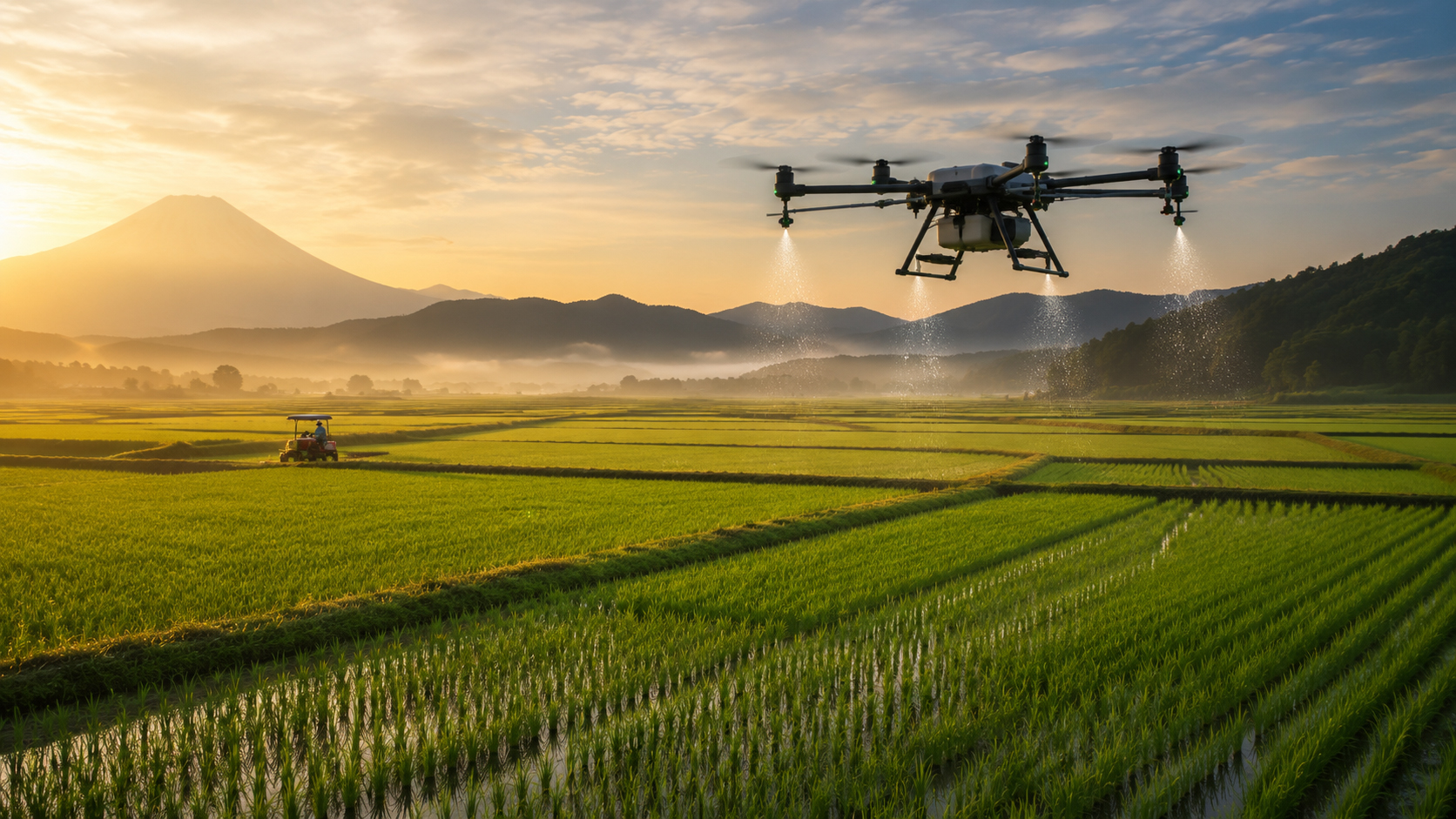
The rice field is quietly asking for a future. It is easy to say “smart agriculture” in a Tokyo conference room. It is harder to stand in a summer field, manage water, walk the levees, prepare chemicals, and do heavy work under a brutal sun when the people who know how to do that work are getting older every year.
That is why the February 2026 collaboration between Sumitomo Corporation and NTT e-Drone Technology matters. The announcement sounds modest: expand the adoption of domestically produced agricultural drones. But beneath that phrase is one of Japan’s biggest structural questions. How does a country with an aging farm workforce keep producing food without turning every field into a museum of noble exhaustion?
This story should not be reduced to “a drone sprays pesticide.” It is about telecom infrastructure, trading-company sales power, domestic manufacturing, Nileworks’ inherited development knowledge, and the national question of whether Japan can keep its fields productive with fewer hands.
The quiet crisis in Japanese agriculture
Japan’s agricultural crisis rarely arrives as one dramatic headline. It arrives as an older farmer, a field with no successor, a road too narrow for large machinery, a village that no longer has enough people to do seasonal work, and a food system asked to become more resilient in a more unstable world.
Pesticide and fertilizer application can be some of the most physically demanding field work. In many places, a person still has to carry equipment, walk field edges, operate in heat, and repeat the task across irregular plots. A drone does not solve every problem, but it can remove some of the worst strain from work that must still be done.
Who is NTT e-Drone Technology?
NTT e-Drone Technology was established in 2021 through a structure involving NTT East, OPTiM, and WorldLink & Company. NTT Technical Review describes the company as emerging from smart-agriculture experience and the growing use of drones in pesticide spraying, fertilizer application, sensing, and seeding. In other words, the company was not born as a hobby-drone venture. It was born around practical field work.
The company’s own message is broad: drones can support food production, surveying, infrastructure inspection, wildlife control, and disaster response. That is very NTT. It is not only about the aircraft. It is about turning a device into a regional operating system.
Why Sumitomo matters
Sumitomo Corporation changes the story from a technology announcement to a market-building exercise. Japan has many clever machines that struggle to reach conservative, busy, cost-sensitive users. Farmers do not adopt hardware because a press release is elegant. They adopt it when it is sold properly, supported properly, financed properly, repaired properly, and explained by people they trust.
A trading company understands the unglamorous side of adoption: channels, service, financing, local relationships, supplier networks, municipal projects, and after-sales support. Drones will not become normal in Japanese agriculture because the aircraft looks impressive. They become normal when the business layer around the aircraft works.
The Nileworks lineage
Nileworks is part of this story. The company was once one of the best-known names in Japanese agricultural drones. In 2019, it raised about ¥1.6 billion from investors including Sumitomo Corporation, Sumitomo Chemical, INCJ, Drone Fund and others, with plans to build commercial production capacity and launch a new model.
But the agri-drone market is not easy. It requires product development, sales, service, regulation, accident response, farmer education, and a price point that makes sense in real fields. In 2025, Nileworks’ agricultural-drone development resources were transferred to NTT e-Drone Technology, with remaining businesses moved elsewhere and Nileworks later dissolved. That can be read not simply as failure, but as consolidation: Japanese agri-drone knowledge moving into a larger operating base.
AC101 and AC102: designing for Japanese fields
NTT e-Drone’s AC101 is presented as a Japan-made agricultural sprayer designed around local field conditions. Product materials describe a 7.3 kg aircraft, an 8-liter tank, up to 35 minutes of maximum flight time, and up to 2.5 hectares of spraying area. The point is not just bigger capacity. The point is lightness, compactness, efficiency, and a machine that can fit into Japanese work patterns.
AC102 continues that thinking, emphasizing a compact agricultural drone designed for Japanese farm sites and up to 2.5 hectares on one battery. A huge American farm may reward huge machinery. Japan’s fields often reward something else: a tool that fits a kei truck, handles irregular plots, and respects the practical nuisance of real rural geography.
Agricultural drones do not replace farmers
This matters: agricultural drones are not, at their best, machines for deleting farmers. They are machines that help farmers continue. An older farmer may avoid some of the most exhausting work. A part-time farmer may finish spraying in a smaller window. An agricultural corporation may manage more land with fewer people. A young worker may enter farming without inheriting the idea that everything must be solved by physical suffering.
Japan does not need to preserve every painful task as culture. It needs to preserve the ability to farm. Drones can help separate the dignity of agricultural knowledge from the exhaustion of unnecessary manual burden.
Bird damage, disease control, and food security beyond rice
NTT e-Drone’s reach also extends into wildlife and disease-prevention uses. In 2025, reporting described an NTT laser-equipped drone system designed to deter wild birds from poultry farms in Chiba after a severe avian-flu season. It sounds odd until one remembers the stakes: bird flu can force mass culling, damage local economies, and disrupt food supply.
Food security is not only the production of rice. It is also disease prevention, wildlife control, monitoring, early detection, and the ability to act with fewer people. Agricultural drones are becoming eyes in the sky, precision applicators, and sometimes mobile scarecrows with software.
The new meaning of “domestic drone”
A few years ago, “domestic drone” could sound like an emotional slogan. Now it is a practical question. If a drone is used in food production, who controls the flight software? Where does the data go? Who services the aircraft? What happens during a supply-chain shock? Can local operators trust the machine and the support network behind it?
Agricultural drones sit at the intersection of machinery, data, chemicals, telecoms, and regional infrastructure. That makes domestic capability more than industrial pride. It becomes a resilience question.
What to watch next
The key metric is not the number of announcements. It is deployment: how many aircraft are bought, how often they fly, how reliably they are serviced, whether farmers keep using them, and whether municipalities, agricultural corporations, and JA-related networks integrate them into ordinary workflows.
The second metric is data. NTT e-Drone’s long-term value may not be only the aircraft. It may be the work logs, mapping, remote support, flight planning, regional operations, and disaster-response crossover that turn drones from machines into infrastructure.
A small national strategy over the rice fields
An agriculture drone looks small above a rice field. But the problem beneath it is large. Who will maintain the fields? Who will produce food? Who will help villages with too few workers keep functioning? Who will make disease control and wildlife control less labor-intensive?
The Sumitomo and NTT e-Drone collaboration is one answer. It combines trading-company reach, telecom operating culture, domestic drone development, and the hard lesson that technology has to fit the field, not the other way around.
The future of Japanese agriculture does not have to be fully unmanned. It only has to be possible. Sometimes that means a person stays on the ground while a small machine flies the hardest part.
| What to watch | Why it matters |
|---|---|
| AC101/AC102 adoption | Compact domestic sprayers must prove they fit Japan’s small, irregular, labor-starved fields. |
| Sumitomo’s channel power | A drone market needs sales, financing, service, explanation, and trust, not just hardware. |
| Nileworks assets | Inherited development knowledge may become more valuable inside a larger operating platform. |
| Bird and disease control | Agricultural drones can protect food systems beyond spraying, including monitoring and biosecurity. |
| Connectivity and data | NTT’s deeper play may be regional drone operations, work data, and support infrastructure. |
- Sumitomo Corporation and NTT e-Drone Technology announced a February 2026 collaboration to expand domestically produced agricultural drones.
- NTT e-Drone was established in 2021 and sits at the junction of agriculture, telecom infrastructure, AI, inspection, and regional operations.
- Nileworks’ agricultural-drone development resources were transferred to NTT e-Drone in 2025, consolidating part of Japan’s domestic agri-drone knowledge.
- AC101 and AC102 emphasize light, compact, efficient tools designed around Japanese field conditions.
- The best agricultural drone story is not replacing farmers. It is helping farming remain possible.
Sources and references
This article draws on Sumitomo Corporation and NTT e-Drone Technology’s February 2026 announcement, NTT e-Drone product information, NTT Technical Review, AC101/AC102 materials, Nileworks-related releases, and agricultural-drone market reporting.