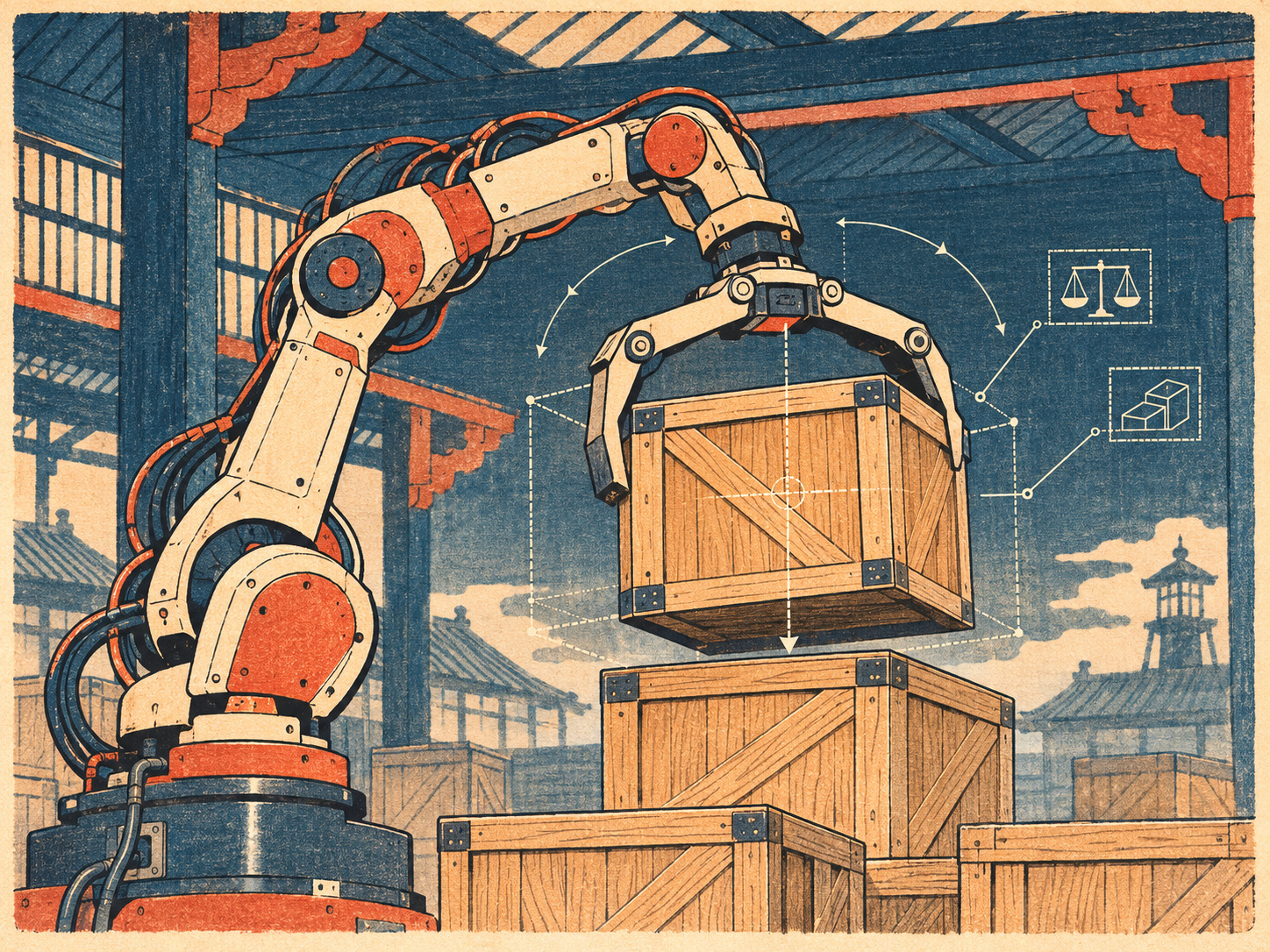
- The moment before a box falls
- What the 92.3% figure actually says
- Why a convincing video can be physically wrong
- A second opinion for the robot planner
- The unfamiliar-object problem
- Japan’s strength—and its historic constraint
- The longer history of machines that plan
- The airport is the next test, not a completed success
- What the public benchmark cannot certify
- A November exhibition—and a careful use of “first”
- The significance of being able to reconsider
The moment before a box falls
Consider a baggage handler facing a cart of mismatched suitcases. A rigid case offers a flat surface; a soft duffel shifts under pressure; a handle catches against the bag below it. A person may pause, adjust the angle, and choose a different spot. That pause contains a form of prediction: not simply where an object can be moved, but what will happen after it is released.
NTT announced on November 11, 2026, that it had built a way to put such an assessment into a robotic decision loop. Its system examines several candidate actions, estimates the physical consequences, and helps choose one less likely to cause a load to collapse or an object to fall. The phrase “predicts the future” is an effective headline, but the important advance is more specific: using explicit physical quantities to test possible next steps before a machine takes them.
What the 92.3% figure actually says
In an experimental shelf-loading exercise using a small robot, NTT reported a task success rate of 73.1% without its technology and 92.3% with it. That is an increase of 19.2 percentage points, not an assurance of near-perfect performance in the field. The relative gain is about 26%, but percentage points are the clearer way to express the comparison.
The distinction matters. NTT described a simulated loading task, not an airport-scale pilot involving an unpredictable daily stream of baggage. The public announcement does not establish fleetwide throughput, damaged-item rates, long-term reliability, or statistical uncertainty across all operating conditions. It supports a promising result in a defined comparison—not a claim that any robot will succeed on 92.3% of arbitrary loads.
Why a convincing video can be physically wrong
Generative video systems can be excellent at producing frames that look plausible. Plausibility, however, is not conservation of matter. An object can warp or vanish between frames; a collision can appear to pass harmlessly through another object. In entertainment that may be a visual defect. In a robotic warehouse it can become an unsafe decision.
NTT calls its additional component a “physics control adapter.” It estimates such properties as an object’s position, orientation, velocity and mass, uses equations of motion to estimate how states change, and feeds that information into a video-generation model. The resulting predicted sequences can be compared for outcomes such as a drop or collision. It is an attempt to combine the flexible pattern recognition of learned models with constraints drawn from mechanics.
A second opinion for the robot planner
The system is not presented as a replacement for every element of a robot’s control stack. A vision-language-action model, or a motion planner, might first propose possible movements. NTT’s world model then evaluates what could happen if those movements are carried out. In this architecture, deciding how to reach a location and deciding whether that location will be stable are related but distinct questions.
Imagine two placements within reach of the same arm. Both are kinematically feasible. But one rests a heavy container on a secure base; the other puts it on a sloping surface. A route planner may accept both unless it has sufficiently rich information about the object interactions that follow. NTT’s work addresses that missing layer of judgment, while leaving the practical integration with existing machinery as an engineering task.
The unfamiliar-object problem
Robotic systems often perform best when objects, fixtures and paths are known in advance. A modern baggage stream resists that discipline: every flight delivers bags with different shapes, weights and materials. NTT argues that representing physical quantities explicitly can help predictions remain meaningful in situations that were absent from training data, including cases where a robotic arm partly obscures an object.
The company also evaluated generated predictions using OBJ3D, a public benchmark containing interactions among multiple objects. It reports stronger performance than comparison methods on LPIPS, a perceptual image-similarity metric for which lower values indicate better agreement. That is useful evidence about video prediction. It is not, on its own, a safety certification or a measure of how often a real suitcase would be damaged.
Japan’s strength—and its historic constraint
Japan’s place in industrial robotics was built on making machinery repeat demanding tasks with exceptional consistency. Kawasaki Heavy Industries traces its 1968 technology agreement with the American company Unimation to commercial production of the Kawasaki-Unimate 2000 in 1969, recognized in the company’s history as Japan’s first domestically produced industrial robot. Such systems helped industrial processes become more repeatable and less dependent on strenuous manual handling.
That tradition remains valuable in welding, assembly and other controlled production environments. But automation encounters a different economic proposition when every item is different. A luggage conveyor or parcel-handling center cannot demand that every customer pack a standard box with a known center of mass. Adaptability—not just precision—is the scarce capability NTT hopes to improve.
The longer history of machines that plan
The dream of predicting an action before performing it reaches back through the history of artificial intelligence. At SRI, researchers developed Shakey between 1966 and 1972. With cameras, sensors and planning software, the mobile robot could reason about a simplified environment and carry out sequences of actions. It became an early demonstration that robotic movement could be guided by symbolic reasoning rather than a completely fixed script.
Today’s tools are radically different: high-capacity neural networks, video generation, rapid visual recognition, and powerful computing hardware. Yet the central question remains recognizable. How can a machine connect what it perceives to the likely consequences of what it does? NTT’s distinctive answer combines generated future imagery with calculated physical state changes, rather than treating impressive video alone as evidence of real-world understanding.
The airport is the next test, not a completed success
NTT identifies airport baggage loading and unloading as its initial intended application. It says it will work with Mujin, a Japanese robotics automation company, on efforts toward real-world implementation and may extend the approach to logistics, manufacturing, construction and retail. These are plans, not verified operational deployments of the newly announced model.
At an airport, a useful system would have to predict in time to keep up with baggage flow. It would have to respond to crushed corners, sagging fabric, straps, uncertain weight distribution and partially occluded objects. Operators would want to know not only whether it avoids an immediate fall, but how often it stalls, how it recovers, and what its maintenance and safety costs look like. Such data are not supplied by the headline success-rate comparison.
What the public benchmark cannot certify
Predictive accuracy has several meanings. A video may be perceptually similar to a reference sequence yet still estimate the crucial moment of contact incorrectly. A model may classify a stable stack correctly on average but miss the rare and consequential case of a bag hitting a person. For working robots, those tail risks matter disproportionately.
The crucial future evidence will therefore include independent tests with novel bags, calibrated contact measurements, inference latency, recovery behavior, and sustained operation across shifts. The model’s outputs must also be assessed alongside conventional safeguards such as speed limits, physical barriers and emergency stops. An AI prediction should contribute to safety engineering, not replace it.
A November exhibition—and a careful use of “first”
NTT plans to present the technology at NTT R&D FORUM 2026, scheduled for November 18–20 and November 24–25. The company characterizes its integration of a physics control adapter into a video-generation foundation as a world first. That priority claim is NTT’s; the announcement alone does not amount to an independent survey of every potentially related system.
For readers evaluating the development, the more consequential question is whether it can produce reproducible advantages across independent environments. A short demonstration can show possibility. A deployment study can show economics, maintenance burden and risk. Those are different milestones, and reporting should not collapse them into one another.
The significance of being able to reconsider
This is not a robot that knows the future. It is a system that can compare modeled futures, each dependent on the sensor readings, simplifying assumptions and physical parameters available to it. Friction may be uncertain; a bag may hide a heavy object; a hand may enter the working area unexpectedly. The robot’s model will sometimes be wrong.
Nevertheless, there is a meaningful difference between acting first and noticing failure afterward, and testing alternatives before moving. Industrial robotics has spent decades becoming dependable at repeated actions. The harder frontier is dependable behavior when the objects and circumstances refuse to repeat. NTT’s announcement gives that challenge a concrete experimental result, and an equally concrete list of questions that field trials must answer.
Sources and verification
Reporting note: The technical claims are attributed to NTT’s November 11 announcement. Robotics history was cross-checked against Kawasaki and SRI. No independent interview, field test or reproduction of the model’s results was conducted.