- The Moon needs more than another landing
- Two jobs for light: bits and watts
- Why a lunar rover cannot rely on the familiar grid
- NTT’s path from fiber networks to space
- A laser power test—and the efficiency that should not be hidden
- Laser links have a history beyond Japan
- ispace’s ambitions run alongside two hard lessons
- A relay satellite planned for 2027, another landing targeted for 2028
- The strategic meaning of cislunar communications
- What credible progress would look like
The Moon needs more than another landing
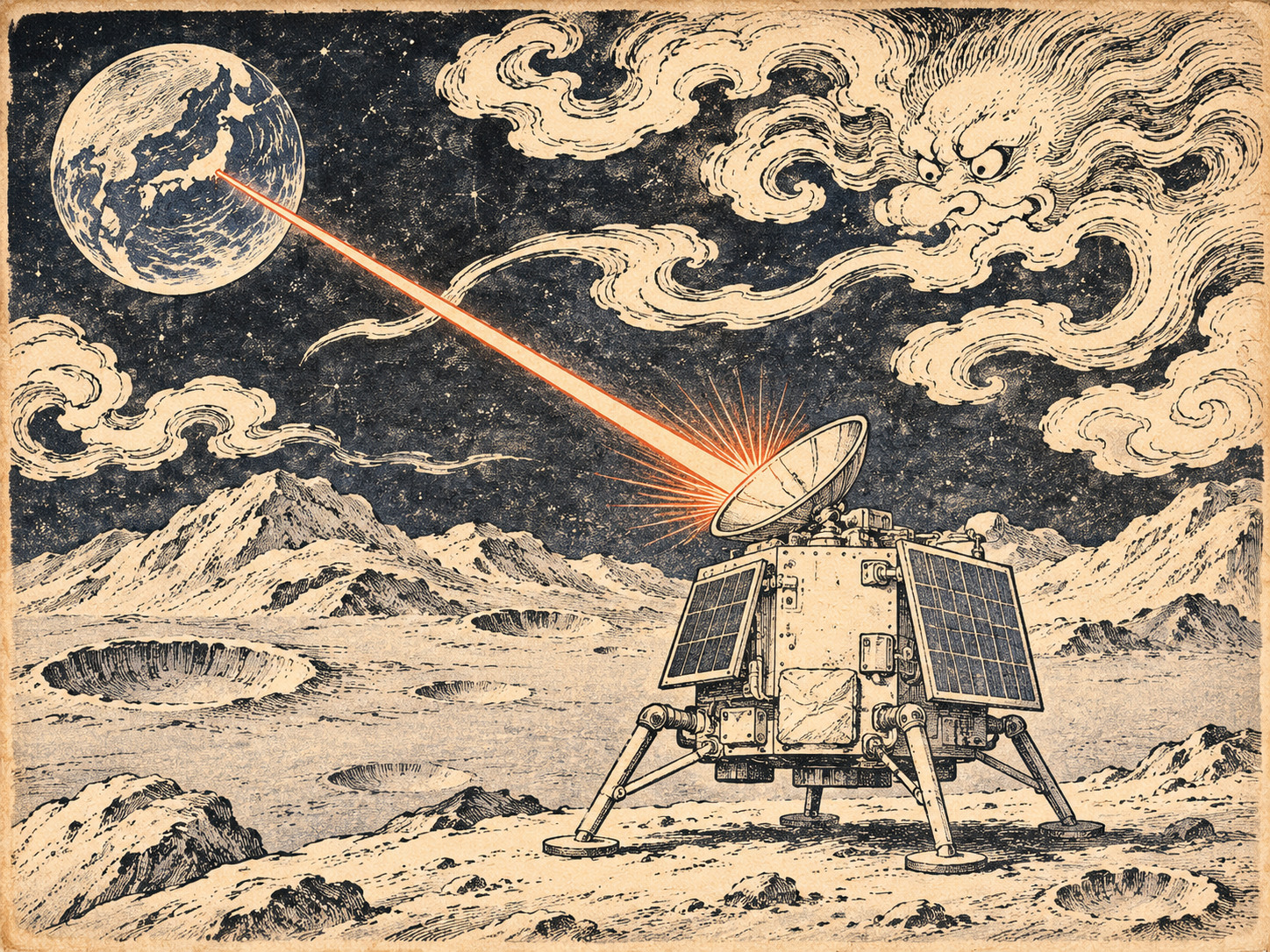
A spacecraft touching the lunar surface makes an unforgettable image. What follows is less photogenic: a rover needs to send its findings home, a construction machine needs energy, and operators need to know whether the equipment is healthy. On November 16, 2026, Japan’s NTT and lunar company ispace announced a collaboration to study two building blocks of that future: high-speed optical links between Earth and the Moon, and laser-based power delivery for equipment operating on the surface.
The announcement is a research and commercialization study, not a deployed lunar network. The companies intend to examine use cases, system architectures, requirements and demonstration methods, with future tests on Earth or in space under consideration. No transmission capacity, lunar installation date, energy output or commercial price was disclosed. The distinction matters: a serious infrastructure story begins not when a laser is pictured, but when an operator can guarantee a service.
Two jobs for light: bits and watts
An optical communications link uses light to encode and deliver information. Its tightly directed beam can carry large amounts of data between precisely aligned terminals. A laser power link has a different objective: put usable energy at a receiver, where a photovoltaic or other converter turns incoming light into electricity. One system is judged by the integrity and rate of data; the other by safe, reliable power at the load.
Both require sophisticated optics and pointing. But a successful communications demonstration does not imply that the same beam could charge a rover at a useful rate. Nor would a successful power demonstration guarantee a resilient network. NTT and ispace are investigating two related but technically distinct areas, whose equipment, power budgets and risk controls will likely differ.
Why a lunar rover cannot rely on the familiar grid
There is no established lunar electricity distribution system. A lander might carry solar arrays and batteries, but a mobile rover can move into shadow, and cables connecting distant vehicles would constrain the operation. On many lunar sites night lasts for extended periods. At the poles, illumination varies greatly with local terrain. Transporting and maintaining energy storage also imposes mass, thermal and reliability costs.
Beamed power might one day extend operations or provide a supplemental supply to mobile equipment. Yet the engineering is unforgiving. A receiver must remain visible, pointed correctly and thermally managed. A ridge or vehicle can block the path; moving platforms change alignment; dust contamination and stray light introduce additional risks. A workable architecture must include alternatives for when the beam is unavailable. These are engineering questions, not performance claims established by the new agreement.
NTT’s path from fiber networks to space
NTT introduced its IOWN concept in 2019 to address the growing capacity and energy demands of digital systems using optical technologies. The group began commercial all-photonics-network-related services in 2023. The familiar terrestrial network is still a very different environment from an interplanetary optical link: fiber guides light through a protected medium, while a spacecraft must point a narrow beam across enormous distances.
Nevertheless, source and receiver technology, optical signal processing, network engineering and systems operations offer areas of relevant expertise. NTT has also described a Space Integrated Computing Network and carries space initiatives under the NTT C89 brand. Nothing in the November announcement proposes a physical fiber cable between Earth and the Moon; the contemplated links are optical wireless connections.
A laser power test—and the efficiency that should not be hidden
A useful grounding point predates the ispace agreement. In September 2025 NTT and Mitsubishi Heavy Industries announced that they had delivered 152 watts of electrical power at a receiver one kilometer from a laser transmitter operating at one kilowatt of optical output. The companies described roughly 15% power-transfer efficiency for the stated test conditions, which included strong atmospheric disturbance.
That is a tangible technology result, not a moon-ready power grid. The published percentage is not a wall-plug-to-rover system efficiency, nor a promise that a lunar system could deliver that percentage over a much longer link. The Moon removes some atmospheric problems but creates others, from thermal extremes to pointing and operational hazards. A comparison must include transmitter electricity consumption, receiver mass and heat dissipation—not just watts at the optical source.
Laser links have a history beyond Japan
NASA’s Lunar Laser Communications Demonstration tested high-speed optical connections across the Earth–Moon distance in 2013. A decade later its Deep Space Optical Communications experiment launched aboard the Psyche spacecraft and demonstrated data transfer over distances far beyond the Moon. The project completed operations in September 2025, after returning signals from hundreds of millions of kilometers away.
Those achievements matter because they establish that laser-based communication in space is much more than science fiction. They also demonstrate the persistence of the operational problems: cloud cover at ground stations, extremely accurate pointing and rapidly changing geometry. Future systems may need multiple ground locations, relays and radio fallback. NASA’s achievements are not NTT–ispace demonstrations, but they set a useful benchmark for what the Japanese partnership must eventually prove.
ispace’s ambitions run alongside two hard lessons
Tokyo-based ispace has worked to build a business around lunar transportation and data services. Its first HAKUTO-R landing attempt in April 2023 failed to achieve a soft landing. Its second mission, using the RESILIENCE lander, also ended without a successful touchdown in June 2025. In its subsequent technical analysis, the company identified an issue affecting the laser rangefinder during final descent.
A laser rangefinder measures distance; it is not the laser communications system or power-transfer technology announced with NTT. The distinction is essential. Still, the failed missions illustrate how difficult dependable lunar operations remain, even after a spacecraft has traveled nearly all the way to its destination. Any future infrastructure service will have to demonstrate not just a functioning device, but reliability across an entire mission.
A relay satellite planned for 2027, another landing targeted for 2028
ispace announced plans for its Lunar Connect Service in March 2026, envisioning communications and positioning services using lunar-orbiting satellites. In September, ispace’s U.S. subsidiary and Argo Space finalized an agreement to deliver the first satellite, Alpine, under the so-called Mission 2.5 plan, with launch targeted as early as 2027. The company separately targets a lunar landing for Mission 3 in 2028. Those are schedules and intentions, not completed deployments.
Another partnership adds context: on November 12 ispace and KDDI disclosed further work toward lunar communications architecture and services. NTT’s optical study and KDDI’s collaboration are distinct undertakings; their components and commercial responsibilities are not yet a unified operational system. A central question is whether future relay satellites, ground stations and surface terminals can be made interoperable rather than becoming isolated technical demonstrations.
The strategic meaning of cislunar communications
The area between Earth and the Moon is increasingly discussed as cislunar space. The NTT–ispace release connects its research not only to exploration data but to space situational awareness, traffic management and sovereign communications capabilities that Japan can operate with confidence. That expands the story beyond the prospect of a fast lunar internet connection.
Infrastructure creates governance questions: who controls access, which technical standards will be adopted, how does a network respond to outages, and who carries responsibility for safety? A national capability might support economic resilience, but it also depends on cooperation with other space actors and compatible standards. A laser network is a potential component of resilience, not automatically a substitute for radio or for political coordination.
What credible progress would look like
The next milestones should be specific enough for engineers and customers to assess. Optical links require published targets for throughput, link availability, pointing accuracy and weather redundancy. Power transfer needs credible delivered-watt figures, conversion efficiency, heat management, beam safety and scenarios for equipment moving behind obstacles. Integrating those functions into a flight opportunity would be a further milestone, not an assumption of the agreement.
For now the companies have not disclosed a budget, a contracted demonstration mission, system performance specifications or a timetable for commercial operation. Their proposition nonetheless marks a meaningful change in emphasis. A lunar economy will be built less by isolated spectacular arrivals than by ordinary capabilities repeated reliably: moving information, delivering energy and keeping machines working long after the cameras stop watching.
Sources and reporting limitations
This independent analysis uses primary announcements and NASA technical background available through November 16, 2026. No first-hand interview or mission verification has been conducted. Budgets, performance specifications, demonstration dates and operating economics remain undisclosed.