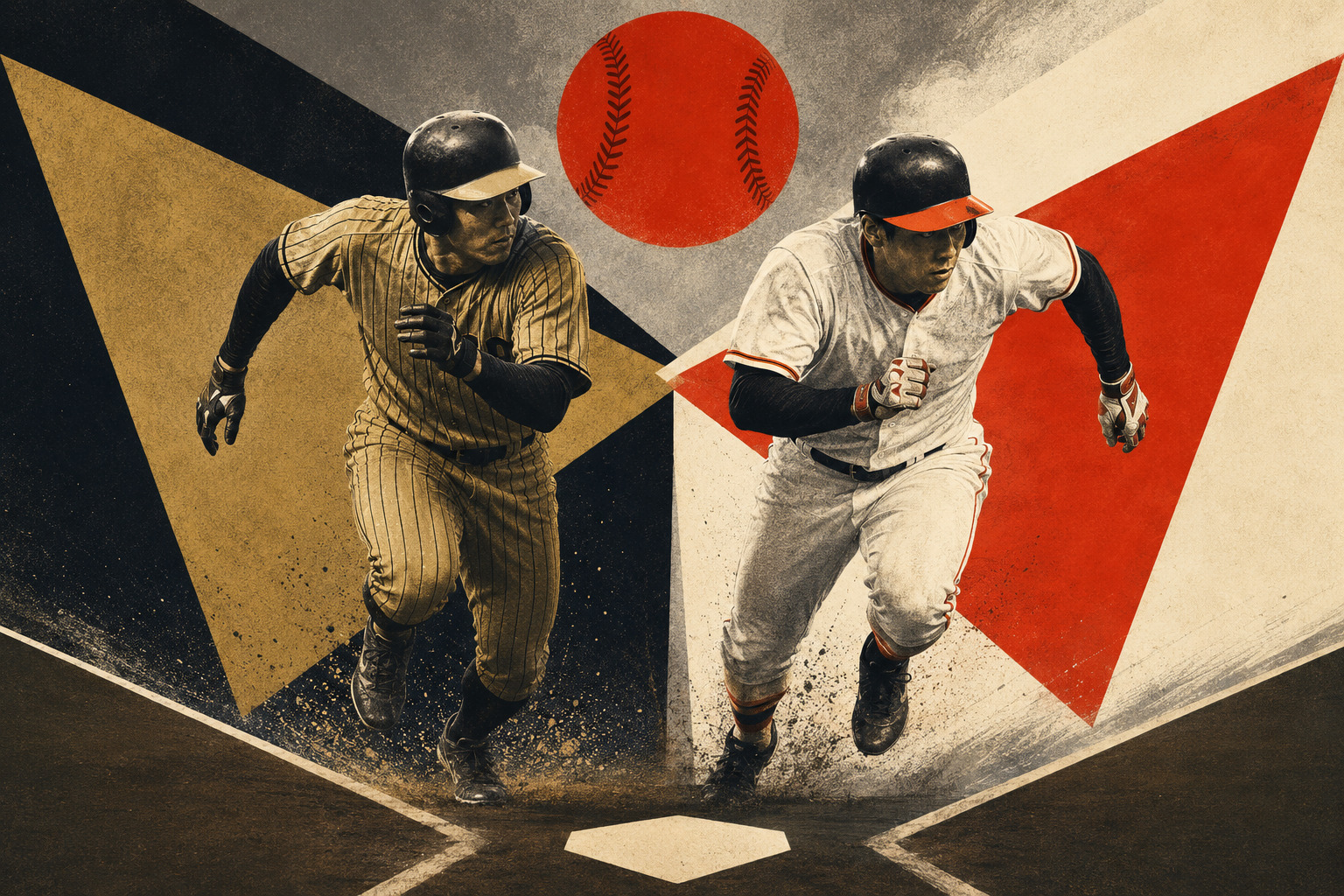
When the last pitch settled into the catcher’s glove, Koshien Stadium’s scoreboard held one run and an entire pennant race: Hanshin 1, Yomiuri 0.
It was July 26, the final game before NPB’s All-Star pause. Hanshin starter Shoki Murakami finished all nine innings on four hits with six strikeouts. Teruaki Sato’s third-inning solo home run—his 22nd of the season—was the night’s only scoring. Shinnosuke Ogasawara gave Yomiuri seven innings of one-run baseball and still lost. The Giants had been shut out for the 10th time.
For Hanshin, the victory salvaged the end of a difficult series. Yomiuri had won 4–2 on July 24 and 5–1 the following night. Tigers manager Kyuji Fujikawa described the finale as a repayment for the hurt absorbed in the opener. Yet what one victory made was larger than revenge. Hanshin moved to 50–40–1; Yomiuri to 50–40–2. Their winning percentages were identical at .556. The games-behind column disappeared.
Never before had two Central League teams reached the All-Star break tied for the lead. NPB as a whole had produced only two previous instances: Daiei and Nankai in the 1953 Pacific League, then SoftBank and Nippon-Ham in the 2011 Pacific League. In both years, the defending champion—Nankai in 1953, SoftBank in 2011—ultimately repeated. That is a comforting fragment of precedent for 2025 Central champion Hanshin and a small piece of history for Yomiuri to overturn.
The tie feels like perfect balance. It is not. It is the meeting point of two teams built to win in opposite ways.
The same record, two different machines
The most startling comparison is the one that initially appears to prove the teams are twins. At the end of the first half, Yomiuri’s staff ERA was 2.90. Hanshin’s was 2.91. At the level of a full team, a fraction of one hundredth of a run separated them.
Then the components begin to pull apart. Hanshin had eight complete games and 14 shutout victories. Yomiuri had three complete games and six shutout wins. The Giants, meanwhile, had 34 saves and 97 holds; the Tigers had 28 saves and 53 holds. Hanshin’s best starters carry games deep. Yomiuri turns the late innings into a relay and wins by making the remaining distance shorter.
The offensive divide is less subtle. Through July 23, Hanshin was batting .244 with 334 runs, 72 home runs and a .316 on-base percentage. Yomiuri stood at .235 with 287 runs, 67 homers and a .292 OBP. The Tigers had created 47 more runs. They reached base more often and possessed more ways to turn a lineup over.
Yet the standings awarded no premium for style. Yomiuri converted a smaller supply of runs into 50 wins by protecting thin margins. Hanshin’s larger offense did not become a lead because runs are not stored from one night to the next. A 10–1 victory and a 1–0 victory occupy the same line in the standings.
| Measure | Hanshin | Yomiuri | What it reveals |
|---|---|---|---|
| Record / percentage | 50–40–1 / .556 | 50–40–2 / .556 | Complete surface equality |
| Team ERA | 2.91 | 2.90 | Almost no difference in total prevention |
| Complete games / shutout wins | 8 / 14 | 3 / 6 | Hanshin’s starters control more of the game |
| Saves / holds | 28 / 53 | 34 / 97 | Yomiuri builds a deeper relief chain |
| Runs / on-base percentage | 334 / .316 | 287 / .292 | Hanshin owns the clearer offensive advantage |
Interleague play supplies the final twist. Hanshin went 6–12 against Pacific League opposition; Yomiuri went 10–6–2. Remove those games and the Tigers’ record against Central clubs was 44–28–1, a .611 pace. The Giants were 40–34. Hanshin controlled its own league but gave away ground during the 18-game crossover. Yomiuri gained four wins above .500 there and used them to close the gap.
The second half is once again dominated by league games. If the first-half pattern survives, that calendar favors Hanshin. If Yomiuri’s June and July represent a changed team rather than a temporary run, the old split matters less.
Hanshin: three starters, one dangerous middle, a champion’s shape
The Tigers enter this race as the known structure. In Fujikawa’s first year as manager, they went 85–54–4 in 2025, won the Central League by 13 games and claimed the seventh CL pennant in club history. They lost the Japan Series to SoftBank in five games, but their authority over the Central League was decisive.
The 2026 rotation retains that authority. Haruto Takahashi entered the break with 11 wins, a 1.70 ERA and a .917 winning percentage. Murakami’s four-hit shutout on July 26 gave him an eighth victory. Hiroto Saiki had a 2.71 ERA and 133 strikeouts. Immediately before the break, Murakami, Takahashi and Saiki occupied the Central League’s top three places in innings pitched.
That last statistic has consequences beyond durability. Every seventh inning completed by a starter is an inning the bullpen does not have to cover. A rotation capable of carrying 20 or 21 innings across a three-game series can win today while protecting tomorrow. It gives Fujikawa the luxury to use his best relievers because the middle group is less exposed.
Sato supplies the attack’s defining force. His July 26 homer was No. 22. Just before it, he was around .320 with 64 RBIs and an on-base percentage over .400. Shota Morishita had 24 home runs and 57 RBIs. Takumu Nakano was hitting .296, and Yusuke Oyama had driven in 52. Hanshin’s lineup is not only Sato’s power: Nakano reaches, Morishita and Sato change the shape of an inning, and Oyama extends the danger.
The vulnerability appeared during interleague play. Against unfamiliar pitchers, deeper Pacific bullpens and different lineup construction around the designated hitter, the offense went quiet often enough for Hanshin to finish 6–12. The rotation also concentrates risk. August heat, a minor injury or a disrupted schedule could force the Tigers to discover how far their fourth, fifth and sixth starters can carry a contender. Fifty-two remaining games cannot be placed on three arms.
Still, Hanshin owns the clearest simple advantage in the race: it has beaten Yomiuri 10 times in 17 meetings. Eight direct games remain. Each one offers a contender the rare chance to add a win while delivering the precise loss it needs from its only co-leader.
Yomiuri: a midseason rupture and the craft of shortening games
Yomiuri’s first half contains a break that baseball statistics alone cannot describe. Manager Shinnosuke Abe resigned on May 26 after a family-related legal incident. Head coach Hideki Hashigami became acting manager for the remainder of the season. The off-field circumstances were serious; the competitive consequence is that a club trying to recover ground also had to change leadership in motion.
It did not disintegrate. From Hashigami’s appointment through the break, Yomiuri went 26–18–2. There was no long runway to install a new identity. The practical answer was to control the game already in front of the team: secure the next out, use the bullpen, defend and manufacture enough movement on the bases to make a narrow lead survive.
Raidel Martínez had 29 saves late in the first half, and Eito Tanaka had 27 holds. The team’s 97 holds do not merely describe volume. They show how often the Giants asked one pitcher to preserve the game for the next. The arrangement can absorb a starter who reaches only the fifth or sixth. It can also carry danger: every new pitcher is another point at which the chain may break, and every repeated appearance accumulates fatigue.
The rotation has given that chain quality entries. Atsuki Inoue had nine wins with a 2.11 ERA. Rookie Kazuyuki Takemaru had won seven games, struck out 96 and produced a 2.97 ERA. Their task is often less forgiving than Hanshin’s starters face. A team that has scored 47 fewer runs asks its pitchers to be nearly exact.
Rookie Shunsuke Urata has brought a different weapon to the offense. He was batting around .281 with 25 stolen bases, tied for the league lead. Bobby Dalbec had 17 home runs and 55 RBIs; Trey Cabbage had 13 homers. The Giants can turn Urata’s speed into a run without waiting for three hits, or wait for Dalbec to supply the single swing. What they have not done consistently is place enough runners on base. A .292 team OBP and 10 shutout losses leave almost no allowance for an ordinary pitching night.
- Hanshin beyond the big three: Can the back of the rotation hold .500 on the days Takahashi, Murakami and Saiki do not start?
- Yomiuri’s traffic: Can the Giants put enough runners ahead of their power to make Urata’s speed and Dalbec’s bat count?
- Bullpen fatigue: Does Yomiuri’s 97-hold strength become an August workload bill?
- The season series: Can Hanshin protect its 10–7 edge, or can Yomiuri reverse it over the final eight meetings?
Born in 1936: Tokyo, Osaka and the making of a “traditional game”
This race carries more weight than another first-versus-second matchup because the two clubs are nearly as old as professional baseball in Japan. The Giants were organized in 1934. The Osaka Tigers, the club that became Hanshin, followed in 1935. They first met in Nagoya on July 15, 1936, and the Tigers won 8–7. On September 25 of the same year, Eiji Sawamura threw Japanese professional baseball’s first no-hitter against the Tigers at Koshien.
The rivalry therefore did not attach itself to an established league. It grew alongside the league. The label dentō no issen—the “traditional game” or “classic matchup”—is generally traced to the 1949–50 period around the creation of the two-league system. Promoters imagined a professional counterpart to the celebrated Waseda–Keio university rivalry. Tokyo and Osaka supplied the cities; newspapers, railways, broadcasting and regional identity supplied the amplification.
The history is not balanced. When the clubs reached their 2,000th meeting in May 2021, Yomiuri held an all-time lead of 1,093 wins to Hanshin’s 834, with 71 ties. The Giants’ V9 dynasty, the era of Sadaharu Oh and Shigeo Nagashima, and national television accumulated a huge advantage. Hanshin’s side of the rivalry was shaped as much by resistance to that power as by its own championships.
1936: The Osaka Tigers won the first meeting 8–7; Sawamura later threw the first pro no-hitter against them.
1973: Winner takes the pennant in the final game at Koshien. Yomiuri won 9–0 and completed the V9 dynasty.
1985: Hanshin became Japan champion, sending a vast answer back from Kansai.
2005: The Tigers clinched the Central pennant at home against the Giants.
2008: Yomiuri erased a 13-game deficit and passed Hanshin for the title.
2023: Hanshin won its first pennant in 18 years and first Japan Series in 38, going 15–10 against Yomiuri.
2025: Hanshin won the league by 13 games and finished 15 ahead of Yomiuri. One year later, the gap is zero.
The wounds of 1973 and 2008
On October 22, 1973, Koshien held the purest and most brutal version of a pennant race: Hanshin and Yomiuri met on the last day with the winner taking the league. The Giants won 9–0. It became the final Central pennant of their nine-year run and led to a ninth consecutive Japan Series championship. For Tigers supporters, the “tragedy at Koshien” is remembered not as a collapse across a month but as an entire season concentrated into one afternoon.
The 2008 wound is different. Hanshin once led Yomiuri by 13 games, a distance that ordinarily feels like security. The Giants erased it and won the pennant in what their campaign called “Make Legend.” The lesson was statistical and emotional: games behind are descriptive, never protective.
Hanshin has its own counter-memory. In 2005, the Tigers clinched the pennant in a home game against Yomiuri. In 2023 they beat the Giants 15 times in 25 meetings, won their first Central title in 18 years and then their first Japan Series since 1985. In 2025 they finished 13 games clear of second place and 15 ahead of Yomiuri.
That makes the 2026 tie more than nostalgia packaged for television. The Giants have erased a 15-game gap in one year. The defending Tigers, while level overall, still lead the direct series. Current teams have made the old stage competitive again.
The August map: six games, two ballparks, one shared lead
The regular season resumes at 6 p.m. on July 31. Yomiuri hosts DeNA at Tokyo Dome while Hanshin visits Yakult at Jingu Stadium. The co-leaders restart in different parks against different opponents, each trying to defend something neither owns alone. The Giants have 51 games left; the Tigers, because of an extra game and one fewer tie, have 52.
The rivals first meet again August 11–13 at Tokyo Dome. They return to Koshien August 28–30. Six of the final eight head-to-head games are compressed into less than three weeks in August.
The venues illuminate different parts of the teams. Tokyo Dome can reward the Giants’ power and makes a managed sequence of relievers easier to script. Koshien’s expansive outfield, weather and wind can pull a game toward defense and starting pitching. Yomiuri has the first opportunity to turn the season series at home. Hanshin then receives the late-August answer in the place where Murakami and Sato created the tie.
The pennant also has more October value in 2026. Under the revised Climax Series rule, if the league champion’s Final Stage opponent finishes below .500 or at least 10 games behind, the champion receives a two-win advantage instead of one, and the stage expands accordingly. The rule rewards not only finishing first, but finishing clearly first. A contender cannot assume that a narrow lead and a 10-game lead purchase the same postseason conditions.
That matters because the bottom four Central clubs are already separated from the leaders. Yakult entered the pause 6½ games back, DeNA 10½, Hiroshima 12½ and Chunichi 13½. Hanshin and Yomiuri are racing each other, but the size of the eventual margin over whoever reaches the postseason behind them may determine how steep that challenger’s October climb becomes.
The Pacific: SoftBank controls the race without completing it
The Pacific League presents a different geometry. SoftBank reached the pause at 58–34–1, a .630 winning percentage, 5½ games ahead of Seibu and six ahead of Nippon-Ham. While Hanshin and Yomiuri share a chair, the Hawks appear to own both the chair and the space around it.
The position is not accidental. SoftBank won the Pacific in 2024 and 2025. Last autumn it defeated Hanshin four games to one in the Japan Series, securing the franchise’s 12th Japan championship and its first in five years. Four of the five games were decided by one run. The Hawks are pursuing a third consecutive league title and back-to-back Japan Series titles: a dynasty in the active tense.
The 2026 offense explains the cushion. Through July 23, SoftBank was batting .254 with 424 runs, 100 home runs and a .332 on-base percentage. Kensuke Kondo was around .305 with 22 homers, 78 RBIs and an OBP in the .420s. Ryoya Kurihara had driven in 76. Pitch around one hitter and the next can make the avoidance expensive.
The pitching is sufficiently deep to protect that force. Ryosuke Otsu had nine wins and a 2.51 ERA. Young left-hander Yugo Maeda beat Seibu 3–0 on July 26 to move to 8–0. Kazuki Sugiyama recorded his 21st save. SoftBank’s 3.12 team ERA was not the league’s best, but the combination of prevention and the Pacific’s most productive offense has been unmatched.
There is still a fault line. Seibu’s 2.86 team ERA was the best in the league. Even after SoftBank’s July 26 victory, the Lions led the season series 9–8. Nippon-Ham sat only another half-game behind Seibu despite losing 12 of 14 against the Hawks. Seibu owns both elite run prevention and evidence that it can beat the leader directly; Nippon-Ham owns a large opportunity to change its matchup record.
| Pacific League | Record | Pct. | Behind |
|---|---|---|---|
| SoftBank | 58–34–1 | .630 | — |
| Seibu | 53–40–3 | .570 | 5½ |
| Nippon-Ham | 54–42–0 | .563 | 6 |
| Orix | 46–46–2 | .500 | 12 |
With 50 games left, a 5½-game lead gives SoftBank control. Even a .500 finish would force a pursuer to play far above .500 to pass it. But control is a probability, not a trophy. If the leader continues to lose its direct matchup with Seibu, one bad series can cut two games from the distance in three nights.
Fifty games will expose what the first 90 concealed
During the first half, every contender covered a weakness with a different strength. Hanshin recovered from its interleague stumble by dominating Central opponents. Yomiuri concealed its run shortage behind Inoue, Takemaru, Martínez and a chain of relief innings. SoftBank used the Pacific’s best offense to make a merely very good staff enough.
The second half asks whether those exchanges remain available. Can Hanshin’s starters work deep through Japan’s August heat? Can the fourth and fifth starters keep the club level on days when the big three rest? Can Yomiuri’s bullpen continue to defend one run after 97 first-half holds? Can the Giants improve their on-base percentage before ordinary pitching nights turn into losses? Can SoftBank answer Seibu’s run prevention in the games that move both sides of the standings at once?
Hanshin and Yomiuri occupy the same point but travel different roads. The Tigers have the champion’s shape, superior run production and a 10–7 direct advantage. The Giants have the adaptability created by an abrupt managerial change, the league’s most elaborate relief system and a habit of surviving inside games with no margin.
The rivalry’s history has repeatedly warned that neither run differential nor games behind gives away the final meaning. The first game in 1936 ended 8–7. The last-day judgment in 1973 ended 9–0. A 13-game gap disappeared in 2008.
At Koshien on July 26, one run made 90 games perfectly level. The next decisive run might come at Tokyo Dome. It might come at Jingu, with the rivals watching each other on an out-of-town scoreboard. It might come in late August, carried or denied by the wind at Koshien.
The zero in the games-behind column is not an absence. It is a space left open for the rest of Japan’s baseball summer to fill.
Reporting notes and sources
Standings and team and individual records were checked primarily against official NPB data through the close of first-half play on July 26, 2026. Some team batting tables were current through July 23 and some pitching totals through July 25–26. Games played after this article’s July 31 reporting cutoff are not included.
- NPB: official 2026 standings
- NPB: Central League team pitching
- NPB: Central League team batting
- Hanshin Tigers: standings, head-to-head and interleague records
- Nikkan Sports: Hanshin and Yomiuri tied at the break; NPB precedents
- Nikkan Sports: Murakami’s shutout and Sato’s July 26 home run
- Nikkan Sports: Kyuji Fujikawa’s postgame comments
- Associated Press: Yomiuri’s managerial change
- Livedoor News: Yomiuri’s record under acting manager Hashigami
- NPB: Hanshin’s 2025 Central League championship
- NPB: SoftBank’s 2025 season review
- NPB: Pacific League team batting
- NPB: Pacific League team pitching
- NPB: Pacific standings and head-to-head records
- NPB: the origins and history of the Giants–Tigers “traditional game”
- Sponichi: all-time record at the 2,000th Giants–Tigers game
- NPB: August 2026 schedule
- Sponichi: 2026 Climax Series rule revision