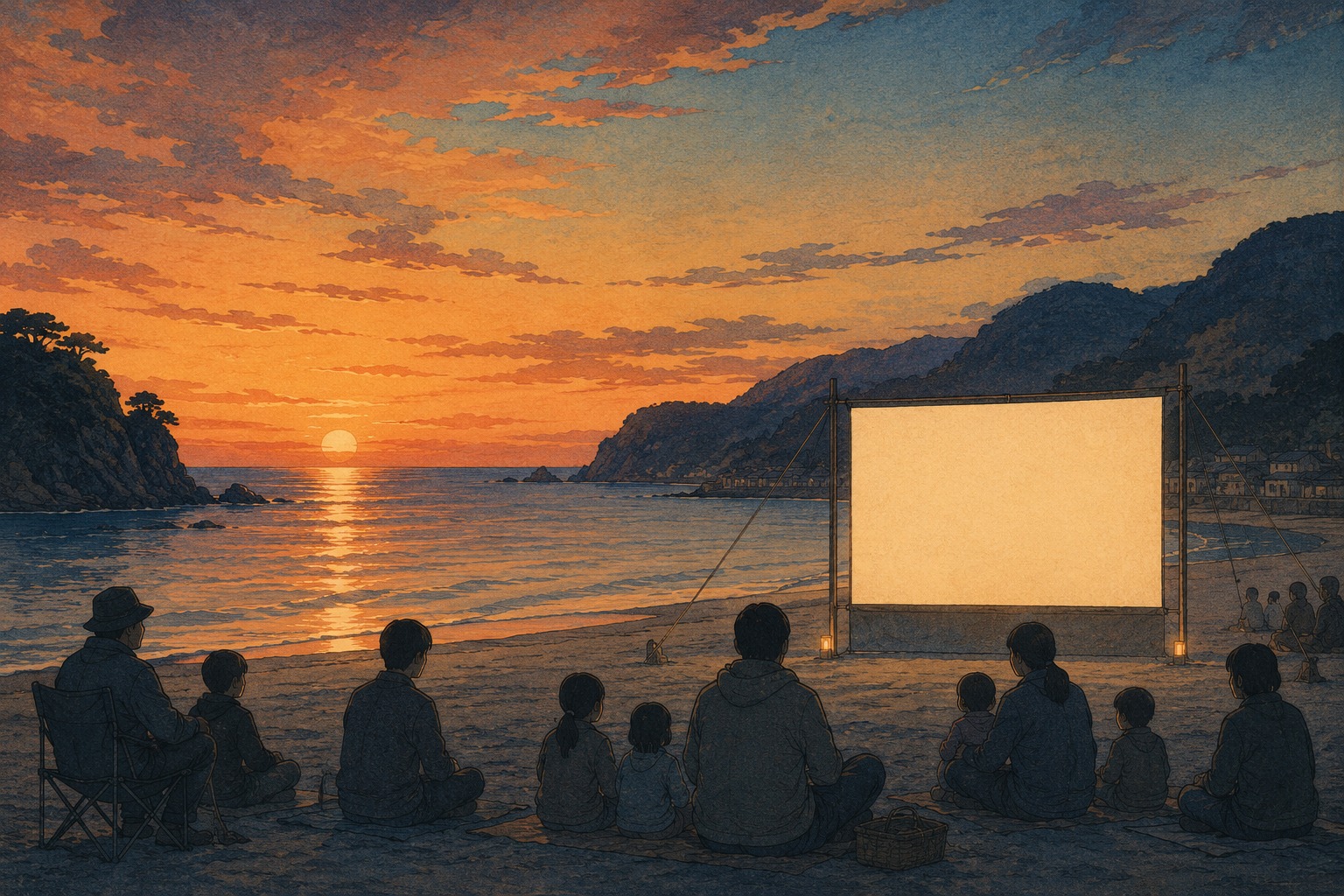
The first picture everyone sees will not come from a projector. It will be the sun descending across Suruga Bay. Only after the color drains from the sky and the audience settles into the same darkness will the films begin.
Toi Tourism Revitalization Co. plans to hold the second “Film Festival Watched with the Sunset—Nishi-Izu Sunset Festival” on October 3, 2026, at Matsubara Park and Terrasse Orange Toi. The program runs from 11:00 a.m. to 8:30 p.m.; screenings are scheduled from 5:15 p.m. Admission is free. Two films are planned, but the organizer’s August 21 announcement did not identify them.
Rebuilding a cinema without rebuilding the building
The organizer says Toi once had a small movie theater where residents watched together. It describes the inaugural 2025 festival as reviving that communal experience after roughly 40 years. The published material does not provide the old theater’s name, address or documented closing date. The 40-year interval should therefore be understood as the organizer’s account, not an independently established chronology.
The idea remains powerful. A permanent cinema requires a building, equipment, staffing and year-round demand. An outdoor festival borrows what the town already has: parkland, sea, horizon and night. When people face the same screen at the same hour, the public function of a theater briefly returns without its walls.
The first festival took place on October 18, 2025, with two blocks of short films. This year’s event begins earlier and surrounds the screenings with a food market, stamp rally, dance and stage performances, and art made by local students. The design brings together people who arrive for different reasons and gives them a common ending to the day.
“Sea and sunset” is part of the city’s strategy
The sunset is not merely a private company’s marketing invention. In a 2022 policy address, Izu City distinguished its tourism areas as the history of Shuzenji, the rural landscape of Nakaizu, the literature of Yugashima, and the “sea and sunset” of Toi. The city says Matsubara Park contains about 100 pine trees more than 400 years old and offers sunset views across Suruga Bay throughout the year.
The park also has monuments connected with poets Wakayama Bokusui and Shimaki Akahiko. Watching the coast has a cultural history here that predates contemporary destination branding. The festival temporarily adds projection and sound to a landscape already used for walking, memory and verse.
Its timing matters. A conventional theater eliminates outside light; Toi makes the fading light part of the program. Waiting for darkness becomes an event rather than a delay.
A disaster refuge that is also a gathering place
Terrasse Orange Toi opened in July 2024. Its formal city name identifies it as the Matsubara Park tsunami-evacuation complex. It is both a refuge tower and, in ordinary times, a tourism and community facility with shops, food, visitor information and a terrace overlooking the bay. Izu City called it Japan’s first such combined facility when it opened; that national-first description is a municipal claim.
Holding a festival beside an evacuation structure exposes the two truths of coastal tourism. The sea creates Toi’s beauty and its risk. In Japan.co.jp’s analysis, regular use may make the facility and its routes more familiar rather than leaving them remote from daily life. The event should not be mislabeled as disaster training, but it fits the building’s stated purpose of combining emergency safety with ordinary gathering.
A district where more than half are 65 or older
Izu City counted 2,920 residents in the Toi district on April 1, 2026. Of those, 1,529 were 65 or older, an aging rate of 52.36 percent. The numbers do not prove that a film festival will reverse decline. They explain why the organizer emphasizes places where generations can meet.
The 2026 theme is “weaving.” Students will reuse sheets no longer needed in Toi to create art based on the area’s natural scenery. This puts younger residents on the production side rather than treating them only as an audience.
A one-day event cannot solve population loss. If success is measured only in attendance, it may miss the harder questions: Did residents recover a place to encounter one another? Did enough people learn to run the event again? The significance of a second year lies in continuity, not scale.
From hot springs and gold to time spent in town
Izu City’s tourism information traces Toi Onsen to a spring that emerged during the Keicho era, about four centuries ago. Toi Gold Mine operated across the Edo, Meiji and Showa periods before becoming an attraction. Hot springs and mining shaped the town’s established visitor economy; the film festival proposes something different—a reason to remain through the afternoon and into the evening.
Izu City argued in 2022 that longer visitor stays were important to increasing local spending. A festival that moves from a daytime market to sunset and evening films fits that policy logic. The organizer also has a commercial interest: Toi Tourism Revitalization belongs to the ARTH group, which operates LOQUAT Nishi-Izu and Atarayo Nishi-Izu. Its cultural aims and hospitality business interests coexist and should both be visible.
The company is seeking ¥1.6 million through crowdfunding through September 30, primarily for venue setup, performer compensation and equipment. Those uses and the stated ambition to establish a new local tradition are the organizer’s claims.
Outdoor cinema includes what cannot be controlled
Rain, wind, temperature, surf and stray light are not minor concerns for a beach screening. The August 21 announcement did not explain the full bad-weather policy, seating arrangements or film titles. Visitors should check updated official information before traveling.
Yet uncertainty is also the form’s appeal. Cloud cover, the color of the horizon and the sound of the sea will change. A conventional auditorium standardizes viewing conditions; Toi leaves the place itself visible around the film.
The most revealing measure of success may come after the screen is removed. Does the park return to ordinary life with new relationships behind? Does anyone begin preparing a third edition? Turning a sunset into a cinema takes one evening. Turning the evening into culture requires people who wait for the next one.