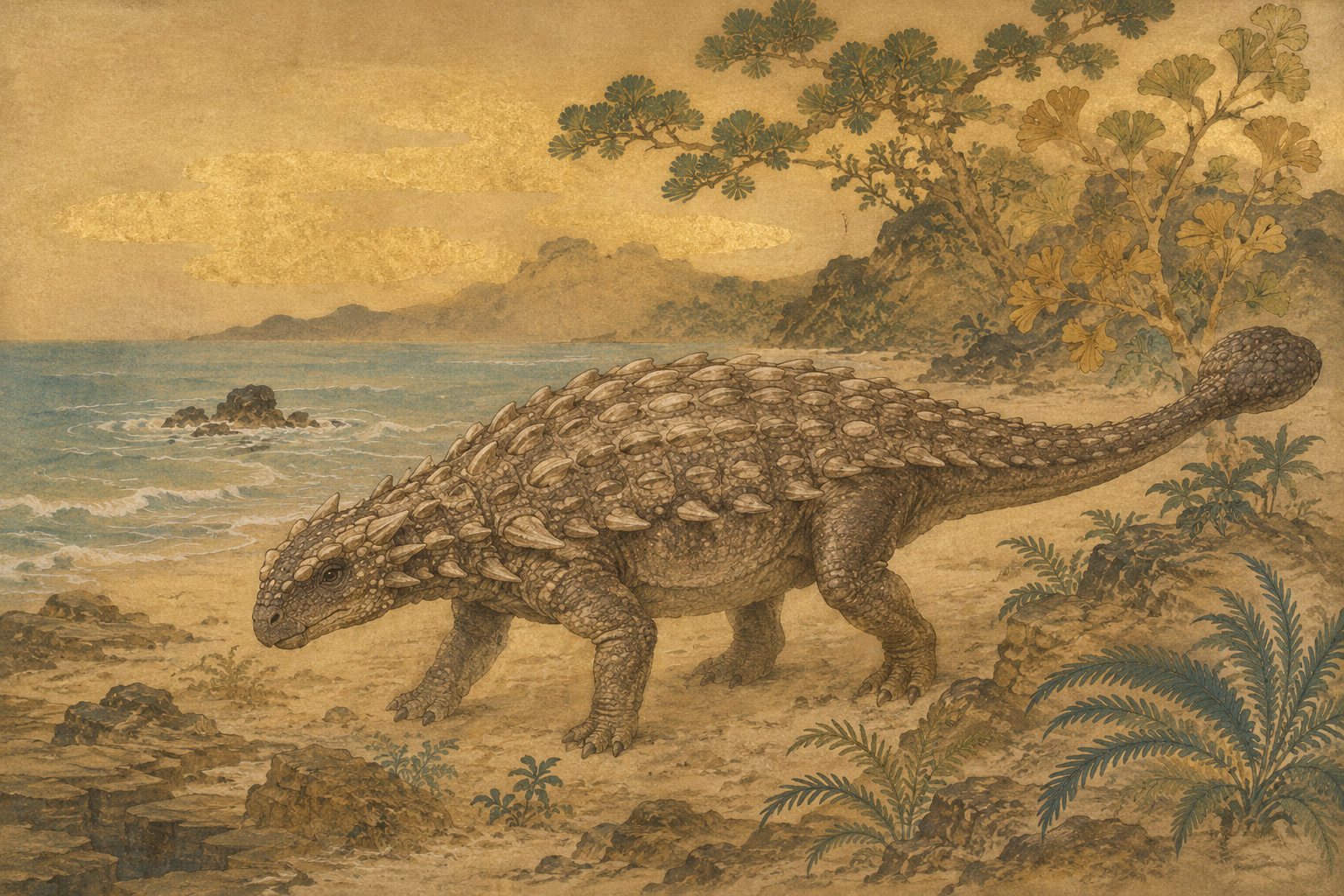
The dinosaur was found in 1995. It was recognized as important almost immediately. By 1996 it had been presented as evidence that nodosaurid armored dinosaurs had reached Asia, and in 2005 its partial skull was formally described in the scientific literature. Yet for more than three decades it had no genus or species name. Too much of the anatomy remained locked inside a hard concretion. In 2026, CT imaging changed the specimen without touching it. Digital preparation exposed characters that mechanical preparation could not, and the fossil finally became Nipponopelta yezoensis — “the Japanese shield from Yezo,” the old name for Hokkaido.
The new dinosaur is known from a skull, not a complete skeleton
The holotype of Nipponopelta is MCM A522, permanently housed at the Mikasa City Museum. The material re-described in the 2026 paper centers on a partial skull, the atlas — the first neck vertebra — and 11 isolated teeth associated with the skull. It was found in a concretion at Omakizawa, a tributary of the Shuparo River in Yubari City.
That matters when looking at any life reconstruction. Nipponopelta is not known from an articulated full skeleton. The body outline, armor pattern, shoulder spikes, coloration and soft tissues in reconstructions necessarily incorporate information from relatives. The authors could diagnose the animal from preserved cranial, dental and vertebral anatomy; they could not directly measure a complete body.
Japan.co.jp therefore does not assign a definitive body length or weight in this article. Online estimates may appear quickly after a new dinosaur is named, but the primary paper does not provide a complete skeleton from which a precise total length can be measured.
CT scanning did what chisels and acid could not
After the specimen was discovered, Hiroshi Hayakawa of the Mikasa City Museum prepared it and helped establish that it was a nodosaurid. The 2005 description relied on the dentition and occipital region, but the concretion was exceptionally difficult to separate from bone. Acid preparation had been used, and some teeth remained inside cavities in the skull where conventional preparation could not safely expose them.
Shumpei Oyabu and colleagues returned to the specimen with CT data. By segmenting differences in density, they digitally removed matrix and reconstructed hidden anatomy in three dimensions. The technique allowed the researchers to rotate bones, inspect surfaces that remained embedded and trace structures inside the skull without physically destroying the specimen.
This is not merely a better photograph. In vertebrate paleontology, a ridge a few millimeters high, the direction of a process or the pattern of grooves on a tooth can determine whether two specimens belong to the same taxon. The digital model made enough of those characters visible to revisit a question that had remained unresolved since 2005: was the Yubari nodosaurid distinctive enough to name?
A unique combination of seven anatomical features
Hokkaido University’s detailed release lists seven features whose combination distinguishes the taxon. They include the shape of the quadrate, a shelf-like structure involving the paroccipital region, the posterolateral orientation of the paroccipital process when viewed from below, a clear horizontal ridge on the side of the braincase, distinctive tooth-crown striations, relatively large crowns with S-curved roots, and a concave anterior margin on the neural arch of the atlas.
The team then scored 340 anatomical characters across 93 thyreophoran taxa — the broader armored-dinosaur group that includes stegosaurs and ankylosaurs. The phylogenetic analysis placed Nipponopelta deep within derived Nodosauridae. Thirteen shared derived characters supported that placement.
At the same time, several traits retained a more primitive appearance. The researchers highlight a mosaic of derived nodosaurid anatomy and characters that also occur in more basal armored dinosaurs. Evolution does not replace every old feature at once; a fossil can carry both deep history and recent specialization in the same skull.
Why call it the “Japanese shield”?
The genus name Nipponopelta combines Nippon, Japan, with pelta, a Latinized word of Greek origin meaning shield. The species name yezoensis refers to Yezo, the historical name associated with Hokkaido. Hokkaido University renders the combined meaning as “the Japanese shield found in Hokkaido.”
The name fits the broader group. Ankylosaurs were quadrupedal herbivores carrying bony armor, or osteoderms, in the skin. The two best-known major lineages are ankylosaurids, many of which evolved massive tail clubs, and nodosaurids, which lacked the classic ankylosaurid tail club and often carried prominent spikes around the neck and shoulder region.
But the name should not be mistaken for a complete anatomical inventory of Nipponopelta. The Yubari specimen does not preserve the full armor arrangement. The “shield” is both a taxonomic reference to armored dinosaurs and a reconstruction grounded in relatives.
Japan’s 14th named dinosaur, Hokkaido’s third
According to Hokkaido University’s tally, Nipponopelta becomes the 14th formally named new non-avian dinosaur genus and species from Japan. It is the third from Hokkaido, following Kamuysaurus in 2019 and Paralitherizinosaurus in 2022.
The Hokkaido trio share a striking geological circumstance: all were recovered from strata deposited in marine settings. Kamuysaurus came from Mukawa, Paralitherizinosaurus from Nakagawa and Nipponopelta from Yubari. The animals were terrestrial, but the Yezo Group repeatedly preserved their remains within a geological record better known for ammonites and marine reptiles.
2019: Kamuysaurus japonicus — Mukawa.
2022: Paralitherizinosaurus japonicus — Nakagawa.
2026: Nipponopelta yezoensis — Yubari.
Why is a land dinosaur in marine rock?
Nipponopelta came from the Hikagenosawa Formation of the Yezo Group, a succession dominated by fossil-rich mudstone and sandstone deposited under marine influence, from shallow to deeper offshore settings. The matrix around the specimen includes brown to dark gray mudstone and black plant fragments.
That does not mean Nipponopelta was a marine dinosaur. Ankylosaurs were terrestrial herbivores. A carcass can be transported down a river or along a coast, float offshore, sink and become buried in marine sediment. Paleontologists have long considered post-mortem transport as one possible reason nodosaurids appear disproportionately often in marine deposits.
The new paper goes beyond the sediment surrounding one skull. The authors combined the phylogenetic tree with information about where different armored dinosaurs were found and what environments those sediments represent, then reconstructed ancestral habitat states. In derived nodosaurids, the analysis recovered an increasing association with marine-influenced settings, while ankylosaurids were reconstructed as more consistently terrestrial.
That is why “coastal dinosaur” should be understood as an ecological hypothesis supported by a broader comparative analysis, not a direct observation of Nipponopelta walking on a beach.
Asia’s nodosaurids did not come from a single invasion
Nodosaurids are much better represented in North America and Europe than in Asia. Asian taxa include forms from China such as Taohelong and Dongyangopelta. If those animals all descended from a single nodosaurid population that entered Asia once and diversified locally, they might be expected to cluster together on the evolutionary tree.
They did not. Nipponopelta, Taohelong and Dongyangopelta occupy separated positions in the analysis. The researchers therefore infer that different nodosaurid lineages entered Asia independently on multiple occasions.
Nipponopelta itself falls among derived nodosaurids with close relationships to North American taxa such as Pawpawsaurus, Panoplosaurus, Nodosaurus, Edmontonia, Denversaurus, Borealopelta and Aletopelta, as well as the European Dracopelta. That result makes the Yubari skull especially valuable: other Asian nodosaurids are largely represented by postcranial material, while Nipponopelta preserves cranial anatomy that can be compared directly with animals on other continents.
It does not mean an individual Nipponopelta walked from North America to Hokkaido. Phylogenetics reconstructs relationships among lineages; biogeographic modeling reconstructs probable ancestral ranges. Neither records an individual migration route.
A Cretaceous route existed between North America and Asia
The ancestral-range reconstruction suggests that the common ancestors of Nipponopelta and other derived nodosaurids occupied a broad region spanning western North America’s Laramidia, eastern North America’s Appalachia and Asia. The inferred ancestral area is broader than that reconstructed for ankylosaurids in the same study.
During parts of the Cretaceous, the Bering region provided terrestrial connections between Asia and North America as sea levels and geography changed. Hokkaido University points to nodosaurid evidence from Alaska along that broad route, including an Edmontonia skull and armored-dinosaur trackways preserved in coastal or estuarine sediments.
The proposed mechanism is therefore not dinosaurs swimming across the Pacific. It is repeated range expansion through northern terrestrial corridors, perhaps aided by an ecology that made coastal lowlands, river mouths and wetlands familiar habitat.
Did nodosaurids use buoyancy in shallow water?
The university release also draws attention to trackways attributed to nodosaurids in South America and armored-dinosaur tracks from Alaska. Some tracks have been interpreted as lacking a clear heel impression, raising the possibility that animals moving in shallow water partially supported their bodies with buoyancy.
It is an evocative possibility, but it should not be turned into a claim that Nipponopelta was a swimmer. The Yubari fossil contains no direct behavioral evidence of swimming; swimming ability is not directly established for Nipponopelta. Trackway interpretation from other taxa and continents provides ecological context, not a behavioral diagnosis for this individual species.
The safer conclusion is more interesting scientifically: multiple lines of evidence make frequent use of coastal or wetland environments plausible for at least some nodosaurid lineages, and that habitat preference may have affected which geographic corridors they could exploit.
What is established—and what remains a hypothesis
| Question | Strongly supported | Still inferred or unknown |
|---|---|---|
| Taxonomy | Nipponopelta yezoensis, a new nodosaurid genus and species | Fine-scale placement may change with future specimens and datasets |
| Age & locality | Cenomanian Hikagenosawa Formation, Yubari, Hokkaido | The precise habitat occupied immediately before death |
| Anatomy | Partial skull, teeth and atlas anatomy | Exact body length, mass, coloration, soft tissues and full armor arrangement |
| Relationships | Close to derived North American/European nodosaurids | Exact timing and route of ancestral dispersal |
| Asian dispersal | Asian nodosaurids fall in multiple separate lineages | The number and chronology of each dispersal event |
| Ecology | Comparative reconstruction links derived nodosaurids with marine-influenced habitats | Nipponopelta’s individual behavior or swimming ability |
Hokkaido’s marine rocks have become a dinosaur archive
For generations, the Cretaceous rocks of Hokkaido were celebrated primarily for ammonites, inoceramid bivalves, mosasaurs and other marine fossils. The Mikasa City Museum presents the Yezo Group as one of the defining records of Hokkaido’s Cretaceous seas. Yet those same sediments occasionally captured animals that lived on land.
Marine burial can be a disadvantage and an advantage. Transport can disarticulate or damage a carcass, but rapid burial offshore can also protect bones that might otherwise weather away on land. In Hokkaido, that unusual pathway has helped preserve all three of the prefecture’s formally named dinosaurs.
It also demands careful taphonomy. A fossil found in marine sediment is evidence of where it was buried, not automatically where it lived. The strength of the Nipponopelta study is that its coastal-habitat argument does not rest on the Yubari sediment alone; it is tested against habitat data mapped across a large evolutionary tree.
Museum collections are unfinished scientific instruments
One of the most modern parts of the Nipponopelta story is that the new species emerged from an old museum specimen. MCM A522 has been kept at the Mikasa City Museum for decades, and the museum identifies the Yubari nodosaur skull among its actual dinosaur fossils on display. Its continued preservation allowed a question from the 1990s to be reopened with 2020s technology.
In 1996, the important fact was that a nodosaurid existed in Asia. In 2005, researchers could describe the skull and braincase in far greater detail. Then the comparative world changed: new Chinese nodosaurids were named, remarkably preserved North American forms such as Borealopelta expanded anatomical knowledge, phylogenetic matrices grew and CT tools became more accessible.
The fossil did not change. The scientific context around it did. Hokkaido University explicitly points to that lesson: specimens already in museum collections can yield new discoveries when new technologies and new comparative data are brought back to them.
A 31-year-old fossil opens a new map of Cretaceous Asia
Nipponopelta is not the kind of dinosaur discovery that arrives as a spectacular complete skeleton. It is fragmentary, scientifically patient and, for that reason, revealing. A partial skull that waited 31 years for a name now provides the best cranial evidence for an Asian nodosaurid and places Hokkaido inside a much wider history connecting Asia, North America and Europe.
One fossil does not prove a transcontinental migration. But combine its position on the family tree with Chinese nodosaurids on different branches, the reconstructed habitats of relatives, northern land connections and coastal track evidence, and a more complicated pattern emerges: armored dinosaurs entered Asia more than once.
The name “Japanese shield” belongs to one animal from Yubari. The question it raises is continental. Around 100 million years ago, which landscapes did armored dinosaurs follow, which habitats made movement easier, and how many times did those lineages cross between the great northern landmasses?
For three decades, part of that answer was physically present inside a rock in a Hokkaido museum collection. The CT scanner did not create the fossil. It gave paleontologists a new way to ask it questions.
Sources & Reporting Notes
- Hokkaido University, “Hokkaido dinosaur fossil named Nipponopelta yezoensis” — Primary Japanese university announcement, September 2, 2026.
- Hokkaido University detailed press release (PDF) — Primary details on specimen MCM A522, CT reconstruction, diagnostic anatomy, phylogenetics and Japanese dinosaur naming history.
- Oyabu et al., Cretaceous Research, “A new nodosaurid ankylosaur…” — Formal taxonomic paper, available online August 21, 2026.
- ScienceDirect article page — Abstract, geological setting, specimen description and discussion of phylogeny and palaeobiogeography.
- Mikasa City Museum, Cretaceous exhibition — Museum context for the Yezo Group and the actual Yubari nodosaur skull specimen.
- Mikasa City Museum, FAQ — Confirms that the Yubari nodosaur skull is displayed as an actual fossil.
- Hayakawa, Manabe & Carpenter, “Nodosaurid Ankylosaur from the Cenomanian of Japan” — The 2005 study that first described the Yubari specimen in detail as a nodosaurid.
- Geological Survey of Japan, Cretaceous geology of central Hokkaido — Geological background on Hokkaido’s marine Cretaceous strata.
This article was checked against public material available by 2:24 AM JST on September 3, 2026. Taxonomic claims, Japanese terminology and the discovery/research chronology were checked against Hokkaido University’s primary announcement, its detailed release and the formal Cretaceous Research paper. Yoshitsugu Kobayashi’s Japanese reading is confirmed by the university release; Manabu Kano’s by Mikasa City Museum. Hokkaido University’s Japanese release does not provide a kana reading for Shumpei Oyabu, so the Japanese edition does not invent one. Coastal-habitat preference, dispersal routes through northern land connections and possible buoyancy-assisted movement are treated as reconstructions or hypotheses rather than direct observations of Nipponopelta. No definitive body length or mass is given because the primary specimen is incomplete and the formal paper does not provide a complete skeleton from which to measure one.
Image rights: © 2026 Japan.co.jp. AI-assisted scientific editorial illustration. Reproduction or reuse without permission is prohibited. For licensing, see the contact page.