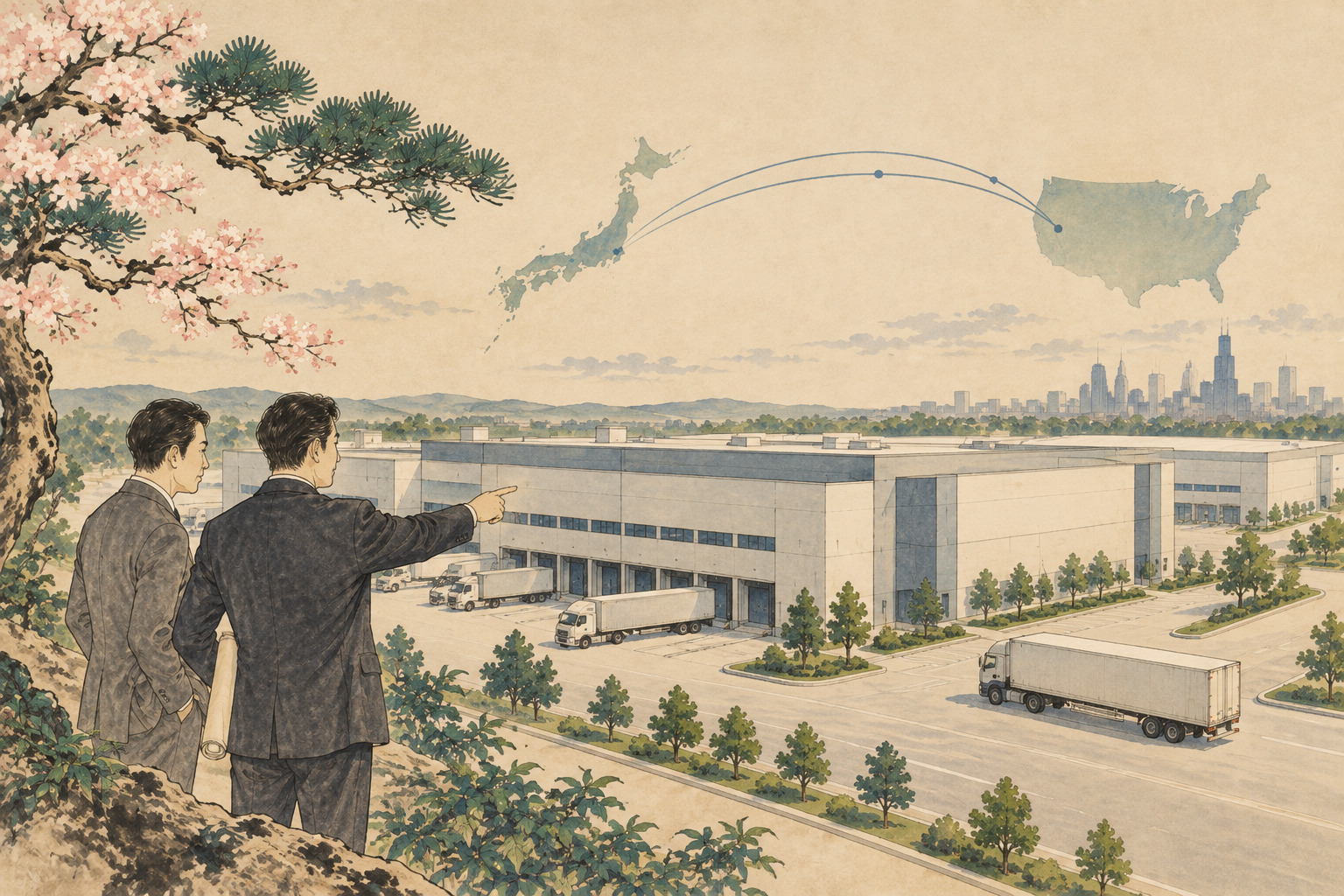
A warehouse park outside Atlanta may look like an ordinary piece of American industrial real estate. For Nippon Steel Kowa Real Estate, however, Buford Creek Business Center sits at the intersection of three larger stories: the growth of the U.S. Southeast as a manufacturing and distribution region, the movement of Japanese capital into American logistics property, and the rapid expansion of a logistics business that the Tokyo developer only began building in earnest in 2018.
Nippon Steel Kowa Real Estate announced on September 18 that Buford Creek Business Center in Buford, Georgia, had been completed on August 28, 2026. The three-building industrial park covers 63,768 square meters—about 686,400 square feet—on a 229,781-square-meter site. For Nippon Steel Kowa, it is the company's second U.S. logistics development. [1][2]
The project was developed with Trammell Crow Company, CBRE Japan, Hankyu Hanshin Properties and Keihanshin Building. Trammell Crow describes it as a speculative Class A industrial park: space developed for the broader leasing market rather than as a single tenant's pre-committed build-to-suit facility. CBRE is marketing the buildings for sale or lease on behalf of the ownership group. [2]
Three buildings designed for different logistics jobs
Trammell Crow's completion announcement provides a more detailed picture than the Japanese investor release. Building 100 is a 349,440-square-foot cross-dock warehouse with 40-foot clear height and 64 trailer parking spaces. Buildings 200 and 300 are each 168,400 square feet, with 36-foot clear heights and rear-load configurations. They provide 40 and 24 trailer parking spaces, respectively. [2]
| Building | Floor area | Configuration |
|---|---|---|
| 100 | 349,440 sq ft | 40-ft clear, cross-dock, 64 trailer spaces |
| 200 | 168,400 sq ft | 36-ft clear, rear-load, 40 trailer spaces |
| 300 | 168,400 sq ft | 36-ft clear, rear-load, 24 trailer spaces |
That variety matters. A cross-dock building can support higher-volume regional distribution, with goods entering one side and moving rapidly toward outbound loading on the other. Smaller rear-load buildings can suit urban distribution, regional inventory or manufacturing-support users that do not need a 350,000-square-foot box.
Trammell Crow identifies Atlas Collaborative as architect and The Conlan Company as builder. Nippon Steel Kowa's release lists AL Grading for site work and Conlan Company for building construction. The descriptions are consistent on Conlan's construction role, while providing different levels of detail. [1][2]
“Atlanta” means a site about 30 miles to the northeast
The property is not in central Atlanta. It sits in Buford, roughly 30 miles northeast of the city, at the northeast corner of Lanier Islands Parkway and Big Creek Road. Trammell Crow puts the site about three miles from Interstate 985, which connects into the I-85 corridor and the wider Southeastern road network. [2]
Nippon Steel Kowa says the site is intended to support both last-mile delivery of consumer goods—including e-commerce merchandise—and distribution of finished products and components manufactured inside and outside Georgia. That dual use is significant: metropolitan Atlanta is both a major consumer market and an inland distribution point for a rapidly industrializing Southeast. [1]
The freight road begins hundreds of miles away at Savannah
Atlanta's logistics position cannot be understood only through its highways. The Port of Savannah handled nearly 5.7 million twenty-foot-equivalent units in 2025, its second-busiest year on record, according to the Georgia Ports Authority. Rail movements exceeded 545,000 containers for the year. [8]
Georgia Ports is also pursuing a $4.5 billion port-and-inland infrastructure program that includes five new container berths in Savannah. The expansion of port capacity matters to inland industrial properties because imported goods, manufacturing inputs and exports require places to be staged, stored and redistributed away from the coast. [8]
Georgia's economic-development agency markets the state as a platform from which more than 80% of the U.S. market can be reached within a two-hour flight or a two-day truck drive. That is a promotional statewide measure rather than a guaranteed delivery time from every site, but it explains the geography behind the state's logistics strategy. [10]
Manufacturing investment creates warehouse demand behind it
Georgia reported approximately $35.2 billion of economic-development investment commitments in fiscal 2026, covering 436 new locations and expansions and an estimated 25,300 future private-sector jobs. Manufacturing accounted for 67% of the jobs announced through the state's Global Commerce program. International companies accounted for more than 9,350 new jobs and more than $7.8 billion of foreign direct investment commitments. [9]
None of those figures guarantees leasing at Buford Creek Business Center. But the connection is structural. New factories and expanding plants create demand for component storage, finished-goods distribution, spare parts, returns and third-party logistics. Modern warehouse development often follows industrial investment rather than standing apart from it.
A vehicle built specifically to bring Japanese capital into U.S. logistics
Buford Creek Business Center is also the second investment of CBRE Japan's U.S. Industrial Venture, or UIV, series. CBRE created the program to give Japanese companies a structured route into U.S. logistics development. UIV II brought together Hankyu Hanshin Properties, Keihanshin Building and Nippon Steel Kowa Real Estate as investors in the Buford project. [3]
CBRE describes the program as combining U.S. limited-partnership structures with investment-management support, while Trammell Crow provides local development expertise. CBRE handles functions including project selection, due diligence, asset management, analysis of differences between U.S. and Japanese business practices and investment reporting for Japanese partners. [3][11]
The model reduces the need for each Japanese investor to build a full U.S. development organization from scratch. It does not remove real-estate risk, construction risk, leasing risk, interest-rate risk or currency risk. But it gives investors access to a local development platform and a Japanese-facing asset-management structure.
Nippon Steel Kowa's logistics business is only eight years old
Nippon Steel Kowa Real Estate itself has a much longer corporate history. Kowa Real Estate dates to 1952, and Kowa Real Estate and Nippon Steel City Produce combined in 2012 to create the predecessor of today's company. The company adopted the Nippon Steel Kowa Real Estate name in 2019. [7]
Logistics is newer. The company established its logistics development unit in April 2018 as a business it intended to build alongside offices and housing. The first LOGIFRONT facility, LOGIFRONT Koshigaya I, was completed in March 2019. In September 2024 it completed the flagship MFLP/LOGIFRONT Tokyo Itabashi project with Mitsui Fudosan. [4][7]
International logistics followed quickly. In November 2024 the company entered its first overseas logistics development at Plainfield Business Park in Illinois. In June 2025 it announced Buford as project No. 2. By May 2026 it had joined a third project, Plainfield Business Park Phase II, beside the first Illinois site. At the time of that third announcement, the company said it had been involved in 23 logistics projects in Japan. [4][5]
April 2018 — Logistics development unit established.
March 2019 — First LOGIFRONT property completed in Koshigaya.
September 2024 — MFLP/LOGIFRONT Tokyo Itabashi completed.
November 2024 — First overseas logistics project: Plainfield, Illinois.
June 2025 — Buford announced as overseas logistics project No. 2.
May 2026 — Plainfield Phase II becomes project No. 3.
August 28, 2026 — Buford Creek Business Center completed.
“Second project” depends on whose history you are reading
Nippon Steel Kowa calls Buford its second U.S. logistics development. Hankyu Hanshin Properties, one of the co-investors, calls the same property its first U.S. logistics real-estate development. CBRE calls it UIV II. Trammell Crow sees it as one project within a much larger U.S. industrial development platform.
Those descriptions are not contradictory. They measure different corporate histories. That distinction matters when a joint venture is described simply as “Japan's second” or “the partners' second project.” It is No. 2 specifically for Nippon Steel Kowa's overseas logistics program and for CBRE's UIV series. [2][3]
Completion is a milestone, not the end of the investment
Real estate does not become a successful investment merely because construction ends. Trammell Crow calls Buford Creek a speculative industrial park and says CBRE is marketing the buildings for sale or lease. That means leasing and capital realization remain part of the story after physical completion. [2]
The materials reviewed by Japan.co.jp do not disclose the total project cost, land purchase price, the individual ownership percentages or investment amounts of the Japanese partners, financing structure, target return, current occupancy, signed tenants or expected sale price. Without those figures, completion cannot by itself be used to judge the project's investment performance.
There is also a minor difference in how the structure is described across documents. Nippon Steel Kowa's completion release describes reinforced-concrete construction with some steel, while earlier CBRE program material summarizes the project as a single-story steel-frame logistics facility. For the finished-building description in this article, Japan.co.jp follows the developer's September 2026 completion release. [1][3]
Currency can change the result for a Japanese investor
A Japanese company investing in dollar-denominated property is exposed not only to property performance but also to the yen-dollar relationship. Rental income, construction cost, debt service, asset value and sale proceeds may all translate differently into yen depending on timing and hedging.
The ownership and financing disclosures available for Buford are not detailed enough to calculate that sensitivity. The reference rate carried in Japan.co.jp's September 23 edition—US$1 = ¥157.47—is an editorial reference rate, not necessarily the rate used by the project partners for investment accounting, hedging or valuation.
Beyond logistics boxes toward broader industrial real estate
Nippon Steel Kowa has signaled that its industrial-property ambitions extend beyond conventional distribution centers. The company says it intends to pursue crane-equipped warehouses, hazardous-material facilities, refrigerated and frozen storage, R&D buildings, industrial-support facilities and data centers. Its first 01-LabFactory rental R&D and factory project opened in 2025. [4][5][7]
That strategy reflects a broader change in real estate. Logistics property is increasingly connected to manufacturing, research, data infrastructure and specialized supply chains. For a developer, the opportunity is not simply to build larger warehouses but to own more of the physical infrastructure that industrial companies need around their core production.
Japanese capital is investing in the movement of American goods
Warehouses are rarely the most visible expression of Japan Inc. abroad. There is no consumer brand on the roof and no assembly line turning out cars. Yet a 686,400-square-foot park with 40-foot clear heights and more than a hundred trailer spaces is a direct investment in how American goods move.
For Nippon Steel Kowa, Buford is already followed by a third U.S. logistics development in Illinois. The next meaningful indicators will not be the completion photographs. They will be tenants, rents, occupancy, operating income and ultimately whether the ownership group chooses to hold or sell the assets.
Japanese corporate expansion in the United States is no longer only factories, banks and consumer brands. It increasingly includes the land and buildings behind the supply chain itself. Buford Creek Business Center is one quiet example of that shift.
Sources & documents
- Nippon Steel Kowa Real Estate: Completion of Buford Creek Business Center in Georgia (Sept. 18, 2026, official Japanese PDF)
- Trammell Crow Company: TCC and Japanese Consortium Deliver 686K-SF Buford Creek Business Center near Atlanta (Sept. 8, 2026)
- CBRE Japan: Second Joint U.S. Logistics Investment Program for Japanese Partners (June 10, 2025)
- Nippon Steel Kowa Real Estate: First overseas logistics project in Plainfield, Illinois (Nov. 21, 2024)
- Nippon Steel Kowa Real Estate: Third overseas logistics project, Plainfield Phase II (May 19, 2026)
- Nippon Steel Kowa Real Estate: International business
- Nippon Steel Kowa Real Estate: Corporate history
- Georgia Ports Authority: Port of Savannah achieves second busiest year ever (Jan. 27, 2026)
- Georgia Department of Economic Development: FY2026 record economic-development investment (Sept. 3, 2026)
- Georgia Department of Economic Development: Logistics in Georgia
- CBRE Japan: Existing U.S. Industrial Venture 1–3 portfolio table