- A Century of Papermaking Ends, but the Site May Not
- The November 6 Decision: Three Machines and a Business Model
- The Earthquake: A Date and a Human Toll
- Yatsushiro, 1924: Why Paper Factories Became Local Institutions
- The Industry Was Already Changing Before the Ground Moved
- What the ¥15.1 Billion Loss Actually Measures
- Employment Promises Will Be Tested by Geography
- How Kyushu Gets Its Newsprint Without Yatsushiro
- Can a Timber Supply Chain Replace a Paper Mill?
- Recovery Must Include the Investigation
- What a Successful Second Century Would Look Like
A Century of Papermaking Ends, but the Site May Not
For more than a hundred years, the industrial rhythms of Yatsushiro in Kumamoto Prefecture included paper production. On November 6, 2026, Nippon Paper Industries decided that the mill would not restart its graphic-paper and pulp lines after a catastrophic earthquake. The July 28 disaster damaged chimneys, one of which collapsed, killing nine employees and contractor personnel. That loss of life belongs at the center of this story, not as a footnote to restructuring.
The company is not announcing a complete departure from Yatsushiro. It says it wants to preserve the site, examine businesses that use regional timber resources and seek partners. It has pledged to make every effort to maintain employment through transfers and other arrangements. What remains uncertain is how much economic activity—and how many opportunities to work locally—can be rebuilt after the machinery that defined the mill is retired.
The November 6 Decision: Three Machines and a Business Model
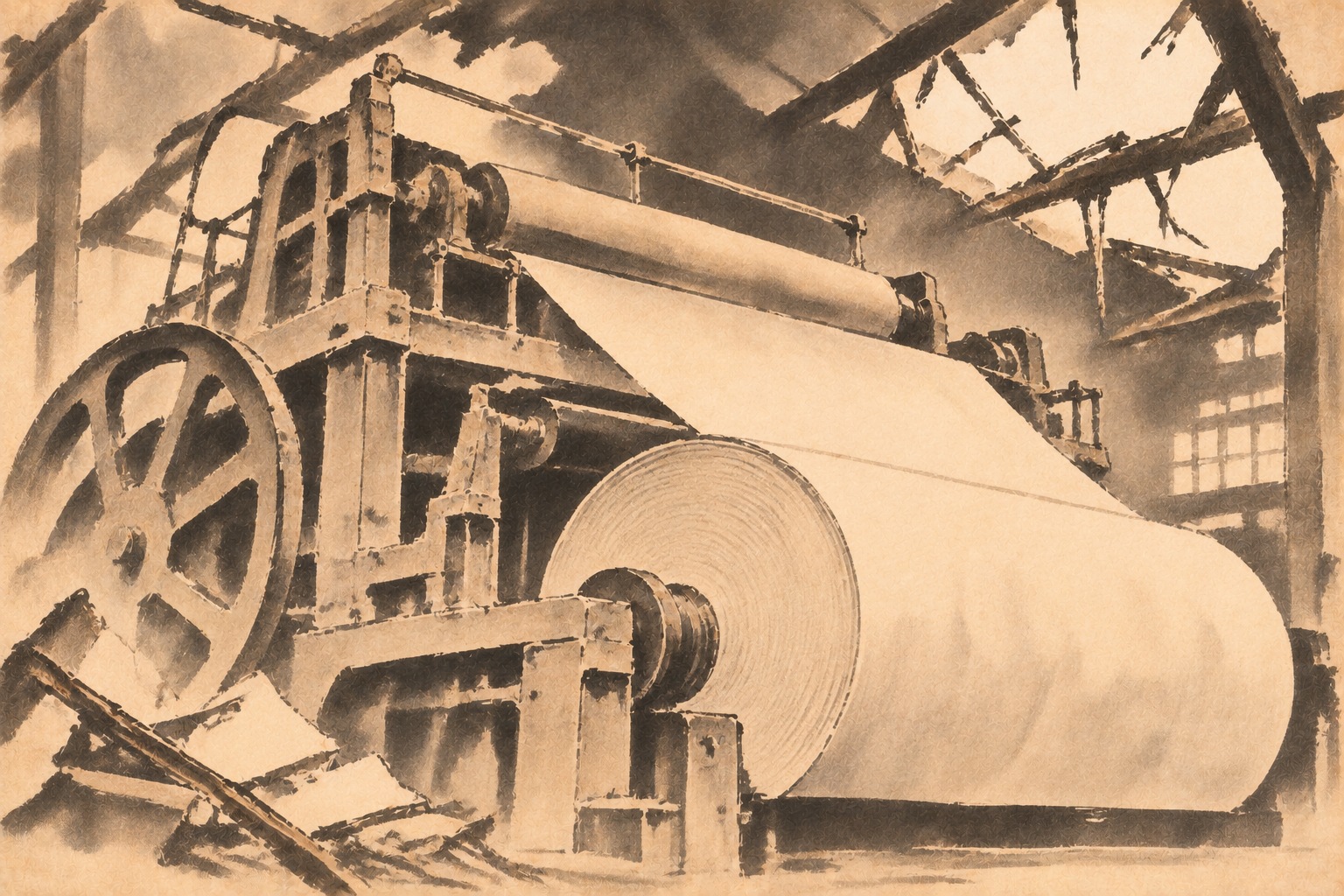
The Japanese disclosure is titled “Termination of Graphic Paper and Pulp Operations at Yatsushiro Mill and Future Business Policy.” It covers paper machines No. 4, No. 6 and N1, together with pulp production and related equipment. Repairs and replacement would require approximately three to four years and substantial expenditure, according to the company. The damage extends across buildings and operating assets, making a return to the former production configuration impractical in management’s view.
A planned shift into household paper is also on hold. Construction work has been suspended while the company reassesses timing and commercial viability, with a policy decision targeted within the current fiscal year. Ending graphic-paper production, keeping a physical business site and successfully launching a new industrial operation are three distinct developments. Only the first of these has been decided unequivocally.
The Earthquake: A Date and a Human Toll
At 4:27 p.m. Japan time on July 28, a magnitude-7.1 earthquake struck the Kumamoto region at a depth later established as 16 kilometers. The Japan Meteorological Agency recorded the maximum intensity of 7 in Uki City and Hikawa Town and formally named the sequence the 2026 Kumamoto Earthquake. It is a separate event from the much better known 2016 Kumamoto earthquakes. At the Yatsushiro facility, three chimneys were damaged and one collapsed.
Nippon Paper’s first company statement on July 29 reported 11 people trapped inside a building and five confirmed deaths, with rescue and verification still in progress. Subsequent reporting established a final toll of nine at the mill. Those figures represent different points in a developing emergency and should not be conflated. On September 10 the company established a damage investigation committee including external structural experts to investigate the chimney collapse. The existence of an inquiry is not evidence that its engineering conclusions have already been established.
Yatsushiro, 1924: Why Paper Factories Became Local Institutions
The mill traces its origins to 1924, when paper was indispensable to newspapers, books, government records and commercial life. Industrial papermaking depended on water, energy, chemical processing, transportation and continuous maintenance. A large mill could anchor an ecosystem of machinery suppliers, local contractors, warehouses and transport providers. For regional cities, such establishments helped define not only production but technical skills and employment across generations.
Yatsushiro was particularly significant for newsprint serving Kyushu. Every newspaper rolling off a press has an industrial history before a journalist writes a word: wood or other fiber must be prepared, pulp produced, paper rolled, transported and delivered to printing plants. The loss of one production geography changes that chain. It does not, however, mean newspapers will immediately run out of paper; substitutes have already been used during the mill’s shutdown.
The Industry Was Already Changing Before the Ground Moved
The earthquake was decisive, but it hit a business already undergoing structural adjustment. Printed newspapers and some office-paper markets have faced declining demand as communication migrates to screens. Nippon Paper had already been concentrating graphic-paper production and planning a stronger focus on household and forest-related products. In August 2024, the company announced that Yatsushiro’s N2 newsprint machine would stop around June 2025 and that household-paper production was planned for the site.
Its Medium-Term Management Plan 2030, released in May 2026, made consolidation, capital efficiency and expansion in forest and wood-related businesses central priorities. This context matters. The disaster did not create the digital shift or the decline in graphic-paper demand, but the destruction altered the cost and feasibility of any transition. It would be misleading either to blame the entire decision on the earthquake or to imply that the company would inevitably have closed the same lines in the same way without it.
What the ¥15.1 Billion Loss Actually Measures
Nippon Paper booked ¥15.1 billion in earthquake-related extraordinary losses in the six months to September 2026. It expects losses associated with the earthquake of approximately ¥20 billion for the fiscal year ending March 2027. Its group-wide forecast now calls for a ¥40 billion net loss for that fiscal year, compared with ¥11.7 billion net profit in the prior year; other disaster-related costs also contribute to that outlook.
These are not three numbers to add together. The interim charge is included in, rather than separate from, the full-year earthquake loss estimate. The ¥40 billion figure is a forecast for the consolidated company, not the direct price tag of destroying Yatsushiro. Impairment of fixed assets is an accounting recognition and does not necessarily represent cash paid out at that moment. The future cost of repurposing a site remains a separate and unresolved economic question.
Employment Promises Will Be Tested by Geography
Local reporting describes roughly 400 employees associated with the mill and cites a headcount of approximately 370 as of March 2026. The figures refer to different dates and potentially different personnel categories. The company says it will work to secure jobs through group-wide reassignment, considering individual preferences. That commitment is material for workers facing uncertainty after months of disruption.
But continued employment is not the same thing as continued employment in Yatsushiro. A transfer that requires relocation can affect a household, childcare, family care or housing; a new business may need different skills than the old paper machines. Moreover, contractors, cleaning crews, maintenance companies and freight providers face their own questions. The company has not yet supplied a publicly verified breakdown of how many roles could remain locally or how many transfers may be required.
How Kyushu Gets Its Newsprint Without Yatsushiro
The company intends to shift manufacturing to other mills where possible—a process called isho, or transferring grades between paper machines—and outsource some production or discontinue particular grades. Kyodo reported that after the July shutdown, supply to Kyushu was supported in part by deliveries from the Iwanuma Mill in Miyagi Prefecture and alternative arrangements with other producers.
Longer shipping distances could change inventory needs, freight expense, lead times and emissions. Conversely, consolidating production may improve the operating efficiency of surviving facilities. No published evidence yet establishes the net effect on customer prices or emissions. A responsible account of supply risk distinguishes a changed logistics network from an actual shortage; it also recognizes that different grades of paper cannot always be transferred from one machine to another without qualification and adjustments.
Can a Timber Supply Chain Replace a Paper Mill?
Nippon Paper has identified the site’s established relationships, physical assets and wood-resource supply chain as possible foundations for future businesses. The company has mentioned locally sourced Japanese timber and partnerships with other firms. These possibilities align with its 2030 plan, which gives more emphasis to the commercial value of forests, wood materials, packaging and other activities less dependent on graphic-paper demand.
But a promising sector is not yet an investment decision. The company has not publicly settled which product would be produced, what capital would be committed, how much labor would be needed or whether a partner would be selected. Claims that forestry, biomass or other wood-based products will restore all lost jobs would exceed the evidence. The most important questions concern the business model, sustainability of feedstock procurement, safety of the site and the transferability of workers’ skills.
Recovery Must Include the Investigation
Kumamoto Governor Takashi Kimura welcomed the company’s stated intention to remain in Yatsushiro and expressed support for a new business initiative in comments reported by a local broadcaster on November 6. That political and economic support may help shape the next stage, but it is not proof of an approved subsidy, a selected partner or a funded new factory.
The cause of the chimney collapse also remains a separate and consequential matter. A new business at the site will have to be built on safe structures and credible lessons from the disaster. It would be premature to assign engineering blame before the investigation concludes. The workers and families who lost colleagues deserve reporting that follows the inquiry as carefully as it follows the announcement of any replacement investment.
What a Successful Second Century Would Look Like
There are specific milestones to watch: the promised reassessment of household-paper plans within the fiscal year, actual transfer arrangements for staff, published progress of the damage investigation, decisions on alternate suppliers and any binding commitments from new business partners. None should be confused with the company’s current expression of intent.
For a century, Yatsushiro turned raw materials into paper that carried Japanese information and commerce. It is now being asked to make a different transition. The old production lines may not return; the industrial knowledge they cultivated need not disappear. Whether the site can enter a second century will be measured not by the optimism of a press conference, but by the jobs, safe facilities and viable businesses that follow.
Sources and reporting method
Company and meteorological primary documents are cross-checked with dated contemporary reporting. Early provisional casualty figures are separated from the later reported toll.