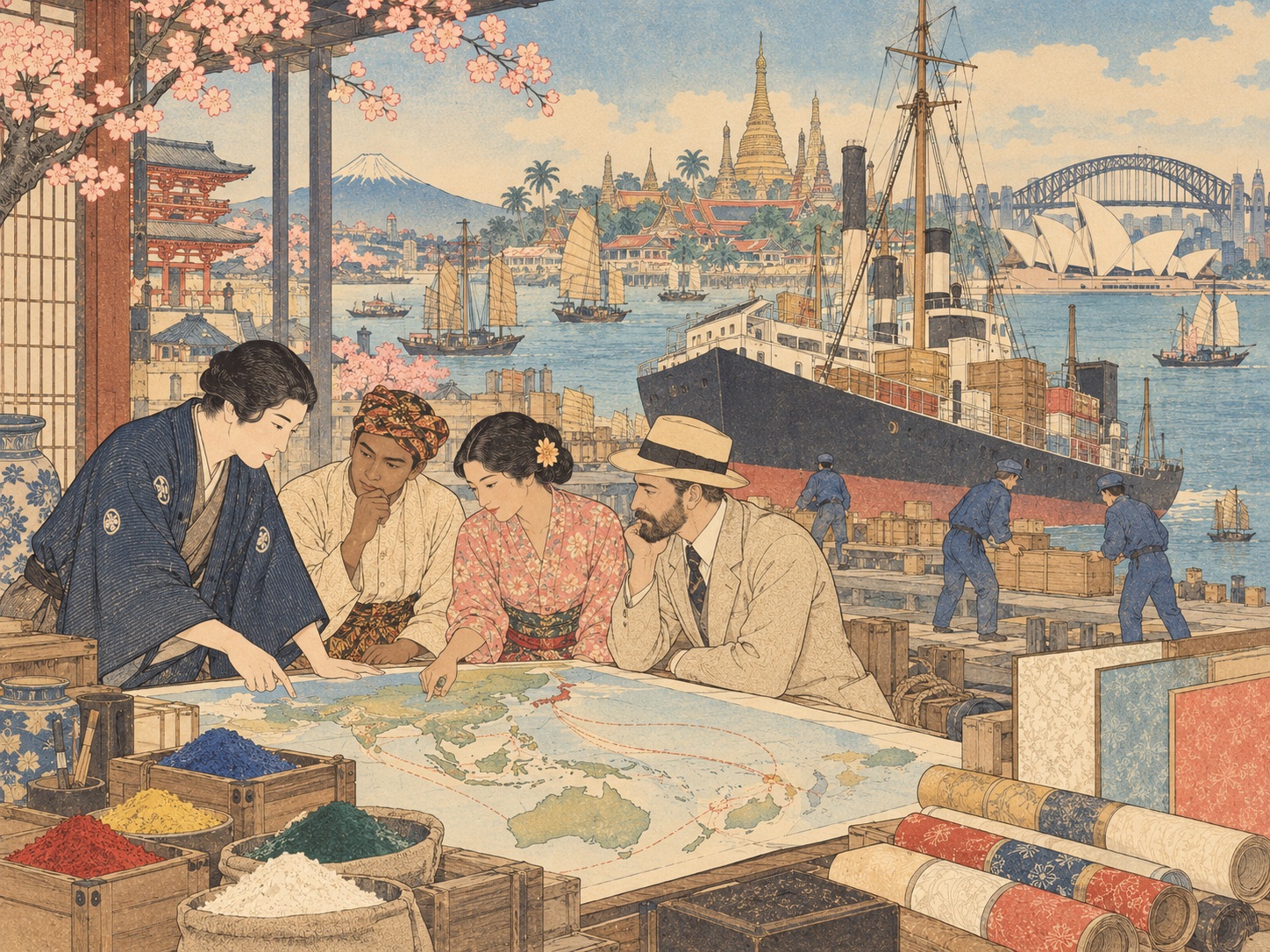
Nippon Paint Holdings is making another major move in Asia-Pacific, and this one lands directly inside markets where it already has deep roots.
On October 5, the Japanese coatings group announced agreements to acquire AkzoNobel’s decorative-paints businesses across seven markets: Vietnam, Indonesia, Malaysia, Thailand, Singapore, Papua New Guinea and Australia. AkzoNobel values the transaction at about $1.35 billion, or €1.20 billion, on an enterprise-value basis—roughly 21 times the businesses’ fiscal 2025 EBITDA.
Seven markets in one transaction
This is not the purchase of a single plant or a single national brand. It is a regional carve-out of decorative-paints operations spanning Southeast Asia, Papua New Guinea and Australia.
AkzoNobel will retain its coatings activities and Global Business Services organization. The company had already agreed to sell its decorative-paints operations in India and Pakistan; it says the Nippon Paint transaction completes its broader review of the decorative-paints portfolio in Asia.
AkzoNobel expects roughly $1 billion in net cash proceeds after taxes and payments to minority partners. CEO Greg Poux-Guillaume framed the disposal as part of a strategy to concentrate resources where the company can build differentiating scale and stronger positions.
This is not a move into blank territory
The strategic significance is easy to miss if the deal is viewed simply as another Japanese company buying overseas assets. Nippon Paint has spent more than six decades building a coatings platform in Asia.
The roots of its NIPSEA business go back to 1962, when a predecessor venture was established in Singapore. The network expanded into Malaysia and Thailand in 1967, Indonesia in 1969, Hong Kong in 1970, the Philippines in 1976, China in 1992 and Vietnam in 1994.
That platform eventually became one of the core engines of Nippon Paint’s global business. The group now operates across 48 countries and regions and has made decorative paint one of the largest components of its portfolio.
In other words, Nippon Paint is not buying access to these markets. It is buying more density inside markets where it already has manufacturing, distribution, brands or management infrastructure.
The Dulux name creates an unusual history
The transaction also intersects with one of the paint industry’s most recognizable brands: Dulux.
Nippon Paint acquired Australia-based DuluxGroup in 2019. DuluxGroup operates heavily in Australia and New Zealand, but rights to the Dulux brand differ by geography; the global Dulux businesses are not all owned by one corporate group.
AkzoNobel’s Southeast Asian decorative-paints operations also use strong local and international brands, including Dulux in several markets. Bringing those businesses into Nippon Paint’s broader regional system creates a striking overlap of brand history, even though licensing and ownership structures remain market-specific.
The commercial opportunity is clear: established brands can be layered onto existing distribution, procurement and manufacturing networks. The integration challenge is equally clear: brand architecture and channel strategy cannot simply be copied from one country to another.
The price is not cheap
At around 21 times FY2025 EBITDA, the transaction is priced at a demanding multiple. That makes execution more important than headline revenue growth.
Nippon Paint will need to extract value from scale in raw-material purchasing, manufacturing, logistics, marketing and administration while preserving the local brand strength that made the businesses worth buying in the first place.
Decorative paint is especially dependent on local networks. Unlike automotive coatings, which are often sold to a relatively concentrated set of industrial customers, architectural paint moves through dealers, contractors, homebuilders and do-it-yourself channels. Brand trust, tinting systems, contractor habits and retailer relationships can be as valuable as factories.
From an 1881 Tokyo paint maker to a global acquirer
Nippon Paint’s history began in 1881 with Komyosha in Mita, Tokyo, during Japan’s early industrialization. Founder Jujiro Motegi and his collaborators helped establish domestic production of Western-style paint at a time when coatings technology itself was a national industrial challenge.
The company was incorporated as Nippon Paint Manufacturing in 1898 and grew alongside Japan’s industrial economy. Over the next century, the business expanded from domestic coatings into automotive, marine, industrial and architectural applications.
The more recent transformation has been driven by acquisitions. Dunn-Edwards in the United States joined the group in 2017. Betek Boya in Türkiye and DuluxGroup in Australia were acquired in 2019. Nippon Paint fully integrated its Asian joint ventures with the Wuthelam Group in 2021, then acquired Cromology in France and JUB in Slovenia in 2022, Alina in Kazakhstan in 2024 and AOC in the United States in 2025.
Nippon Paint describes its model as an “Asset Assembler”: buy strong regional businesses, preserve entrepreneurial autonomy where useful, and compound value across the group. The AkzoNobel transaction is almost a textbook example of that strategy.

A smaller victory after a much larger 2026 pursuit
The deal also has to be understood against a turbulent year of takeover activity around AkzoNobel.
In May, Nippon Paint and Sherwin-Williams confirmed a joint proposal to acquire AkzoNobel outright. AkzoNobel rejected the all-cash approaches, and the two bidders ended their pursuit on June 3.
Nippon Paint later made a reported €7.5 billion proposal for AkzoNobel’s decorative-paints division. That larger approach also failed to produce a transaction. What emerged instead is the regional Southeast Asia and Australia package now valued at $1.35 billion.
In pure size, it is far smaller than the earlier ambitions. Strategically, however, it may be easier to integrate because it sits beside businesses Nippon Paint already knows well through NIPSEA and DuluxGroup.
AkzoNobel is simplifying for its next chapter
For AkzoNobel, the sale is part of a portfolio reshaping rather than an isolated exit. The company has already disposed of its decorative-paints operations in India and Pakistan and says the latest agreements complete its Asian decorative-paints review.
Management is also focused on closing its planned combination with U.S.-based Axalta Coating Systems. The logic is straightforward: reduce exposure to businesses where AkzoNobel lacks the scale it wants, then concentrate capital and management attention on stronger global positions.
The same asset can therefore mean two different things to buyer and seller. To AkzoNobel, the businesses are part of a portfolio being narrowed. To Nippon Paint, they fit directly into a region where it is trying to increase density.
Australia could be the most complicated piece
Australia is strategically important because Nippon Paint already owns DuluxGroup, one of the country’s dominant decorative-paints platforms.
That makes the Australian component more than a straightforward expansion. Regulatory review, overlapping channels, brand architecture and product rationalization could all become important. Both sides have made clear that closing remains subject to customary conditions, including regulatory approvals.
The staggered closing schedule underlines the complexity. AkzoNobel expects the Indonesia transaction to complete separately in late 2026, with the other markets following around mid-2027.
In decorative paint, the intangible assets matter most
Asia-Pacific’s architectural-paints market benefits from urbanization, renovation, household formation and rising incomes. But economic growth alone does not determine winners.
Customers and contractors care about weather resistance, mold protection, washability, odor, color selection and ease of application. Just as important, painters use familiar products, dealers stock brands that turn quickly, and builders specify systems they trust.
That means Nippon Paint is buying more than revenue. It is buying dealer relationships, contractor loyalty, tinting infrastructure, local formulations, customer data and brand recognition built over many years.
The real test begins after closing
The press release announces a deal. It does not prove the deal will create value.
The questions begin after closing: How much procurement can be combined? Which factories remain distinct? How will brands be positioned? How much distribution overlap exists? Will local management stay? Can sales forces cross-sell without confusing dealers or cannibalizing products?
At a 21-times EBITDA multiple, Nippon Paint has little room for sloppy integration. The acquired businesses must either grow faster under Nippon Paint ownership or become materially more efficient—or both.
The group does have one advantage: it is not learning Asia-Pacific from scratch. NIPSEA and DuluxGroup give it operating experience on both sides of the transaction’s geography.
A different kind of Japanese overseas acquisition
Japanese outbound M&A is often described as a defensive response to a shrinking home market. Nippon Paint’s strategy is more aggressive than that framing suggests.
The company is not merely replacing Japanese revenue with foreign revenue. It is assembling strong local brands across a global industry that remains intensely regional, then trying to create scale without erasing local market knowledge.
That is a long distance from the company’s origins in 1881, when domestic production of Western-style paint itself represented industrial modernization. In 2026, Nippon Paint is no longer trying to catch up with foreign coatings companies. It is helping redraw the ownership map of the global industry.
The $1.35 billion purchase price is only the opening number. The real measure will come after 2027: whether Nippon Paint can convert overlapping brands, distribution systems and manufacturing assets into durable market share and cash flow without destroying the local strength it paid a premium to acquire.
Sources and references
- 日本ペイントホールディングス — 「アクゾノーベル社の東南アジア建築用塗料事業の買収について」2026年10月5日。
- Nippon Paint Holdings — Notice Regarding Acquisitions of Akzo Nobel's Decorative Paints Business in Southeast Asia, October 5, 2026.
- AkzoNobel — Sale of Decorative Paints South East Asia business to Nippon Paint for $1.35 billion, October 5, 2026.
- Reuters — AkzoNobel to sell Southeast Asia paints business to Nippon Paint for $1.35 billion, October 5, 2026.
- 日本ペイントホールディングス — 「145年の歴史 Vol.1」光明社創業と日本の塗料工業の始まり。
- Nippon Paint Holdings — Timeline of the Nippon Paint Group, 1881–2026.
- Nippon Paint Holdings — M&A Information, including DuluxGroup, Dunn-Edwards, Betek Boya and NIPSEA integration.
- Nippon Paint Holdings — Joint proposal with Sherwin-Williams to acquire AkzoNobel, May 27, 2026.
- Nippon Paint Holdings — End of pursuit of AkzoNobel, June 3, 2026.
- Nippon Paint Holdings — Group overview, history, operating footprint and acquisitions.
Reporting cutoff: October 6, 2026, 1:23 a.m. JST. Enterprise value, countries covered, expected closing schedule and the EV/FY2025 EBITDA multiple are based on October 5 disclosures from AkzoNobel and Nippon Paint Holdings. Where brand rights, integration plans or quantified synergies remain undisclosed, this report does not present them as settled facts.
Why it matters
Nippon Paint is adding established regional businesses inside markets where NIPSEA and DuluxGroup already give it operating scale.
Valuation test
The roughly 21-times FY2025 EBITDA multiple makes post-deal integration and growth critical.
What to watch
Indonesia’s separate late-2026 closing, mid-2027 completion elsewhere, regulatory approvals and brand/channel integration.