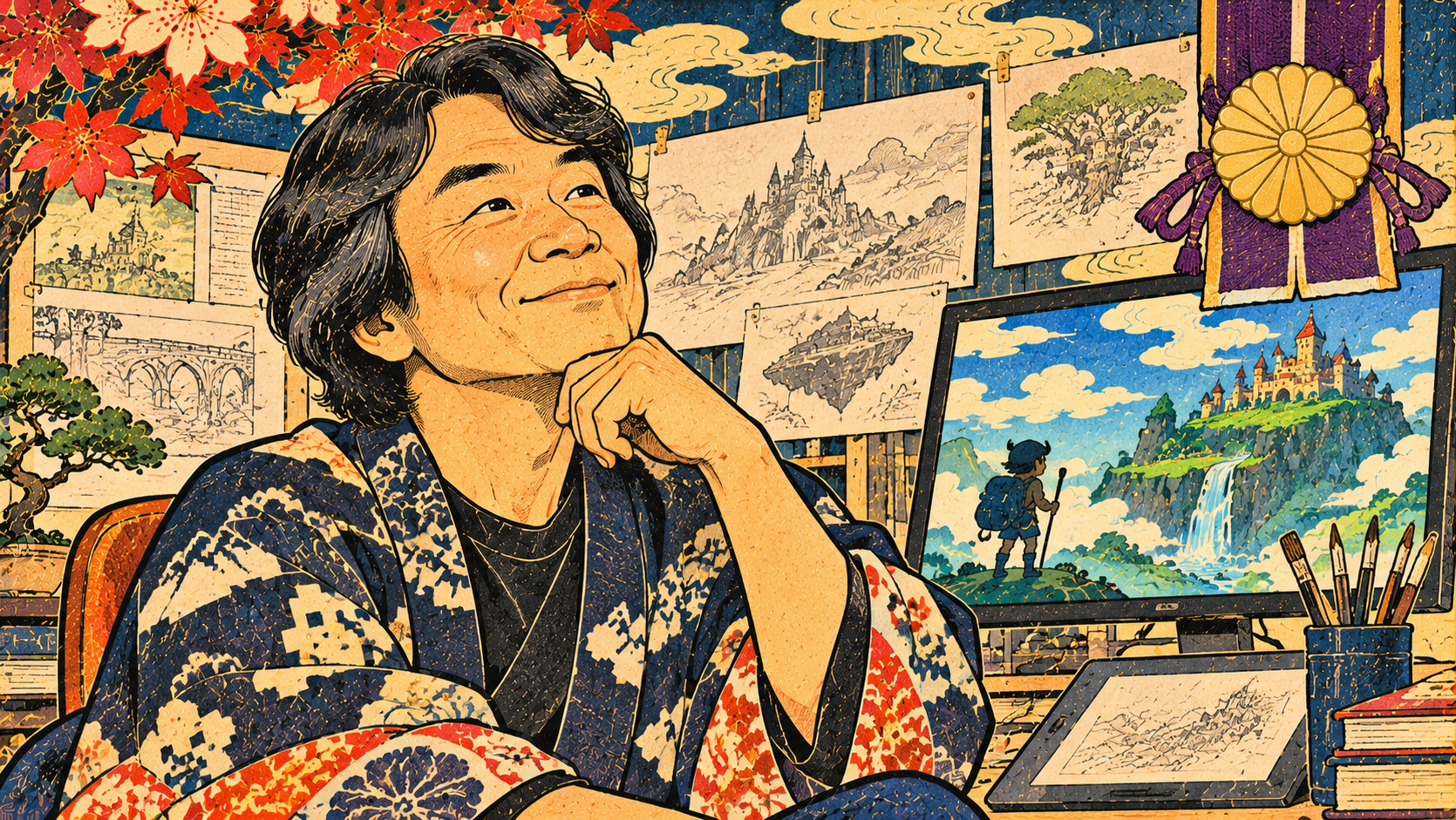
- A national honor for the person who designs play
- What the Order of Culture actually means
- Nintendo’s first business was also about play
- Donkey Kong: a character, a goal and a set of rules
- Why Super Mario Bros. traveled so far
- Zelda made curiosity into the central action
- Teaching players to move through three dimensions
- From the game screen to cinemas and parks
- Recognition should not flatten the story into genius worship
- The problem of preserving an interactive art
- A small act repeated around the world
A national honor for the person who designs play
On Japan’s Culture Day, November 3, 2026, an unusually revealing profession appeared on the government’s list of Order of Culture recipients: “Media Arts (Games).” The honoree was Shigeru Miyamoto, Nintendo’s representative director and fellow, whose work helped give generations of players the instinct to jump over a gap, explore an unfamiliar room or simply pick up a controller.
The distinction is exact and worth preserving. Eight people were named to the honor; seven attended the presentation at the Imperial Palace. Miyamoto, 73, did not attend, according to contemporary ceremony coverage. The reason was not established in the sources consulted, so it would be wrong to depict him receiving the decoration in person or to guess why he was absent.
What the Order of Culture actually means
Japan’s Order of Culture is a state decoration for distinguished contributions to the development of the nation’s culture. The Cabinet Office describes a process of recommendation by the education minister, review and cabinet decision. Its presentation customarily falls on November 3, a national holiday devoted to culture.
This is not the first time the state has recognized Miyamoto’s work: he was named a Person of Cultural Merit in 2019, and he has received international honors before that. The importance of 2026 is not that Japan suddenly discovered games could matter. Rather, the field of game creation was explicitly represented among the country’s highest cultural honors.
Nintendo’s first business was also about play
The company behind Mario did not begin as a computer manufacturer. Nintendo traces its founding to 1889, when Fusajiro Yamauchi began making hanafuda playing cards in Kyoto. It expanded into other card products and gradually built a business around forms of amusement long before electronic games existed.
Miyamoto joined Nintendo in April 1977, as the company’s own shareholder documentation records. The Family Computer would not launch in Japan until 1983. His career thus spans the company’s transformation from a maker of playthings into a worldwide creator of interactive worlds. It also reminds us that Nintendo’s continuity lies in entertainment, not any one technology.
Donkey Kong: a character, a goal and a set of rules
The 1981 arcade game Donkey Kong is commonly remembered for the beginning of Mario’s story. Nintendo’s archived developer conversations tell a more instructive story: the game emerged from design discussions involving a proposed licensed character and the need to invent a distinctive form of action within limited hardware.
The crucial achievement was legibility. The player could understand danger, movement and a goal from a small screen and a handful of controls. A character had to communicate intention through movement, not through dialogue. Miyamoto’s contribution was therefore not only an image people would recognize; it was a way to make interactive rules understandable and satisfying.
Why Super Mario Bros. traveled so far
In September 1985, Super Mario Bros. launched in Japan for the Famicom. Players encountered a language-light grammar of running, jumping, discovering and trying again. A screen could introduce a risk and teach a response almost without words. The pleasure depended on the interval between player intention and what the character actually did.
It is tempting to compress this era into a solitary-inventor legend. Nintendo’s own accounts describe collaborators including Takashi Tezuka and engineers working within severe memory limitations. Koji Kondo’s music was equally fundamental to the experience. A national honor for a creator need not erase the broader team that made the creative system possible.
Zelda made curiosity into the central action
The Legend of Zelda, released in Japan in February 1986, approached interaction from a different direction. Instead of organizing delight primarily around momentum and well-timed leaps, it offered a world to search, secrets to notice and a structure in which choosing where to go could be part of the pleasure.
In Nintendo’s retrospective interviews, Miyamoto described the appeal of adventure and treasure hunting as an inspiration. The pairing of Mario and Zelda matters because it shows range within the same medium: one foregrounds movement, the other exploration. Both trust players to make meaning through action rather than passively receive a predetermined sequence of scenes.
Teaching players to move through three dimensions
When Super Mario 64 appeared in 1996, the design problem changed. In a three-dimensional environment, cameras, angles and depth perception all become part of movement. It is not enough to build a larger world. Designers must help players understand where their characters are, how they will move and what a button will do.
Miyamoto’s Nintendo interviews repeatedly return to the relationship between function and form. Objects, controllers and interfaces should suggest their possible use. This principle belongs as much to design history as to the history of video games. It helps explain why approachable controls can sometimes matter more than a spectacular technical specification.
From the game screen to cinemas and parks
By the 2020s Nintendo was developing new ways to meet audiences beyond a console. The company identified Miyamoto as a co-producer of The Super Mario Bros. Movie’s cinematic successor, The Super Mario Galaxy Movie, scheduled for release in 2026, alongside Illumination’s Chris Meledandri. Nintendo’s official releases also name him as co-producer of the live-action Legend of Zelda film, alongside Avi Arad.
That strategy presents a creative test. Games ask their audiences to act; movies ask them to watch. Translating an interactive world to a linear narrative is not a simple exercise in moving familiar imagery between screens. Nintendo’s stated aim of broadening contact with its intellectual property also introduces commercial interests distinct from the artistic challenge.
Recognition should not flatten the story into genius worship
Miyamoto’s career provides an unusually compelling individual narrative, but games are collective achievements. Programmers, musicians, artists, engineers, testers, marketers and later generations of designers have shaped Nintendo’s output. Nor should the honor be interpreted to mean that every commercially successful game is necessarily a cultural masterpiece.
The broader point is more measured and more interesting: interactive design is capable of creating durable shared experiences. A medium once treated largely as a novelty business can produce works that influence how people learn rules, collaborate, take risks and imagine spaces. That capability deserves serious cultural discussion without turning criticism into celebration by default.
The problem of preserving an interactive art
Traditional cultural preservation can protect manuscripts, paintings or recordings. A video game raises additional questions. Its meaning can depend on a functioning console, a specific controller, timing, sound, technical limitations and the social worlds in which people once played. Keeping a file is not always the same as keeping an experience.
The Order of Culture does not establish a preservation fund, a new archival standard or a legal obligation to make old games available. Yet Miyamoto’s recognition makes the problem more visible. Researchers, museums, publishers and players will have to decide what it means to carry these works beyond the machines for which they were created.
A small act repeated around the world
Miyamoto’s greatest cultural legacy may be easiest to describe at the scale of a single second: a child learns that pressing a button at the right moment can change a world on a screen. That feeling can be transmitted across languages and decades without a lecture about national identity.
On November 3, 2026, Japan placed the designer of many such experiences among its Order of Culture honorees. The ceremony was one event; the underlying achievement has been accumulating for nearly half a century. And the next question is not simply how to celebrate the games people remember, but what new kinds of play creators will make possible.
Sources and reporting method
Original government, corporate and archived developer sources were used. The award, appointment and chronology are documented facts; discussion of cultural significance is editorial analysis. The article does not imply Miyamoto attended the ceremony.
- MEXT: 2026 Order of Culture recipients, names and disciplines
- Cabinet Office: Order of Culture criteria and selection process
- Jiji Press: November 3 ceremony and Miyamoto’s absence
- Nintendo: official corporate history
- Nintendo: official corporate profile and representative director/fellow
- Nintendo: 2024 shareholders’ meeting notice with Miyamoto biography
- Nintendo Iwata Asks: how Donkey Kong was developed
- Nintendo Iwata Asks: early Mario and collaborative game design
- Nintendo: official Super Mario game history
- Nintendo: 2023 announcement of live-action Zelda film
- Nintendo: September 2026 Zelda live-action film update
- Nintendo: 2026 Super Mario Galaxy movie production announcement
- Nintendo DREAM: interview and documented recognitions