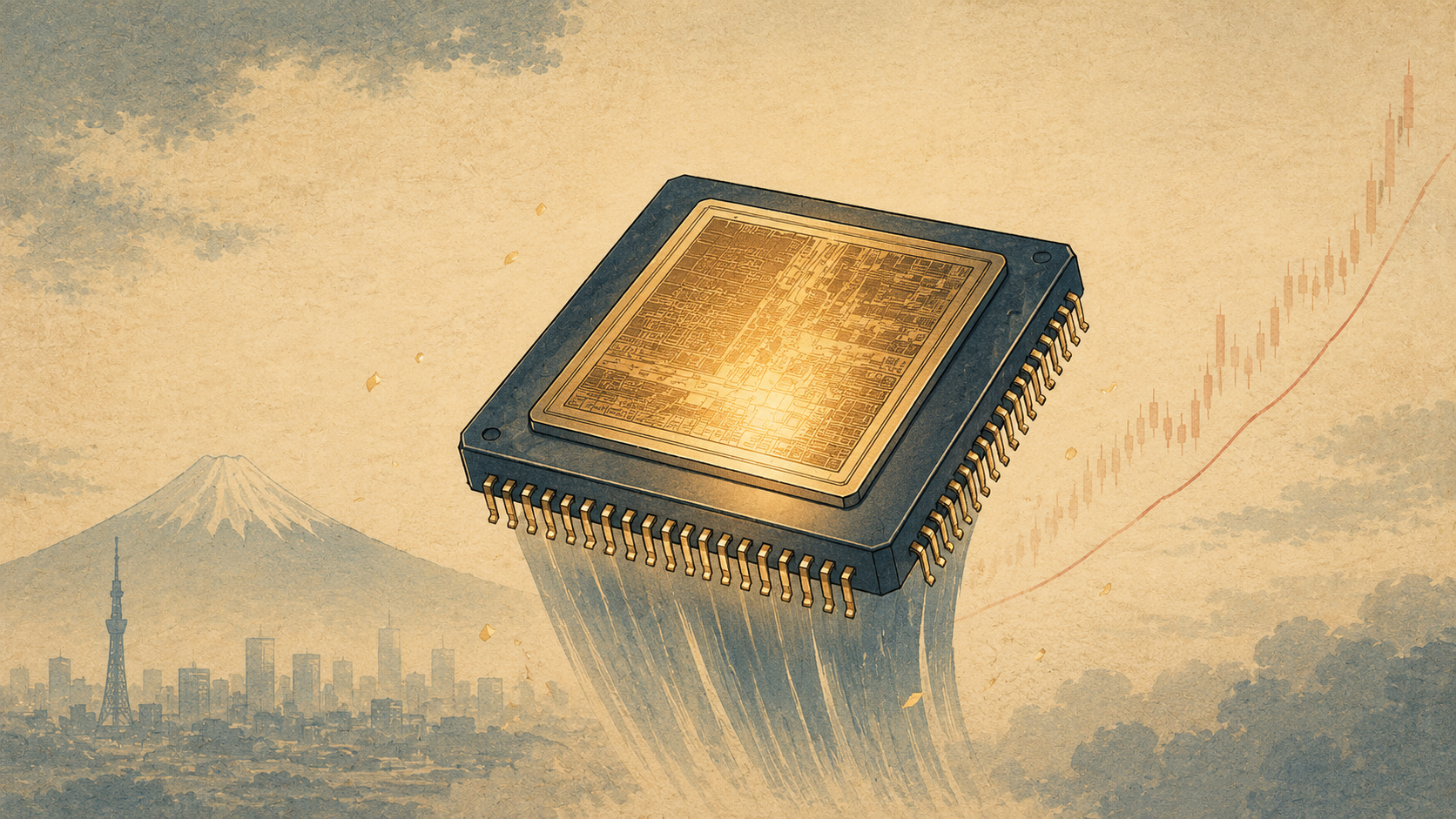
At first, Japan’s AI stock rally was easy to understand. SoftBank Group. Tokyo Electron. Advantest. Investors looking for the artificial-intelligence trade bought the names closest to the theme: capital, chips, equipment and testing. But by the summer of 2026, the story moving the Nikkei had become more interesting. The market was no longer only buying the obvious AI names. It was hunting for the companies that make AI physically possible.
Reuters reported that Japan’s record Nikkei rally has shifted into a search for the next AI darlings, spreading from SoftBank and Tokyo Electron into the component, cable, substrate, memory and power-infrastructure companies needed by data centers. Murata Manufacturing, Taiyo Yuden, Fujikura, Furukawa Electric, Ibiden and Kioxia are not consumer-facing AI brands. They do not sell chatbots. They do not write the prompts. But without their capacitors, fibers, substrates and memory, the AI cloud is only a slogan.
That is what makes this market turn compelling. The AI trade has descended from the dream of software into the physical world. Artificial intelligence feels invisible because users meet it through a screen. But behind the screen, AI consumes electricity, produces heat, fills server racks, depends on fiber networks, stores oceans of data and needs components that can tolerate extreme electrical stress. The bigger AI becomes, the more investors rediscover the Japanese companies buried deep inside the machine.
The first wave bought the stars. The next wave bought the wiring.
The first AI wave in Tokyo was a star-stock rally. SoftBank symbolized global AI capital and semiconductor ambition. Tokyo Electron and Advantest stood for the machinery and testing equipment behind advanced chips. They were the obvious names: close to AI, close to semiconductors, easy for global investors to understand.
But as data-center construction becomes more real, the shopping list gets less glamorous and more precise. AI infrastructure needs optical fiber for high-speed communication. It needs multilayer ceramic capacitors to stabilize power. It needs advanced substrates to carry high-performance chips. It needs memory to store data. It needs cooling, power conversion and grid capacity. The GPU is the celebrity; the system only works because thousands of less famous components perform reliably.
That is where Japan’s industrial history matters. Japan lost ground in many final consumer products, from personal computers to smartphones. But in materials, components, production equipment, precision manufacturing and reliability, Japanese companies remain deeply embedded in the global supply chain. As the AI trade moves from the surface to the machinery underneath, Japanese names reappear.
Why Murata and Taiyo Yuden matter
Murata Manufacturing and Taiyo Yuden are leading makers of multilayer ceramic capacitors, or MLCCs. A capacitor temporarily stores electrical energy, filters noise and stabilizes circuits. It is used in smartphones, cars, base stations, industrial machines and AI servers. The part is tiny. The consequence of failure is not tiny.
AI servers are electrical beasts. GPUs demand sharp bursts of current; dense racks create power and heat loads far above traditional server rooms. The more difficult power stability becomes, the more valuable high-quality components become. Investors are not buying Murata and Taiyo Yuden because AI looks fashionable. They are buying them because AI is physically hard.
Fujikura and Furukawa: AI travels by wire and light
An AI data center is not an island. Training data, inference requests, enterprise workloads, cloud platforms, telecom networks and overseas sites must be connected. That is why optical fiber matters. Fujikura and Furukawa Electric sit inside the part of the AI trade that moves data rather than calculates it.
Fujikura was founded in 1885. Its history runs from electric wires to telecommunications, from Japan’s industrial modernization to the fiber networks of the data-center age. A century-old company that once represented the infrastructure of modern Japan is now being repriced as an AI beneficiary. That is not just a stock-market anecdote. It is a story about old industrial capabilities finding a new role in a new technological era.
Kioxia, Ibiden and the invisible foundation
Kioxia, formerly known as Toshiba Memory, represents another part of the AI stack: storage. AI is not only about calculation. It is also about memory, logs, datasets, model weights, retrieval systems and inference services. The AI boom is also a storage boom.
Ibiden is known for advanced package substrates. Modern AI chips do not operate in isolation. They need substrates, interconnects, thermal management and precise packaging. Investors see Ibiden as an AI-related company because the performance of an AI chip is not determined only inside the silicon. It is also determined by how that silicon is connected, cooled and integrated.
The other foundation: Tokyo Stock Exchange reform
The AI rally should not be explained by AI alone. Japan’s stock market also has a structural reform story. On March 31, 2023, the Tokyo Stock Exchange asked companies on the Prime and Standard Markets to take action toward management that is conscious of cost of capital and stock price. It was an explicit challenge to Japan’s long-standing problems of low PBR, excess cash, weak capital efficiency and sleepy balance sheets.
In 2026, the Financial Services Agency and the TSE have continued corporate-governance revisions aimed at promoting growth investment. That means the AI theme is meeting a domestic reform cycle. Global investors are seeing two stories at once: the world needs Japan’s AI supply-chain companies, and Japan’s market institutions are pressuring listed companies to use capital more effectively.
The bubble memory — and why this is different
When the Nikkei breaks records, Japan remembers the late-1980s bubble. Land, stocks, financial engineering, overconfidence and then decades of stagnation. That memory makes every Japanese equity boom feel suspicious.
The 2026 AI rally is not free of risk. It can overheat. Valuations can detach from earnings. A correction in the U.S. semiconductor complex would likely hit Tokyo’s AI names. But structurally, this is not the same as the land bubble. The underlying drivers include global compute demand, data-center capex, semiconductor supply chains, power infrastructure and corporate-governance reform. There is real demand underneath the speculation.
Power becomes the next bottleneck
The AI data-center boom is also an electricity story. The International Energy Agency has warned that data-center electricity consumption could more than double by 2030 to around 945 terawatt-hours — roughly comparable to Japan’s total electricity consumption today. AI is a digital industry, but it is also becoming a major energy industry.
That changes the investment map. Power components, batteries, transmission, cooling, construction, land, renewable energy, nuclear policy and grid planning all matter. Blackstone’s reported plan to invest $30 billion in Japanese AI data centers, including facilities exceeding 1 gigawatt, shows how quickly AI has moved from a software theme into a national-infrastructure theme.
Japan may win the foundation, not the consumer app
Will Japan beat the United States or China in global generative-AI platforms? That is not the easy bet. U.S. companies dominate frontier models, hyperscale cloud and global AI platforms. But the foundation is a different contest. Components, materials, equipment, substrates, memory, fiber, power and cooling are areas where Japan still has deep industrial strength.
For Japan.co.jp, this is not simply an “AI stock boom.” It is the revaluation of Japan’s old industrial depth by a new technological demand. Factories, quality control, precision processes, component reliability and decades of supply-chain trust are being pulled back toward the center of the story. What looked boring in the smartphone era may look essential in the AI era.
What investors should watch
The warning is simple: a broader rally is not necessarily a safer rally. Stocks that have risen hundreds of percent can fall sharply. Data-center projects require power, land, cooling, permits, transmission, materials and skilled labor. AI capex must eventually become cash flow. A stronger yen would affect exporters. A fall in the U.S. semiconductor index could spill directly into Japan.
The better question is not whether a company has “AI” attached to it. It is which bottleneck the company solves. Compute, memory, communication, power, heat, construction, grid integration — each is a different market. The AI rally has broadened, but it has also become harder to read. The simple phase of buying the obvious names has turned into a supply-chain analysis exercise.
Japan.co.jp view
The broadening of Japan’s AI rally is good news for the market. But the more interesting point is that the rally is moving from glamorous AI toward the quiet Japan that makes AI possible. Murata’s tiny components, Taiyo Yuden’s capacitors, Fujikura’s fiber, Ibiden’s substrates and Kioxia’s memory do not usually dominate front pages. Yet they help determine whether the AI era can physically run.
Japan’s modern industry was built by railways, wires, electric machinery, materials, precision parts, semiconductor tools and automobiles. The 2026 AI rally adds a new chapter to that history. Generative AI may be marketed by U.S. cloud platforms and used on devices around the world. But behind the cloud, small components smooth the electricity, fiber carries the data, memory stores the models and substrates endure heat and current.
That is why this story is bigger than a stock chart. The continuation of the AI boom depends not only on market enthusiasm, but on power, supply chains, governance, industrial policy and whether Japanese companies can turn investor attention into real growth investment. The Nikkei’s rise is a number on a screen. Behind that number are factory lines, test equipment, port shipments and data centers running through the night. That is where the 2026 Japan market becomes truly interesting.
| Theme | How to read it |
|---|---|
| First wave | SoftBank, Tokyo Electron, Advantest — obvious large AI-linked names. |
| Second wave | Fujikura and Furukawa Electric — communications infrastructure for data centers. |
| Third wave | Murata, Taiyo Yuden, Ibiden and Kioxia — components, substrates, memory and power stability. |
| Market reform | TSE and governance reforms connect the AI theme to Japan’s broader equity revaluation. |
| Risks | Overheating, U.S. semiconductor correction, power constraints, currency moves and data-center economics. |
Sources and references
This article is market and industrial analysis based on public reporting, exchange and regulatory documents, and international energy research. It is not a recommendation to buy or sell any security. Stock prices, index levels, market capitalization and exchange rates change continuously.
- Reuters: Nikkei's record rally shifts gears as investors chase next AI darlings.
- Reuters: Blackstone plans $30 billion investment in Japan AI data centres, Nikkei reports.
- Japan Exchange Group / Tokyo Stock Exchange: Follow-up of Market Restructuring and request for management conscious of cost of capital and stock price.
- Financial Services Agency / Tokyo Stock Exchange: Revised Corporate Governance Code to Promote Growth Investments, April 2026.
- International Energy Agency: Energy and AI executive summary on data-centre electricity demand.
- Reuters: Fujikura and the AI data-centre supply chain.