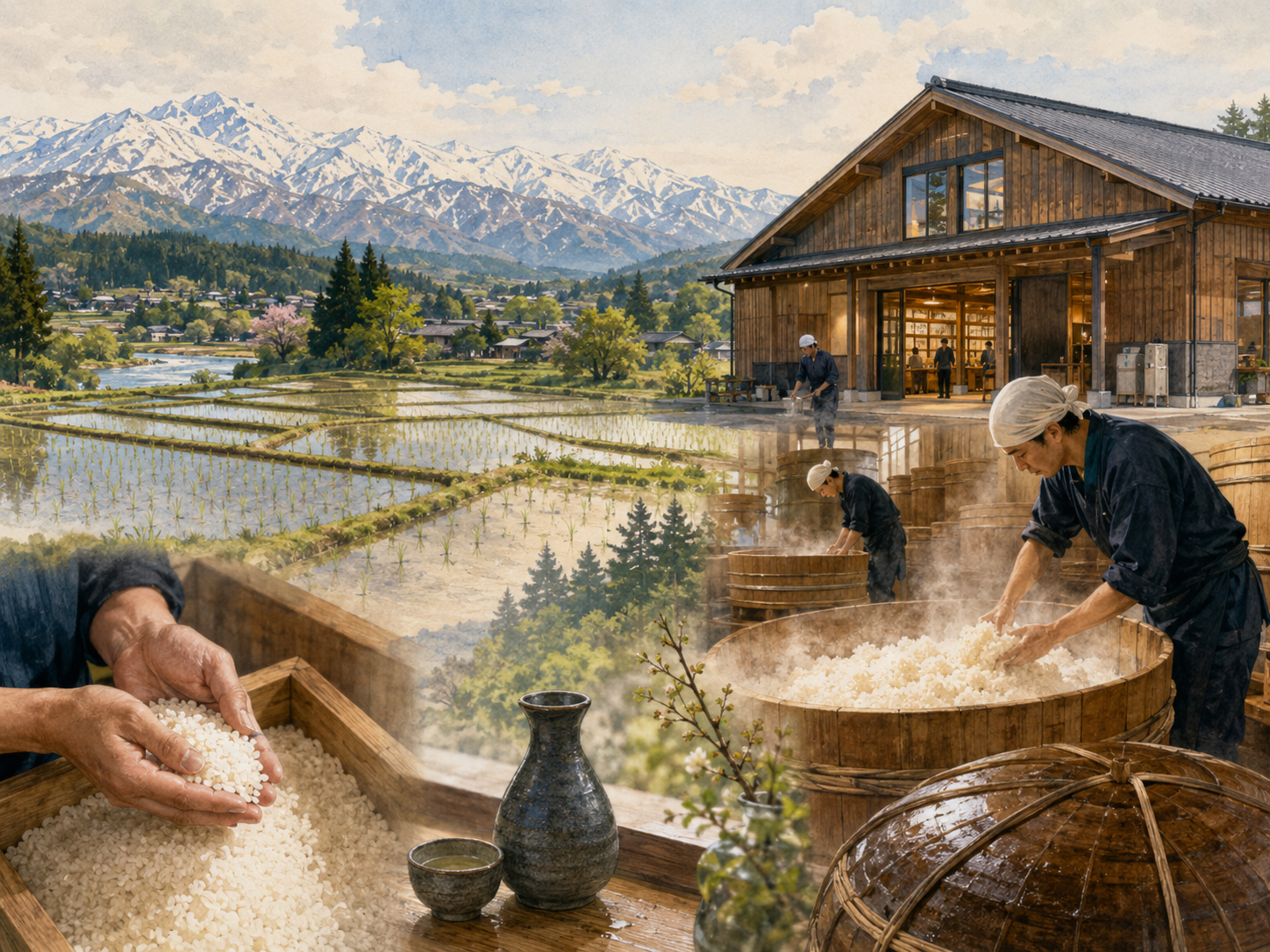
A new dot has appeared on Niigata’s sake map. In the snowbound satoyama of Matsunoyama, Tokamachi, Snow Satoyama Sake has opened a brewery in a prefecture where new breweries almost never appear. Sake culture often values age: 100-year houses, 200-year houses, family lineages, winter brewers and inherited yeast memories. But in 2026, one of Niigata’s most interesting sake stories is not about a venerable old kura. It is about a new one.
The Japan Times has profiled Snow Satoyama Sake, led by Tomomi Duquette, as one of the very few breweries to open in Niigata since 1953. Niigata once had well over 100 breweries, but consolidation, declining domestic consumption and licensing barriers reduced that number over time. A new brewery is therefore not just a business opening. It is an exception in a highly regulated industry.
Why new sake breweries are rare
Sake production is not a hobby that can simply scale into a factory. It requires a license under Japan’s liquor-tax system. For ordinary domestic-market sake, new licenses are difficult to obtain; in many cases, newcomers must acquire an existing licensed company, revive dormant capacity or work under special conditions. Export-only licenses have opened a limited path, but a true new domestic sake brewery remains rare.
That system reflects postwar tax policy and supply control. Sake was long an important source of revenue for the state, and licensing was used to manage quality and production. During the high-growth years, domestic demand was robust. Later, beer, shochu, wine, whisky, canned cocktails and craft beer reshaped drinking habits. As the market shrank, the number of active breweries declined, and entry became harder.
Niigata’s clean sake image — and what comes next
Niigata sake is often described as tanrei karakuchi: clean, light and dry. The image grew from cold winter fermentation, soft water, excellent rice and a brewing culture built around precision. Niigata’s sake schools, tasting events and regional pride helped turn the prefecture into one of Japan’s defining sake regions.
Yet the sake market is no longer satisfied by one phrase. Overseas drinkers increasingly discuss sake like wine: origin, pairing, acidity, texture, rice, aging and story. Within Japan, brewers are exploring sparkling sake, lower alcohol, kimoto, yamahai, aged sake, organic rice and craft expressions. Snow Satoyama Sake’s use of “Satoyama Mariage” signals this new language: sake as a partner to food, landscape and travel.
Snow is not an ingredient. It is an environment.
Tokamachi and Matsunoyama sit in one of Japan’s heavy-snow regions. Snow slows life, burdens roofs and shapes winter labor. But it also stores water, preserves food, moderates temperature and supports fermentation. Niigata’s yukimuro, or snow-cellar culture, uses packed snow as a natural refrigerator to age and preserve sake, coffee, tea, vegetables and other foods. In Snow Country, snow is infrastructure.
Satoyama is the other word in the brewery’s name. It refers to the inhabited edge between mountain, field and village — a landscape where forests, rice paddies, streams, wild greens, fermentation, old houses and local rituals form a single ecological culture. Snow Satoyama Sake is therefore not just branding. It is an attempt to turn a living rural environment into a sake identity.


Women, internationalization and a changing industry
Sake brewing was long male-dominated. In the Edo period and afterward, women were often excluded from breweries, partly because of ideas of ritual impurity and partly because brewing became associated with heavy industrial labor. That barrier has weakened. Mechanization, education, international markets, tourism and labor shortages have made room for more women brewers and managers.
Tomomi Duquette’s career fits that wider shift. Through Niigata Sake Lovers and related projects, she connected local sake with international education and tourism. Her brewery is not only about making bottles. It is about building a cultural bridge: Niigata rice, snow, food pairing, rural stays and global drinkers who want to understand the place behind the glass.
Sake tourism as the next market
Domestic sake consumption may be lower than in past decades, but international interest has grown. Japanese cuisine, tourism, sommelier education and food pairing have made sake more visible. Niigata is especially well placed: the Joetsu Shinkansen links it to Tokyo, while ski resorts, onsen, terraced rice fields, seafood, Sado Island and the Echigo-Tsumari art region give travelers reasons to stay.
A new brewery can be designed for this environment from the start. Older breweries may have beautiful buildings and deep history, but their layouts were often made for production, not visitors. A new kura can plan tours, English support, pairing events, online sales, export communication and lodging partnerships from day one. That is part of why Snow Satoyama Sake matters beyond its first tanks.
Awards and the danger of judging too soon
Snow Satoyama Sake has already drawn attention at the Tokyo Sake Challenge 2026, where the Satoyama Mariage Collection received recognition. For a new brewery, such early attention is powerful. But sake is not judged in one season. Water, rice, koji, yeast, temperature, equipment, microbial environment, blending, aging, bottling and distribution all change as a brewery matures.
The right way to read Snow Satoyama Sake is with two clocks. The short clock says a rare new Niigata brewery has appeared and already attracted attention. The long clock asks whether it can become part of the region’s flavor over 10 or 20 years. Niigata’s famous houses earned trust slowly. A new brewery must respect that weight while speaking in the language of its own era.
- Can a new brewery combine licensing, export and tourism in a sustainable model?
- Can Snow Country become experience value, not only flavor identity?
- Can women-led and internationally minded projects help answer sake’s labor shortage?
- Can Niigata expand beyond tanrei karakuchi without losing its identity?
- Will Tokyo and overseas restaurants make room for a new Niigata voice?
Old industries need new doors
Sake is a traditional industry, but it is also a mature industry facing population decline and changing tastes. Preserving alone can become shrinkage; innovation alone can become rootlessness. A new brewery’s value is that it creates another entrance. A traveler who does not know Tokamachi may discover it through a bottle. A foreign drinker who does not know Niigata may find rice fields, snow cellars, fermentation and satoyama through one glass.
The story of Snow Satoyama Sake is still young. But the fact that a nearly static map has gained a new name matters. The future of sake will not be carried only by old houses. Sometimes, like a rice field beneath winter snow, a very old landscape waits for a new fermentation to begin.
Sources and references
This Japan.co.jp report is based on public reporting, sake-industry material, tourism sources and regional-culture background.
- The Japan Times: Snow Satoyama Sake profile
- Sake World: Tomomi Duquette and Snow Satoyama Sake background
- Tokyo Sake Challenge 2026 awards
- Japan Sake and Shochu Makers Association: sake brewery history and decline
- Discover Niigata: snow, rice, sake and regional travel
- Food & Wine: Niigata snow-aging culture
- AP: women in sake brewing and changing industry roles